
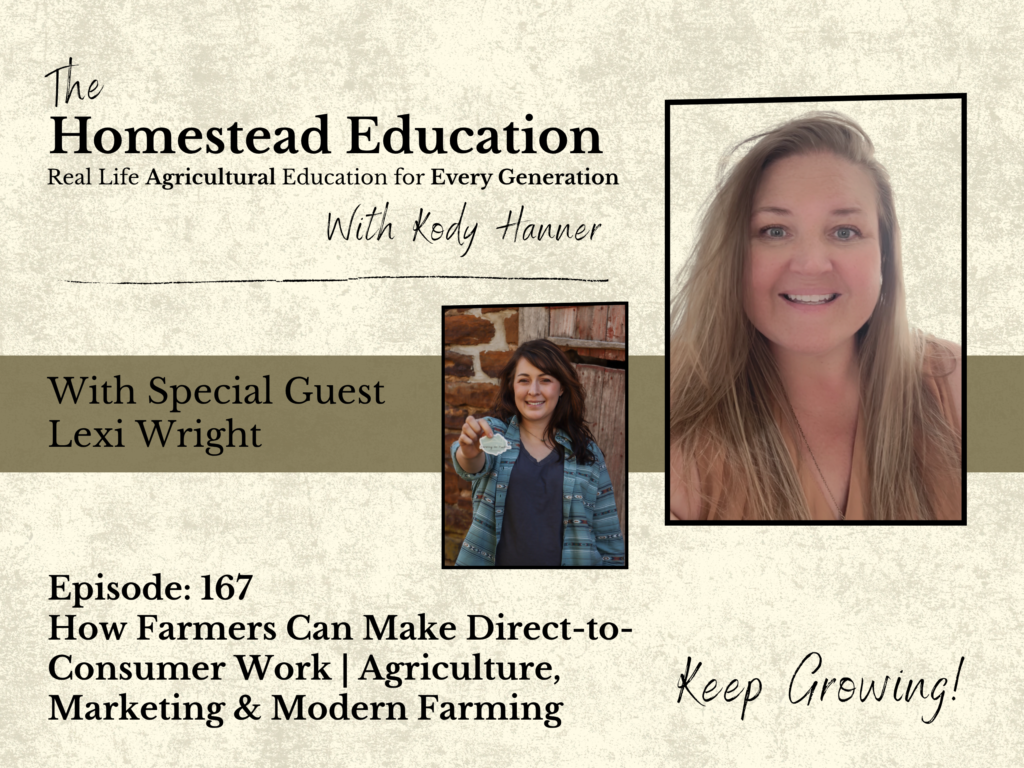
Episode 167: How Farmers Can Make Direct-to-Consumer Work | Agriculture, Marketing & Modern Farming
- Homestead Education Team
Episode Highlights
Food systems are shifting. Farming is shifting. And the reality is — making a living in agriculture today looks nothing like it used to.
In this episode of The Homestead Education Podcast, Kody Hanner sits down with Lexi Wright of the Farming on Purpose podcast for a real conversation about what it actually takes to make farming work in today’s economy — from direct-to-consumer sales to managing multiple income streams and navigating the challenges modern farmers are facing.
From the disconnect between consumers and their food to the growing pressure on farmers to become marketers, educators, and business owners all at once — this episode breaks down what’s really happening behind the scenes.
This isn’t about going back to the “old way” of farming.
It’s about building something that actually works today.
If you care about:
- Direct-to-consumer farming and selling your products
- The reality of farm income and multiple revenue streams
- Marketing and building relationships with customers
- Small-scale farming, homesteading, and sustainability
- Understanding where your food comes from
This episode will challenge how you think about agriculture — and what it takes to make it work.
In This Episode, We Cover:
- What it really takes to make money in farming today
- Why direct-to-consumer is becoming essential for farmers
- The challenges of marketing, education, and selling your products
- How farmers are balancing multiple income streams
- The disconnect between consumers and real food systems
- What’s changing in agriculture — and what it means for the future
Podcast Links and Resources
If you enjoyed this conversation, be sure to connect with Lexi Wright from Farming on Purpose and support the work she’s doing to help farmers and rural businesses grow.
🎙 Listen to her podcast: Farming on Purpose
📲 Follow on Facebook
Kody's Links
Homestead Education Curriculum:
https://thehomesteadeducation.com
Shop Books & Resources:
https://thehomesteadeducation.com/shop
Join the Email List for Resources & Updates:
https://www.thehomesteadeducation.com/subscribe
Instagram:
https://www.instagram.com/homestead_education
Facebook:
https://www.facebook.com/thehomesteadeducation
TikTok:
https://www.tiktok.com/thehomesteadeducation
YouTube:
https://www.youtube.com/@homesteadeducation
ShowHide Full Transcript
Introduction
Hi everyone and welcome back to the Homestead Education podcast. Today I have Lexi Wright from the Farming on Purpose podcast, and I am really excited to have this conversation with her. She’s a marketer, a rancher, and someone who has spent a lot of years trying to make sense of how modern life fits with the values we were raised on. I started reading her bio and said it wrong—she started her marketing agency, Back Pocket Social, to help rural businesses and food producers grow based on what makes them real. And along the way, she realized the same lessons apply to all of us. This is a conversation I feel like I have day after day, so I’m really excited to have it with you. Thank you for joining us.
Thanks for having me, Kody. I’m excited to be here.
Lexi’s Background & Farm Journey
So just give me the five-minute version—your elevator pitch. Tell me a little bit about you.
I’m a mom to four kids, and my husband and I purchased his grandmother’s farm almost three years ago now, which I can’t believe went that fast. I like to say we went from being first-generation farmers doing our own thing, starting on a small homestead, to sixth-generation farmers basically overnight. It’s come with a lot of lessons, and it’s given us the opportunity to take the farm and do things that make sense for our family.
That’s awesome. Being first generation and sixth generation all at once—you’re getting to do it your way, but you also have all that knowledge behind you. That’s invaluable.
For sure. We rely on his family a lot for past information about the farm and things they did for years. There are so many things about the land—it’s like, water always runs through here, or that fence has always been that way, and here’s why. Someone starting from scratch wouldn’t know that. It’s really valuable to have that context.
The Reality of Modern Farming
It really is. I’m a third-generation farmer, but never on the same piece of land. So I have the knowledge, but when we came onto our property—40 acres that hadn’t been farmed in five years—I was like, where does every wire fence go? It was a learning curve.
Tell me a little about the mission of your podcast, because I really like what you’re doing.
I started it when my youngest daughter was about 10 months old. At the time, we hadn’t bought our farm yet, and we were trying to expand our homestead and hitting a lot of walls. I started it from a place of wanting to learn—what’s working for other people? I wanted to hear their stories and figure out if this was even possible for us. It was almost out of desperation.
I also wanted to highlight the hard work these people are doing. They’re building businesses outside the norm of the industry, creating their own paths, and working twice as hard to make it happen. I wanted their work to be recognized.
I feel that. We’ve been doing this full-time for seven years, and this morning I was like, if we don’t sell one of those cow-calf pairs, I’m not making the mortgage. We’ve got to figure this out.
Exactly. It’s that constant balance. Most people in agriculture have multiple income streams. There’s this idea that you plant your field and harvest it and that pays all the bills—but that’s not reality anymore.
It really isn’t. We own three businesses and have layers within each of them just to make things work. Sometimes it feels like we’re just moving money between them to stay afloat.
Yeah, it feels like musical chairs sometimes.
The Shift Toward Direct-to-Consumer
I went to my first ag conference representing Homestead Education, and I thought I’d get run out of there because of the perceived divide between homesteaders and conventional ag. But instead, I had a line of people—multi-generational ranch families—asking how to go direct-to-consumer. They were saying, “We’re done taking cattle to auction. It’s not worth it anymore. How do we change?”
That’s huge. And I think we’re doing the same things, just thinking about them differently. When people hear new perspectives, it sparks ideas. Historically, farming and homesteading weren’t so divided. The Homestead Act is how most farms started.
Exactly. The line between homestead and business is blurry. I raise 350 hogs a year—I’m not eating 350 hogs. That’s the business. But we also fill our freezers.
Marketing, Sales & Customer Education
So what shifts are you seeing right now?
A big one is farmers connecting directly with consumers. If they’re not selling at a sale barn or through a co-op, they have to build relationships with buyers. Without that, they end up with freezers full of unsold meat.
I’ve been there. I butchered a cow thinking it’d be Christmas income, and then—nothing. No buyers.
And that’s why those relationships matter before it’s time to sell.
I find I get bogged down educating customers just so they understand how to buy my product. Are you seeing that?
Yes, but it looks different for everyone. Some people focus heavily on education, others don’t have time. You have to balance education with actually making the sale. Sometimes it’s not education that’s the barrier—it’s just making it easy to buy.
That makes sense. I’m in North Idaho, where people already value local food, so it’s easier. But in other places, convincing someone to pay for higher-quality meat is a challenge.
Exactly. Location matters. Being near a larger population helps. Many farmers sell cuts at butcher shops, farmers markets, or ship products.
Shipping is a whole different ballgame. We do it, but I don’t love it.
Same. It works best when it ties into other parts of your business.
Pricing, Value & Consumer Mindset
Are you seeing direct-to-consumer outside of meat?
A little. Some grain farmers are milling their own flour or making pasta. There are also distilleries sourcing local grains. It’s growing, but those producers are busy.
What challenges are new farmers facing?
The biggest one is capital. Land prices are insane, and access to land is difficult. Equipment, feed, startup costs—it’s a lot. And banks want experience and a solid business plan.
We tried to get a loan for a maggot farm once, and they asked if we had experience. I was like… who does?
Exactly. You have to really sell your experience.
What are you seeing in marketing shifts?
People are more willing to buy online. Before, they wanted to come to the farm. Now they’ll buy based on a TikTok or Instagram post. That’s a big shift.
I see that too. But people still struggle with understanding bulk buying—like why it’s worth it.
Right. It’s not more expensive—it’s more work. You’re trading convenience for cost savings.
Exactly. People compare ground beef prices without realizing they’re also getting premium cuts in a quarter beef.
Education is still important, but it has to be simple.
Industry Trends & Lifestyle Shifts
What trends are you seeing overall?
There’s a shift away from glorifying burnout. Younger farmers want balance. They want to attend their kids’ events, take vacations, and still farm. That’s changing how farms operate.
I’ve seen that too. More young families are entering farming.
Yes, and they’re more willing to hire help sooner. They’re prioritizing sustainability—not just financially, but in lifestyle.
Food System Concerns & Preparedness
What about the future of agriculture?
I’m hopeful, but I think we’re heading toward some crossroads. There’s a lot of division in the industry, and that could impact food systems. Change in agriculture doesn’t happen overnight, but pressure is building.
I agree. Our food system is fragile. COVID showed that. Even small disruptions can have big impacts.
That’s why skills matter. Not doomsday prepping—but knowing how to feed your family if things change.
Exactly. It’s about responsibility and resilience.
And it should be taught. Cooking, preserving food, basic skills—those are just as important as anything else kids learn.
Absolutely.
Closing
Well, I think that’s a great place to wrap up. Tell everyone where they can find you.
You can find my podcast, Farming on Purpose, on all major platforms, and I’m on social media under the same name.
Awesome. Be sure to check her out—I love what she’s doing. And I always like to end with this: what does “keep growing” mean to you?
To me, it means keep learning—always learning how to become a better person.
I love that. Thank you so much for being here.
Thanks for having me.