
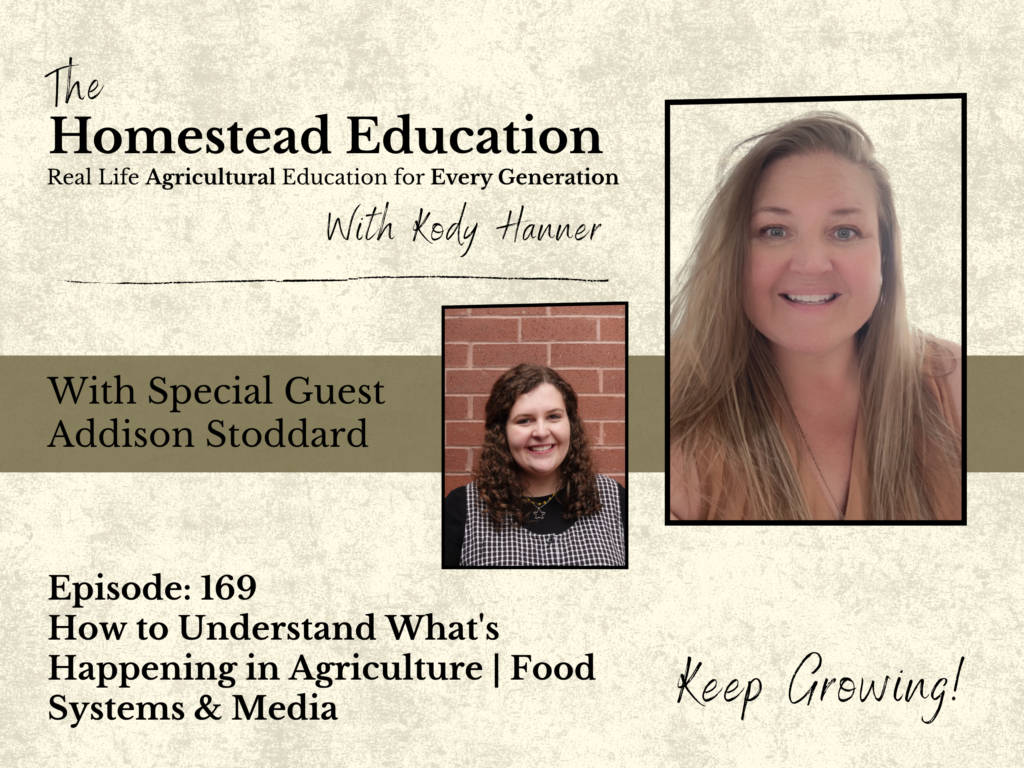
Episode 169: How to Understand What’s Happening in Agriculture | Food Systems & Media
- Homestead Education Team
Episode Highlights
Agriculture isn’t just happening in the fields — it’s happening on the airwaves, in policy conversations, and in the everyday decisions that impact what ends up on our tables.
And the truth is — most people have no idea how much is happening behind the scenes… or where to find reliable information when it does.
In this episode of The Homestead Education Podcast, Kody Hanner sits down with Addison Stoddard — host of the All Things Ag Gal Podcast and farm director for the Kansas Farm and Ranch Radio Network — to talk about the role of agricultural broadcasting and why it still matters more than ever.
From early mornings on the radio to breaking down complex topics like fuel, fertilizer, and food supply chains — Addison shares what it really looks like to be the voice delivering ag news to farmers who rely on it daily.
From market updates and policy changes to the realities of misinformation on social media — this episode dives into how information is shared, who people trust, and why accurate communication in agriculture is critical.
This isn’t just about radio.
It’s about understanding where your information comes from — and why it matters.
If you care about:
- Understanding how agricultural news actually reaches farmers
- The role of media and communication in food systems
- Breaking down misinformation in agriculture
- The connection between policy, markets, and your grocery bill
- Real conversations about sustainability, production, and the future of farming
This episode will challenge how you think about agriculture — not just as a practice, but as a system of information, trust, and decision-making.
In This Episode, We Cover:
- What agricultural broadcasting actually is and why it still matters
- How farmers use daily radio reports to make real-time decisions
- The role of trust and credibility in ag media
- How misinformation spreads — and how to navigate it
- Current challenges in agriculture, from fuel costs to fertilizer shortages
- What sustainability looks like in real-world farming operations
- Why communication is one of the most overlooked parts of agriculture
Podcast Links and Resources
If you enjoyed this conversation, be sure to connect with Addison and follow her work in agricultural media.
🎙️ Podcast: All Things Ag Gal
🌐 Listen Live: https://nwksradio.net
🌍 Website: https://allthingsaggal.com/
📘 Facebook: https://www.facebook.com/profile.php?id=61581960825517
📸 Instagram: https://www.instagram.com/allthingsaggal/
Kody's Links
Homestead Education Curriculum:
https://thehomesteadeducation.com
Shop Books & Resources:
https://thehomesteadeducation.com/shop
Join the Email List for Resources & Updates:
https://www.thehomesteadeducation.com/subscribe
Instagram:
https://www.instagram.com/homestead_education
Facebook:
https://www.facebook.com/thehomesteadeducation
TikTok:
https://www.tiktok.com/thehomesteadeducation
YouTube:
https://www.youtube.com/@homesteadeducation
ShowHide Full Transcript
Introduction & Background
Hi everyone and welcome back to the Homestead Education podcast. Today I have Addison Stoddard with me today and I think this is just going to be such a fun conversation. She is the host of the All Things AgGal podcast and she’s the farm director for the Kansas Farm and Ranch Radio Network. So thank you so much for being here today.
Thank you for having me, I’m so excited to chat with you.
Okay, so I was listening to your podcast and you are like a radio person. So how did I do? I want to be graded.
Amazing? Are you kidding? Amazing. You have a voice for radio.
My husband said that podcasting was the best job for me because then I talk to somebody else all day.
There you go, there you go. I got told a million times growing up that I talk too much and it has paid off.
100%. I think that’s a thing. People ask me all the time, did you know you’re going to grow up to be a podcaster? And I was like, podcasting didn’t exist when I was growing up. So I literally got a degree for something that I never knew I was going to do.
Real, real. It’s evolved so much in the last little bit, even the last couple years.
For sure. So tell us a little bit about you, your background, what you do now.
Yeah, so I grew up in Idaho. I have two sisters. I grew up on a small hobby farm in Idaho. I did all of the traditional things. I’m six feet tall, so I played basketball growing up. I did 4-H, FFA, all the things in high school. I was super involved in my family participating in agriculture.
I have to laugh and say that it’s a little funny that I ended up in agriculture because when I was young, I think I had the worst attitude about everything ag-wise that my family did. My sisters would just deal with it and do it. I think I pushed back a lot, but I love it now.
I went to school at Utah State and got a degree in agriculture communications and journalism. I didn’t plan on getting into radio until my last year of school. I got an internship that changed everything for me. After graduation, I moved to Kansas for the job I do now. It was kind of a whirlwind.
Finding Your Path in Agriculture
That’s a reoccurring theme in agriculture. A lot of people go to school and think they know exactly what they’ll do, but then there are thousands of options.
Yes, it made me feel grateful for my degree because my options are endless, but it was also overwhelming.
I have two 17-year-olds wanting to major in ag, and they’re starting to ask those same questions.
I have friends who went through the same thing. It’s intimidating to make those decisions.
There were definitely days I questioned everything. I loved the work, but I didn’t know if it was the right fit for my life.
I had a similar experience. I originally wanted to go into Extension. I got an internship and realized I loved the topic but couldn’t sit at a computer all day. That experience helped me pivot.
I thought I would go into USDA food safety. I got an internship at an almond plant and loved the balance of hands-on work and desk work. I did that for almost 10 years.
Now I do something I never imagined—homeschool curriculum, podcasting, direct-to-consumer farming.
It’s not something you see listed on job boards.
But it’s the perfect balance of creative work and farm life.
What is Ag Broadcasting?
So I want to know more about ag broadcasting and what that job is like.
I originally started in TV broadcasting. Then I got an internship in ag radio and everything changed.
Now I work at a commercial radio station. I do ag news, markets, and in the morning I’m kind of a DJ. I talk about weather, news, and interact with listeners.
It’s a lot of fun. I’m on an old classic country station, so I’m talking about music from before I was born.
The best music is what you grew up listening to on the farm.
It’s a lot of fun. I produce several news pieces a day, and our network covers the whole state of Kansas. Other stations use our content.
There’s a lot of pressure because people rely on that information.
Why Ag Radio Still Matters
Farmers still listen to the radio daily for markets and updates.
That was going to be my next question. In some areas, people don’t have reliable internet in the field.
Exactly. It’s a completely different world. People rely on it heavily.
Radio is often said to be dying, but in the Midwest it’s not going anywhere.
Why do farmers listen every morning?
Tradition is part of it. Their parents did it, so they do it.
There’s also a strong sense of community. People gather at diners, listen together, and call in.
There’s also trust. Farm broadcasters are trusted sources of information.
That’s a lot of responsibility.
It is. Farmers rely on accurate, timely information.
What Kind of Information is Shared
What kind of information are they getting?
It varies. This week I covered bird flu, drought conditions, wildfires, and policy topics like E15 fuel.
Gas prices, fertilizer costs, and global events all impact farming.
That means food prices rise too.
Exactly. Everything is connected.
I try to cover both serious topics and lighter stories about people in agriculture.
The Problem with Misinformation
I wish more people had access to this kind of information.
Right now, many people rely on social media for agriculture information.
I posted something recently about potential food supply challenges and got backlash.
People accused me of fear-mongering.
That’s becoming more common. You can’t take everything on social media as truth.
Farm broadcasters aren’t trying to scare people. They’re trying to explain what’s actually happening.
There’s a difference between sharing patterns and creating fear.
Exactly. It’s about being prepared, not panicked.
Trends in Agriculture
What trends are you seeing in agriculture?
I’ve been surprised how quickly farmers are adopting sustainable practices.
That’s encouraging.
There’s a lot of focus on no-till farming, water conservation, and monitoring resources.
Farmers are willing to adapt to preserve their land and improve efficiency.
When sustainability is framed as saving money or improving yields, farmers listen.
Extension programs have done a great job helping farmers implement changes.
Markets, Costs & Realities of Farming
Farmers are constantly making decisions about inputs and costs.
That’s something many people don’t understand.
Exactly. It’s not just planting and harvesting. It’s constant decision-making.
Input costs are rising, and margins are tight.
For small producers, even a small price increase can have a big impact.
And without protections like subsidies or futures, small producers take on more risk.
That’s a huge gap in understanding for consumers.
Food Systems & Bigger Picture
There’s a disconnect between consumers and how food systems actually work.
Yes, and that’s why communication matters so much.
Farmers, media, and consumers all need to be connected through accurate information.
Where to Find Addison
Well, I have absolutely loved having you on today. Do you want to tell everyone where they can find you?
Yes! My personal social media is Addison.Stoddard. My podcast is All Things Ag Gal, and you can find it on all platforms. You can also listen live at nwksradio.net. I’m on 790KXXX every morning from seven to nine.
Final Question
What does “keep growing” mean to you?
For me, it means never stop learning. People think I have all the information, but I’m constantly learning from farmers, industry leaders, and others.
It’s about being willing to learn and share that knowledge with others.
Closing
Thank you so much. I love everyone’s answer to that question.
Everybody make sure you go check out Addison. I really enjoyed this chat today and looking forward to talking to everybody soon.
Great, thank you so much.