
How to Practice Livestock Injections Safely Using Oranges
This post may contain affiliate links where I earn a commission at no additional cost to you.
As a farmer or rancher, you are the first line of defense for keeping your herd healthy. Sometimes that means administering a vaccine, worming medication (wormer), or vitamins. Other times, it is in an emergency situation, when you have a sick animal. Feeling comfortable and confident about giving injections can save you money on veterinary bills and save lives when the vet is not available.
When giving an injection, there are certain locations on the animal that you want to avoid, especially if the animal is destined for food. These areas include the shoulders, hips, and the muscular part of the back, unless specified. This is because the shot could cause damage to the meat. The label will also tell you how to administer the injection (see below). The label should be read carefully to ensure you leave enough time between the injection and slaughter dates. This is identified by finding the withdrawal date. This is how long it takes for the medication to leave the animal’s body and be safe for consumption. Any medication that is given to an animal should be under the care of your veterinarian and the relationship you have built with them.
Supplies:
- Oranges (2-3)
- Needle and syringe (can be purchased at local feed stores and can have an angled, sharp bevel or a flat, dull bevel).
- Food Coloring
- Water
- Jar
- Rubber glove (optional)
- Kitchen Knife
Directions:
- Mix a few drops of food coloring in about a half a cup of water or whatever combination gives you a dark color in a jar. You can put a rubber glove over the jar and secure it to simulate an injection bottle.
- Draw up 1mm of fluid into the barrel of the syringe.
- Holding the orange tightly, administer first an intramuscular injection directly into the flesh of the orange.
- Next, pinch the peel of the orange a little to “feel” where the peel and flesh separate. Insert the needle into the separation area and press the plunger to administer the injection.
- Cut the orange in half to see how well you did.
- Repeat as many times as you would like to practice. However, don’t waste by rotating the orange to use different areas, or be willing to eat your oranges.
- Once you are done, dispose of the needle safely either in its cover or by wrapping it in tape.
- Careful not to poke yourself.
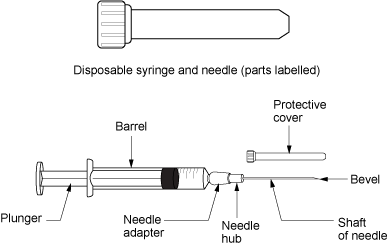
Anatomy of a Needle
- Barrel – Aids in the measurement of medication and then holds the liquid until it is injected
- Plunger – Seals barrel to hold liquid in place for measurement and storage, then is used to excel the medication through the needle.
- Needle adapter – there the needle attaches to the barrel, usually screwed into place with threads.
- Needle hub – what the needle is attached to for hooking to the barrel.
- Shaft of needle – the long, hollow metal part of the needle for the medication to pass through.
- Bevel – the angled and pointed hollowed end of the needle for piercing the animal’s skin.
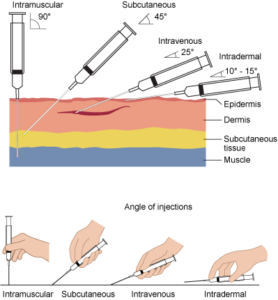
Ways to Give a Shot
Subcutaneous (SubQ) – Insert the bevel of the needle right under the skin from an angle to avoid the medication going into the muscle.
Intramuscular (IM) – This injection can be administered directly into the muscle.
Intravenous (IV) – This is an injection, blood draw, or infusion where the needle is inserted directly into the animal’s vein.
Make It Easy With the Printable Project Sheet
To keep this livestock science activity simple and organized, we’ve created a ready-to-use printable project sheet you can download and use right away. This one-page resource walks students through the orange injection practice while reinforcing essential livestock health concepts in a clear, age-appropriate way.
The printable includes:
A brief overview of proper livestock injection techniques and why placement matters
A simple breakdown of needle anatomy and injection types (SubQ, IM, IV)
A complete supply list using easy-to-find materials
Step-by-step instructions for practicing injections with oranges
Guided observation questions to help students evaluate their technique
A clean, student-friendly layout perfect for science notebooks or portfolios
It’s designed to be low-prep, hands-on, and practical—perfect for homeschool families, co-ops, FFA groups, or farm-based learning days.
Download the Orange Injection Livestock Science Project Printable Below!