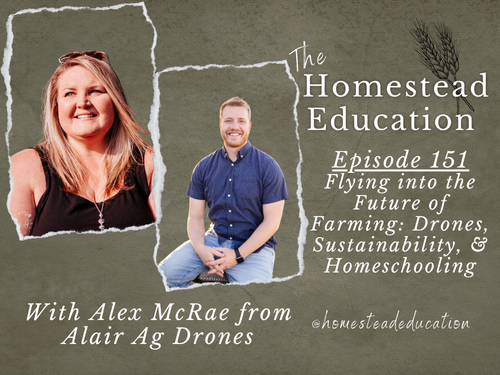
Episode 151: Flying into the Future of Farming: Drones, Sustainability, and Homeschooling with Alex McRae
Episode Highlights
In this episode, I sit down with Alex McRae, founder of Alair Ag Drones and co-founder of Nature Shield Pest & Lawn, to explore how drone technology is revolutionizing modern agriculture. Raised in rural Idaho, Alex blends his love for farming and aviation to support sustainable, healthy land practices. From crop dusting with drones to navigating FAA certifications, he shares how innovation is helping small farms thrive.
But that’s not all, Alex also discusses his family’s homeschooling journey, how real-world experiences shape their education, and the value of bringing entrepreneurship to the kitchen table.

Podcast Review
Did you enjoy this episode? Please drop a comment below or leave a review to let us know. This can help other folks learn about this podcast and we also really appreciate the feedback!
Podcast Links and Resources
Alair Ag Drones Website- https://alairdrones.com/
Nature Shield Pest & Lawn Website- www.gonatureshield.com
Nature Shield Pest & Lawn Facebook- https://www.facebook.com/gonatureshield
Kody's Links
Website: https://www.thehomesteadeducation.com/
Shop Curriculum: https://www.thehomesteadeducation.com/shop
Speaking Events: https://www.thehomesteadeducation.com/events
Facebook: https://www.facebook.com/thehomesteadeducation
Instagram: https://www.instagram.com/homestead_education
Watch episode on YouTube: https://www.youtube.com/@homesteadeducation
Read MoreLess
Introduction
Hi everyone and welcome back to the Homestead Education Podcast. I have a special guest today who I met at the Spokane Ag Expo, and he has something to share that is normally associated with commercial ag — but I’m so excited to tell you about how it can fit any model. This is Alex McRae from Allaire Ag Drones, and I am so happy to have you on today.
Awesome, I’m glad to be here.
So Alex, do you want to tell everyone a little bit about who you are and like a brief rundown of what Allaire Ag Drones are?
Alex’s Background and Family Roots in Agriculture
Yeah, absolutely. So I’ve been raised in Idaho my whole life. I grew up on a little 15-acre farm in Caldwell, Idaho. I always say we farmed boys and horses. I’m the oldest of four boys, and then we had horses growing up.
I have seven boys. So yeah, everyone always said my mom’s got a ticket straight to heaven. You must have too — you’re like, you’ve got front row seats if you’ve got seven boys.
And one hormonal 16-year-old girl right now.
So yeah, grew up on the farm, always loved agriculture. My grandpa was a field man out in Arizona. They ran a thousand-acre cotton farm as well. And then in the 90s, they decided they hated the heat of Arizona and wanted to move to Idaho and get some cooler weather. So they all moved up here.
From Dentistry to Business
My dad is a dentist, so originally that was my plan. I went to college and got a degree in business finance, just in case dental school didn’t work out. But dental school was my dream for a long time. And then COVID hit.
Yes, great time for lots of changes.
I had two kids. We had just had our second in April of 2020 — in the middle of COVID.
Oh my gosh, those 2020 babies.
I had one in February of 2020.
Yes. We were in the hospital for three days. They wouldn’t let us leave. No one could come visit. So it was a hectic time.
Early Career: Pest Control and Entrepreneurship
During college, I worked as a salesman for a pest control company. I ended up doing door-to-door sales for just about a decade — ran teams, managed them, moved every summer across the country.
That takes a lot. I did real estate for a while. I could never do that type of cold call.
Yes, I’ve knocked tens of thousands of doors and talked to tens of thousands of people. I was pretty successful — not crazy successful like some of the guys who kill it — but successful enough to pay my own way through college without student loans.
Throughout that timeframe, something was eating at me to start my own business. After that summer of 2020, we moved to Arizona. I worked and sold solar for a few months, and throughout the winter started a pest control company in the background.
In March of 2021, we moved back to Idaho full-time and started Nature Shield Pest and Lawn. Our two big things are that we use all the same products everyone else does, but all of our trucks also carry all-natural products. For those who are worried about traditional sprays — pregnant women, babies, allergies — we offer a natural solution.
That’s huge — you’re the guys we want in service industries.
And as far as I know, we’re the only pest control company in the nation to record every service with a body camera. We email that footage to the customer as proof that we did the full service, didn’t skip corners, and didn’t fake it. It’s transparency and quality assurance.
Launching Allaire Ag Drones
So I’ve been running that business for five years, and my employee now helps me manage it while I start Allaire Ag Drones.
I’d heard about ag drones for a while — being in pest control, you cross paths with tank distributors and farm supply dealers. One local distributor had a drone in their showroom. I’d ask questions and thought it was cool, but they kind of undersold it.
They said it was for farmers when the ground’s wet and they can’t get tractors in. I thought, “That’s great for the soil, too.” But I assumed it must be hundreds of thousands of dollars.
Love of Aviation and the Spark
I’ve always loved aviation. One of my favorite movies growing up was Pearl Harbor. My dream plane — people have dream cars — I have a dream plane.
You would love where we live. We have a dirt strip all the planes use to go into Canada.
Yes, and all kinds of aircraft — helicopters, gliders — practice landing there.
My dad had a share in a plane growing up, and we’d fly to McCall or Donnelly. We’d go to the Pancake House just to eat breakfast and fly back for the flight hours. I’ve always loved it.
So when I saw that big ag drone, it piqued my interest again.
Discovering Agricultural Drones
Last year, I came across a YouTube channel called New Way Ag. The creator started by using thermal drones to find wounded deer for hunters, then moved into agriculture.
That fascinated me. I realized drones were being used for spraying, mapping, and precision farming. I thought, “Anyone can do this.”
So I got my FAA Part 107 pilot certification last fall, then my Department of Agriculture pesticide applicator license, and I’ve been working ever since. We got our drone last Friday — we’ve been out flying, spraying, and testing.
That’s so exciting — what a big step!
Understanding Pesticides and Applications
In the pest control world, the Department of Agriculture regulates everything that’s sprayed — residential, commercial, agriculture, even bodies of water. “Pesticide” technically means any chemical that kills anything: herbicides, fungicides, insecticides, even household cleaners.
So even Clorox qualifies as a “pesticide.” There’s talk of requiring house-cleaner certifications!
This week we’re learning the drone — it flies similar to a DJI but on a much bigger scale.
Comparing Tractors, Crop Dusters, and Drones
Drones aren’t replacing tractors or crop dusters, but they fill the gap between them.
Crop dusters are great for volume — thousands of acres quickly — but drones are more precise. The AI-driven GPS lets us pinpoint flight paths and spray patterns.
The propellers create a vortex that opens up the plant canopy, pushing product deep into the foliage. A tractor sprays in a flat sheet. Plus, drones avoid soil compaction — no 10,000-pound tractor rolling over microbial life.
At the Spokane Expo, a used ground rig sprayer was listed for $375,000 — used! With 1,000 gallons of water at eight pounds per gallon, that’s 8,000 lbs of water alone, plus 4,000 lbs for the machine. That’s 10,000+ lbs compacting soil.
With a drone, we park at the edge of the field and fly — no compaction, no rutting, better coverage, and huge cost savings.
The Science: pH, Chemistry, and Efficiency
Most farmers spray 15–20 gallons of water per acre. Drones do it with just two gallons per acre. That small volume keeps the pH more stable and reduces chemical waste.
Most pesticides are acidic — when mixed with too much neutral or basic water, their effectiveness drops. Tractors dilute them drastically, forcing farmers to buy acidifiers to correct pH.
Drones avoid that problem. Less water, less pH swing, more potency, less runoff — and safer for the environment.
Sustainability and Cost Savings
The sustainability factor is huge. Farmers spend hundreds of thousands on specialized equipment for each operation. Drones cost a fraction of that, with less fuel, fewer repairs, and no soil damage.
One Washington farm reported saving 1,000 gallons of fuel in a single year by switching from tractors to drones for spraying the same acreage.
Our company motto reflects that:
“Elevating the Status Quo.”
We want to make agriculture more sustainable, more affordable, and safer.
Safety and Regulation
Crop dusting is dangerous — we’ve all heard of accidents and collisions. Drones remove the pilot from the danger zone.
The FAA requires a Part 107 pilot’s license for any non-recreational drone use — even teachers or real-estate agents using drones for work. It ensures we understand airspace, weather, and safety.
Our drones have LiDAR and radar for automatic terrain-following, staying 10–12 feet above crops while maintaining even coverage, even over hills.
The Equipment Setup
We use a 16-foot enclosed cargo trailer with 500 gallons of water capacity, an auto-mixer system that measures and mixes chemicals automatically, and a 700-pound drone with an 11-foot wingspan.
The drone fills, flies, sprays, and returns automatically — I just swap batteries and refill. The entire process keeps humans away from chemicals and fumes, protecting both the applicator and the farmer.
Seeding and Beyond
Yes, drones can also seed and spread fertilizer. One of the largest teff growers in the country is here in Boise, and they’re working with us to test drone seeding.
The drone’s precision allows us to handle tiny seeds like teff at just three pounds per acre — something tractors struggle with. Drones can also spread beneficial insects like ladybugs or predatory aphids for organic pest control.
Accessibility for Small Farms
Drones make treatment accessible even for small or irregular plots. We can fly over a 20,000 sq ft area or a 25-acre hillside — no problem.
For example, one farmer’s hilly Wagyu pasture in Lewiston was too steep for tractors. The drone’s LiDAR system adjusts height automatically, keeping the spray consistent across uneven terrain.
This opens up land that was previously unsafe or unreachable for equipment — a game-changer for small and regenerative farms.
Generational Opportunities for Farm Kids
One of my favorite parts about this industry is that it creates generational jobs.
On family farms, the younger kids often can’t stay because the land can’t support multiple families. But with drones, they can stay in agriculture — providing spraying, mapping, or seeding services to others.
It’s a way to keep youth on the farm, expand opportunity, and strengthen rural economies.
This industry is just leaving its infancy. As it grows, it’ll need mechanics, pilots, and tech operators — all roles farm kids are already perfectly suited for.
Future Growth and Vision
Our goal is to bring professionalism and innovation to drone spraying. Coming from pest control — a multi-billion-dollar industry — I’ve seen the good, the bad, and the ugly. I want to raise the standard for safety, reliability, and transparency.
And yes, we plan to post videos, tutorials, and 360° footage of drone flights to show exactly how the business works and inspire others to start their own.
Where to Find Allaire Ag Drones
You can find us at alairdrones.com — spelled A-L-A-I-R, short for “All Air.”
We’ll be launching social media soon with footage, training, and behind-the-scenes clips.
Keep Growing
Usually at the end of each episode, I ask guests what Keep Growing means to them.
For Alex, it means growing an industry that makes farming more sustainable and accessible.
“If we can bring costs down in agriculture, we improve the entire economy — locally and globally. I just want to be a small part of that and elevate this industry.”