
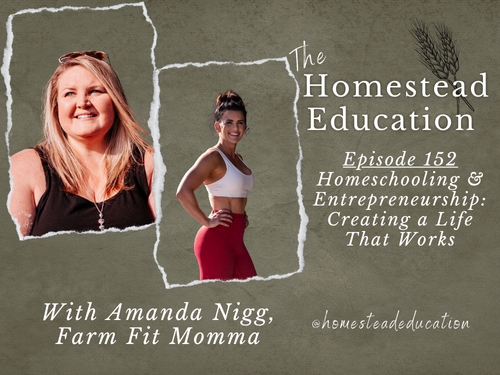
Episode 152: Homeschooling and Entrepreneurship: Creating a Life That Works with Amanda Nigg
Episode Highlights
In this episode, I am joined by Amanda Nigg—better known as Farm Fit Momma—a homeschooling mom and entrepreneur who built a business that fits her life and family, not the other way around. Amanda shares her real-life journey of growing a purpose-driven brand while raising kids, managing homeschooling, and staying rooted in faith.
From early-morning bookkeeping to balancing client work during naptime, Amanda opens up about the flexibility, discipline, and intentional planning it takes to run a successful business from home.
If you’re a homeschooling parent, work-from-home mom, or aspiring entrepreneur, this episode is packed with relatable insights and encouragement to help you build a business that aligns with your values, your schedule, and your purpose.

Podcast Review
Did you enjoy this episode? Please drop a comment below or leave a review to let us know. This can help other folks learn about this podcast and we also really appreciate the feedback!
Podcast Links and Resources
Website: https://www.farmfitmomma.com/
Instagram: https://www.instagram.com/farmfitmomma/
Facebook: https://www.facebook.com/Farmfitmomma
Kody's Links
Website: https://www.thehomesteadeducation.com/
Shop Curriculum: https://www.thehomesteadeducation.com/shop
Speaking Events: https://www.thehomesteadeducation.com/events
Facebook: https://www.facebook.com/thehomesteadeducation
Instagram: https://www.instagram.com/homestead_education
Watch episode on YouTube: https://www.youtube.com/@homesteadeducation
Read MoreLess
Introduction
Hi everyone and welcome back to the Homestead Education Podcast. So, so many of you know my husband’s story and how natural food and non-toxic living helped save his life and was a huge factor in his recovery. But what we don’t talk about is how exercise and physical fitness and mental health were a huge part of that as well.
So today I invited Amanda Nigg from also known as FarmFitMama online on to chat about that a little bit. So thank you for coming. I’m excited to be here.
Yes, mental health is super huge and it’s not talked about enough, especially in agriculture. It is not. I’m, I’m sure we’ll go into that.
Amanda’s Background and Life in Agriculture
So do you want to tell everyone a little bit about yourself, like what you guys do with ag and what you do with your business? Absolutely. So I’m a farmer’s wife and I take great pride in that. I know some women don’t like to identify as a farmer’s wife.
I don’t know why, but I know my husband is a farmer’s husband. So, you know, there we go. See, I married into agriculture.
So I grew up in Western Nebraska. My dad worked for the railroad as an engineer and my mom actually worked for UPS. So in our small town that I grew up in, it was so much agriculture or railroad.
Like those are the two biggest industries. So I knew a lot about agriculture before I met my husband. And when I met my husband, it was, I don’t know if he will agree with it, but for me, it was like love at first sight.
Like I latched my wagon to his, I was like, you’re going nowhere. And I always joke too, is like, I thought I knew a lot about agriculture until I was in it. Like there was so much, I didn’t know.
Like I, I knew like there were seasons, you know, they had planting season and then harvest because just, you know, being in a small town, you, you know, when they hit busy season because of the trucks and getting the crops out and stuff. But there’s a lot more that goes behind it that I didn’t realize. Like it’s a full on business.
Like there’s marketing, there’s, you know, you’re selling stuff on crops. Like you’re, we’re the world’s biggest gamblers. Like we really are when it comes to weather, crops, prices, everything.
And so it was really eye opening to marry my husband who is a fifth generation farmer, by the way, I don’t know if I said that. And we farm up here in South Dakota. So it’s, it’s, it’s super cool to raise my boys in agriculture because it’s, it really opens my eyes to the possibilities of what they can accomplish.
Just not like you and I were talking about this, like life skills, you know, like they learn so much more than they can just by sitting in the classroom. They learn how to communicate, like they learn to how to market themselves, you know, dealing with seed dealers, even they learn so much more just by being on a farm operation. So it’s super cool to be able to raise our family on that.
That’s awesome. I love seeing kids on these big farms and running them like a business, just like their families are. And I love South Dakota too.
We always love driving through there because my son wants to be a crop farmer. I don’t know why he wasn’t raised on a crop farm, but he’s obsessed with crop farming. So we always take our time.
He’s working on a, he does the mechanics for one of the neighbors, like, or helps my husband do one of the mechanics to keep their hay operation going. And they keep telling him like, one of these days, we’ll let you drive the equipment. And he’s like, I’m 16.
When are they gonna let me drive it? And see my boys have been driving since they were like two. Right? I mean, he drives our tractor and stuff, but he wants to drive their big stuff. Yeah.
The combine that’s where every kid wants to work up to is that combine. Right.
From Medical Field to Fitness: Why Health?
So what kind of brought you to working with like physical health and mental health and stuff? Well, I always been in the men, the physical side of things. So I actually went to college and I got my health promotion and I went into the medical field and I loved it. Cause like, I’m a, I always say I’m a fixer personality, but I’m more of like a science personality.
Like I like to understand how things work and why they work the way they work. And so when I went into the medical field, I went into oncology because I really wanted to understand oncology, like the science. And what I found out is like, everybody has a cancer bug.
It’s just certain events will trigger it to become active. But over the course of going through oncology medical school, it was just like, I knew I wanted to always eventually launch my own gym and really help people understand how to feel their body through everyday nutrition. And so in 2020, it was actually my pivoting moment.
And I always tell everybody, I think God has a plan for all of us and he’s going to put us in the right direction. Even though we 2020 was all of us, he’s all of us. Yeah. Well, big time.
2020: House Fire, Lockdowns, and a Mental Health Crash
And like we actually, and I share this in, it’s called a hero video, but the day before that, so we just built our forever home. That was like half a mile away from the farm. We were going to retire in the sucker.
Like we lived in it for four years and our house caught on fire and we lost everything. So March 19th, 2020, our house burnt down to the ground. Like we lost everything.
And then the next day was the national lockdown. So 2020 was a whole different beast for us. I was bringing my baby home from the NICU that day.
Really? They basically were like, he’s good enough. Go get out of your way. You can’t, it was just like, there was so many unknowns.
And like for us as a family, you know, I had to pivot to going homeschooling, which we talked about, you know, it was a learning curve in itself. And then I had to pivot, you know, I sold insurance at that time door to door, which I absolutely loved. I serviced rural America with supplemental coverage and I couldn’t even do that.
And so my world was like rocked upside down is just like my mental health tanked. We didn’t have a home. There were so many unknown battles we’re going through, you know, we’re told the social distance, which I’m very, so much an extrovert.
So like I thrive on human connection and it was just like, I was struggling and it really opened my eyes to like how there wasn’t really mental health services available in rural America. Because like, if, if you had an issue or if you were struggling, the only thing really available was a 1-800 number. And it’s like, okay, you could talk to a stranger, but what happens after that? Like usually you want to.
There’s a one year waiting list in our community to get in with a mental health provider. Yeah. It’s, it’s crazy.
And it was just like, and then health too, like, you know I think in 2020, and actually I don’t think I know this is instead of like pushing people to take care of their health, you know, like, Hey, start to work out, you know, start to dive into nutrition because nutrition can change a lot of things. Like you don’t realize your gut and your brain there’s this in between the two. And when you’re not feeling yourself correctly, it’s going to impact your brain as well.
And so like 2020, it was more, I felt like a scare tactic where they weren’t talking about nutrition. They weren’t talking about exercising and relieving stress, going about the holistic side of things that do work, which now they’re talking about because there’s this whole movement of, I think it’s called Maha that’s going on, you know, but still it’s just like a lot of people that disconnection and I really opened my eyes to it.
The First FarmFit Challenges
So I did a, what I did, Cody is I did a couple of free challenges that year. And at the time I wasn’t certified as a personal trainer, nutritionist or mental health coach or any of that. And I remember in May of 2020, this planking challenge, you know, something super simple, just planking.
And I threw it up online and I was like, you know, if 10 people participate in this, I’m going to impact 10 people. And it ended up being like 800 plus farmers across the world. Like, I mean, we had people on Australia, Canada, planking on me chills. Yeah.
It was just a cool thing. Cause it was like, it, it opened my eyes to like how much our community needed this. It was just like that outlet of like, we’re all going through these massive curves and insecurities.
And it’s just like, you bring a group of people together to work on their physical health. And so later that year, I did a couple more challenges and I was like, you know what? I’m going to make a business out of this. Like I’m going to, I’m going to show that, Hey, 15 to 25 minute workouts.
Like I got the methodology, like I can humble your ass in that time, but I promise you you’ll walk away and you’ll be, you know, a more active parent. You’ll be more engaged in your farming operation. You know, how many times do we hear people go, you know, back in the day or relive the high school glory days? You know, when I was in my peak performance and a lot of people don’t realize like your peak performance goes all the way to 70, 70, and it doesn’t go down.
Like, so I’m saying your peak performance being your teens, like I’m almost 40 and I’m, I’m in better shape than I was when I was younger. So it’s just like, I wanted to give people the tools and strategies to show them like, Hey, you don’t have to spend 45 minutes to an hour in a gym. The closest gym for me is an hour away one way, you know, so it’s two hours.
And then by the time you get there, you’re there for an hour. So it’s like three hours a day. Like I don’t have that.
My closest gym I’d have to go to Canada for. Yeah. Yeah.
And it’s just like, that’s, that’s the biggest struggle is a lot of people are like, I don’t have the equipment and you don’t like it. My programming, I really specialized in those 15 to 25 minute workouts. You know, you can do it all scout calisthenic, which is body weight movement.
And it’s more functional training is what I call it. It’s a training where it’s setting you up for longevity. You know, you’re, if you want a six pack abs, great.
If you don’t want a six pack abs and you want to be able to do your everyday tasks with ease, this is it, you know, and, and the nutrition, I mean, I’m sure you and I are going to go deep into nutrition is it’s just like diet culture. So thick, you see it one, one side of the other, like they’re pushing intermittent fasting and now it’s all of a sudden carnivore diet. So it’s just like, it’s so thick out there.
And it’s like, okay, let’s myth bust that. And let’s educate people on like how to feel their body correctly. Um, and set up for success.
Your Husband’s Story and Food as Medicine
Well, that was the biggest piece. And, you know, I kind of prefaced it a little bit at the beginning, cause I’ve had people listening for a couple of years. So I don’t like go into it real deep, but my husband had, was diagnosed with end stage liver disease eight years ago.
He had like only been out of the military for a couple of years. He wasn’t a drinker. Um, his late wife was Mormon.
So they, I mean, he didn’t drink for 12 years and all of a sudden, I mean, he just had some heartburn. So we’re like, and he couldn’t get it under control with like reninadine or something. So we’re like, let’s just go to the doctor.
Next thing I know we’re getting a terminal diagnosis. And they told him that they may, he maybe had a year and yeah, we were, I was 34. So he would have been like 36.
And I mean, we were just like, what do we do? You know, and they probably pushed like drugs on you or something actually, because in stage liver disease, there’s like nothing you can do for it. And liver disease in general, the only thing you can do for it is healthy eating, like, you know, stop the onslaught on your liver. But once your liver is scarred, they’re like, there’s nothing you can do.
And they’re like, well, if you have a slightly healthier lifestyle, you might improve his quality of life. And I was like, great, that gives me something to work with. And you’re an so.
Um, what does that look like? You know? Yeah, exactly. And they don’t educate. Yeah.
I mean, we grew a lot of our food at the time. I mean, just gardening and stuff. We always raised pigs and chickens.
And we were big hunters. Like we were always out in the woods. We have the big mountains out here.
So I mean, when we’re out hunting, we’re hiking. Yeah, we’re getting a good workout. Like and my dad used to actually run dogs on wild pigs.
I mean, we literally ran through the mountains. And that’s how I spent like my whole childhood. And so we’re like, Okay, well, how much healthier can we get? We already cook at home, we already grow our own food, like, what do we do? And so we started to look into diets and that type of stuff.
And we’re like, that’s, that’s not for us. That’s not what we’re trying to do, especially when we don’t want like fake sugars and things like that in our system. And so we literally just everything that we needed to buy, we started looking for ways to not get it at the grocery store.
And that’s, that’s pretty much been the entire premise of our diet. And six years into that he was told he had a fully healed liver. Yeah, you don’t know, people don’t realize how much junk they put in food.
They really don’t like I know, the current government is trying to tackle that right now. But you you really don’t know. So I one of the things we do in forfeit training is I really educate how to read nutrition labels, because even the marketing, like, food industry spends billions, let me put this billions of dollars on food marketing, they will market stuff that are GMO free that don’t even have freaky GMOs in it.
Like there’s 11, 11, who’s that are GMO, the market. They donate to nonprofits that are ran by like the FDA and stuff like that. 100%.
And like, people don’t realize the control they have on the industry. And it’s like, when you start to dive into the science of it, it’s like, okay, back to that invisible highway, when you get your gut health in check, really changes your life and your body thrives on that, like, kind of think of not going back to the caveman phase, but like, you know, going back to the land and getting your food that way. Like I partnered up with like a lot of, for example, they call it farm to fork families.
So like three farm daughters, I’ll throw them out there. They’re a farm north of me about two and a half hours, they not only grow the wheat, but they also process it and make it into pasta noodles. And it’s like, you know, you’re taking that middleman out.
And so you’re getting these quality of food cheaper. Farmer markets are huge in our area as well. But it’s just like, a lot of people don’t understand, like, you know, when you start to feel yourself correctly, your whole life changes, your skin changes, your hair changes, you know, so you have more pep in your step, your body can run.
And like the analogy I like to use here is like, you know, right now, carnivore diet is huge, which is horrible. Don’t please don’t do it. Anybody that’s listening to this, do not do it.
But like, a carnivore diet, super low on carbs. We need carbs, carbs are energy. It’s your energy source.
And it’s like that whole Dr. Atkins thing, like it just keeps. Yeah, like you need carbs, you need carbs to survive. So with that being said, like, I always explain it this way is it’s like you have your tractor in it.
And instead of putting diesel in your tractor, you put gas, and it’s going to, you know, over time, it’s going to start to run sluggish, you’re going to start to slow down the same with like, you know, sugar substitutes, exact same analogy, it’s going to start to learn slow sluggish, because it doesn’t know how to break it down, it doesn’t know how to process it. But if you put diesel in it, it’s going to run, it’s going to get a test done, it’s going to run ultimately, you’re not going to have issues, you’re not going to have a check into like, it’s just like our bodies as well as when we feel our bodies like with natural sugar, cane sugar, you know, when you fill yourself with complex carbohydrates, we’re talking full grains, you know, potatoes, yes, you can have potatoes, start to potatoes, like when you’re eating those natural, like man made natural, not over processed carbohydrates, your body knows how to run. And it’s this amazing mechanism that a lot of people don’t tap into, like in a fitness journey, you shouldn’t just work on your physical health, you should also work on your mental health.
And when you’re working on your physical health, nutrition plays into that, because when you work on both nutrition and physical health, it impacts your mental health as well. And it just all works together. And so one of the things I actually educate about is have you ever heard of macronutrients? Yeah, it’s just basically it’s a nutrition theory.
It’s not a diet. So you’re just focusing on the nutrients and foods in large amounts, which are protein, carbs and fats. And everybody is unique, you know, your body’s unique and how we ingest different, like how we what our protein number is, what our carbohydrates are, what our fats are, it’s all unique.
And so it’s just really cool to see clients start to dive in that process and understand like, hey, I’m feeling myself and I’ve noticed my moods better. I’m not as sharp with my kids, you know, I’m lifting heavier. I have more pep in my step, I have more energy.
And so it’s really cool to like, wrap that up into a simplified form where it’s like, okay, here’s the tools and strategies like this is really simple to incorporate. And it doesn’t have to be complex, like it is that you see on social media. Absolutely, it’s, it is so much more simple, but a lot of people don’t understand like, even how to deal with the cooking of it, or where to source it, or the price.
And sometimes that’s what I spend a lot of time doing is teaching like how to cook it, how to source it, like how to, you know, not break the bank buying organic or something like that. Which I don’t buy into that completely either. I don’t buy organic if anybody wants to know like, I mean, again, it’s just a lot of people think organic farming is they don’t use pesticides and they do.
It’s like, yeah, it’s not the case. They just use organic approved pesticides. Yeah.
It’s like nobody really understands it. They hear that little nugget and it sticks with them. And they’re like, Oh, I have to buy all organic.
And it’s like, No, it’s really just a paperwork trail. Um, you know, when with my husband’s liver, we do look at working, you know, chemicals that are going on to things. So we try to source as much of our foods we can either like from ourselves or locally, or because then I know what’s going into it, like our neighbors, they have, they, you know, have wheat and process it, and we can buy flour directly from our neighbors and stuff.
And I know what they’re putting on it. So it’s a different and we live in a very, we have wheat and stuff, but we’re not a, there’s not so much ag happening here that there’s just chemicals and everything flying around, like we’re in a pretty pristine place. And so like, I can really like limit that.
But yeah, I don’t, I go with good, better, best and good is fed better is quality food and best is growing like it yourself and cooking it at home, you know. And sometimes we just make sure we’re fed. Yeah, well, and I tell everybody there’s, there’s so many amazing farmers right now and ranchers that are selling their product online.
Like a, you had to go to the grocery store to get stuff. And like, you know, I already mentioned three farm daughters, but there’s also like, I buy my flour from a gal not too far in Minnesota from me. And it’s like, you can buy directly from the farmers and ranchers.
You don’t have to go to the grocery store. I say with beef, like we get our beef here locally from a rancher. That’s like 10 minutes away from us.
He takes a cow and we butcher it and get it cut and processed how we want it and we buy fill our freezer full. And so it’s just like, I can’t tell people enough, like, there’s there is ways to get access to good quality food. And you don’t technically have to go to the grocery store to get it.
Direct-to-Consumer Ag and Rural Sourcing
Absolutely. You know, I went to a local ag expo in February with my homestead homeschool curriculum. And I’m like, Oh, my gosh, they’re just going to eat me alive here.
But I needed to like, put my toe in, you know, I’m like, I’m an Aggie. I’ve been an Aggie at heart. My dad was a California cowboy.
Like, I can do this, you know. And they loved me. And the conversation I had, like, I mean, there was a lot of ag teachers that were like, we want to teach this way, not the way we have been.
But that was really exciting. It has took me down a whole different path. But almost every single farmer that stopped by my booth was like, we need to figure out how to do the direct to consumer model.
And we don’t know how to do that. And there’s not a lot out there teaching us. Like we came here hoping to find something that would help us with that today.
And I was like, wow, like, I didn’t realize, I thought a lot of the commercial farmers wanted nothing to do with the whole direct to consumer market. And it’s really exciting to see that because if we had more farmers doing the direct to consumer, less people would even have to ship because you would be able to source it locally. But if we’re not buying from these farmers, they can’t make an income and they have to just sell to cities where they’re shipping it and stuff.
So I had a gal actually reach out to me. So I partnered with a couple of meat companies like Abbotsons, West 40 Meat, same thing from our producer to customer, like they took the middle man out. And when I was talking to somebody online, I think I did it on my stories or something.
And I can’t tell you how many DMs I got of people asking where they could source like their meat or fresh veggies and like just a quick search, like with AI out there, like you can find it. It’s super. And there was like stores popping up, like the other day I just ordered avocados directly from a farmer in California that are coming, shipping to me.
That’s good to know because you could not get a good avocado in North Idaho. Oh my gosh, you can get it from a California farmer and I’ll give you the information. But it was just like, I’m all over it.
Avocados are a healthy fat, so they’re really good for you. But yeah, it was one of those things. And I don’t have chickens on our farm, but I buy my chickens from my neighbor who has, she gives me three dozen fresh eggs every two weeks.
And it’s just like, there is ways, it takes a little work. And that’s my tip to everybody. If they want, they truly want to reach out to sources and get connections, like ask a farmer, because usually most farmers have connections and they can connect with people to get your meat from, or if you want to start buying your eggs locally or whatever it is, like there’s always, we all network in agriculture.
I say big industry, but it’s also small because it’s like, everybody’s really working towards myth busting and really helping the consumers understand how us producers make the food. But at the same time, it’s like, that’s one of the pushes for me launching my business is like, everybody’s working on the producer and consumer side, but nobody’s working on that. The in between, which is us, you know, that mental and physical health.
I kind of took flight with what I offer is, and I don’t just work with agriculture. I should make that clear is like, I work with rural America. So if you live in not just rural America, rural Canada, like in rural countryside, that’s like my main target audience is really to explain like how feeling yourself in that little physical work can really impact your, your business, your relationships, who you are as a parent, if you have kids, and it just, it starts at home.
And I think that’s kind of where you and I align because we just went off on about homeschooling. So yeah, and that’s a lot of my listeners, they’re homeschool moms, they live in rural America. And a lot of them are new farmers, because they’re moving from urban and suburban communities to rural communities.
And then yeah, suddenly they no longer have a gym. They’re isolated from friends and family and even their new friends and family. I mean, I live 27 miles from town.
So it’s not like I can just pop in and have coffee with a girlfriend or do our morning walk together or something. And so that’s kind of like when I came across you, I was like, Oh my gosh, this would be such a great conversation to have with so many of the people that I’m working with on how to bring exercise and the importance of that and the mental health because like I bring a lot of the natural food part of it, but that bringing it all together with how important the exercises and how to get that in when you live early or when you’re working your farm 18 hours a day. And so I was really excited to have that conversation.
No, I’m excited. Yeah. Thank you for asking me.
First and foremost, I’m honored to be here. I’m super excited. I mean, that’s the thing too, is a lot of people, it’s kind of like that.
Another analogy here for you, you can pour from a half empty cup, but you can’t pour from a half full. If you think of our way, I said that right, right? Yeah, you can pour from a half full. There we go.
I said it backwards, pour from a half full, but not half empty. Um, and so, you know, we’re our longest commitment. A lot of people forget that.
Like it starts at, like, it’s not being selfish. Like if you check in with yourself for 15 to 25 minutes and do a quick workout, bring your kids along. Like, I can’t tell you how many times my kids have joined me in workouts when they were little.
Um, or we go for walks. Like we just make it a part of our daily lifestyle because I know when I don’t get that time from like to check in with myself, I noticed I’m more snappy as a mom. Um, I don’t have patients.
I’m more like frazzled all day. It seems like I just am not organized. And when I take that time for myself, um, to check in, you know, and also create those healthy meals and get my boys to, you know, help create it and talk about nutrition, it becomes part of our life.
And it’s really cool to educate them along alongside that. Cause like my oldest actually just did a nutrition class in sixth grade and he came home and he was like, mom, they’re teaching this wrong. Like they’re not covering this.
Right. She tried to tell me that I shouldn’t be drinking at least two liters of water. And I’m like, no, you should, uh, your body’s 65 to 70% of your body’s water.
So we were talking about that and it was just like being able to myth bust with him and educate him and give him the science with that. And that’s really what I do, um, with my clients as well, is it’s like, we don’t just tell you what to do. We educate you along the process.
So you fully understand. And that’s where we really stick out when it comes to like physical health, um, in nutrition is it’s more about the education behind it. Cause like, if you understand something fully, you’re more likely to stick to it and understand the importance of it.
The “Why Statement”
And so one of the things I love doing with clients when they come into firm fit training is we do a why statement and it’s like the most powerful tool you can do it. Anybody can do this. You can do this today too.
As Cody is a why statement is your like deepest, darkest emotions you have about yourself. And this is like, you know, maybe it’s like right now you’re uncomfortable in your own skin. Maybe you want to be that active mom or the active dad, or maybe you want to make the jump to homeschooling, which I’m going to be making here soon.
So me and Cody are going to be talking a lot, but you know, like it’s just like, um, your why statement is where you’re at right now. And the reason why I love doing this is it’s a mental health, um, trick that I do with all my clients is because it gets us to face our insecurities. A lot of times we don’t like to face our insecurities cause we’re uncomfortable and you have to be willing to be uncomfortable to grow.
And if you don’t base your insecurities and hit them head on, you can’t grow as an individual. You can’t step outside that comfort zone and do things that you’ve never done before. Like you said, you went to an ag expo and you’re like, okay, I’m just going to go.
And then it ended up being a wonderful experience. But what if you didn’t have that confidence, you know? And so much, so I got invited to DC to talk about what I was doing. Oh my God.
I love that. Those opportunities wouldn’t have presented themselves. If you did step outside.
And so like, you know, when we’re talking about a physical transformation, a nutrition, you know, mental health, it’s all encompassing. Like you need to look at those all as the same package. Like when you start to dive into physical health, you’re going to automatically impact your mental health and you’re going to start to eat better.
You know, when you start to dive into a nutrition, the next thing you know, you’re going to want to start lifting weights, you know, and dabbling into that one. But along the course, you’re going to start impacting your mental health and they all work together. And so, um, the why statement, I encourage everybody to do this is sit down, block off 15 minutes of time and just keep asking yourself why.
So like, for example, like one of my driving forces, I always saw my mom on diet pills and I hated it. She was always on that yellow, yellow hamster wheel diet culture. And I just like wanted to like, I don’t want my boys to see that.
Or I heard her talk negative about herself. Like she always nitpicked herself negatively. And I’m like, I don’t want that for my boys.
I want to show them like strongest being strongest. I keep digging over here because I lost my pen and I want to write down all these amazing things you’re talking about. You see me rummaging.
It’s because I think you’re great. I’m following you on social, so you’re not getting rid of me. All right.
It’s just like, you know, um, diving into that. And so like going back to my wife’s statement is that was my start of my wife’s statement is like, I didn’t want to be, I wanted to change the course with my family. I wanted to show my boys like lifting and taking care of yourself and how you talk to yourself really impacts your mental health.
And then also I wanted to be that hands-on mom. Like I go to like my son’s cross country meet, or, you know, I go to his basketball games and I can’t tell you how many parents don’t engage with their kids that are not out there, you know, running or, you know, shooting the ball. Or, uh, the other day my son played, um, flag football and I was out there playing flag football with a bunch of 12 year olds.
And I loved it, but I was the only parent, you know, all these other parents were sitting on the sideline and it’s like, no, like kids are only young for so long. I only get them for eight. I only get my boys for 18 years, you know? And so it’s like, I want to be that hands-on mom.
That’s right there in the thick of things and not missing out on those. You just added 1500 hours a year with them. Oh my gosh.
Yeah. What? 1500 hours a year. You just added with your kids.
If you’re homeschooling them. I am going to homeschool them. So but you know, um, it’s, it’s everyone’s going to be like, I need to follow her and see her into homeschooling.
It ain’t going to be pretty, but it’s going to happen. But, um, you know, it’s just one of those things where it’s like, I really want to be that hands-on parent. And so like, that’s really, what was my driving force when I started my fitness journey is like, I was that overweight mom.
I actually had two emergencies. Well, my first one was emergency section. The second one was a schedule C section and it ended up being a horrible experience in itself.
And so like I put on 60 pounds, I’m five one, you know, that’s a lot of, see, I, my last baby after every baby, I lost all my weight again and was like, I’m a big girl. But like, I went back down to where I was really healthy and comfortable. And my last baby afterwards, my body attacked itself.
And it’s been five years of steroids and I gained 80 pounds, but I’m also six foot. So 80 pounds. I didn’t, I only went up like one pant size, but I went up like five, six.
Yeah. I was super uncomfortable. And it, you know, I’m, I’m, I call myself fun size.
I’m five one and 125, 30 pounds comfortably, but it was a lot for my frame. Like I would get winded just walking across the farm yard and it just drove me nuts. It was like, no, I don’t want to be that mom.
I want to be that active hands-on. And now it’s, it’s cool because like my husband, so we don’t have any hired help. We farm by ourselves, but my husband will send me a text and be like, I need your muscles.
And it’s like, it’s like the biggest compliment. I love it. I know I’m like on my way.
I get the, Hey honey, I need your brains. Yeah. You know, it’s, it’s cool to be like in that position where you feel wanted, you know what I mean? You can make fun of my weight, but you can’t make fun of my brains.
You know, he does, but like other people. Yeah. If you ever are looking for a fitness program, Cody, I can help you with, uh, fitness and you dive into your journey with me and then you can help me with homeschooling.
This is all right. Maybe, maybe it’s a deal. So no, it’s, it’s really cool.
And the biggest thing I want to tell everybody is start small, don’t over-complicate it. You know, sometimes we tried to bite the whole elephant in one gulp. You, you got to build your foundation correctly and it takes time, you know, and time and consistency is the biggest thing here.
And I’m sure you can agree with me is like, when you’re diving into a healthy lifestyle with nutrition, for example, as well, don’t think you have to go out there and buy everything locally, you know, maybe buy your meat first and then start doing meats a really big step. Uh, even milk, like milk again, milk at the grocery store is great. I buy our milk at the grocery store.
Some people drink raw milk, which is even great, you know, um, you know, when our cows are dry, I absolutely buy just regular pasteurized milk at the store. Cause we still need milk.
And personally, because most of the year I am on raw milk, I’m not paying $20 a gallon for milk. That isn’t ours. Yeah.
So then I buy, I buy milk at the store, but drink whole milk is what I’m going to tell you. Do not buy 2%, 1% or fat free drink, whole milk. Your body knows how to break it down.
Don’t be scared of it. I promise you first and foremost, it’s more for like, Oh, well, it’s really good for you. Uh, they add vitamin D in it because most people are vitamin D deficient, but it helps your body break it down in simple terms.
But whole milk is where it’s at or raw is what I would recommend everybody to buy. And I can tell you how many clients come in and they’re drinking almond milk and stuff. And I’m like, let’s change that.
Let’s adjust that for a second. Let me educate you. But it’s just, um, it’s water that tastes better.
Like it’s no whole milk or raw is where it’s at. Like trust me, your body knows how to break it. Going back to what we talked about earlier is your body knows how to break natural foods better than it does processed or chemical foods.
And I’m not saying 2%, 1% or fat free or process, but they do take the healthy fats out and replace it with a sugar. Uh, that’s where you get this, um, sweet flavor back in. So you’re taking the healthy nutrition, your vitamins and minerals and everything are found in your fats and milk, you know? So we actually switched to cooking primarily with, um, our home rendered lard from our like heritage pork.
And we dropped our cholesterol over 200 points a piece. Yeah. Everybody’s like the crazy right now is beef talon.
And I’m like, I haven’t eaten that sucker for years. Who knew I was ahead of the curve. We were always like my husband and I, even in our younger years when we were really in good shape, we’re bigger people where we just are.
So we were always like watching that diet. So it was like, Oh, you know, you have to do the fats that are liquid at room temperature and you know, all that stuff. So the thought like my dad, my dad was the healthiest person I knew, but he grew up in Tennessee and cooked everything in lard.
And I thought he was just healthy because of how many hours he spent running through the mountains. And I look back on it now and I’m like, no, he had it right. But no, everyone else didn’t, you know? And so we started rendering our own lard.
Even my daughter gets in there like on processing day, that’s her job. She renders and strains all of our lard and packages it up and puts it in the root cellar. And yeah, I like to cook with a beef tallow or avocado oil for all.
Those are my, my go-to grabs, but it’s crazy how things are kind of coming back. Like back, you know, there was a phase when I was younger, I remember reading that eggs were bad for you, you know? And now it’s like, well, can I get enough eggs? You know? So it’s like, again on social media. And this is one of the things is like shift through the information.
Don’t take it for face value. Like if somebody can’t explain something with scientific evidence and really break it down to you, then they’re probably not the coach or person that you want. You know what I mean? I kind of just go with, with the food stuff.
It kind of just clicked for me one day, like all of humanity has survived on these foods for thousands of years. And suddenly in the last, you know, 50, 60 years, we’re going to say it’s better to have it processed and broken down and taken apart and all those things. Like, it just doesn’t make sense.
So I kind of go with, when you’re making a choice, try not to be more than five steps away from God, like the way he made it. And it’s really, it helps because then I’m like, how far has this been processed? And five steps goes really fast. Like just getting burger, like if I slaughter a cow right on my property and turn it into burger, it’s hit five steps.
So that’s what we try to stay under. But one thing that we really saw when we started our health journey is I knew we needed to exercise in our diet or in our diet, in our lives more than what we already did and more intentional about it, not just our hunting trips or something because my husband needed it for his liver. And he was super depressed because, I mean, he just got a terminal diagnosis.
And that was something that really like turned the tables for us is I said, like, I know you don’t want to go to the gym and stuff. Let’s just take the kids out, like hiking every day after dinner. And we started doing that and like extending what we were doing.
And I literally saw his mental health and like even his PTSD from he was blown up three times in Iraq. So even like his PTSD, like turned just by like between the gut health and the exercise, it was like such a huge difference. And we were really intentional about our time.
But I know a lot of families are really crazy and like on the farm, like, how do you suggest they kind of like work that into their day? Well, if you first and foremost, if something’s important enough to you, you’ll find a way. And that’s really true because like we do something similar. So like on our farm after dinner, so we always have dinner together.
You know, lunch and breakfast are kind of up in the air. My husband’s all over the place. But like something my husband and I agreed upon is every night at six o’clock, we’re coming together as a family.
We’re sitting down, even if he’s in the field, I hike everything out to the field and we sit down. And and now that lots of field meals. Yeah, I mean, the same here.
And so like, you know, if it’s important enough to you, you’ll figure it out. Like you guys incorporated hiking, you know, being outside is a big mental health booster in itself. You know, and bringing loved ones with you is another one.
It doesn’t have to be overcomplicated. It can be something as simple as like, hey, your husband comes in for lunch, maybe going and doing a 10 minute walk, you know, being intentional. Or if your kids instead of letting them like right now, I’m on an anti electronic thing going on in my house because I I hate YouTube.
And so like one of the things I do with my boys is like if I see him sitting down, I’ll I’ll get up and I’ll be like, let’s go for a walk. Let’s go take the dog to the river, you know, just like being intuitive and paying attention to running. But to work it in your busy schedule is planning, you know, like how many times Yeah, like I tell clients to when they start a fitness journey with me is like, not only set your clothes out, but plan when you’re going to do it in your calendar and schedule it, like a date with yourself.
Because you’re more likely to show up when everything you take those barriers out of the way to get to where you want to go. And so it’s just like, you know, if you want to start walking, you know, instead of riding your ranger across our farm, because our farmyard is 40 acres. I mean, it’s spread out.
Yeah. So like, for us, like, I’ll purposely park the ranger back and block it into something. So I have to walk, you know, and just well, our son blew up our quad motor, so we have to walk.
Yeah, we have a three wheeler, we have an old school three wheeler. Oh my goodness. I didn’t even think those were like, oh, we got one of those.
I mean, it’s a dinosaur, but that sucker’s never gonna die. We’re on 40 acres total, like not just our barnyard, but our barn is uphill from the house. So that’s our like, if you’re going to the barn, you got to walk like we don’t take the truck, unless we have to haul something with the truck.
So yeah, just being intentional, you know, and treating and celebrating it. You get to move. Like, do you know how many people wish might be going through something terminally ill and can’t do stuff? Like celebrate the fact that you get to move, you get to do this, like change that mindset of how you speak about it.
Instead of being like, oh, I got to walk across the farmyard again, be like, I get to walk across the farmyard. I can walk across the farmyard. Like that’s a celebration in itself.
Like, I get to walk. Absolutely is.
Fitness for Farmers: Injury Prevention and Longevity
So something with farmers that we see a lot of just in general is that, you know, there’s a ton of depression, suicide rates, farm injuries from not staying in shape, wives who are having to work off farm to provide health insurance. So I know that like, making sure that you’re staying healthy to be in shape to do the work that you have to do as a farmer is really important as well. Do you kind of have anything on that with like, you know, keeping like your back muscles healthy and those types of things? Yeah, I mean, well, first and foremost, agriculture as a whole, we’re 3.5 times higher to commit suicide than any other. Let’s pause for a second.
That’s massive. Like, that’s a big deal. And I think it has to boil down to the, like, we’re the world’s biggest gamblers.
You know, we gamble when it comes to weather prices, markets, you and I talked about this. And so to keep yourself healthy, like think about everyday movement, like you’re squatting, you’re lifting, you’re bending over all the time. So, you know, why not add 25 squats in there, you know, or add a quick, like, if you’re sitting down, don’t sit at my rule of thumb is don’t sit down more than 45 minutes at a time.
So like when, when my timer goes off for 45 minutes, I like get, I’m laughing. I’m a writer. So like, Oh my God, I couldn’t, like, I mean, I always get up and try to move, like I’m a mover.
Like my husband said, he’s going to buy me a standing desk because I get so antsy, but like, I need something like, so I can like stand and type. One of my friends just did that. She got a standing desk and those little walking treadmills.
Yeah. And she loves it. I’ve tried typing while on my like stationary bike, but I just, my brain and like hands can’t work at the same time.
So I figured at least if I’m standing, you know, Which is standing even burns calories. Do you know, do you know if you stand at least 12 hours a day, you burn additional 250 calories a day just by standing. So yeah.
You know, it’s just don’t overcomplicate it. And it helps your posture and everything. Like I really noticed my posture has been bad since I’ve been working, like writing so much.
Cause I don’t always write in my office desk. I write in my recliner a lot because then I’m in the living room, like homeschooling the kids and, you know, like doing life with my family, you know? Yeah. Um, calisthenic workouts, um, are great.
We actually, I actually have a free or not a free, uh, a program it’s called farm fit methods training. It’s only bucks 1999. Oh, Wow.
It’s 14 day calisthenic. So it’s all body weight movements and the workouts are anywhere from 10 to 15 minutes. Anybody can buy it.
Anybody can go through it. Um, it’s super like you can even print out my workouts if you want, um, after the 14 days and continuum, like it’s, it’s super simple. You don’t need any equipment.
All you need is yourself. You don’t even need a pair of tennis shoes, workout barefoot. Cause I do most of my workouts barefoot, like, you know, just.
I do as many things as I possibly can barefoot, but you know, Brown body connection. Yeah. I have a no shoes in the garden rule.
There’s actually a sign going into my garden gate that says like no shoes in the garden. All that. Yeah.
Like my kids run around across rocks, barefoot and everybody’s like, how did they do that? And I’m like, I used to be barefoot when I was little, like farm kids. Yeah. But this one sounds like a really good one.
I have a 16 year old daughter who hates working out. She does like going hiking and stuff, but she hates any type of extra workout and like homeschool promise coming up and she wants to get a really fitted dress. And I’m like, you need to like tone it up a little, like, and I mean, she’s tiny.
Like I’m not even saying she’s overweight at all. Like she is probably five, eight at this point and only weighs like 30 pounds, but she’s definitely like, she’s getting the, like she needs to tone up a little, we’re going into summer. She needs like a hot girl, summer look, you know, weights is what she needs to do.
Cause the quickest way to tone up. Um, I can’t tell you, I have so many women that come into my program and they’re like, I want to tone. And I’m like, the only way you can tone really quick is to pick up weights.
Like a lot of women, that’s one of the biggest myths out there on social media is if you lift heavy, you’re going to get big and bulky. First and foremost, our chemical makeup as females are way different from a male. And there’s absolutely no way we’re going to be, but like, it takes years to pack on muscle for a female because we don’t, we don’t have testosterone, for example, like our whole chemical makeup is a lot different.
And so, um, when I talk to females and they’re like, I want to tone, um, definitely start with a calisthenic workout just to get the form and movements down. But once you add weight and you will tone up so fast and you’ll start to see muscle definition way quicker than you can going through like a detox diet or, you know, like whatever is out there. Like you’ll just see more progress faster, especially when you couple it with a, like what you and I were been talking about, like feeling your body for success.
Yeah. And she’s big on that. She actually does a lot of our cooking at this point.
And that’s her favorite part of her chores is making sure that we have a well-rounded diet and our freezers are all stocked. Like it’s kind of become her mission, but yeah, she doesn’t like the workout. So this could be a really fun one for her and I to do together.
Cause I like to be like, I’m old. Right. I’m like, I’m old and out of shape and I’m like whooping your butt in the mountains.
So come on girl, let’s get it together. I mean, it’s 14 day calisthenics. No, no weights, no, nothing.
Just problems at the end of the month. So I’m gonna see you guys might be cussing me out, but Hey, that means it’s working and it’s only 15, 10 to 15 minutes. You can do it.
That’s perfect. I think I’m all about it. So I, one last question.
How would you suggest that homeschoolers work in some like PE for their kids other than like for our kids were on the farm, I’m like, you have a farm gym, go outside. I don’t want to see you. That’s your PE.
But how would you suggest they kind of work that in or even some nutrition education and things like that? Well, nutrition education, first and foremost, don’t follow the food pyramid. That is absolutely garbage, but nutrition, keep it simple. Like educate them the importance of like hydration, educate the importance of protein, you know, complex carbohydrates, healthy fats, and if they need pointers, check out my page.
I do it on it for free. Also my website, I have a couple of free eBooks they can download to educate too. You know, nutrition, the biggest thing is really talk about like feeling your body, not taking things away because like as a society, like we’re drawn, we’re emotionally attached to food.
We really are as a society. And so when you don’t educate nutrition properly, that’s where a lot of kids think sugars are bad. You know, there’s some crack jobs on social media that talk about sugars being bad.
Again, it’s all about motivation. So just, you know, educating, make sure that it’s backed up by science. Um, you know, I do a ton of myth busting on my pages as well.
They can check out, they can message me and I’ll even give them tons of ammo to be able to educate on the nutrition side of things. And then with PE, have fun, do something fun, like do a mini obstacle course outside in your backyard. You know, like set up an agility course where you have to hop or bounce or climb, you know, or even like do like a little time circuit through the jungle gym at a local park, you know, just have fun with it.
The biggest thing when you’re doing PE is just make it fun, you know, um, don’t overcomplicate it. Don’t think you have to like incorporate weight training right off the gate, especially with little guys, which is beneficial by the way. I mean, there’s no, my little guys, they, um, they got all of our workout equipment out and set it up in their playroom and then they, um, time each other and play bootcamp.
So I’m like, whatever they handled it. My boys will watch it. Ninja warrior.
And the next thing you know, they want to like rope swing across the barn, you know, or whatever it’s like, and you can make it fun. So if you don’t have a lot of space, just like get like those little cones or not even cones, like just like put little obstacle course outside and just make it where they have to do burpees at one station. And then they have to do jumping jacks, you know, or, you know, something simple that they can do for 15, 20 minutes and you do it with them.
Uh, they will love that 10 times. Then, uh, having like a structured workout where you’re like, you know, where they’re watching somebody else work out or something like that, you know, last night after dinner, we have like these flashcards that are move cards. Like, and it’s like, you know, hop like a frog or something like that.
And we, it was all of us like teenagers, little boys, me and my husband, and we turned on some music and we were all doing the like hop like a frog and that type of thing through the living room. And it was a blast and it wore the boys out and it wore me out. And it was a good time.
And you guys giggled probably and had a ton of fun, you know, and that’s the thing with movement is make it fun, you know, celebrate your body being able to move. Like it doesn’t have to, you don’t have to be so feel like you have to do this massive workout for 45 minutes to an hour, like something simple as like hopping like a frog, you know, or like bouncing or doing hopscotch or, you know, or jump rope. You know, I used to do that all the time when I was little, like do that with your kids as well.
It can be super fun and simple and you’re moving your body and it’s, it counts.
“Keep Growing” — What It Means to Amanda
So I like to ask everybody at the end of our episodes, what does keep growing mean to you? Keep growing is never settled for being average to me.
And the reason I say that is because I am like that with everything I do in life. I am actually working on another certification right now, or actually five. So I’m in, I’m getting my one or five, whatever.
Well, I’m getting my sports nutrition right now through NASM, which is National Academy of Sports Medicine. But I’m also working through my ICF, which is the International Coach Federation. I’m working on my psychology, neuro logistics programming, master and practitioner.
And so, Oh, there’s my, my two boys. So for me, it’s just like, I mean, do I need these certifications? No. But at the end of the day, I’m, I’m hunger.
Like I’m always hungry to keep going. Like, I don’t want to settle. Like there’s always something that I can learn or incorporate or do better or explain better.
And so, um, for me, it’s just never settling and keep pushing that envelope and keep learning and being humbled about it as well. Like be, be a sponge in a world that doesn’t celebrate sponges. That’s awesome.
I totally feel you on that. I am. I always say that I am tired of living up to society’s mediocre standards or living down to them.
And I mean, when my twins graduate or, you know, launch out of the house, I plan on getting my master’s in agriculture. So because it’s something I’ve always wanted to do. And so why not take that from, why take that from myself? Just because I’m have a career, you know? Yep, exactly.
You know, there’s amazing things. Like, did I ever think I would fly? Did I ever think I would launch a fitness business? No, you know, um, or a mental health or nutrition business? Absolutely not. But it’s just like, I always want to be a student of the system.
Like, I always want to keep learning and keep being able to bring new strategies and practices and education to my clients. And so it’s just one of my things is like, continue to grow. Like, I’ll never settle for just average.
Like, I’m always going to push myself to be above and be the best person I can be.
Where to Find Amanda (FarmFitMama)
Well, thank you so much for sharing all that with us today. Do you want to tell everyone where they can find you and like what programs you have? And well, we kind of, so best place to start is, uh, go to my website, www.farmfit.com. And it’s M O M M A. Uh, that’s where I have that calisthenic program on there.
There’s a macro calculator on there. I mean, there’s tons of free eBooks as well on there that people can download instantly. Um, and ask questions.
Um, I am on Instagram, Facebook and X as FarmFit mama as well. Uh, so they can reach out to me on there and I do handle all my personal, I don’t have a VA. So if they message me in DMS, they’re talking directly to me because that is one thing I take great pride.
I, I will never hand over it to a VA. I’m like, no, they’re coming to ask me and talk to me. So I like that.
I, I do have an assistant, but she, we share it and she only responds if it’s like, where’s my order or something rather than like, how do I homeschool? You know? So yeah. And, um, yeah, also that best place to start would be my website. All right.
Well, I’ll make sure I linked that all in the show notes and you guys go check her out. I’ve been following her on Instagram for a while. She has so much great information.
And obviously as we talk today, she’s really passionate about what she’s doing. So thank you so much, Amanda. Thanks for having me on.
I appreciate it.