
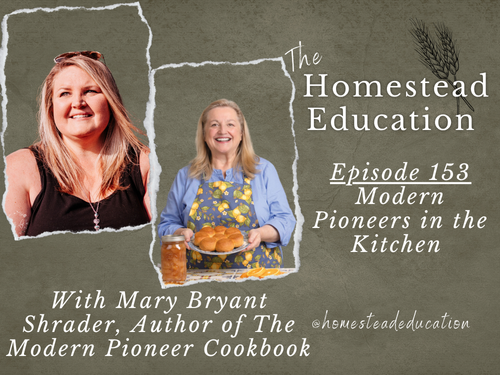
Episode 153: Modern Pioneers in the Kitchen with Mary Bryant Shrader
Episode Highlights
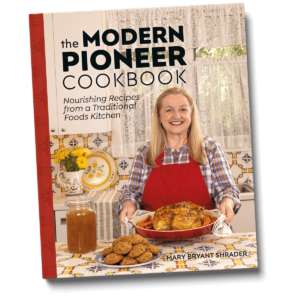
In this episode, I’m joined by Mary Bryant Shrader—author of The Modern Pioneer Cookbook and The Modern Pioneer Pantry, and the host of Mary’s Nest on YouTube, where she shares over 700 videos on nourishing, traditional cooking from scratch.
Mary opens up about her journey from homeschooling mom to a trusted voice in traditional food. Her books aren’t just cookbooks—they’re hands-on guides for anyone ready to make simple, wholesome meals at home. We discuss the free K–12 cooking curriculum she created, the value of real-life skills such as rendering lard, making broth, and baking from scratch, and how she teaches in a way that’s encouraging—not overwhelming.

Podcast Review
Did you enjoy this episode? Please drop a comment below or leave a review to let us know. This can help other folks learn about this podcast and we also really appreciate the feedback!
Podcast Links and Resources
YouTube: Mary’s Nest
Website: marysnest.com
Purchase her cookbook here: marysnest.com/my-cookbook
Download your free copy of The Modern Pioneer Cookbook Curriculum: https://marysnest.com/cookbook-curriculum/
Facebook: facebook.com/marysnest
Instagram: instagram.com/marysnest
Kody's Links
Website: https://www.thehomesteadeducation.com/
Shop Curriculum: https://www.thehomesteadeducation.com/shop
Speaking Events: https://www.thehomesteadeducation.com/events
Facebook: https://www.facebook.com/thehomesteadeducation
Instagram: https://www.instagram.com/homestead_education
Watch episode on YouTube: https://www.youtube.com/@homesteadeducation
Read MoreLess
Introduction
Hi, everyone, and welcome back to the Homestead Education Podcast. We have Mary Bryant Schroeder today, the author of The Modern Pioneer Pantry and host of Mary’s Nest on YouTube. I’m so excited to have her on because she’s really speaking to my heart with natural traditional eating.
So welcome, Mary. Oh, Kody, thank you so much for having me. I really appreciate it.
And I look forward to getting to know your listeners. Yeah, absolutely. We have such a great group of listeners.
They’re homesteaders, homeschoolers, moms, dads, like I have everything in between. So there’s going to be a lot of wonderful people who are going to get to hear what you are teaching about. Oh, I love that.
And I was just for a little background, I was a homeschool mom of my son from first grade through eighth grade. So I love the homeschool community. That’s wonderful.
I mean, we didn’t start out as homeschoolers. We were like, no, those kids are going to school. And same with us.
Same with us. And then we’ve been homeschooling for eight years now and wouldn’t look back. So it’s wonderful.
Mary’s Background and Mary’s Nest
So Mary, tell us a little bit about yourself. Well, I started my YouTube channel. And I have also a corresponding website that goes along with it.
It’s all Mary’s Nest. And I started in July of 2018. And I thought that it would be nice from the encouragement of my husband and son to put up a group of videos on how to make traditional foods.
And how I came to do this was, as I mentioned, I was a homeschool mom, and I’m an older mom. My son was born to us when I was in my 40s. And so my social circle was women much younger than me.
And the book Nourishing Traditions by Sally Fallon had come out. And they were all saying to me, you know how to cook like this, don’t you? And I said, oh, yes, I grew up like this. You know, my mother was born in the 1920s, you know, and I’m in my late 60s now.
And so I grew up, you know, being taught, as my mother would call them, the gentle arts of domesticity, but then didn’t wind up getting married and having a baby till later in life. But I think that was the happiest she ever was. Because before that, I was just, you know, in the outside working world, as opposed to the in-home working world.
But in any event, it’s funny, because when I switched from the outside working to the in-home working, my mother was like, oh, yeah, that’s funny. That’s funny. How are you ever going to be into social security now? Generational differences, right? So it was interesting that these lovely ladies said, well, you know how to cook like this.
So they announced to me, we’re coming over to your house every Saturday. Our husbands will take the kids, but we’ll bring the nursing babies, which of course, you know, I would encourage that. And you’re going to teach us how to how to make this food.
So I said, okay, that sounds like a lot of fun. Well, fast forward about 20 years later, I was still teaching in my kitchen and the ladies kitchens always for free. I’m very passionate about this.
Finding Her Niche: Complete Beginners
And I learned very early on that there was a real niche, like if people look at my website, and my YouTube channel, Mary’s Nest, they will see that I’m not a zealot. Because I learned very early on that when people start this journey, if you tell them right away, okay, we’re going to do sourdough bread, they sometimes will recoil. And how I learned this was when I had about five or six moms around my kitchen table, and I announced, okay, today, we’re going to make a sourdough starter, and then we’re going to do sourdough bread.
And one woman, it was so cute. She was almost in tears, and she burst out, I don’t even know how to make bread. And then the other ladies around the table were so cute, because they all looked at her and said, I’m so glad you said that.
So I realized, I said, okay, this is the niche I’m going to be in, I’m going to take complete beginners, and I’m going to start them on this journey. And we’re going to go very, very slow. And so I got some all purpose flour, some packaged yeast.
And I said, okay, we’re going to make sandwich bread. And you’re going to learn how to make homemade sandwich bread so you can stop buying the thing in the plastic sleeve. You know, I think that’s like the biggest, like, check off the box, when you can make your own bread, that just, it’s amazing.
And so it was very, and has saved us a lot of money. Yes, it’s such a money saver, because you can make it for, you know, under $1, in many cases, depending on the ingredients you’re using. And we live 45 minutes from town.
So when we say, we’re out of bread, we don’t, like, if we drive to town, that’s, you know, a quarter tank of gas and everything else we decide to buy at the grocery store. Exactly, exactly.
Why She Starts with Easy Wins
And something I discovered in teaching this way starting, and I did get, you know, pushback from my friends online and whatnot, who were, you know, like us, very traditional cooks.
And I said, you have to understand, some of these people, they don’t even know how to cook. Yeah. And if you tell them, okay, you’re clearing everything out of your pantry, and you’re saying, hey, kids, come to the table, we got liver, that the revolt is so intense, and people are just crying.
And but what’s very cute is 20 years, 25, 30 years later, now, my son is a grown man now. But what is so cute is I’m still friends with a lot of these ladies. And when I chat with them, we reminisce about those early days.
And they say, Oh, yeah, we’re zealots. Now. We’re eating liver once a week with zealots.
You know, it’s very cute. But you find that when you bring people on a journey, they get there after a year or two versus being harsh with them.
The Overwhelmed Young Mom Story
Because I also learned this very early on when I was in a Facebook group for traditional foods, and traditional foods cooking.
And we were all chatting and you know, we’re all on the same page. And we’re all getting along.
And then one day, there’s a post.
And all it had was a stream of consciousness. There were no capital letters, there were no periods. And as you read through it, you felt that this young mother with young children was crying.
And it was all about being overwhelmed and that this was too much. And I can’t do, you know, bone broth, cultured dairy, ferment, sourdough, this is too much. You know, she tried to do everything day one.
Yeah. And she was very, very overwhelmed. And I read this and it brought tears to my eyes.
I was like, God bless this poor woman. She’s in her early 20s. She had like three or four children.
I said, no wonder she’s completely overwhelmed. You know, they were like, oh, I forget what she said all under six, you know, I mean, had like consecutive babies, and she was completely overwhelmed. And so in the comments, people, God bless my social circle, sometimes in this traditional foods, what are you good traditional foods world, we can, you know, people can sometimes be a little harsh.
And they were saying to her, well, you know, you just got to pull it together, you got to do this, you got to do that. And my heart broke for her, because I had been teaching this. And I saw people actually sometimes crying at my kitchen table.
And I said, forget about all of it. Just buy a chicken. I don’t care what type of chicken you get, what’s in your budget, roast it.
And if you have to put gloves on to put it in the roasting pan, you know, I get a big kick out of it. Yeah, people are very afraid, you know, to touch the raw chicken. I said, put some plastic gloves on if you have to put it in a roasting pan, put in some carrots, some potatoes, and some onions, all relatively inexpensive, roast it, and then serve this roast chicken for dinner and call it a day.
That’s all you have to do. Then save the carcass. And then when you’re free, you know, I generally say I like three carcass.
When you’re when you have some time, throw those carcass into a stockpot. Throw in maybe the carrot shavings and the onion skins you saved when you were originally making the roast chicken. And then you can start making bone broth.
You have begun your journey. Yep. And your children are going to eat the roast chicken.
Why Roast Chicken and Bone Broth Matter
It’s very rare, unless someone’s a vegan or a vegetarian, that I’ve ever had anybody say, I’m not eating your roast chicken. Most people are like roast chicken. And, you know, so I, I always tell people, if this is a new way of cooking for you, start slow.
And that’s in my first book, The Modern Pioneer Cookbook. That’s exactly I take people on a journey. I start with white flour and yeast, packaged yeast.
And then at the end of the chapter, we’re doing sourdough. So, you know, we start with quick breads, and we just take it slow and teach people how to cook, how to bake, so that hopefully at the end, when they’ve worked their way through that cookbook, which it’s really much more, it’s more of a manual, as is my second one now, The Modern Pioneer Pantry, where I talk all about food preservation, but not just how to preserve this, that and the other thing, which I’m sure you can really relate to on your homestead, but how to use what we preserve. Yeah, it’s really important how to make meals with what we preserve.
And again, a manual, second manual now, and I take people on the journey. And we don’t rush, we do things easily, and simply. And so that hopefully, I like to think that after a year or two, people now are traditional food cooks.
And they’re, they’ve weaned themselves off a lot of the packaged food. They’ve weaned themselves off, as my mother would call the prepared foods. Those were like, what were packaged foods at the grocery store, which were kind of making, you know, we’re getting more and more common when I was a little kid in the 50s and 60s.
And I would say to my mother, can we get this? Can we get that? She said, no, someone else prepared that. That’s a prepared food. We can prepare it ourselves at home.
Keeping Skills Alive
I always, I mean, and right up into her 90s, she was saying, Oh, my gosh, the the selection of prepared foods at the grocery store is amazing. But that that’s, that’s really my, my mission is I’m very passionate about this. I want to keep these skills alive.
I’m very worried that with all of the quote, unquote, prepared foods now even prepared meals, we see at the grocery store, young people are going to fall away from home cooking, and not just miscellaneous home cooking, but traditional foods, cooking, properly preparing food for the best possible nutrition, so that like our ancestors before us for a millennia, knew how to nourish their bodies, knew how to be able to produce healthy babies, knew how to raise healthy children. All of this has been passed down to us from our ancestors. But in maybe about the last 100 years, we’ve really gotten away from that.
And what do we see? We see people less healthy, more allergies, more illnesses. Everybody seems to have a runny nose. You know, there’s so many people wearing eyeglasses.
It’s, we need to make sure that we’re always filling ourselves with the best possible nutrition we can. And it doesn’t need to be expensive. It just needs to be simple food, real ingredients that we properly prepare.
And then we need to teach, we need to teach young people.
Free K–12 Traditional Foods Curriculum
And even on my website, you know, people are always very surprised about this. I had the homeschool heart of a mom, you know, a homeschool mom.
I worked with a curriculum developer to create a K through 12 curriculum that goes along with my cookbook, the first one, the Modern Pioneer Cookbook. And it’s free, 250 plus pages. You can download it for free at my website.
I don’t even make you put in an email because I want people to download this homeschool program and work with their children, teaching them how to make traditional foods using my cookbook as in essence, a textbook. And even if they don’t have it, pretty much every library carries my book. So, and it’s published by Penguin Random House.
So if your library doesn’t have it and you ask them to get it, they’ll very most likely be willing to get, to carry it. And then you can download this curriculum and it’s broken into chunks. You’ve got the first, in essence grade group that goes up to fourth grade.
Then you have the curriculum that’s appropriate for middle school and then you have the curriculum that’s appropriate for high school. But if you have multi-level ages, you can keep everybody busy with something that’s appropriate to their grade level. And if you have one or two children that are very close in age, you can just focus on that, you know, particular chunk, so to speak, that’s appropriate to their grade level.
But it’s very easy to use and it makes learning how to make traditional foods very accessible. And it’s very well done. I have to really thank the curriculum.
Jamie O’Hara was the wonderful woman I worked with who was a curriculum developer and also now a homeschool mom. So she really gets it. She really understands.
The Big Why: Nourishing Future Generations
But to me, that is what this is all about. This is about teaching our friends, our neighbors, and most importantly, our children how to cook like this so that they can be healthy and especially have healthy reproductive health to create happy and healthy children, build strong children who then continue. I mean, it sounds kind of dramatic, but we want to continue the human race.
Yeah, no, it’s absolutely true. And the way we’re going to do this is through proper nutrition, properly prepared foods.
Cooking Meat on the Bone
You know, I find myself worrying a little bit with how far recipes have come from what our ancestors taught us.
How rare is it that you see a recipe today that tells you to cook the meat on the bone? Yeah. And how important that is and how up until 100 years ago, even maybe 75, whenever that famous chef Escoffier, the French chef started creating cuisines for fine restaurants, he felt that, well, we have to take it off the bone, we have to have a lovely presentation, and so on and so forth. But what happened? We lost thousands of years of nutritional, very important nutritional information.
Meat should be cooked on the bone. And if you don’t have meat on the bone, get a bone and throw a bone in when whatever you’re cooking, or use bone broth, because the bone releases the gelatin into the meat, the collagen that becomes gelatin when it’s cooked, releases the collagen into the meat. And that makes the meat easier for us to digest, and then absorb the nutrients that the has to offer.
And especially when you start to either raise cattle, or buy pastured grass fed meats, there is expense and time associated with this. And you want to get the maximum nutrition, the best so to speak bang for your buck out of the meats that you’re eating. And the same with chickens.
Why do we roast a whole chicken? Because the bones in the chicken will release collagen into the chicken meat, allow us to digest it better, and allow us to absorb the nutrients better. So forgive me for going on and on and on. I’m very passionate about this.
Collagen Powders vs Real Food
Oh no, it’s so informational. And you know, I mean, I look at how many people spend hundreds a month on collagen supplements. It’s nuts.
When you could literally go buy a roast from your local farmer and cook it and drink the bone broth every day and get the same benefits and probably better benefits, because it’s not processed and your body’s designed to absorb that. No, exactly. I laugh, I find it almost a little bit of a, it’s comical, that there has been so much success at convincing people to buy these dehydrated powders, and then rehydrate them, and then drink that.
And they think that that’s really providing nutrition. What was the process to dehydrate it? Was it dehydrated at a very low temperature in a small little dehydrator at home? I mean, you can do things like that to take your own broth on the road with you. Or, you know, like I grow, always grow way too much like spinach and greens and stuff, but I cannot stand them going to waste.
So I dehydrate them. Right. And that makes complete sense.
Home Dehydrating vs Factory Processes
There’s so much we can dehydrate at home in our little dehydrators, or there’s a lot of things you can dehydrate just in the air. There are a lot of things you can dehydrate in your oven, just with the pilot light or the electric light on. And these are things that are gentle and natural, and in many ways mimic what our ancestors did.
And I’m a big supporter of that because I don’t, I’m a no waste girl. Don’t waste, I was raised by two people, my mother and father lived through the Great Depression and World War Two. We don’t waste anything.
But what is happening in these big factories? What’s going on? And why is it white? I noticed a lot of that. Why? What happened? How did it become white? I always am a little suspicious of that. Well, and then you read the ingredients and they add caramel coloring.
It’s nuts. It’s nuts.
Start with Bone Broth (and Sneak It In)
And it’s so the thing is making bone broth that’s where I always like to start people.
Roasted chicken, even if beef isn’t in your price range, roasted chicken, make chicken bone broth, and use it in every capacity that you can. Use it in place of water, even if you’re still at the point where you’re making white rice, use bone broth instead of water. Add a little butter, add a little sea salt, and you’ve used the white rice as a vehicle to get the bone broth into your family.
Or my son, he drank bone broth every morning for breakfast growing up. I had somebody this last weekend, she was talking to me about, we were just talking traditional foods and she goes, and you can put bone broth right in your chocolate milk to get, so that you can consume more bone broth. And I was like, but I like it just the way it is.
I’m telling you, I have a video where I share with people how to get all types of bone broth into smoothies. Beef bone broth, like if you say your children, they’ll go, I don’t know if I really want to drink it. You can make a chocolate smoothie with beef bone broth.
You can make lighter fruit colored smoothies with chicken broth. And you can even use a fish broth, at which people are shocked by this, you can use a fish broth, which is very easy to make. If you go to your fishmonger and if he’s cleaning up his fish in the morning, and you can ask him if you can buy the whole carcass, that’s just the bones with the head and the tail, a lot of nutrition in the head and 45 minutes, it’s what the French call a fish fumet.
You don’t need to boil fish bone broth very long because you can create something that would be otherwise be rancid. And on my website and my YouTube channel, oh my gosh, I have a plethora of videos on how to make all kinds of bone broth, even very, very inexpensive ones. Because I feel this is the backbone of the traditional foods kitchen.
And if you make the fish broth, you can add that to a green smoothie. If you like to make green smoothies, you won’t notice it. And how wonderful, you didn’t have to add your collagen powder.
And people are like, oh, okay, well, now, Mary, you’ve got me covered on collagen, but I need my whey protein. Really? That’s just like, how is that processed? And that’s a byproduct and whatnot. Add some cottage cheese, strain your yogurt, add some whey.
There are different things, your own way. Yeah, we use whey for smoothies all the time. I don’t like wasting it.
Right. Yeah.
Building Relationships with Farmers and Ranchers
So this is the beauty of learning traditional foods cooking.
All of a sudden now, you’re not buying all of these prepared products, and your grocery budget is thanking you because now the $50 or whatever that you would have spent on that tub of collagen, you can put toward maybe buying a really nice selection of meat and bones from a local, I’m in Texas, so I’ll say a local ranch. But today, there are so many people, regardless of where, you know, you’re in the United States, I’m sure the same would apply to other places in the world, that when you start on this journey, it’s amazing how you will find people who are raising pastured chickens, people who are raising, you know, or selling their eggs or selling their chickens, people who are raising small herds of cattle and selling beef.
We have a direct-to-consumer pork operation.
We raise about 300 pigs a year. See? Exactly. All on like pastured and local grain fed and… Exactly.
You can meet people at the farmer’s market. There are different things you can, when you search online in your area, you can find who may be selling these traditional foods products. And a really good way to save money is if you have a nice little social circle of folks who are eating a traditional foods diet, you can often approach a rancher or a farmer or whomever may be, you know, raising the type of meat that you want.
And for example, when I was with my home school circle, the rancher would say, if you girls want to buy a whole cow, I can give you a really good price per pound. Oh, it’s way cheaper to do a whole or a half. Yeah, we would just buy a whole and split it up four ways.
Or what we would also do, which was very cute, and I highly recommend this tip, talk to a local rancher and say, because I have had many ranchers look at me and say, I love you, because of the tip I’m going to share with you right now. You can go to a rancher and you can say, I’m not in a position right now to buy a whole cow from you. But when you are having the animal processed, do you what are your customers buying the tongue, the liver, the kidneys, the bones, or most of your customers buying, you know, just a nice, you know, steak without the bone, chopped meat, so on and so forth.
And many ranchers will say, oh, that’s interesting. Yeah, most people want, you know, you know, bone free, or ground beef and this and they sure as heck don’t want the organ meats. Why? And then you say, I would like to buy those.
I would like to buy any bones you have, I’d like to buy your organ meats, your oxtails, so on and so forth. And the rancher is going to look at you, or the farmer is going to look at you and say, I love you. Thank you.
Yes. You’re, you’re clearly, you know, old fashioned cook, they usually don’t use the word traditional foods cook, you know, they say old fashioned, old world, whatever the case may be. And you will find you will develop such a good relationship with these people, because they are so grateful to you, that you want to buy things that are harder for them to sell.
Yes, there’s more of a market than there was 20 years ago, as people become better educated about the benefits of eating organ meats. But it’s still in many cases, things that ranchers and farmers have trouble selling.
Using Pork Fat and Leaf Lard
And one thing we sell a lot of is our pork fat.
Yes, a lot of our customers don’t want it. So I’ll take it all. We you know, we render lard with it and whatever, but we live in a big hunting area.
So people will kill an elk or a deer and they want to make their own sausage. But to go buy the pork or the fat to add in is really expensive, and they can buy it from us. No, that’s wonderful.
And you have also the leaf lard or the leaf fat around the kidneys. And that’s prized. When people start doing traditional foods baking, and they want to bake with lard.
Yes, the regular lard was from the back fat, you would know better than me with raising pigs. But the back fat, you know, can sometimes have that aroma, which works great in chocolate. There’s no trouble at all with that.
It works great. But say you want to make a very delicate cake, and you really want something that’s very a aroma free, that leaf lard is prized. And sometimes if you talk to a very fancy dancy professional baker who’s baking high end pastries for fancy restaurants, he’s often going to tell you he’s using leaf lard.
Yeah, so there’s a lot of like savory pies, like the chicken pot pies like that. And we just use our lard in the pie crust. And it’s amazing.
Oh, lard in a pie crust is you’re making it foolproof. Because this is what when those vegetable shortenings that white stuff in the can, which is so highly processed, it scares me. But that is what replaced lard in our baking, sadly, because that’s just a damaged fat, you never want to use that.
But when you go back to using lard in your pie crust, and but say, Oh, but Mary, I really like a butter crust. You still using your butter, maybe three quarters of its butter, and you put in a quarter of lard. It’s foolproof, you cannot overwork that crust.
If you’re a beginner, and if you’re doing a savory pie, and you can do all lard, but say you’re doing a sweet pie, and you say, Oh, I like to have some butter. Yeah, but just add in a little lard, you can work that thing. You can so overwork the pie crust that especially if you’re a beginner, and you’re not sure and you’re working and you’re working and that butter just is like completely dissipated now and melted, lard is going to save your day.
That’s still going to be the flakiest pie crust in town. And you’re gonna and if you do the the state fairs, you use a little lard, which I think a lot of ladies know that secret. But she is a little lard, and you’re gonna win the blue ribbon.
Yep. I have my daughter makes a lot of pie crust, and she overworks and she’ll get frustrated. I’m like, just throw it in the fridge, let it get cool again and start over.
Like Yeah, yes, which is very true.
“Whole Food Is Too Expensive” Myth
You know, that’s one thing with the kids is, um, you know, so a lot of people are so frustrated with not knowing how to cook. And then all I hear is, but whole food is so much more expensive than processed food.
Well, yeah, if you’re wanting to walk in the door and buy something to eat at the grocery store, like right then Yeah, it is more expensive. But the thing is, it’s not that it’s more expensive. Or Yeah, it’s not that more expensive.
It’s more work. Yes. And that’s where it really comes down to it.
But I mean, if you you can buy a bag of potato chips for $5, like, or more, they’re so expensive now. Not that we buy a ton of them. But every you know, we travel a lot.
And so I’ll be like, yeah, let’s get stuff for sandwiches and a bag of chips. And I’m like, Oh my gosh, you know, you can buy that for that same $5, you can get 15 pounds of potatoes. And it’s just it blows my mind.
And so what I tell a lot of moms that are like, I don’t, you know, I don’t know how to cook, but I want to teach my kids these skills. I’m like, show your kids that you don’t know how to do it and do it together, like learn together. And that’s what’s going to build that generational like skills.
Parents Learning with Kids
Yes, that’s so many parents who have used my free homeschool curriculum that works with my first book, the modern pioneer cookbook have told me that so many of them have enjoyed using that to teach themselves. And they and their children are learning together. They’re doing things they never did before.
And I love it not only brings you closer to your children, you’re giving them a lifelong skill. You know, it’s funny, my son to this day, he’s very funny.
Because he says, Mom, I always remember you making it almost like it was an announcement.
We would just be doing something or we’d be somewhere. And all of a sudden, you’d stop and you’d take my arm and you go, Okay, this is a life lesson. And he laughs, he says, he was laughing so hard one time, because he was doing so he has his own home, you know, and he was doing something.
And he said, Oh, yeah, I remember this was a life lesson. It was something that he was doing in his house, you know, that that life lesson, my mother had taught me. And it was cute, because when he was in high school, he would sometimes his friends would do with something, you know, and he’d go, Wait a second, guys, life lesson here, life lesson.
Yeah. Something about staying safe or whatever. But yeah, he always talks about learning how to roast a whole chicken was a major life lesson.
And he says, Yep, my mom would always say sometimes he’ll be being interviewed about something. They’ll go, Yep, my mother always said learn how to roast a chicken, you never go hungry.
“Make It Weird”: Teaching a Teen Son to Roast a Chicken
I probably ruined it for my son, because he goes, Mom, will you teach me how to roast a chicken? Like, that’s the one I want to know how to do now.
Because I have 16 year old twins, and they’re boy girl twins. And my daughter cooks a lot. But my son, he’s like, Okay, teach me how to do a chicken.
So I’m like, Okay, so I go in, I’m like, you know, you get out the tub of lard, and you really want to like lather that chicken in lard, it’s gonna make that skin so like crispy and yummy. And then our broth, if we’re not canning, it is just gonna taste so good, you know? Yeah. And so he’s in there.
And he’s like, kind of dabbing it and like, trying to the lard on and it’s coming back off on his hand. And he’s getting really frustrated. And I go in, I’m like, you just got to rub that sucker like make it weird.
Yeah, he was like, I’m done. Oh, that is so funny. But now it’s like our joke.
He’s like, you know, whoever’s making chicken or turkey or whatever has to go make it weird. Oh, that’s funny. That is very funny.
Teen Daughter Feeding the Family for a Month
But yeah, my daughter, she a couple years ago, money was a little tight. And she goes, Mom, if I can make all of our meals out of what we have, like, you know, in the freezers in the pantries. For the whole month of December, would that make Christmas better for my little brothers? And I was like, yes, yes, it would.
So we sat down and kind of made a plan. And I was like, you know, the cow was just freshened. So we didn’t have any hard cheeses.
But we had just butchered a sow and you know, canned everything for the year and gotten a deer. And so I mean, we were good on like meat and eggs and milk and that type of stuff. So I gave her a budget of about $200 for the month.
So I’m like, we need some hard cheeses and a few other things. And her goal was to just do dinners. And she ended up making all three meals for a month straight on that $200.
Oh, and I mean, it was good food, like homemade tomato basil bisque and sourdough bread. And I mean, just delicious stuff. And she goes, at the end of it, she goes, Mom, I think I want to keep doing this.
Oh, that’s wonderful. Yes, it’s been like a year and a half. And she does almost all of our cooking.
She does most of the meal planning, we kind of sit down and go over it together. She lets me know when like our pantry preps are getting low. She’ll say, Hey, like we’re getting low on lard.
So I think I’m gonna, you know, pull some meat out and grind it and, you know, render some lard this weekend, or she’ll have a girlfriend up and they’ll pull out like all the old meat and stuff and make dog food. And I’m just like, this is awesome. Go for it.
That’s amazing. See, oh, the skills that you this is such a gift. This is such a gift that how you have prepared her, you know, for life and for feeding herself and her family, you know, down the road.
That’s such a beautiful thing.
Seasonal Cooking and Buying “Uglies”
And I think that when people say, Oh, I’m concerned, this is more expensive, and whatnot. When you look at this from a seasonal viewpoint, and you go into the grocery store, and you don’t Oh, yes, there are plenty of sites on internet that will tell you what’s in season in your area when, but the bottom line is, if you go into your grocery store, whichever are the least expensive vegetables are going to and fruits are going to be those that are in season.
Often your fish that’s fresh will be in the summertime, you know, especially if they’re cold water fishes, they’ll be available to you in the summertime. And then you can move to using canned fish, you know, in the winter months, and so on and so forth. And when you develop the seasonal rhythm, and you begin to be able to buy foods in bulk, even like what they call the uglies, you can go to your product, our grocery store does this on a regular basis.
But if you don’t see this at your grocery store, you can go to the produce manager and you can say, Do you have any fruit or vegetables that doesn’t look perfect to sell, but that you can sell to me. And at our grocery store, they sell their quote unquote uglies for 50% off 90% off. And yet, there’s nothing wrong with it.
It’s just a little misshapen. It’s not rotten or anything.
10–20 Recipes, 20 Ingredients
And so but what happens is all you really need.
And I’m sure you and your daughter have this mindset when you’re doing your meal planning. I find it to be very true that all you really need is about 10 or 20 recipes. And all you really need to buy is about 20 ingredients at the grocery store or from your farmer’s market or a local farmer ranch, whatever the case may be.
And you make these things throughout the season. And then when you go into the next season, you’re still basically making those same 10 to 20 recipes, but you’re tweaking you’re adjusting them for the season. So your fruits and your vegetables will change even your meats will change up eating lighter meats, maybe in the summer in the spring, heavier stews in the winter, fresh fish in the summer, canned fish in the winter, so on and so forth.
But they’re always basically those same ingredients. And as you learn, and since they are basically the same ingredients, and you’re learning how to buy in bulk, especially dry goods, like beans and whole grains and stored properly, my goodness, they can last a very long time.
Old Beans Still Work
And even beans, people think, Oh, old beans, I bought them in bulk.
And now they’re a few years old, they’re not going to cook up. I saw a study and it was so cute. But I think it was either Utah State or the University of Utah, I think it was Utah State, or the University of Utah.
And it was so cute, because these scientists got these beans that were really, really old. And they cooked them up. And then they got beans that were fresher, and they cook those up.
And yes, the older beans did take longer to cook, but they properly prepared them, they soaked them overnight, maybe even for 48 hours and then cook them. Okay, they gave them to the taste testers. The taste testers couldn’t really tell the difference.
And nutritionally, the old beans had only lost about 20% of their nutrition. So they still retained 80%. And they were really old, older than probably most of us would have on hand, because we would be using our supplies, right? Yeah.
And when we like buy new, if there’s like this much beans in the bottom of the bag or something, I’ll cook them up and mix them into our raw dog food or something. Oh, see, that’s fantastic. Yeah, actually, like our Guardian dogs and stuff.
So I’m always trying to keep them healthy. Oh, yes, definitely.
Stop Chasing Over-Modernized Recipes
And so I think what people find is when they go on this journey, and they get those, don’t be looking all over the internet, all of these recipes are too modern.
And they’ve been tweaked too much from what our ancestors taught us. And half the time, they say use a 10 and a half ounce can of tomatoes. I’m gonna I go nuts with that or half an onion.
What am I supposed to do with the other half? My mother would have never cooked like that. And just get those basic recipes, this old world cooking, ancestral cooking, traditional foods cooking, get this under your belt.
And then cook seasonally.
Keep those 20 or so types of foods on hand. Start to learn to buy in bulk, start to get to know your farmers, start to get to know the folks at the farmers market. This becomes more and more affordable.
The more you do this, the more you’re on your journey, the more you get into a rhythm. Next thing you know, you’re making your homemade fermented ketchup. You’re making all your salad dressings.
You’re making homemade mayonnaise. And these are so good for you and so much better than anything you can buy at the grocery store. And you’re making them for so much less money than what you would pay for some jar of mayonnaise made with soybean oil, which is very damaged processed oil.
So you just keep going like this. And next thing you know, wow, I have a lot more money in my grocery budget. And it’s not as much work as people imagine it being because when you like kind of add one thing in at a time, it just becomes part of your routine.
Traditional Cooking Isn’t “More Work”
Oh, and I always say I never feel that it’s more work because how much easier is it to roast a whole chicken than it is to babysit some boneless, skinless chicken breasts on the stovetop and make sure you don’t dry it out and you’re watching and it’s, oh my gosh, is it scorching on the bottom? It’s a lot more work. And fermentation, for example, who’s doing the work? The good bacteria. You stuff some stuff in a jar with salt and put it on your counter.
That took no time at all. Bone broth, you stuck it on a stovetop while you, if you’re a stay-at-home parent and or a single person, if you work at home, whatever the case may be, you stuck it on your stovetop or even in a crockpot, a slow cooker. And who’s doing the work? You just threw some stuff in there.
It’s doing the work. Cultured dairy, you know, and if you have access to raw milk, you’re basically just leaving that on your counter and it’s turning into sour cream and so on and so forth. But if you don’t have access to raw milk, buy the milk at the grocery store.
Put a dollop of yogurt or kefir in it, whatever you have, and it’s sitting on your counter and it’s culturing overnight. Yogurt, homemade yogurt, oh my gosh, you don’t even need a machine. All you need is two bowls and some warm water.
And it tastes so good. Like I can’t use store-bought, like unflavored yogurt because it’s like sour and it doesn’t taste good. When I make it, we have our own cows and so like I make it all the time and it’s sweet just as it is.
It is so good. And smooth and delicious, you know.
Avoiding Overcomplicated Modern Recipes
So I always tell people, it’s really not, you may think that this traditional foods cooking is going to be very time-consuming because you’re thinking of modern recipes that list 50 ingredients with half a teaspoon of a spice you’re never going to use.
And then all of these steps that are constantly taking your time to babysit. Oh yeah. If I try to follow a recipe like that, I’m in the kitchen for three or four hours.
Yes. Do you know, I recently experimented with something. It was funny.
I had this cookbook and it was, the sad thing about it is it led you to believe that it was going to be traditional cooking, which I expected would just have like, you know, a handful of ingredients and an easy process that basically had me put them together and then they were going to do their thing, whether cooking or fermenting or culturing, whatever the case may be. Like you said, I was in the kitchen for three hours. There were so many ingredients, there were so many steps, so much of my time was taken up.
And basically all it was, it was a soup. And it was funny. I was laughing at my girlfriend and I said, boy, when I looked at this, I could have streamlined this fast, fast based on what my mother or my grandmother or my great grandmother would have, how my great grandmother would have prepared this, you know, it would have been nothing like what they were thinking.
So that’s what I always tell people, don’t look at these modern recipes. If you pick up an old cookbook, that’s going to have no pictures and you’re going to see, it’s going to have like four or five ingredients. And it’s going to be, now a lot, a lot was assumed that people knew how to cook and had understanding.
And so in modern day cookbooks for traditional foods, like my Modern Pioneer Cookbook and then the Modern Pioneer Pantry, I walk you through very gently, step by step by step, because I know a lot of people don’t know how to cook and I had to create a manual. But in time, you’re going to get all of these skills under your belt. That’s the beauty of it.
And it’s not time consuming, it’s not expensive. It just takes time to build your traditional foods kitchen. And in a year or two, you’re going to look back and you’re going to go, wow, not only do I have so much time in it, you know, versus how I used to have to cook, and I’m saving money.
Because when you think about traditional cooking, go back in time and think about our ancestors. They didn’t have, that’s why I like to say the modern pioneer in the kitchen. We’re modern pioneers in the kitchen.
Because we have modern conveniences, most of us do. We have electricity, we have running water, we have a lot of conveniences, we have slow cookers, so on and so forth. We have cooktops.
Think of our ancestors. How could cooking have been so complicated or so hard or so time consuming? They didn’t have that time. They had to go and they had to get the chicken, like my Italian relatives I have seen do, you know, and clean it up, get it in the pot, and then let it cook while they moved on to something else.
Because they had many other tasks. They were caring for children, they were doing laundry, they were trying to iron without electricity, the big old heavy cast iron things that they got off the coals, you know. And tend to their garden, and then make sure they had lunch ready, dinner ready.
So, they showed us how easy, in essence, the cooking could be in a modern kitchen. Because we already have, in many cases, the chickens already cleaned up for us. So what, you’re putting it in the crock pot, you’re putting it in on the stovetop, you’re putting it into the oven.
What does this so much work? You know, and then you have your whole morning free, or your afternoon free, depending on what time you’re cooking your chicken. And you’re caring for your children, you’re homeschooling, doing your wash, tending your garden. And yet you didn’t have to do all the prep that our ancestors did.
So if they can do it, if they can do it, we can do it. And we can do it timely and affordably. It just, it just doesn’t happen overnight.
Be gentle with yourself. And say, I’m on this journey, this is going to take me a year or two, I’m going to go slow, I’m going to learn this. And I’m not going to rush.
And over time, everyone is going to really enjoy coming to the table, because it’s going to be real food, it’s going to be traditionally prepared, they’re going to feel better, they’re going to digest their food. And before they know it, they’re going to start seeing their health improve. Your husband’s story is a testament to that.
Absolutely, it is. It changed so much. And you eat less when it’s not convenient, and all those things.
Learning the Manual First, Then Using Appliances
You’re talking about the modern appliances. And it’s like, I remember my parents making me learn how to drive a stick shift before. That’s how I learned how to drive.
Yeah. And that’s, I think of that when I think of like the kitchen appliances, like myself and all my kids, we know how to bake bread completely, like kneading it and the whole thing. And once we understood it, understood how it worked, could do it without thinking about it.
Then I was like, yeah, we’re doing this dough in the bread machine, because we don’t have time in our day for this. And so we do our dough in the machine, and then we pull it out and let it rise and do it in the oven because we have other things going on in life. But that’s how we do like so much stuff is we learn it, we master it.
Then we make it work for modern life. Exactly, exactly.
“Keep Growing” Question
So we’re kind of getting to the end of our time.
So my favorite question to ask everybody is, what does keep growing mean to you? Oh, I love that. Well, at my age, I am still growing. I am growing intellectually, I love learning.
And I believe in never to stop learning, learning new things, new techniques, new skills, always be growing intellectually, because that keeps you young, it keeps you alert. And it simply makes you a little smarter. And that’s always a good thing.
That’s awesome.
Where to Find Mary and Her Books
Do you want to tell everyone where they can find you find your books? And about your book that’s coming out? Yes, my website is mary’s nest.com. And my YouTube channel is the same name. And I have gosh, I think now probably well over 700 videos on how to make traditional foods.
And it’s all free. And on my website at mary’s nest.com. I also have that homeschool curriculum that I mentioned that’s very easy to download. And I’ll make sure I link all that too.
Oh, wonderful. And my two cookbooks. The first one is the modern pioneer cookbook that’s available wherever bookstore books are sold.
And it’s also available online at all the different bookseller retailers, like Amazon, Walmart, Target, so on and so forth. And my new book, my second book, the modern pioneer pantry is available for pre order right now. And it will be available in bookstores and wherever books are sold.
Both, you know, in the brick and mortar stores as well as online. In August, it comes out in August. But during the pre sales time right now is kind of exciting, because my publisher will also be sending out signed book plates.
If people request them that I’ll be personally signing for everyone, in the event that they’re not able to make an actual in person book signing, that I’ll be starting those in the summer, you know, once the book comes out in August in the fall. But exciting. Yeah, so two wonderful books, the modern pioneer cookbook and the modern pioneer pantry.
And they’re really, they’re so much more than cookbooks. They’re manuals that will really help you with the traditional foods journey. I’m very passionate about this.
And I want to keep these skills alive. I want people to learn to cook to cook traditional foods, and to stay healthy, and live long, happy and healthy lives just like my mom who lived to be almost 99. That’s such an amazing story.
Well, thank you so much for coming on today. And I will link all these and everybody go check out her books. Because this is just like she said, it’s a manual for how we can embrace this type of cooking ourselves.
No, Kody, thank you so much for having me. And it’s been so nice to be able to chat with your listeners today.