
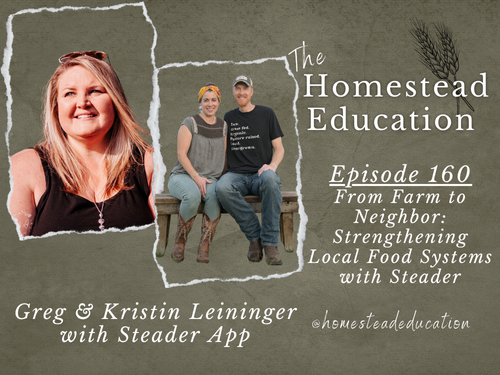
Episode 160: From Farm to Neighbor: Strengthening Local Food Systems with Steader
Episode Highlights
Strengthening a local food system
In this episode, Kody sits down with Greg and Kristen Leininger, founders of Steader, to share how their own homesteading challenges sparked the idea for a faith-led, community-driven app built to reconnect local food systems. They open up about turning that vision into a working platform that helps neighbors buy, sell, and trade. From their family’s journey toward a simpler, purpose-filled life to their mission of helping others live closer to God’s design for food, land, and fellowship, Greg and Kristen show how technology can actually bring homesteaders back together—one trade, seed, or story at a time.
Podcast Review
Did you enjoy this episode? Please drop a comment below or leave a review to let us know. This can help other folks learn about this podcast and we also really appreciate the feedback!
Podcast Links and Resources
Website: https://www.steader.com/
Facebook: https://www.facebook.com/steaderapp
Instagram: https://www.instagram.com/steaderapp/
Kody's Links
Website: https://www.thehomesteadeducation.com/
Shop Curriculum: https://www.thehomesteadeducation.com/shop
Speaking Events: https://www.thehomesteadeducation.com/events
Facebook: https://www.facebook.com/thehomesteadeducation
Instagram: https://www.instagram.com/homestead_education
Watch episode on YouTube: https://www.youtube.com/@homesteadeducation
Read MoreLess
INTRO / WHY COMMUNITY MATTERS
Hi everyone and welcome back to the Homestead Education Podcast. I have some really awesome guests here today that really hit home on that community that I’m constantly talking to you guys about building. So today we have Greg and Kristin from the Steader, the Steader app, and I just want to go ahead and introduce them.
Yeah, thank you so much for having us, Kody. It’s a pleasure to be able to just share the vision for what we’re doing at Steader and yeah, just we appreciate the opportunity.
Well, I’m really excited to hear all about it.
So, you know, typical to my normal story that everybody hears is I met somebody on the road at an event because I do 22 events a year. And I met you guys at Modern Homesteaders and you were kind of doing your soft launch then and it’s been a couple months so I’m just really excited to share with everybody what you’ve been doing and where it’s going.
MEET GREG & KRISTIN (AND THEIR HOMESTEAD)
But if we want to get started, like, do you want to introduce yourselves and talk a little bit about who you are? Like everybody wants to know what animals you have on your homestead, you know?
Yes, absolutely.
No, thank you again. So again, I’m here with my wife, Kristin, and it was really her original vision as we got started with homesteading ourselves with this idea of a platform for homesteaders and what that would look like to really support this community mindset of homesteading together in rural areas and community with one another, providing for one another, buying and selling from one another. And so, yeah, we’ve been homesteading for several years now.
What are our animals? We’ve got some…
Yeah, so we started with chickens, of course. That’s always the case typically. And we went into milking goats.
From milking goats, we really learned how the system of a dairy animal works. And so it’s been my dream and vision to have a larger dairy animal. So I kind of like to use the story of when I went to purchase, what I wanted to find was a Jersey cow that was verified A2A2.
And it was such a challenge. You know, we have Craigslist and you’re weeding through that. There’s some legitimate sellers and then some sellers that you can see the obvious, you know, this isn’t set up quite right.
And even when I brought home that Jersey cow, I don’t know anybody around me that has an animal like that. And so I’m just asking the neighbor who knows a friend who has a friend that has a Jersey cow, what do you feed this cow? And so this, like Greg said, this was birthed from our own homestead adventure. And we now we’ve added kune kune pigs.
And we have some meat cattle that we run just all, you know, pretty small scale, but we really enjoy this. This is a part of life that is very satisfying. We have kids and each of our older kids, they have an animal that they kind of own, so to speak.
So they really I call them management roles.
Yes, they really and they love those responsibilities. So that’s kind of a little bit of who we are.
Yeah, I think I would just add to that as far as like, our enjoyment and like a growing appreciation in this homesteading journey of what it looks like to live the quiet, simple life. You know, for us to get out of the city and to just manage a small homestead and take care of our animals, just to enjoy that relationship, and that just kind of stewardship of animals. It just on a simple scale with gardening and with our animals, it’s just been such a appreciative lifestyle that we’ve kind of really grown to embrace and just just love this.
FINDING PEACE & PURPOSE IN LEAVING THE CITY
So that’s wonderful. I love hearing that, you know, I’m kind of I joke that I’m like one of the black sheep of the homesteading world, because I actually grew up on a ranch. My dad was a cattle rancher in California, and we were hunting guides.
And like, I kind of grew up with that whole, like agriculture around me all the time. But I’ve always loved that way of life. I was like, there should be no other way of life.
And so I’ve always like advocated for it. And you know, hearing so many people have that story of experiencing it for the first time and just like seeing that beauty, like, it’s just like, oh, I love it. It really is there.
And it’s, you know, not to be not to romanticize the idea, but just like, I mean, every time we have to go into town for something into the into the bigger city, when we’re on our way out, I literally feel like this decompression as we’re kind of get out into the country roads, and we’re heading home. It’s just, it’s the it makes home an entirely different idea.
Like, oh, my gosh, yes, it does.
You know, I always say like, yeah, we shouldn’t romanticize it, we should be normalizing it. But you have to go through that romanticization to even want to be there. But like I was saying, I do all these conferences every year.
And a lot of them are in big cities, especially the homeschool ones, like whoo. And my daughter and I will go to him. And when the event is done for the day, like I always make sure we have a rental car and we get in that car and we drive like as fast as we can outside of the city and try to go find like a lake or a park or something and just like, decompress because just going to the hotel room isn’t enough.
Like we need air, we need space, like, so it’s a real thing.
Yeah, absolutely.
THE “FIRST DAIRY COW” PANIC & WHY PEOPLE NEED LOCAL HELP
So, you know, this you were talking about when you got your dairy cow, and I remember that feeling for myself.
Because I had never raised any dairy animals. I’d always been on a beef operation, even when I was in college, like I was an animal science major, and I really focused on pigs and cattle. And even when I worked in the sheep and goat unit, it was all for beef purposes, not for dairy.
We did have a dairy on the farm, and I did my one rotation that we were required, and I was good. Like, I wanted no part in it.
And when we bought our farm, and we really were having to switch to all natural food for my husband’s health.
He goes, we should get a dairy cow. And I was like, No, they were not doing it. Congratulations.
No. But it was, we brought home this first cow. And I had no clue what to do with her.
And I’m like, Okay, that I was an animal science major, I’ve spent time on dairies, I should know what to do with her. Like I knew the basics, like we need to milk her every day, I knew how to Google what we should feed her, which was, you know, a lot that even people who know like, Oh, I can just Google it. If you don’t know what you’re looking for, you don’t, you know, and that type of stuff.
But it was like, can I worm her? We’ve always wormed this way with the dairy cows. Can I? Should I worm her? Is it healthy? Is it safe to worm her? And we were living in a fairly new area to us. And I had to like, go to this lady’s house in the middle of the night and get some stuff from her to deal with an issue we were having.
And I felt so silly, because I should be able to know how to do this. And I didn’t. And it was like, extremely embarrassing for me, because like, someone who’s like, Oh, I grew up on a cattle ranch, and I have no clue what to do with this cow right now.
And so I remember that feeling. And that was actually why I started the Homestead Education podcast was because I wanted to help people answer the questions they didn’t know to ask. So it’s like you can get a dairy cow.
But if you don’t know that they need to be on specialty feed, you don’t know to Google what specialty feed to feed them. Right, you know, and that is kind of those steps going on, because I would rather, you know, animals have the best experience or that our land is treated the best. Then have people not know that they’re supposed to do that.
Right. And that was kind of my mission on what I started doing. So I really, like I resonate so much with that story with you.
WHY LOCAL CONTEXT MATTERS (YOU CAN’T JUST YOUTUBE IT)
And every part of the country is going to have little nuances where what you can do with your dairy cow may be a little different than what I can do. You know, and how we do worm and all of that, what are we looking for? And so learning from someone locally like you did, I think is very vital. But it’s also difficult to find sometimes, especially if you’re new to homesteading and you’re also going into something new.
Like when I was purchasing a dairy cow, I don’t know anybody who has a dairy cow right now. Not now I do. But when I first got them, you know, it’s like, what would I do? I Google is helpful sometimes, but then you may Google something and realize, well, I don’t have that option here.
So, yeah, we’re even trying to find trustworthy sources on YouTube. You know, it can be a lot of hunting around to try to find.
It’s really a hard one because I was always a big one on, you know, you need to find reputable sources.
Well, you start going down those rabbit holes of, you know, agricultural studies that are put out there and standardized publications, and they don’t fit the small scale model on all. Even if you get down to the extension office level, it’s just not the same. And then yeah, you start searching influencers, which ones are educators, which ones are influencers? Which one? Because I’m going to tell you right now, I know a couple of influencers that I’m like, please just stop.
Yeah.
But then even like, let’s look at, say, Joel Salatin, wonderful educational man, like lots and lots to teach. But he lives in Virginia, and I live in Idaho.
There’s things that I would not go off of his recommendations for what I’m doing with my farm.
Right, right.
That’s why I mean, when we build Steader, we knew that it needed to have a very strong local focus to it.
And so it’s very much geographically local to wherever you are. You know, the idea is to connect and really engage in commerce with those around you to make those connections to find out, okay, well, yeah, I would have never known my neighbor, you know, three places down is actually raising these pigs that I would be interested in learning about or that kind of thing. You know, that’s a much richer connection than finding someone on YouTube and learning from them.
THE PROBLEM: PEOPLE WANT TO LEARN, BUT TEACHERS ARE BUSY
Well, there’s a lot of people who aren’t interested in teaching. Like, you know, you move into a neighborhood and you’re like, Oh, I’d love to learn from you. Well, that’s nice.
I’m not. That’s not in my time frame, you know, or you go to like the, you know, crag, craggy old farmer down the road. And you’re like, What should I do? And he, you know, like, I have a cow with a cut.
And he’s like, put gasoline in it. And I don’t even know, I just kind of like made that one up real quick. And you’re like, do what? Sure.
Yeah.
And like, you like to Google it online. And you’re like, Yeah, no, that that doesn’t seem right.
And then like, a year later, you’ll be talking to someone and they’re like, you know, the old timers used to always just put gas in it, and it worked great. And you’re like, Oh, maybe I should have listened. You know?
Yeah.
FAITH, BROKEN SYSTEMS, AND GOING BACK TO DESIGN
It’s funny. Yeah, we, I mean, just to share a little bit about, because I like to share from the from the heart and the vision of what we’re doing and kind of match that with our own worldview. You know, we’re, we’re definitely a Christian family.
We, you know, serve the Lord and view the Bible as God’s Word. And so, as we just live in this, what we all what we all see to be a very broken world that needs a lot of healing in a lot of areas. Food is one of those areas.
Our soil is one of those areas. Our body’s health is one of those areas. Our community and societal connections is one of those areas.
Absolutely.
And so, and I, you know, I’ve thought a lot about this. And I, if I had to kind of narrow down, what is, what is maybe one lens through which to make sense of all this? I really see it as in each of these areas, we’ve gotten away from God’s design, God’s design for our food.
We now, we’ve, we’ve basically transferred that over to food engineers and scientists and global corporations who, which is now wreaking havoc on our health. You know, we’ve, we’ve relegated, you know, stewardship of our own kind of land and animals to mega agricultural. These were gifts to us.
Yeah, absolutely. Absolutely. I mean, and you can, we can even sense that as I’ve shared a little bit about when we start to do this on a small scale around for our, for ourselves, there is a, there’s a really just a sense of, I guess, like a significant sense of peace and calm and just connection, like a purpose that this is, like we were made for this.
We’re, we’re literally, we’re, we’re operating in God’s design when we are, you know, like God planted man in the garden to, to work it and tend it and manage the animals. So I just think it’s a natural place for that. Yeah.
LOSS OF PURPOSE (ESPECIALLY FOR KIDS & TEENS)
I think you really hit the nail on the head with purpose. As a society, like we have zero purpose, you know, even if you talk to someone, well, I want to make all the money for what, like we need, like humans, we need that daily purpose. And like we see our youth, you know, our teenagers who, you know, at 15, a hundred years ago were working, they had farms, they were, you know, maybe even starting their families at that age and have those responsibilities.
And our 15 year olds, their whole sense of everything is they have to do a few homework assignments and stand in line at school, you know, like, like there’s just that zero drive and purpose for them.
Yeah. Yeah.
I mean, I think we have lost that. I mean, ultimately we know from God’s word that our, our primary identity is, is to be in him. And our purpose is just to glorify God and all that we do.
So, you know, what does that mean for, for us, for the, for the platform of, of Steader and the vision for that? You know, we would hope that it is serve as a way to point people back to God’s design for their own lives, for their lifestyle. Not that everyone has to be homesteader on 10 acres with a bunch of animals. I’m not saying that there’s a, but there is a lifestyle aspect of simplicity and kind of tending to your own responsibilities and just living, choosing, okay.
Choosing food according to God’s design. That’s a big one. You made these perfect things for us to eat and consume and use for medicine that were designed to heal and nourish our bodies.
And we have for lack of better word, taking this thing, these things and like bastardized them and then put them back into our bodies and it’s just making us sick.
Right. Right.
REBUILDING NEIGHBOR-TO-NEIGHBOR ECONOMY
Yeah. And that community neighborly connection, you know, I’d rather buy, I had a neighbor get a loaf of bread for me today. And then she had extra comfrey seeds.
You know, it’s like, I want to give these to you. I’d much rather that kind of transaction take place than getting online, you know, finding the seeds that I want. I just, that’s what we want to promote as much as we can.
Just that, that neighborly community focus where we were designed to live in this way and we’ve moved away from it for far too long.
Okay. Yeah.
We’ve been lucky enough to, we live in a community that doesn’t rely on outside sources on a lot of things. Like we don’t take community funding for our fire departments. You know, somebody gets sick.
There’s not a go fund me. The community puts together a barbecue and raises all the money. And, you know, like we’ll donate a whole hog and they raffle off the whole hog.
And, you know, it’s just, that’s how we work as a community. And it’s been a lot of fun to see that happen and then share that outside. And so I really love your guys’ idea of showing how that can work in lots of different communities.
Because yeah, there’s a lot of our daily stuff that we use on our farm that we don’t buy from an outside source. We are trading and bartering within our community.
Yeah.
That’s great. Yeah. And we live in a world that is technology driven.
And so, you know, I knew my husband had the gift of creating through technology and I thought, why can’t you just use technology to promote this even more, you know, make it more expedient to make those connections.
TECH + RESILIENCE: WHY STEADER EXISTS
You know, the area I live in, we just got our, like, I actually, my family just created the first like community Facebook page for our area. There’s some like in the rest of our county, but like, you know, then counties are kind of broken into separate chunks and we’re 40 minutes from the main town.
But there’s a lot of people that live in this area. And we were talking about it at a fire department event, and somebody’s like, oh, well, we know everybody, so we don’t need something like this. And I said, I get what you’re saying.
I said, but how many people have moved into this area that you don’t even know they’re there, or you haven’t had a chance to meet them yet? If we can use technology, where then tomorrow, everything went down, you met 10 new people through this technology, and you know, who are your allies in an emergency?
Absolutely. Yeah, absolutely. There’s no reason that we can’t apply even Amazon grade technology to local commerce.
Oh, yeah.
It should be as simple as, seeing what people have around you, seeing what they do, seeing how do you pay in honey, like online? Yeah, like I can put my price like I have, like 10 pounds of meat, like, the cost is, like we take you like instead of, you know, like clicking like PayPal or visa, you can say like honey or eggs like, right. Sorry, that was just I thought that would be really fun.
We’ve got our own currency.
Yeah. Because yeah, we do that a lot.
Like, my husband, you know, he does mechanics on the side. And so he will like put out there, hey, does anybody need any work done? We’re looking for and list what we want. Or if somebody puts out there like, hey, I don’t want to have to drive to the next big town to get my brakes done.
Can somebody do that for me? I can pay your barter. And I mean, we’ve gotten like, I don’t know, like two five gallon like buckets of honey for some work that he did. I mean, it was amazing.
That is amazing.
Yeah, it is. It’s about making connections and discovery of other people around you easier.
That’s kind of like the original part of the vision was, I mean, part of it was, we this was before we got our kune kune pigs. We were looking for this particular breed. And, you know, it was really hard to find until we actually saw a post on a kind of our neighborhood feed store.
Someone who had some posted and we were able to contact them through that. But that just goes to like without that, we would not have been able to find anything local. There’s just a platform for our life, our lifestyle, sharing what we’re doing, sharing what we have with our neighbors.
HELPING SMALL PRODUCERS KEEP GOING (LOCAL FOOD SYSTEMS)
I really am so happy that you guys are doing that. And, you know, I think it’s also could really help encourage other people to want to really know what the word for it is. Like, sometimes I feel frustrated, like I raise all this meat, and sometimes I can’t, like I can’t have enough of it in stock.
Sometimes nobody buys meat for me in months. And I’ve already sent pigs to the butcher because I was selling out so fast. And I’m like, what is the point of this anymore? Well, I’m on a large scale.
What about somebody who’s like, I just love selling my tomatoes every year, but half the time they go to waste. So maybe I’m just not going to do it anymore. And I always tell people like you to stop doing that because and stop feeling guilty, stop feeling guilty advertising it, because you can’t have a local food system without local food.
And so I think this would encourage more of that.
You can’t lay of people wanting to create that local food system by producing more.
That’s exactly what you hit the nail on the head though desire.
And in fact, building stutter has definitely been partly a painful process, because as a husband wife team, we really believe in what you just said, we really want to promote local food systems. And that’s why we built stutter to allow a platform to promote that as much as possible across, you know, the whole United States. But we so want people to see that their part matters.
And those extra tomatoes matter. And even though it feels so true to me so much right now, because none of my tomatoes turned red this year. So I have no tomatoes.
I have too many tomatoes.
So I wish I was in Texas.
Yeah, I mean, we all find what grows what we can grow, right? But we just that’s, we want to see that happen, because we believe in it.
And we also believe that eating locally from our local soils promotes the best health possible, and really is promoting longevity for our families for our children. That’s, that’s a strong desire and long term community.
Yeah, yeah.
I think about my kids, like, if they move back to this area, or, you know, whatever it is that they do, are they going to be calling me every time? Or did they? Are they going to have a network of people? And when we’re homeschoolers, and we live in a small community? How else do families build these networks other than making them themselves?
Yeah, yeah, that’s where I think the real heroes of the local food market or systems that we kind of grow across the country are going to be all of those little people that just step out and sell their extra little surplus that they have here and there. It has to be a sense of generosity in that. I mean, even if you’re selling it, and I would encourage people to go to sell their little basket of extra tomatoes that they may have.
I think that some people say that because I think that some people have a hesitancy to selling on the really ultra small scale. They’re like, Oh, I’m not really a store. I’m not really a farm.
I don’t really have a business. So just selling this, you know, extra stuff here and there. It’s like the Etsy of the homestead world.
Yes, exactly.
Yeah. So just to be able to provide that, you know, we want stutter to be like this place where it’s, there’s no friction to to go ahead and offer that to your community.
HOW STEADER WAS BUILT (VISION → APP)
That’s awesome. So tell me the story a little bit like how you have like the logistical stuff, like going down the process of creating an app and that type of stuff because that gets really exciting too. And so many homesteaders and homeschoolers are very entrepreneurial, and they love hearing this part.
Sure. Well, it certainly started with a growing vision of an idea. And it really started as just a big and kind of vague idea came from Kristen, we’re just kind of on a walk about again from our own struggle of just trying to figure out how do we connect with those around us? I mean, it was really as simple as that.
How do we find out who’s doing what around us, growing what, raising what, and so that we can connect with them and learn and trade. And so that was, but it took a long time. And the challenge was taking that big idea all the way down to the design and the code of an app that runs a platform on a platform that actually works out all these details.
So like I’m techie, but then somebody’s like, can you build an app that like, that’s a hard no. I have no clue how to do that. Like, yeah, taking it from big vision all the way down to like lines of code that are very specific, you know, because you have to answer every specific question, how are we going to do this? And so running all the way through our vision constantly was important.
You know, understanding the local is very important. So you’ll find that we actually don’t even offer, we don’t currently support a shipping kind of fulfillment service. It’s really just local pickup and local delivery if you want to deliver.
You know, of course we don’t mind at all if someone wants to ship something and they arrange that between buyer and seller. Of course that’s fine. But the app is really designed top to bottom to be very local focused.
And so what did that look like as far as our team and developing, you know, getting it all off the ground? There was several of us. There was a whole design agency that was very talented that we were able to work with. They were very excited about the project from the start, from the idea of it.
And then from there I’ve also…
It’s always amazing when you can find a team that sees that vision. That’s so critical. Yeah, I know that has to come through.
Coming from kind of a niche market, it’s hard finding people that can see what that vision is.
Right. Yeah.
I remember when I first came out with my curriculum, I tried to find a publisher and everybody was like, too niche, not gonna happen. And now I have publishers coming to me and I’m like, you weren’t there when I needed you.
Yeah, that cannot be emphasized enough.
Just the mesh of the culture and the shared vision and the passion for what is being built has to be there. So we were fortunate in that.
That’s awesome.
FEATURES INSIDE THE APP RIGHT NOW
So I know you talked about the e-commerce side of it, but you also talked about building community and asking questions. Do you have a mentorship side or a chat side?
Right now, it’s basically I think that people will connect as they see who’s… So the app right now, you would get on as a seller. You’d go through this little onboarding process to list your products, share about your homestead.
You provide details about who you are, maybe what kind of animals you raise or what you’re growing in your own garden. And then you list your products. You, of course, would connect.
We use Stripe for payment processing, that account for payouts. And then it’s as simple as, you know, then your store can go live on the platform. And so your neighbors are immediately going to be able to see your profile with your product listings.
And then there’s that discovery piece that just it’s completely free to create that and put that out there. And so that’s…
The discovery?
Yeah, the discovery of just… Because once you build that profile in your listings, that’s going to go out on the platform. And so those geographically around you, when they get on Steader, whether they’re selling or not, they’re going to see your profile.
Okay. Show up as someone locally to them, and they can click on your profile right there and see the details of who you are, what you’re doing, all the things that you shared in your profile. If you have products for sale, it’s going to be… Those products will be listed and people can add those products to their cart and check out.
And then, of course, you can message each other in the app. So you don’t have to share phone numbers or email addresses at first if you don’t want to. But there is definitely the messaging aspect of being able to connect and say, maybe you want to ask a question about a product before you buy it, or you just say, oh, I see you’re raising this kind of cow or this goat, and you want to ask a question about it.
You know that this person is a nearby neighbor. And so it just builds that opportunity for discovery. And then, of course, connection through that.
Mm-hmm. That’s awesome. I was writing all that down so that I can promote you guys properly.
Of course, I was writing down some ideas too.
REAL-WORLD EXAMPLE: FINDING UNSPRAYED HAY
I can… Even as an example of just things that have connected over the app for me personally, being at the Modern Home setting, I actually met a handful of people there. And I was excited because they could communicate to me that they have found non-sprayed hay for their local livestock, right? It’s hard to find around here.
I have never been able to find that in the six years that we’ve been raising animals. However, through a connection at another event locally, I did find that. And so what I want to do… So that’s an example of what’s on our profile.
I want to promote that hay provider. And so if you look at my animals on our Homestead profile, I’m going to be sourcing that particular hay farm because I want people to see that this is here. It took me six years to find it, but it’s here.
So those are the little things that make us excited, and that really will help hopefully promote the connection that took me so long to figure that out. And I know, I mean, you said it was hard to find that in Idaho. I think who I connected with at the Modern Homesteading Conference, they were from different states.
And I just thought, I don’t think that exists in Texas. And lo and behold, it does. So yeah.
Yeah.
Providing discovery is a big key to the platform. Yeah.
FEEDBACK FROM EVENTS (MODERN HOMESTEADING / HOA)
So yeah, you mentioned that you were at Modern Homesteaders, and then you said you went to Homesteaders of America. What kind of feedback and stuff were you getting at these events?
I would say it was actually really encouraging. People were excited.
I mean, you could see their eyes just light up when they got the idea of what’s being built here. The questions were interesting and very helpful for kind of feedback for us. I know one question we got a lot at this past Homesteaders of America conference was questions about the legality of selling certain homestead products in their community without particular licenses or that kind of thing.
So my main answer to that was, we’re a platform. And of course, it’s important for each seller to know the laws of their own jurisdiction of what they’re selling. And laws constantly change.
And we can be an educating source on that. So I always tell people, at least on a federal level, there’s some wonderful regional and state level organizations that provide this kind of local food advocacy and education for these kinds of laws. I have a couple of resources myself like on my platforms.
But what I always tell people is to go to the Farm to Consumer Legal Defense Fund. That’s exactly what I was going to say. Yeah, because especially at a federal level, they just do so much great work.
Here in Texas, there’s also the Farm and Ranch Freedom Association is very active. And, you know, Virginia had their own kind of, it’s called VICFA, their kind of local similar type of organization. So, yeah, I think people, sellers do need to get educated in what they can sell.
But the platform is also, you know, you can’t just sell anything on Steadr. It has to be from a select category of type of products. So it’s kind of a protected platform from general marketplaces where you might see what you’re looking for right next.
You don’t have to sort through, you know, used furniture and, you know, old appliances or something to try to find what you’re looking for. It’s a platform dedicated to true, you know, homestead.
But would I be able to find an old milk fridge on there?
We could get there.
I mean, as long as it’s, you know, going to be on there. Related somehow to.
Right.
Yeah.
Right. Yes.
I just kind of thought about it. I’m like, we’re always like, we had this brand new freezer and my husband was getting it ready for an inspection we were having and he drilled a hole right through the freon. Oh no.
And we have this whole freezer full of meat. Like, and yeah, we hopped on a marketplace and found like a freezer and he ran down the road real quick and we swapped it out before they came. And I was like, having like those, like, I mean, that’s a freezer, but sometimes those supplies are so like, we’re out of milk filters right now.
And the closest place we can buy them is over an hour away. Oh, wow. And I like, I mean, I could order them online, but you know.
Someone has some milk filters near you. I can almost guarantee it.
I could, I could probably get around to it, but I found like a stack that my little boys were using as, um, they had stole a box for, um, not stole, but, you know, like, um, it was a half like empty box and they were using it when you put ink on the milk filters, it like spreads and looks really cool, like fireworks.
And I found that box and half of them hadn’t been touched. So yeah. Yeah.
I mean, now everybody’s children’s going to be using all the milk filters for. Yeah. Yeah.
SHARED TOOLS, SHARED CHICKS, SHARED SKILLS
I just keep thinking of prompts that have happened to us over the course of time. I remember hearing Joel Salton on a podcast one time describe how every community should have a setup for butchering chickens. Yeah.
And that was another pin, like just, a steady mark in my mind that probably led us to these conversations of why can’t you have a platform where if I have that I’m promoting it and saying, Hey, this is for, I would love for this to be for community use. I have this setup. We use it twice a year.
I would love it if it could be used, you know, more frequently to promote more people raising their own meat. And in addition to that, um, some of the other thoughts that we had in the process, every time I order meat chicks, I’m always trying to collect with neighbors who want some meat chicks. Cause that is going to go way down if I can buy more.
Right. And so just collaborating and connecting together, those are just kind of the fueling, those, those feeling thoughts that kept building this in our mind. Like we want this to be big.
It feels a little bit like you created Greg did a lot of the creation. Cause this is not my, this is not what I do. But it feels a little bit like you created a seed and you’re planting it and you’re really hoping that the spark of community will be an effort for everyone in this world of homesteading to, to use this tool.
Yeah.
And when I think a lot about the food laws, as people chat more with each other, cause I think that it’s kind of portrayed to us that we aren’t allowed to sell raw milk. We aren’t allowed to sell meat that we raise on our homesteads.
And it’s that they don’t come out and say, you aren’t allowed to sell one pound of burger to your neighbor, but you are allowed to sell half a hog to your neighbor. Right. And that’s not like the caveat in the laws that are shared with us.
And they call them like white sheets or something from, you know, the, at the federal level. And I actually complain about these a lot. If you have all of these exemptions for small farmers and local communities, why aren’t those advertised just as much as what we aren’t allowed to do?
Right.
Yeah. Right.
That’s why I think those local, just those, those law advocacy organizations, they’re very helpful in answering those questions.
Like, Oh, I didn’t realize I, I actually can sell our raw milk to our neighbors, but we just have to do it the legal route, which is it’s, it’s a legal loophole, I guess, but you know, creating her milk shares.
I was a food safety specialist for 10 years. And so I always joke that I’m the queen of loopholes because I’ve worked as a small farmer and I’ve worked, you know, in the food safety field. I actually did consulting for a long time.
And so I was, I have gone to a lot of the rogue food events that Joel Salatin and John Moody put on. And I said, Hey, you guys should let me speak one of these years because I could, you know, I could get up there and actually tell people how they’re actually not doing rogue food, that what they’re doing actually is legal.
And of course, you know, John, that doesn’t make for very good TV, Cody, you know? And I was like, I know, but that’s what people are here for is they want to empower each other. And he goes, Well, we can, we kind of have an unofficial rule, you have to have been arrested before you get to speak. And I said, Do I have to be arrested for a food thing? He was like, Nevermind.
I was like, Well, okay, I tried.
But they’re always fun guys to talk with, because they are pushing. And you know, it’s true, it doesn’t make for very good TV to just say, Hey, there’s all these loopholes, they want to be like, Hey, the government’s coming in and stopping us from food freedom, you know? And that makes for good TV.
But honestly, there are all these wonderful loopholes that as you build community, you learn what those actually are. And that’s what we would love to see kind of explode in the world of community and just having an online platform like stutter, where we become more and more familiar through people like you that are in our local communities. And, you know, this term food emancipation will happen.
I like that.
If we are all in this together, that’s the focus of the Homesteaders of America conference. Yeah, the more we normalize small food, like just local food systems, the more we normalize, just sharing a little bit of food with our neighbors.
And everyone’s doing that on a small scale. You know, it doesn’t feel like there’s this weird rogue feeling to it, it just becomes normal. And that’s what’s frustrating about it, is it’s only been rogue for a few decades, right? Before that, that was normal.
But you know, I see this a lot when people talk about homeschooling. If we sent children to school, at six months old, within a generation, they would think that children couldn’t learn to walk unless they went to school. Exactly.
So it’s the same thing with food. Within just a generation, we believe that it’s illegal to buy eggs from your neighbor. And that’s a very wonderful control mechanism that I don’t really want to be controlled by.
Exactly. That’s a good way to put it.
HOW TO GET THE STEADER APP
So tell me, you went through it a little bit.
So how do I get the Sutter app? I’ve got my phone out.
Sure. Well, yeah, knowing Homesteaders, we want to make it on every platform, including the web.
So it’s on iOS, it’s on Android. And for those even without a smartphone, if you don’t want to use that, it’s on the web at stutter.com. So there’s browser-based as well. So if you’re on your iPhone or Android phone, you can go to your app store.
Does it have a little Amish-looking guy on it?
Yeah.
Okay, I just want to make sure I’m getting the right one. Yeah, you see the farmer guy? That’s our logo.
For anyone who’s watching on YouTube, we’ve got our farmer. That’s the one.
So yeah, of course, when you create an account, it’ll ask if it can use your location.
It’ll use a few different ways to try to figure out where you are according to your permissions. And then since it is a new platform, you may not see any particular sellers right around you, depending on where you are. But the more people get it and talk about it, the more you’re going to see.
Yeah.
So I always encourage people, get on there and get onboarded as a seller and get your profile out there on the platform. Be one of the first and then get your neighbors involved.
Because the platform is there. It’s fully operational. It’s ready to use completely.
So you just go through the seller onboarding process. Like I said, create your little bio or description about your own homestead, list your products, connect to a Stripe account. And that’s all part of the process of the app.
You work through that. And then you share or make your profile public. And so other people in the community can see it.
Nice. Let me make sure it has my right. Sometimes they think I’m in Canada.
I live a thousand feet from the Canadian border. So I’m typing in my actual address. Yeah.
So again, I would really ask, as people are working through this, one thing I continue to crave is any kind of feedback. So this is a huge app. Not everything’s going to work perfectly the first time.
Still building out different enhancements. And we’re taking in everyone’s thoughts and feedback. So whether you would be really helping the platform itself if you just shared, hey, it would be nice if it did this.
Or, hey, it didn’t work when I tried that. That kind of feedback. You can email us at hello at Steader.com. We also have a little support bubble in the bottom right corner of our website at Steader.com. But we would love to make you successful on the Steadr platform as a seller.
So if you have any kind of roadblocks.
I found farmers.
Yeah, that’s great.
I had to go a little further out. But you can adjust your search distance out, right?
Yeah. I found some people out of Lewiston.
Great. Which is, I don’t do a lot of selling in Lewiston, but Coeur d’Alene is right in between myself and Lewiston. So for big purchases, a lot of people will meet in Coeur d’Alene.
Very cool. So that’s awesome. And so it’s such a beautiful app.
Yeah. I had to put that back up. Very bright colors.
And I just wanted it to show up so I could show. That’s so cool.
I’m definitely going to share this, not just on this platform, because this is my homestead education platform. This is nationwide. It’s worldwide, actually. But I could share something like this on North Idaho homesteaders.
And so I really encourage everybody who’s listening, go download the app. Whether you see people or not, share it on your local Facebook pages. Because I know that we all have our local pages, whether it’s an actual homestead or farming page, there’s all sorts of barter and garage sale pages and that type of stuff that you could share on.
If you’re a member of the ladies homestead gathering or something like that, where you have those connections, you guys make sure you’re getting out here and sharing this, because this is amazing, because it’s set up for what we want. And it sounds like these guys are really wanting to make sure that it meets all of our needs.
So that’s awesome, guys.
NEW / UPCOMING FEATURES: LOCAL STORIES FEED
So do you have any features that are coming up in the future or like something that you’ve heard a lot of feedback on or something like that?
One feature that we’re rolling out just now is being able to share what we call stories or basically like posts, a scrolling feed of just things that are happening on the farm, just kind of like real life events of, hey, just harvested this bunch of… I guess we’re on tomatoes today. So just harvested this bunch of tomatoes or, hey, we got these extra pigs or just whatever your little homestead stories are along the way, to be able to share that with your community.
I think it’s kind of a neat way to, again, just to disconnect with each other and see what’s going on around you.
Well, I love it. And I really like that you guys are still taking feedback because the people that are hopping on, this is about a mission. I think so many people believe in that mission.
So I’m going to ask my followers, if you guys are on here and you see something that doesn’t work for you, let them know because they want the heart that you have.
Right. We just want it to be a tool that serves you. That’s really our heart.
That’s wonderful. So thank you so much, guys, for coming on.
CLOSING QUESTION: “KEEP GROWING”
The one thing I do ask everybody before we hop off is what does keep growing mean to you?
Well, do you want to answer that? One of you’s got to.
Yeah, I would say, I would say, you know, I like the motto of just, you know, grow, grow with what you have, where you are, like, just start wherever you are in your journey and make the most of that. And then just, you know, keep taking one step at a time.
I think people get overwhelmed with the idea of I need to learn all the homesteading skills today. And I just would encourage people to really slowly, one project at a time, just learn, just keep learning and don’t feel overwhelmed or intimidated by taking one more step of learning something else.
That’s perfect.
WHERE TO FIND STEADER
So I know you mentioned that we could find you at all the major apps and then it was Stutter.com.
That’s right. Just like Homesteader without the home, it’s Stutter.com.
All right. And then are you guys are on social media yourselves?
We are.
We are on Instagram, Facebook, some others. My wife and I are not big into social media, but we have family that do help us in running that.
Well, it’s one of those ones. Like I know you’re promoting your own platform, but you know, everybody else finds you in these places. So Instagram is probably a good place. And so is Facebook.
All right. Well, I will make sure I link all this in the show notes. And it was so nice visiting with you guys today.
Thank you for having us.
Thank you so much.
Yeah.
Thank you.