
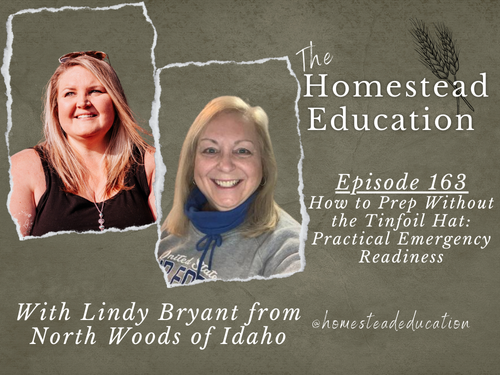
Episode 163: How to Prep Without the Tinfoil Hat: Practical Emergency Readiness with Lindy Bryant
This post may contain affiliate links where I earn a commission at no additional cost to you.
Episode Highlights
In this episode, Kody sits down with Lindy Bryant of Northwoods of Idaho—Air Force veteran, disaster response specialist, and creator of the Grab and Go Binder and Survival in a Bottle kits.
They break down real-life preparedness for normal people: families, single parents, seniors, urban dwellers, and rural homesteaders who want to be ready for power outages, job loss, medical emergencies, and everyday “mini disasters” long before a comet hits the earth.
From emergency binders and car kits to bartering, community support, and skill-based prepping, this conversation will help you rethink preparedness as a practical, affordable, and deeply caring way to protect your family.
Podcast Review
Did you enjoy this episode? Please drop a comment below or leave a review to let us know. This can help other folks learn about this podcast and we also really appreciate the feedback!
Podcast Links and Resources
Website: https://www.northwoodsofidaho.com/
Facebook: https://www.facebook.com/NorthWoodsOfIdaho
Get it on Amazon: Do It Yourself: Grab-N-Go Binder
Lindy’s Book: The Single Person’s Guide to Preparedness: Prepping for One!
Kody's Links
Website: https://www.thehomesteadeducation.com/
Shop Curriculum: https://www.thehomesteadeducation.com/shop
Speaking Events: https://www.thehomesteadeducation.com/events
Facebook: https://www.facebook.com/thehomesteadeducation
Instagram: https://www.instagram.com/homestead_education
Watch episode on YouTube: https://www.youtube.com/@homesteadeducation
Read MoreLess
Introduction & Panhandle Preparedness Expo
Hi everyone and welcome back to the Homestead Education Podcast. Today I have Lindy Bryant from I always do this Northwoods of Idaho like I’m probably not even gonna cut that out because my listeners know that I’m a little spacey so
Hey that’s okay.
Right, well so thank you so much for coming today. Thank you so much for coming on today like I’ve been excited to share your story after we met at a preparedness expo and I just really think that you have so much knowledge to share so I’m excited to have you.
Well thank you for having me on this is a lot of fun I’ve been looking forward to this I went oh good I get to talk to Cody again. Yeah we, we met up at the Panhandle Preparedness Expo in Sandpoint, last point Idaho this little tiny place in the middle of nowhere.
I know a little tiny place that’s growing but it’s I mean it’s it has a a nice facility and we get to use the the fairgrounds there each year so this was our 10th year of that expo that I’ve, I’ve been doing that for several years it’s a lot of fun.
I’ve been wanting to come for a few years I finally I didn’t go to a big event that I usually go to on the east coast this year and I was like I’m gonna go to this one this sounds fun and I’m glad I did.
Yeah and it’s a great group of, great group of folks you know I said one of the, one of the most fun things about the expos you know the things of that nature is the networking it’s the people you meet.
100%.
You know and not just us as like vendors and speakers the guests that come they meet so many amazing people and realize that we are all just here to teach and that that’s what we’re there for and that we love it.
And then and you know a lot of homesteaders and preparedness minded folks and all they come to events like this and then they all go back in their little hidey holes it’s like oh good I did meet them I know they exist.
Right like, you know I saw a person for the first time in three weeks.
I brushed my hair, yes!
Right. I feel that you know sometimes I write a lot you know and then like farm work so I end up just wearing like you know leggings and stretchy pants because you know what I grew up ranching and let’s just face it jeans are uncomfortable and when I have to work that many hours and bounce back and forth between being an author and like crawling on my hands and knees through my garden like it’s a big deal to put on pants and so I, when I do put on jeans to go to town my, or if everybody gets dressed my five-year-old goes what we doing you wear town clothes.
I was like oh my gosh.
Evacuation Basics & Lindy’s Background
Yeah one of the things, one of the things I do is you know I teach classes and one of the classes I give is called Evacuation Ready Set Go and it’s to help families prepare if they have to evacuate in an emergency and the number one thing on the checklist is does everyone have shoes on.
You know because you stop and think about it how often do you get you throw all the kids in the car you get halfway there and you’re going, you know you look at your five-year-old you go where are your shoes. I don’t know.
We’ve actually had that happen on the way home so that was even worse. So tell everyone a little bit about what you do because we like got all excited but I really love your business model.
Well thanks yeah I am a former Air Force officer and when I got out I decided to start my own company. What I had realized my background part of my, my military experience was in disaster response emergency, emergency response and when I got out I realized you know the military does a lot of this stuff for you. If there’s an emergency they give you a place to sleep and they give you food they give your equipment and nobody was doing that for civilians and I went okay I, I want to help.
Even if they are they’re doing it in the big cities.
In the big cities or on a very delayed basis. Yes we are going to be there in three weeks. Well I’m going to be hungry before that. So I created Northwoods of Idaho which ironically I live in the woods in North Idaho and so it started out originally with basically writing a book and it’s called Grab and Go Binder and basically I help people put together an emergency binder so that if something happens they can grab it and go and they’ve got all their pertinent information. That’s kind of where it started and then it kind of blossomed into another book and then I have a product line of survival kits that are non-tack, non-tactical, because one of the problems that people have is if, if you’re not a die-hard you know survivalist you don’t want something that’s cammy you don’t, you know camouflage. Why would I want sometimes they’re like, they’re like five hundred dollars for these kits and I’m like I would never use half the stuff in here even if I was in a survival situation because I don’t know what to do with it.
But the other side…
And I’m not trying to like night goggle on the neighbors you know.
Yeah and a lot of people say oh I don’t want a kit like that it, you know it makes me look like I’m a surviv… I’m a, you know, doomsday prepper.
Does it come with this tinfoil hat?
Really. Well that’s why what I ended up doing is I got like water bottles and I put survival kits in water bottles. Well they don’t look tactical but they have like a flashlight and a lighter and a first aid kit and a sewing kit and an emergency blanket and it glows it has all this stuff stuffed in there you toss it in your car. Well that’s what I started finding is that the niche that I was working towards, the niche I was working with were individuals who needed support but were not rooted in the preparedness community.
And so that’s kind of what I’ve been doing is my, my motto of my company is helping individuals and small businesses be better prepared for whatever happens.
That’s awesome.
So that’s, that’s kind of what I, what I’ve been doing with myself since I decided that you know it was time to get out of the…
Filling Real Needs, Community & “Prepping for One”
You know I love so many like homesteaders, preparedness people, their business models come from not just filling a niche in a marketing sense but filling a niche in the things that people truly need. And that’s been so fun to meet so many people that say I saw that somebody needed this and I made it happen.
Right and you also, I mean I’m sure you do this too with your, with your business. If you get the same question or the same focus from 10 different people you’re going hmm this is something I should be paying attention to this is something that, that needs support. And I mean…
And I mentioned a lot of how do I, how do we build a community we realize that we need to stop relying on the outside systems.
Right.
So not only do I teach how to build community but I also wrote a book on how to teach your kids how to not rely on the, you know the culture of relying on systems.
Right one of the things that, that I had pointed out to me is that a lot of people who are involved in preparedness the, the guidance the, the checklist everything is aimed at large groups or families. And a lot of us are, are single.
Whether by choice or not.
Well and also what if you’re just by yourself when you need it.
Right. And so what I ended up doing, one of the books I, I wrote last year is The Single Person’s Guide to Preparedness Prepping for One. And people said well why are you focusing on single people? I said well if it’s just you do you really need 200 pounds of pinot beans? You know if it’s just you how are you going to handle security because you can’t stay awake 24/7. So it basically looks at and it’s not just for the single person it’s for single parents it’s for retired individuals you know things of that nature. And I mentioned to you, I said one of the things that I’ve been asked, had a lot of questions about in the last year are about people who are starting to become senior citizens but are still not wanting to move into, they don’t want to move into the city they don’t want to you know they don’t want to leave the more rural area.
Yeah.
Right and so I’m in the process of doing a talk right now and it’s going to probably turn into a book about seniors and self-reliance and the, the tagline is, is aging on the homestead. Something that unfortunately I’m going to have to deal with, you know.
We live in an area with a lot of century farms so they have you know aging, you know matriarchs, patriarchs and even though the kids and grandkids help they have their own jobs and you know my husband and I working from home have that unique opportunity to go over and help where we can but not everybody has that community set up or even knows how to create it.
I have some friends who were over visiting yesterday evening.
Because farmers are stubborn by the way.
Yeah and they’re both in their 80s. They’re still in good health they still can do a lot but he has spent 30 years building up his, his homestead and they don’t want to leave. Well they’re looking now at how can we have someone else living on the property to help us or, you know, what can we do to barter to get physical labor so that you know we can help somebody else but they can help us. Those are all issues that, and it doesn’t have to be someone who’s elderly. If you’ve got 20, 40 acres and it’s you your spouse and two or three kids you still can’t do everything.
No. Especially if the kids are young.
Yeah.
Or, or older with lives of their own already started.
Yeah, you know so the question is. How do we, whether it’s building a community or simply learning to barter, with, with folks in the community. Labor for goods, things of that nature.
Bartering Stories & Small-Space Homesteading
Sorry I was laughing when you were quiet for a second there my children are singing, my 17 year olds are singing at the top of their lungs like in the room behind me and I’m like I wonder if everybody’s hearing that because it’s not good.
Bring them on in!
But yeah it’s, what were you saying, right? Oh yeah the trading for goods and stuff that is such, I mean that’s actually how we help and my husband’s an amazing mechanic and while you know the elderly family can’t get out there and do mechanics anymore and the, you know, the younger family members are out working he keeps all their equipment going so that when they get off work and need to like, you know, hay 20 acres before they go to sleep they can just hop on the tractor and go.
Yeah.
Because he’s been there handling it. And then we trade for hay so that we can keep our homestead going.
Now I know from where I’m at I have 12 raised beds plus in ground areas for, for growing things I have a small property but I can grow quite a bit here and I have an herb garden and I have a medicinal herb garden etc etc. So I have a young gal a single mom who lives not too far from me and she will come over and handle some of the stuff that I really can’t. And in exchange she gets herbs that she wants and she gets you know zucchini and squash and you know cucumbers and all that sort of stuff that she doesn’t have the ability to grow. So it is, it’s smart. I mean it anybody, but anybody who thinks you have to have 20 acres to, you know, to be you know am I self-sufficient? Oh heavens no. But can I take steps in that direction? Yes.
Oh absolutely. I, it’s a sliding scale. Everybody thinks that to be a homesteader or a survivalist or a prepper or you have to be all the way at the end of that scale and that is not the case. And honestly I don’t know anybody who is completely an island.
Well you know there was a really good article that was published recently and it, it talked about how unfortunately some people in the preparedness community even but those around it think that, you know, you have to have all the coolest gear and you know you’ve got to have you know all the tactical training and the body armor plates and you know room full of, of weapons and everything. And but he said a 700 backpack does no good if it never comes out of the closet.
Right.
You know and that goes for everything.
If you don’t know how to use the things.
You can start the one… You can start seeds. You take a toilet, toilet paper roll cut it in half close one end put a little dirt in it. And start a seed. You do not have to go and spend 80 dollars at Home Depot for high-tech plant, you know, seed, seed starting equipment. You know so there’s, there are ways to, to be creative and, and I challenge people I say come up with, tell me your most creative solution that costs little to nothing. And, and people start throwing out ideas and people are taking notes going that’s a good idea!
Right and well and you, it’s, it’s just it’s a different mindset when you’re kind of here in and doing this and then you go out and you teach it like we do and it’s sometimes hard to remember that not everybody’s in that mindset. And you know like last night my husband was, we’re butchering a hog this weekend and he goes man I’d really love to have a skinning rack. We just, we don’t have one we usually send our hogs out but this one, he has, he had like a hernia and so we just, we think we’re gonna lose his bellies when we butcher him so we didn’t want to send him to a customer. So we’re like cool we need some sausage in the house anyways. We raise about 350 hogs a year so…
Well…
Yeah and so we don’t, we only butcher like every other year it’s just not our normal or slaughter I guess. We do a lot of butchering we’ll even go get them right after they’ve been slaughtered and then handle them ourselves but he’s like I’d really like a skinning rack he’s like but I need some metal tubing to weld it and he’s like we just can’t afford that right now and I was like you’re right we can’t. And so I was like sitting here thinking like what do we have what do we have I said we have an old feed trough that is a metal framed like crib feed trough. If you just take the crib part out that’s exactly what you need. And so like we were up there we drug it out and we figured out how he can just turn it into a skinning rack and that there if we put slits in the crib part of it like it’s kind of like a leather material or like a stall mat material. If we put slits in it if we want to, you know, be graining a steer at the end or something like that we can just slip that back in and the racks for the pig will just go through the slits. And I was like, okay, like we saved all that money and we have something usable and it’s still usable for things other than butchering.
Right.
And then I kind of stepped back and I was like not everybody does this.
Yeah.
Salvage, Greenhouse Plans & Rural Life
Yeah and the same thing we had my neighbor, the, the house that’s next to me the elderly gentleman that lived there past and his family came out and the, they had this horribly, horrible condition lean to. And one good snow and it went over it was done it collapsed. And they were going to just have somebody come in put it all in a truck take it to the dump. And I went, you’ve got a bunch of roofing panels. And I said, I’ll give you, I’ll give you, I’ll give you a hundred bucks for all of them and they went oh yeah absolutely in fact we’ll take, we’ll take it apart we’ll bring them over and put them in your yard for you. I went, there’s a deal! So I, 26 eight foot metal corrugated roofing panels for a hundred bucks delivered and put in my, in my storage area.
That’s amazing because we are always like we’re building you know pig huts and that type of stuff and like we have to go buy that and it’s so expensive. That’s like our biggest expense.
Yeah well and I…
Salvage wood from something.
I was thrilled to get it because I have an old gazebo in my backyard that I’ve been meaning to turn into a greenhouse so that is going to get recycled and it’ll become the bottom half of my greenhouse so…
Oh perfect.
You know and whenever I’m like and I keep the dimensions in mind and when I’m at like yard sales or estate sales I can sometimes find a really good single pane window. And so I’m building up my collection of windows and will my, will my greenhouse be, be, you know, absolutely gorgeous? No. Will it work? Yes.
Did you ever say there is no Pinterest police. There’s nobody that comes and says that that doesn’t look how it’s supposed to. Does it work? That’s all that matters.
Yeah.
Yeah and if you’re happy with it.
Unfortunately up here in rural Idaho that’s what matters. There are some places where the HOA police would come and smack your hands and that’s why I don’t live there.
Right. And we don’t have it, we have little to no building codes up here too.
Not, not at all like you have in some places.
Yeah like I know you guys have little. We have no up in Boundary County.
Kootenai County down around Coeur d’Alene has more stringent building codes which is also why I moved out of there. Not because I don’t want to meet the codes but because I…
You don’t want to support that they’re doing that.
Well the cost, I mean. I, I put, I put up a, a 30 by 60 pole barn when I lived in Athol. And I think the permits alone cost me over 400 dollars.
Yeah.
And I was like really? Seriously?
Yep.
Well up here in Boundary you only have to get a building permit if you live inside the city limits. And I think it’s, which is only Bonners Ferry or the rest of the county is not inside a city limit. And I think they’re like, oh my goodness, they’re under 100 bucks. They’re like 20 bucks or something like that. And it’s just to say hey I’m building. That’s it, like…
Well my, my daughter, my son-in-law’s active duty navy and they’re stationed out at Fort Maryland so they’re right outside the DC metro area. And they came out to visit and they’re looking around and just loving the, the ruralness of it. My son-in-law said okay so how many people are in Old Town. I said okay because I’m technically, technically in Old Town. I said well I’m not actually in the city the city, the city of Old Town has 190 people.
That sounds about right, yeah.
He said but I can see Town Hall from here. I said yeah. The, the, the school the local elementary school is not inside the town’s, the town either. He’s like what’s in the town. I said they redrew the town boundaries a few years ago to include every commercial building. That’s their tax base. All the people are outside and I called City Hall and I said why. And they said because we don’t want to pay to, to plow the roads. If you’re not in the city limits the county has to do it. I’m going boy talk about cheapskates!
Right. But I, I mean, I love kind of, I don’t want to say like love the cheapskateness but the concept of it too because also if they had to plow, if they had to pay to plow it’s going to cost taxpayers so much more because the county funds come from the entire county not one tiny little town.
Right, right.
So that makes a big difference too.
Stigma Around Prepping & Everyday SHTF
So we were talking a little bit like before the call and a little bit in this that a lot of people don’t prep or don’t prep in the way they should because of the negative connotations that come with it. And I think that’s a really important one to cover because in the conversation that we had I had mentioned that I knew somebody here in Bonner’s Ferry which is a very conservatively prepper minded community and it was right after COVID and they were actually buying a hog from us which was you know at least they were looking at buying some meat but she goes you know prepping isn’t even on my radar.
That’s why I said your broken.
Literally right after COVID. Like, do you not remember when you couldn’t buy toilet paper three months ago? Like prepping isn’t just about waiting for the EMP to hit and take out the entire infrastructure. Prepping could literally be the fact that every winter we lose power for about five days. And we prepare for that every year. We also prepare for the fact that nobody buys homeschool curriculum in December and so I need to have my bills paid in advance and enough food in the fridge where if I don’t sell curriculum I can still pull stuff out of the freezer and pantry. And that’s what for the most part what prepping is to us at least on our regular basis how we’re feeding ourselves from one, you know, in advance.
Right well first of all can I, can I reiterate I have no idea why there was a run on toilet paper during COVID because last I heard that wasn’t one of the symptoms of the…
That’s a lot of nose wiping happening, you know?
Yeah I have no idea. I think it was people just didn’t want to go to the store so they wanted to make sure they had everything they needed but it’s…
No I think it was one person made one comment on social media and everybody ran with it because the herd mentality all the little lemmings followed.
Right.
You know but yes.
I just put it on Amazon subscription and let it show up.
Well the, but the thing you were talking about about people you know planning ahead. I mean the thing to me is the, the SHTF you know when it hits the fan. What is an SHTF event for you may not be for somebody who lives two doors down. I mean if somebody’s house burns down that is a horrible life impacting situation for their family.
Yeah.
It does not have to be a comet hitting the earth for you to need to be able to take care of, of options.
Don’t think about it because it doesn’t like quote affect them except for you know depending on how giving they are they might help out their neighbors but…
But if you have a job loss, a divorce, the death of the primary, of the primary wage earner in your household that is going to change your entire life. And I personally I’ve been in a situation where I had a job loss and it was right when everything was crashing 2008.
Oh yeah that was a hard time.
My company just…
I went through a divorce in that time.
Yeah oh it…
And a domestic violence situation so there was no like we weren’t co-parenting we weren’t, he wasn’t helping me I was figuring it out on my own while the entire world was crashing around us.
And I was a single parent at the time. So you know but, and my daughter, my daughter growing up had always had this mom who always had an earthquake kit when we lived in California and we always had extra food and she would roll her eyes, yeah mom and her little preparedness stuff. And then came 2008 she was in college. And she looked at me and she said am I going to have to drop out of college. I went no. No we’ve got, we’ve, we’ve got the ability not to have you be affected by that. I had a walk-in pantry. And we had enough supplies and staples that other than buying like milk and, you know, fresh foods, eight months, eight months we could live on our supplies. That made a huge impact because I didn’t have to, you know, when you apply for unemployment it takes six to eight weeks before your first check shows up.
Yeah.
You should not have to worry about what am I going to feed my kids during that six to eight weeks. That, that is what preparedness is for is to ensure your family’s stability during that period of time. The, the one I brought up too was it, you can’t plan for everything. What happened in North Carolina last year. It doesn’t matter how well they were prepared. They lost their house they lost their car they lost their phone they, some of them lost part of the property it fell into the river. There’s no way they could have prepared for that.
And their 700 checks weren’t going to cover it from FEMA.
And where was FEMA going to mail the check? The house is gone, the mailbox is gone, the road is gone. Where are they going to get that check?
And then they had to sign a thing if they didn’t pay it back in a year they could take their property. What property?
What property? The, the, the thing too with that is that when they got to a town that had electricity if they, first of all they didn’t have their phone so they had to hunt around and try and figure out how to get in touch their insurance agent. If they got online many of them could not even access their bank accounts because they couldn’t remember how to log in and all the information had been in their phone. If they got a hold of, pardon me, if they got a hold of their insurance agent the insurance agent said absolutely we are here for you I need a list of everything you lost in the serial numbers. And with FEMA, FEMA initially when they contacted FEMA, FEMA would ask for two things. They asked for a copy of their lease or mortgage and last year’s tax returns. They’re in a pile someplace in the mud pile down there.
Yeah.
So they said okay if you don’t have that sit down here fill out this information on the, on the computer and we’ll mail you a 750 check. And they went where are you going to mail it?
Yeah.
You know and when I talk to people they say oh well I have all, all my critical stuff is in my safe deposit box. I said well two things. Number one I hope the bank doesn’t get washed away with the rest of the town. And number two I hope that your emergency doesn’t happen on a Friday night of a three-day weekend.
Yeah.
You know so there’s options and that’s part of what I deal with in my, my talks and my book about putting together a family emergency binder which I also strongly recommend you put all that stuff together and then scan it onto a flash drive. Preferably at least two of them one you hang on to the other one you put with a trusted family member or friend who does not live with you.
Yeah that should yes it should be copies of your insurance papers and your birth certificate and all but also…
And that drive file I actually make sure it’s saved on a cloud too.
Yes but that’s only good…
Infrastructure.
If you can access the internet.
Yeah I was gonna say if infrastructure isn’t down then that’s an option too in case you lose your flash drive and the person who also lost it. And if infrastructure is that far down you probably don’t need it anyway so…
Home Inventory & Simple Preparedness
Well one of the things I recommend too is take your phone. Walk through your house and narrate it room by room put a separate video for each room as you narrate it. Then go outside walk around each of your vehicles then while the it’s running while the video is still running sit inside and capture the VIN number.
Nice. Yeah.
Because if, and it doesn’t have to be the house burns down. If you get robbed you now have proof of the condition of something, the VIN number, the serial number, things of that nature from, from your walk through.
Those things. Although in my house they probably look at the pictures and go oh you got robbed beforehand they rummage through everything. Oh no that’s just my children that’s, that’s what it normally looks like.
Yeah. But I mean that’s the kind of stuff that I work with people on I say it doesn’t have, it doesn’t have to cost an arm and a leg to be prepared. Just time and some attention to detail.
And you know everyone’s level of preparedness is different too. You know it, you know I talk a lot about stop relying on systems. And that’s my big one. But the bottom line is if you live in a city you don’t have the space for a garden and five freezers in a, you know, off-grid system. It’s just not possible.
Right.
So what you need living there is going to look a lot different than what I need to keep my farm running when it hits the fan. And that’s, you know, I really liked when we talked is a lot of your stuff is about making sure you know like you said the insurance papers you have your off-grid kits that includes a urban one.
Mm-hmm.
Yeah and I think that that is just really important so many urban people don’t think about…
Yeah.
The things that are part of our kind of everyday lives.
Oh yeah like I mentioned to you my son-in-law’s active duty navy and they are stationed out near Washington D.C.
God forbid.
Yeah so scary.
What my daughter needs to carry…
I don’t even like traveling out there.
I know. What my daughter needs to carry in her car at all times especially during the winter is different than what I need to carry in, in a rural area of Idaho. But in talking we realized there was overlap. Everybody needs to have a flashlight. Everybody needs to have an emergency blanket. Everybody needs to have a car, a car kit that includes either a flasher or glow sticks or something of that nature. So there what I ended up doing was I took her input and created a kit that is separate for urban as opposed to what people out here need. And I mean like I have out here I have the back country cash and it has all the same basics but then it also has a water filter straw it has, it has a stainless steel spork it has extra fire starters it has things of that nature. The urban one on the other hand has for instance a power pack to charge your phone. Think about people stuck during a mass transit commute. It has an ultralight drink mix because if somebody hands you water it may not taste great. And in every single kit that I sell on top is a piece of hard peppermint candy. And people kind of laugh and they go oh a snack. I said well yes but it’s there for two reasons. One, peppermint aids in digestion. And if you are in an emergency situation you may find yourself eating something that is outside your norm. And so peppermint will aid in digestion. The other is I have several friends who are diabetic. If they are having a diabetic episode you can crush that piece of peppermint put it under their tongue and it will help even out their glucose level.
Yeah, so…
There’s, you know, it’s just. Do you need that kit every day? No. But if you do there’s a little multi-tool, there’s a multi-tool in there, there’s a first aid kit, there’s a sewing kit. I cannot tell you how many times when I was working in corporate America I’m about ready to do a presentation I guarantee you I have either popped a button. Or a zipper has broken.
And you wish that was my problem because mine’s food down the front and my emergency kit has a tight stick in it.
Exactly! And that’s, but that’s the whole point. An emergency doesn’t have to be you know, a comet hitting the earth. It can be getting ready to go onto a podcast and at the last minute you dump spaghetti down your front or, you know. Something along those lines. So yes I agree it’s, it’s amazing how people don’t stop, they, it’s never going to happen to me. You know it’s that, that mindset of disastrous help happened to somebody else until it suddenly does. Until it suddenly comes home.
Skills, Systems & Food Banks
You know and I, yours, a lot of your stuff is about, you know, how to have your house prepped and, you know, the tools you need. One thing I cover a lot is, if it were to hit the fan do you know how to do all the things.
Yeah.
And sometimes that’s, I mean I’m not talking like going out and setting up a whole off-grid system. Somebody else is, you know, concerned about that. I, and I, I’m concerned about it but I’m not, you know, I have other systems in place. But it’s even just as basic as if you are going to rely on a system and you’re waiting three weeks for FEMA to show up or if you lose your job and you’re relying on the food bank. The food bank is not giving you microwave pizzas. The food bank is giving you dried peas. Flour, you know, like that type of stuff. Do you know…
How to cook from scratch.
Yeah! You know there’s even stuff like I always say that we’re prepping skills. Like that’s what we hoard is our skills. And a couple years ago you know we, we made a whole bunch of cider and so I decided to make apple cider vinegar with all my scraps. And my husband you know he kind of gets on board whatever like, you know we started this whole, you know, lifestyle to save his life after a terminal diagnosis and it worked. So he goes along with most of what I suggest. And he’s like okay so is this a thing now are we making apple cider vinegar like is this just our new, he’s like because if it is I’ll go make a place in one of the sellers for it. And I was like no, no I was like we’re gonna make apple cider vinegar this year. And if it works then we’re solid. If it doesn’t work we try it again next year. And then currently I’m still comfortable buying apple cider vinegar from the store. But if we’re everything to go down I have an orchard on my property. Within a reasonable amount of time I could get apples, make apple cider vinegar again and have what I need for cleaning and disinfecting and digestion and all that stuff.
And you know it’s when people talk about you know oh if it hits I’ll, I’ll grow a garden. I’m like have you, have you grown a garden before?
Gardening Reality, Seeds & Toothache Plant
Like and it’s year to year. Good example this last year I mean I start all my veggies inside under grow lamps February March time frame.
I do too, yeah.
And then plant outdoors somewhere around Memorial Day. This year I transplanted and I mean I was going for big. I planned and transplanted 12 zucchini plants, 12, 12 straight neck, straight neck and 12 crook neck and then 12 delicatas. Lots of squash we, we eat a lot of squash. Planted all those. The zucchini did all right. The cucumbers did all right, the straight eight, the straight did fine. I got a total of one yellow, one yellow squash out of 24 plants.
Yeah I planted 20 beef steaks and got two tomatoes.
Yeah oh yeah my tomatoes did like nothing. Like last year we were drowning in tomatoes.
Oh my green beans were great they were coming, coming out my ears but and they were, they were like in, like next to each other in separate raised beds so it’s not and same you know same basic soil same basic watering. So, you know, and like I wasn’t trying to, to feed myself on the…
Right. Well and you know like I had tons of tomato, or I had tons of tomato plants I’m like no tomatoes. I dialed back on peppers this year and had so many peppers that I didn’t know what to do with half of them and it made it worse because I tried some new peppers this year and then my son dropped the tray when we were walking out to transplant and so I had no clue what half the peppers were and so I’m like well we’ll just plant them and see what happens and so a lot of them I didn’t even know what to do with I didn’t even know what they were. But I was like whatever.
One of the, one of the things I decided to try this year too is, I, I, I love sugar peas you know like you use for oriental foods and so what I did is I got four different types. And I have a long narrow bed that I put my peas in and I took little tiny plastic dixie cups like you get at the doctor to, to take your medicine and I wrote the, the type of pea on each one and I put it at the, at the beginning and then I plant, you know, then I here and that way I could remember what kind it was. When I’m looking and I’m going okay those didn’t even come up. These I can’t keep up with because there’s so many of them. Okay we’re going to use that one again. So you know I had tried other things in the past and they went away but if you take a little dixie cup and you turn it upside down and bury half of it and put the name around the top it’ll stay there and the water just…
Nice.
Goes off and they were free.
Which is even better.
Right. Well and you know there’s a lot of people that, you know, they say I’m going to grow a garden but what if everything hits the fan in November? Or if you only have one source of seeds like oh I have one of those emergency seed packs. Well if you grow all those seeds and none of your tomatoes turn red and get ripe where you can seed save. Then you’ve used all your seeds and you have no more tomato seeds for next year.
Well and the other thing too is you get one of those kits and you go okay I’m going to plant these and you take a look and half the seeds are for somebody who lives south of the Mason Dixon line.
You know…
I actually do buy mine from a northern, I have two different suppliers because also again sometimes seeds don’t always go so I have two separate suppliers that are both specific to like the P&W.
Yeah I do too I have a couple that I buy from regularly and then I will also branch out and get a few from like you know baker’s seeds.
Yeah when there’s something fun you want to try and then I seed save every year that everything I can because then again what if you know I mean what if my mudroom floods and all my seeds in my, you know, things go bad but I was seed saving and had them all hanging in the walk-in cooler or something you know like I still have options.
One of the plants that I have started growing that has been very popular. I’ve given it to people is called the toothache plant.
Oh yeah.
I have a bunch growing out in my garden right now but I don’t know, I mean I know what to do with it but I don’t know what to do with it so it’s just pretty.
Yeah well and it really works. If you grow it you take the little flower the little seed flowers and you basically turn those into a poultice.
Uh-huh.
Put them on your, if you’ve got a toothache.
Put it on…
That’s what the Native Americans used. Put it on your gum and it will, it will take that right away. Now it’s also good if you have a cut and you need to for instance stitch it up.
Uh-huh.
Put the poultice on first and it will deaden the skin so that you can, you can, suture.
Well there you go that’s nice.
So it’s a very handy little thing. It doesn’t grow outside very well for me I have to start it indoors.
But mine actually, was volunteer this year.
Oh good for you.
Mine are sometimes forced volunteer grow or else.
Yeah or, were completely overran by the cherry tomatoes that I never picked and so they all started and it literally looks like grass growing of 12 inch tall cherry tomato plants.
Oh god no my, my I learned my lesson when you’re not keeping my mint in check it just kind of took over.
Well I made the mistake of oh I’m just going to, mulch all my dead plants and put them back in my beds, for organic matter for next year which would have been a good idea had a lot of my tomato plants not still had like dried tomatoes on them and so I basically just spread cherry tomatoes all over my entire garden and my compost pile.
There’s worse things that could spread.
Yeah there’s worse things you know so and you know one of them the bed didn’t do very well with the other plants that were in there and I had a ton of cherry tomatoes so you know we’ll work it out but…
Where to Find Lindy & Closing “Keep Growing” Question
So do you want to tell everyone where they can like, you know, find you get all your stuff because her books on her little like kits are, they’re amazing they’re like exactly what every family needs.
Yeah thanks yeah, the two books that I have published so far, one is called The Grab and Go Binder. The other one is called it looks like this it’s a The Single, the Single Person’s Guide to Preparedness Prepping for One. And both of those books are available on Amazon. You can just put in my name put in lindybryant and they’ll pop right up. Then also I have a website which is northwoodsofidaho.com and on there you can find the books you can also, check out my blog which has a lot of great tips for different, different things. And also it has my survival kits, the, the name of them is called Survival in a Bottle. And there are three different kits there’s the backcountry cache, the urban stash and the everyday carry. They’ve all got the same basic items like you know first aid kit sewing kit multi-tool flashlight lighter all that sort of stuff but then they have, one has the water filter straw and things of that nature that’s the backcountry version the urban has the power pack to charge your phone, all that type of thing. And then the everyday carry just has all the basics. And they’re in single walled stainless steel bottles so in a pinch you could cook or boil water in them. So they’re and nothing in those kits is, is harmed by heat or cold so you can take the kit toss it in the glove compartment of your car or your kid’s car and know that they’ve got a flashlight you know they’ve got an emergency kit you know that they’ve got, a, an emergency blanket. Those things, it’s peace of mind in a bottle. That’s why you can wrap peace of mind and put it under the tree this year.
I love it.
So yeah so it’s the website is northwoodsofidaho.com.
All right so as we’re at the end of our time my favorite question for everybody is what does keep growing mean to you?
Keep growing. I mean from a business aspect or from an individual aspect?
Whatever it means to you. That’s the beauty of it.
Well from a personal aspect to me keep growing means keep learning. If you’re bored learn something new meet new people volunteer someplace new. If you’re talking about from a business aspect I’m always looking for somebody else I can help.
That’s great. I, I like that because like we were saying earlier that’s such a beauty about our niche is that we’re always trying to figure out how to fill that gap. I like that. So well thank you so much for coming on today everybody make sure you reach out to Lindy say hi she’s a joy to talk to I, I wish I had all day to just sit and chat but thank you so much for coming on.
Thank you Kody I appreciate it.