Description
Help Your Teen Understand the World That Feeds Them
Agriculture affects nearly every part of human life by shaping civilizations, economies, communities, cultures, landscapes, businesses, and the foods we eat every day. Yet many students graduate high school without ever seriously examining the people, ideas, decisions, and systems behind the food on their plates.
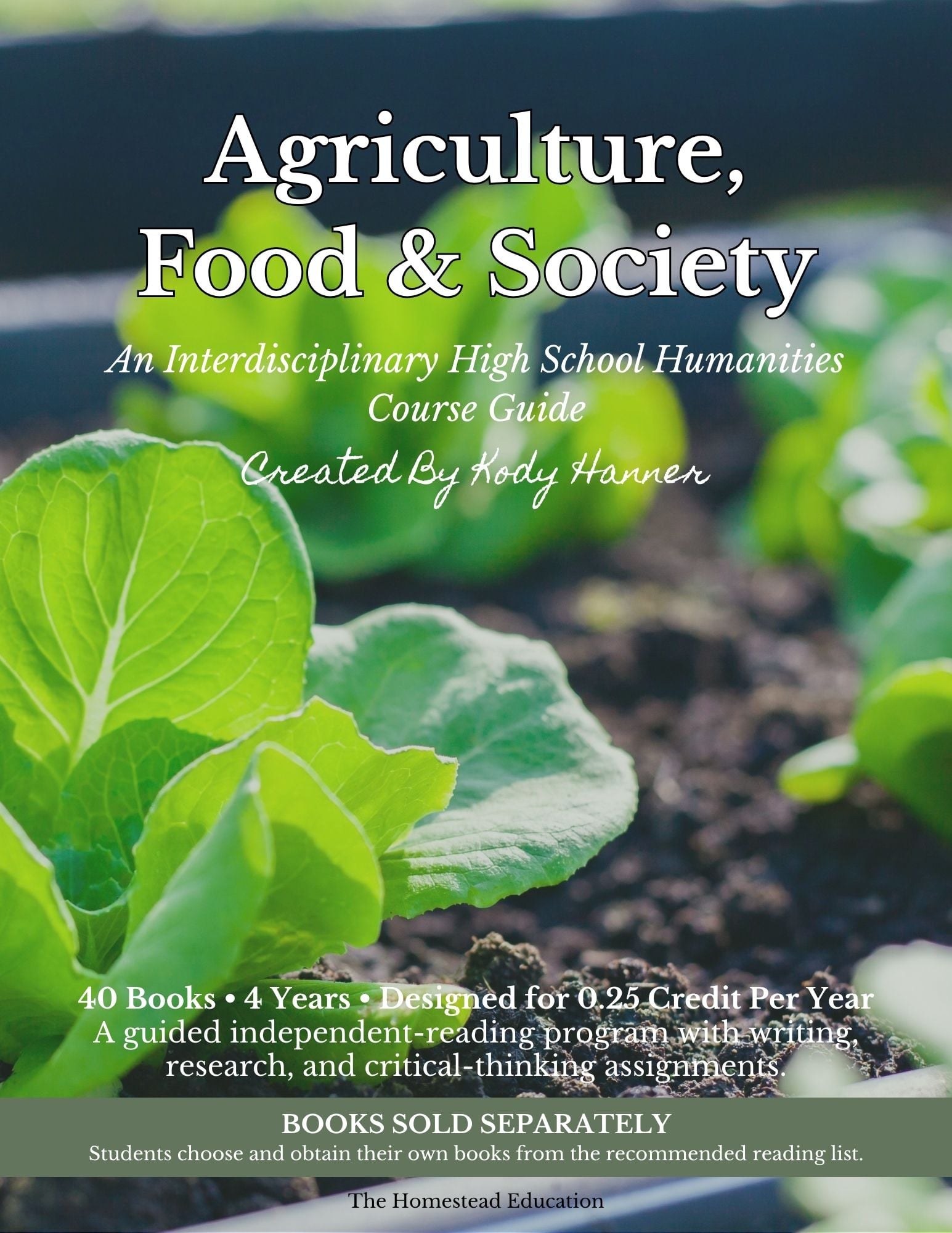
Agriculture, Food & Society: An Interdisciplinary Humanities Course Guide gives students a different way to study humanities—through the lens of agriculture. Instead of working through another traditional textbook, students spend four years reading books written by farmers, historians, scientists, economists, entrepreneurs, conservationists, food-system thinkers, and authors with differing perspectives.
The goal isn’t to tell students what to think. It’s to teach them how to read carefully, ask better questions, evaluate evidence, compare viewpoints, and develop informed conclusions of their own.
A Four-Year Independent Reading Journey
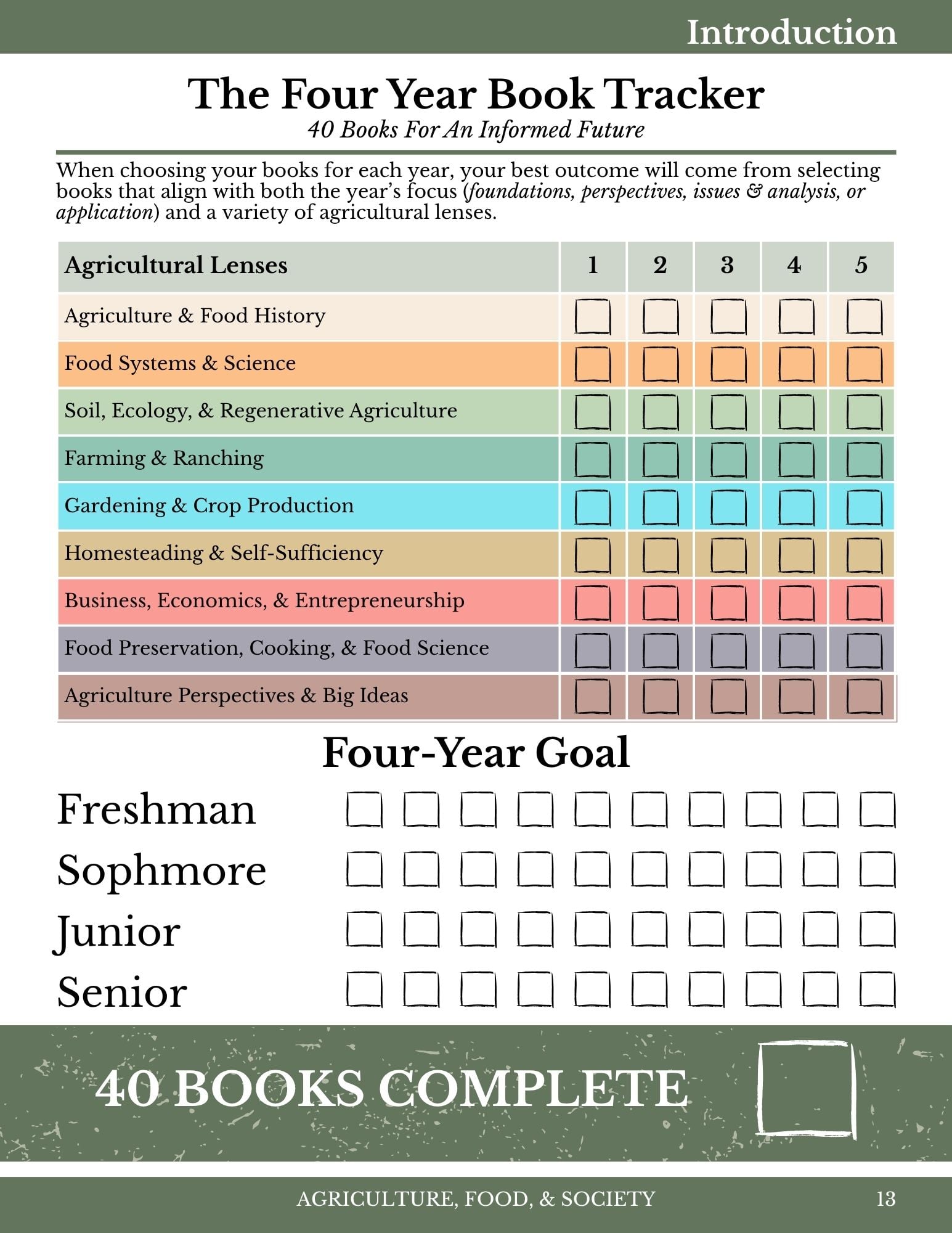
Students complete approximately 10 books per school year, for a total of 40 books across high school. They can choose from the included 100+ recommended titles or select other appropriate books with parent or instructor approval.
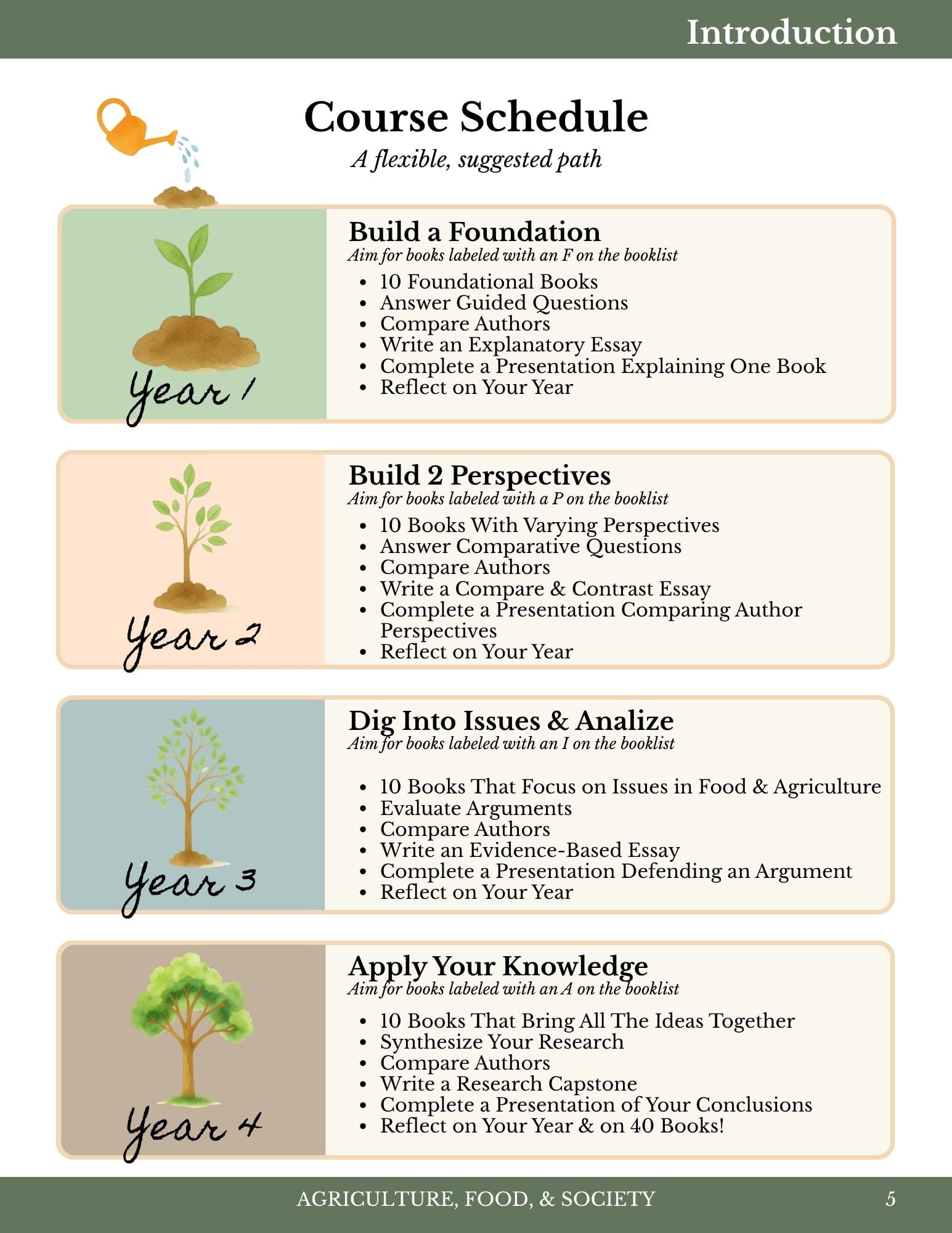
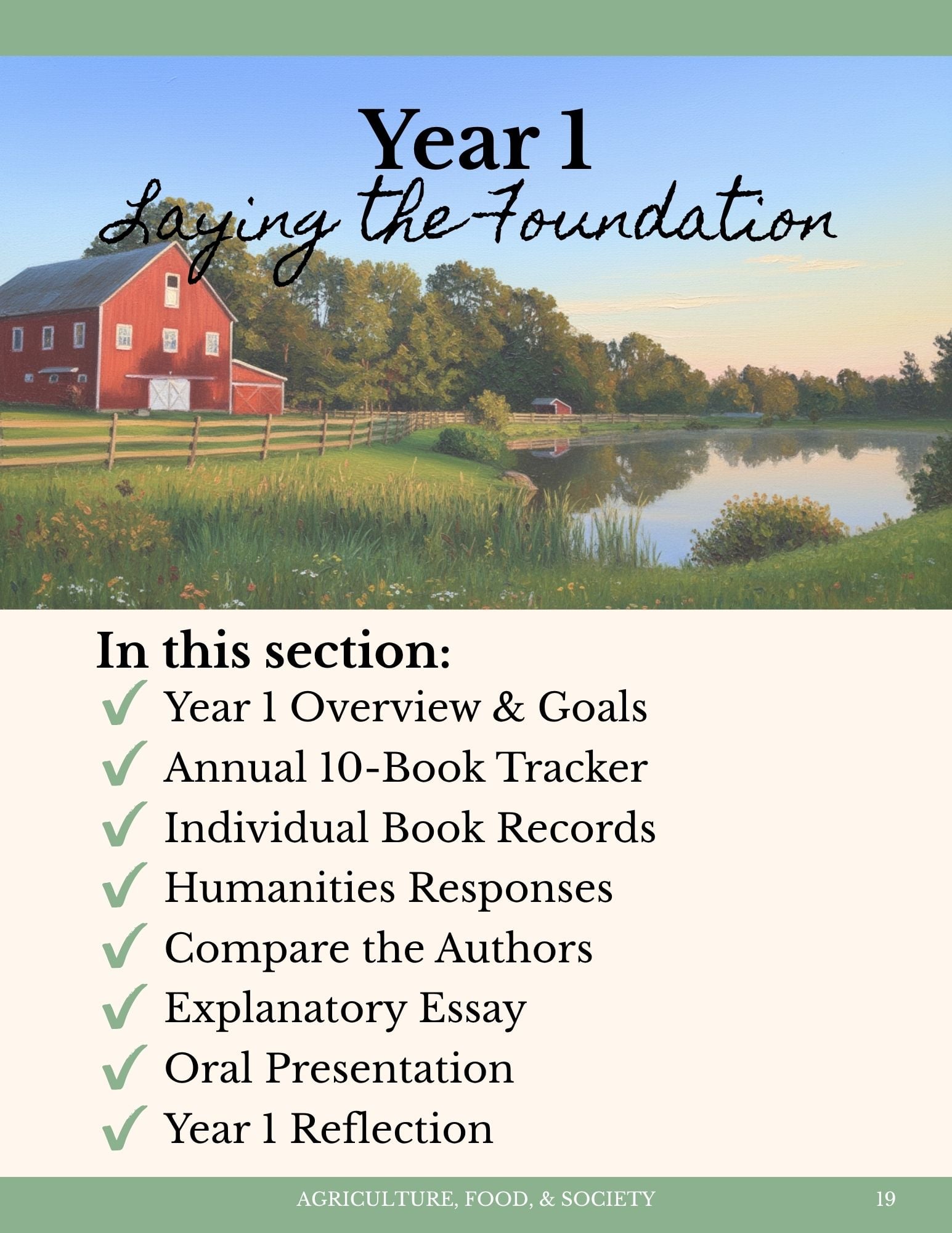
The course gradually increases in depth:
Year 1 — Foundations
Understand central ideas and begin making connections between agriculture, history, economics, culture, and society.
Year 2 — Perspectives
Explore how an author’s experiences, worldview, values, and background influence their ideas.
Year 3 — Issues & Analysis
Evaluate arguments, evidence, bias, counterarguments, and the strength of an author’s reasoning.
Year 4 — Synthesis & Application
Bring information from multiple sources together to form thoughtful, evidence-based conclusions.
By graduation, students have done far more than simply read 40 books—they have spent four years learning how to understand, compare, evaluate, research, synthesize, and communicate ideas.
What’s Included
The complete guide includes:
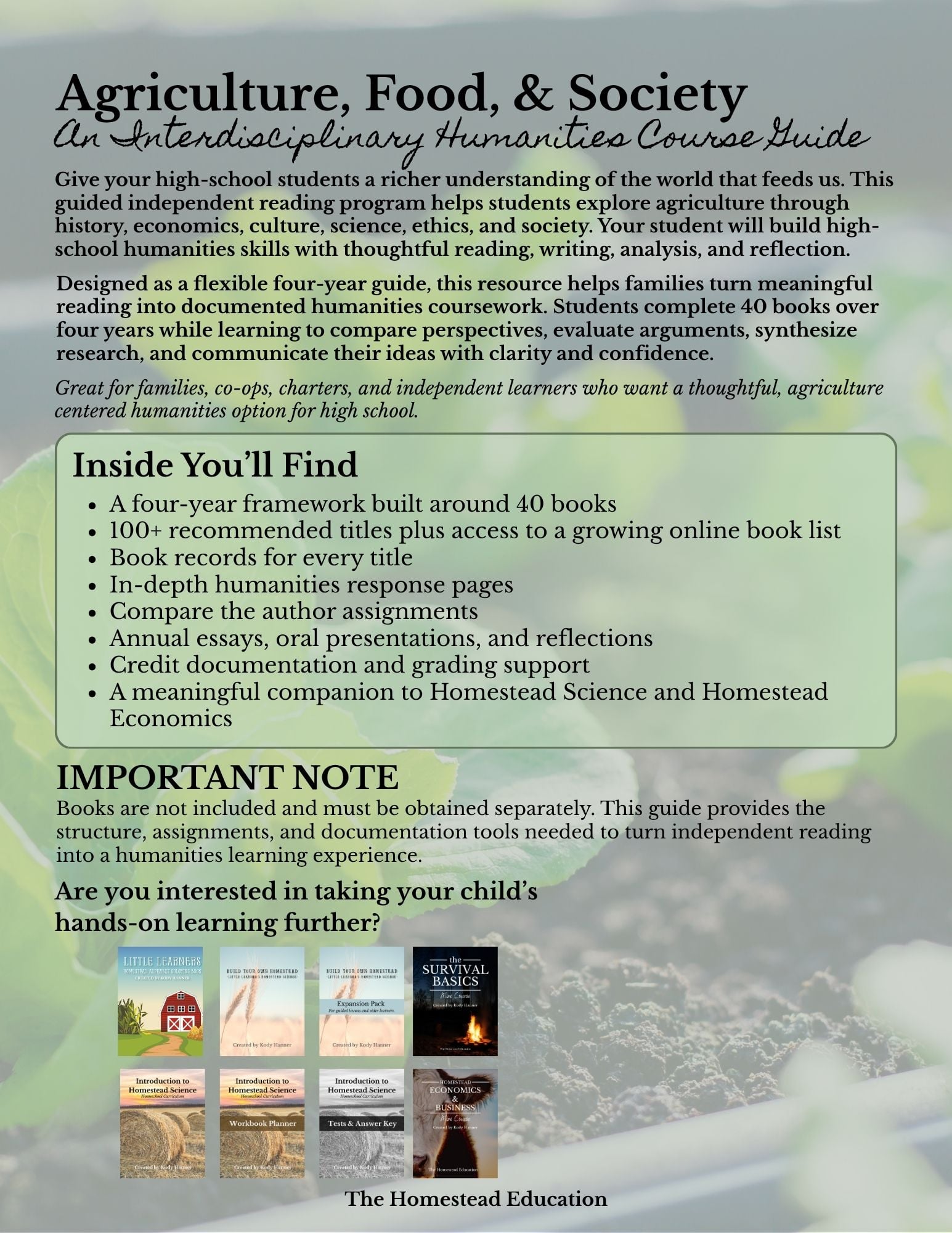
- A four-year humanities framework built around 40 books
- A curated 100+ book recommendation list
- Access to a growing online book list updated as new books and recommendations are discovered
- Four-year and annual reading trackers
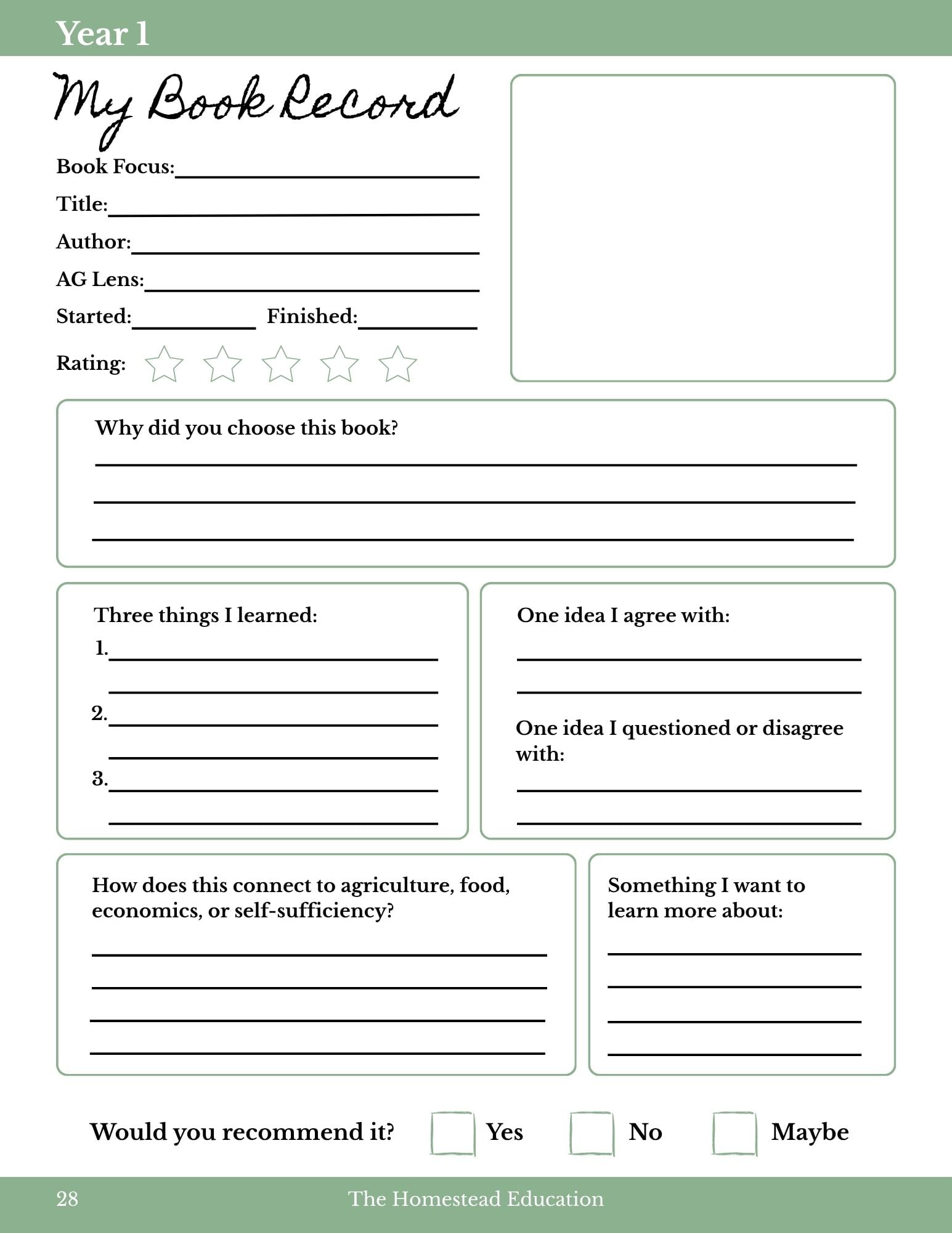
- A Book Record for every book
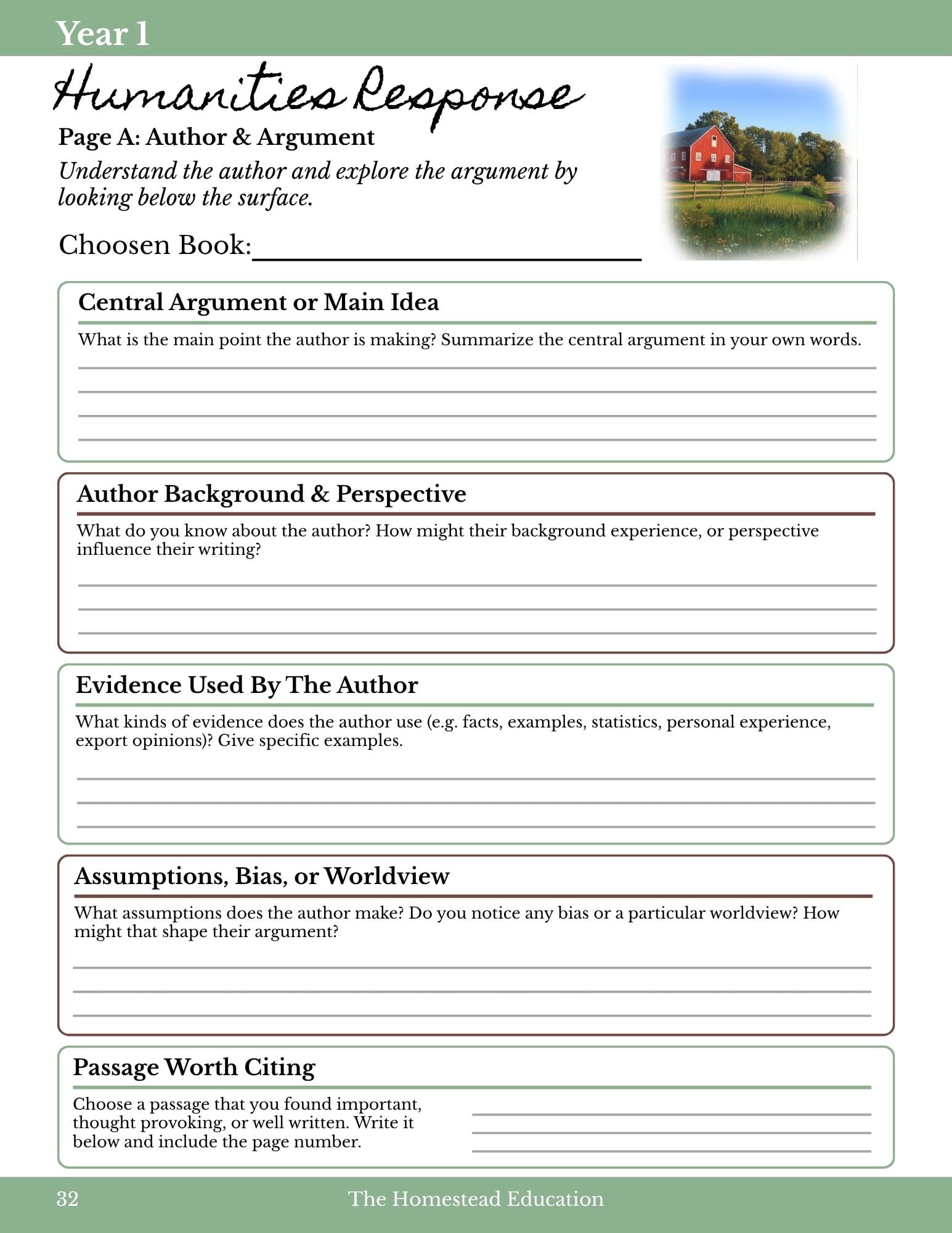
- In-depth Humanities Response assignments
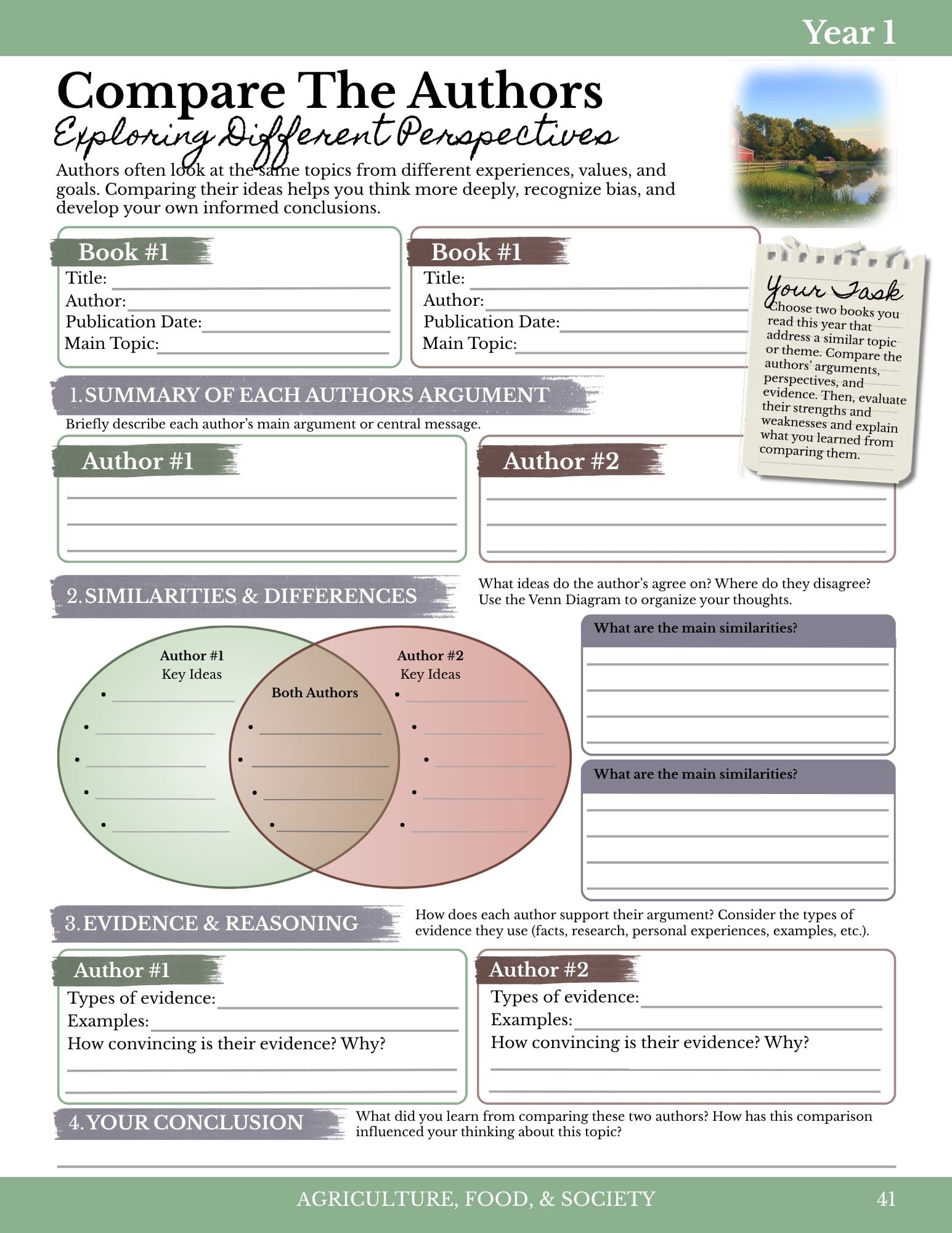
- Compare-the-Authors activities
- Progressive annual writing assignments
- Oral presentation planning and assignments
- Annual reflections
- A final Four-Year Reflection covering the complete 40-book journey
- Parent/teacher implementation guidance
- Academic expectations and standards connections
- A 1,000-point annual grading rubric
- Credit documentation record
- ELA cross-curricular documentation
- Suggested transcript information
Annual Coursework
Each year students complete:
- 10 books
- 10 Book Records
- 4 In-Depth Humanities Responses
- 1 Compare-the-Authors assignment
- 1 Annual Essay
- 1 Oral Presentation
- 1 Year-End Reflection
Writing assignments increase in complexity as the student progresses through high school:
Year 1: Explanatory Essay
Year 2: Compare & Contrast Essay
Year 3: Evidence-Based Argument Essay
Year 4: Research Capstone Essay
This progression helps students build research, writing, argumentation, and communication skills without turning every book into an exhausting book report.
Designed to Support High School Humanities Credit
The guide is designed to support approximately 0.25 humanities credit per year, for a potential total of 1.0 high school humanities credit across four years. However, students can start at any point by either adjusting their timeline to reach a full credit or completing part of the course for an adjusted credit as approved by their parent or institution.
It also incorporates substantial English Language Arts skills, including:
- Informational and literary nonfiction reading
- Text analysis
- Research
- Evidence-based writing
- Compare-and-contrast writing
- Argumentative writing
- Source evaluation and citation
- Vocabulary development
- Oral communication
- Presentation skills
Credit requirements vary by state, school, charter, umbrella program, and homeschool. Families should determine how completed coursework will be documented on their student’s transcript according to their applicable requirements.
Suggested Transcript Title:
Agriculture, Food & Society: Interdisciplinary Humanities
Works Beautifully With Other Homestead Education Courses
This guide can stand alone, but it was also designed to complement:
Introduction to Homestead Science
Students explore the science behind agriculture, farming, gardening, food science, natural resources, and self-sufficiency.
Homestead Economics & Business
Students examine entrepreneurship, budgeting, markets, customer behavior, business planning, and real-world economic decision-making.
*In Progress Homestead History — U.S. Food & Agriculture History (join the waitlist)
A full-year American history course exploring our nation’s story through food, farming, land, innovation, and the people who shaped agricultural history.
Together, these subjects allow students to study agriculture from multiple angles:
Science explains how.
Economics examines decisions.
History shows how we got here.
Humanities asks why it matters.
Choose Printed or Digital
Digital Edition
Perfect for families who prefer immediate access and want to print pages as needed.
Printed Edition
A ready-to-use physical guide for students who prefer working on paper and keeping their four-year reading journey together in one place.
Important: Books Are Not Included
The books on the reading list are NOT included with this product and must be obtained separately.
This is intentional.
Families can use:
- Public libraries
- School libraries
- Used bookstores
- New books
- Ebooks
- Audiobooks
- Books already owned at home
Students are also not required to purchase every recommended title. The reading list provides a wide variety of choices so families can select books that fit their student’s interests, reading ability, worldview, and available resources.
Course purchasers also receive access to the continuously updated online recommendation list at The Homestead Education, allowing students to discover new titles throughout all four years of high school.
Perfect For
Homeschool families, microschools, co-ops, independent learners, and educators looking for a meaningful high school humanities option that connects academics to the real world.
No farm, homestead, or agricultural experience is required.
Every student eats.
Every student participates in the food system.
And every student benefits from understanding the forces that shape the world that feeds them.
40 books. Four years. One deeper understanding of agriculture, food, and society.


Reviews
There are no reviews yet.