
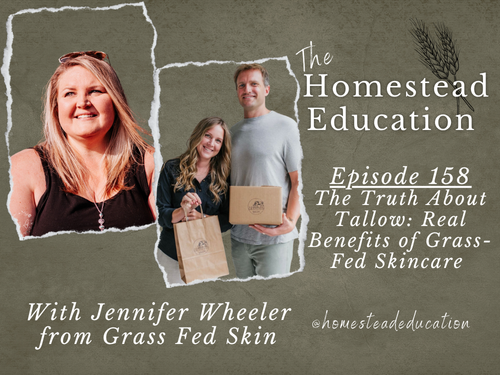
Episode 158: The Truth About Tallow: Real Benefits of Grass-Fed Skincare with Jennifer Wheeler
Episode Highlights
In this episode, Kody sits down with Jennifer Wheeler, co-founder of Grass Fed Skin, to share the inspiring story of how she and her husband, Eric, followed God’s calling to leave their established healthcare careers and build a family-run, faith-led skincare business. Jennifer opens up about the moment she felt led to start something new, the early days of crafting tallow balm at home, and how their simple, natural product has transformed lives by helping people heal their skin and reduce toxins in their homes.
Podcast Review
Did you enjoy this episode? Please drop a comment below or leave a review to let us know. This can help other folks learn about this podcast and we also really appreciate the feedback!
Podcast Links and Resources
Use code “WelcomeGFS” at checkout to get 10% off!
Website- https://mygrassfedskin.com/
Instagram- https://www.instagram.com/grassfedskin
Facebook- https://www.facebook.com/profile.php?id=61550030956702
Kody's Links
Website: https://www.thehomesteadeducation.com/
Shop Curriculum: https://www.thehomesteadeducation.com/shop
Speaking Events: https://www.thehomesteadeducation.com/events
Facebook: https://www.facebook.com/thehomesteadeducation
Instagram: https://www.instagram.com/homestead_education
Watch episode on YouTube: https://www.youtube.com/@homesteadeducation
Read MoreLess
INTRODUCTION
Hi everyone, welcome back to the Homestead Education Podcast.
Today’s guest is Jennifer Wheeler from Grass-Fed Skin. We met at the Azure Standard Harvest Festival, which was such a fun event. I got to meet her, meet her wonderful family, and try their products — and I loved both the story and the mission behind the business. I asked her to come on and share that with us.
WHO THEY ARE
Jennifer and her husband have four kids, they homeschool, and they live in Jacksonville, Florida.
Grass-Fed Skin is their family business — and not just a side thing. It’s their full-time work. It supports the household and, just as importantly, it’s allowed them to be home together instead of living on two separate schedules. They see that as a huge blessing.
A lot of people dream of that “family economy” life — where the work and the kids and the marriage all live in the same place instead of everybody being pulled in opposite directions. They’ve actually done it.
LEAVING HEALTHCARE TO BUILD A FAMILY BUSINESS
Both Jennifer and her husband came out of professional healthcare. She was an occupational therapist in a rehab hospital, and he was a physical therapist and eventually a clinic director in outpatient ortho.
They were good at what they did. They were respected. They expected to retire in those careers.
And then something shifted.
It started as a really strong internal nudge — an uncomfortable, physical sense that life was about to change direction. That feeling wouldn’t go away. It was so strong it felt like somebody was literally tugging on her arm.
From the outside, nothing was “wrong.” The schedule was flexible. The pay was solid. The work was fulfilling. They weren’t looking to get out.
But they couldn’t shake the sense that God was pushing them out of what felt stable and into something completely different.
DISCOVERING TALLOW
Around this same time, Jennifer found tallow as skincare.
She didn’t have a diagnosed skin condition, but she had always hated her skin. Starting as a teenager, she had very dry, crepey skin — the kind that sheds after a shower, the kind that looks fragile and thin at an early age. She assumed it was hereditary because her mother and grandmother were the same way.
Nothing worked. Lotions, creams, oils — they either sat on top of the skin and felt slimy, or they did nothing.
Then she tried tallow.
Right away it felt different: nourishing instead of greasy, absorbed instead of sitting on top. Over time her skin changed. Not just “felt better,” but actually strengthened, held moisture better, and didn’t need constant reapplication. The texture itself improved.
That experience was addictive. That was the first spark.
MAKING SKINCARE IN THE KITCHEN
Because of the way they already ate — bulk-buying whole or half cows from local farmers — they had access to clean beef fat. She started asking for the extra fat so she could render it and turn it into balms and creams for personal use.
Then she started gifting it.
Friends and family had the same reaction: shock that it worked so well, and then, “You need to sell this.”
This was before tallow blew up online. At that point most people’s reaction was, “Wait… are you putting beef fat on your skin?”
So there was education involved. But there was also real, obvious, undeniable change. People with issues that hadn’t responded to anything else were seeing improvement with tallow.
The creativity part — formulating the balms, making small batches, creating gifts — became a joy, but at first it was still “just a hobby.” The answer in her head was, “I already have a career. I don’t have time to start a business.”
And then God spoke.
THE CALL
During a church service, the pastor asked a question:
“If there is something you could start tomorrow — and you knew you would not fail — what would it be?”
Immediately, and clearly, the answer that came was: Start this business.
The next thing the pastor said was, “If you just heard something, that was the Lord speaking to you. I encourage you to take the first step.”
That moment changed everything.
From there, doors opened fast. She told a small circle of mom friends, “I think I’m going to start selling this,” and opportunities just started happening:
A seasoned skincare couple at a local market took her under their wing.
They shared years’ worth of knowledge — labeling, branding, wholesale, marketing.
The business skipped hurdles most startups fight through for years.
It was obvious that this wasn’t random. It felt directed.
GOING ALL IN
The business began to take over her schedule. Without even planning it, she found herself working fewer hours at the clinic and spending more time producing, testing, shipping, answering messages.
It was deeply fulfilling. It felt aligned. It felt blessed.
After a lot of prayer, it became clear that the next step was leaving the “safe” career she thought she’d have forever.
So she quit.
Within about six months, the business grew so much that her husband left his full-time physical therapy job as well to join her.
Now both of them run Grass-Fed Skin full-time. The business supports the whole family, and they’ve even hired five employees. It’s not “mom’s side hustle” anymore. It’s a full company.
They still use their clinical background. Some physical therapy work still happens occasionally, and the products themselves are used by massage therapists, chiropractors, and PTs in wellness settings. The health mindset never left — it just changed form.
FAMILY RHYTHM, GOD’S TIMING
Part of the “why” behind the business was motherhood.
Before all this, the kids were often with Jennifer’s mom during work hours. They weren’t with strangers, but it still didn’t sit right. The desire to actually raise her own kids, day to day, instead of dropping them off all the time — that was heavy on her heart.
That desire was prayed over.
Now the family is together every day: homeschooling, working, shipping, creating, traveling to markets, and being formed by the same mission.
The timing felt orchestrated, not accidental. “We were designed to be together as families.”
ROOTS, HOMESTEADING, AND WHAT REALLY MATTERS
Before a huge move and re-settling, the family lived in a home where they were actively homesteading: chickens, quail, gardening, eggs, green beans from the backyard, toddlers bringing in breakfast in their shirts.
Even now, while renting and in a temporary situation (after an international move to Costa Rica and back), that ache to get back to that slower, land-connected rhythm is still there. Those are still the most cherished memories.
That lifestyle wasn’t trendy. It was deeply grounding. And it changes you.
WHY TALLOW MAKES SENSE
The logic behind tallow-based skincare is actually simple:
Human skin produces sebum (our natural skin oil).
The structure of beef tallow is extremely close to that sebum — often described as a 98% match.
Because of that similarity, the skin recognizes it and uses it. It doesn’t just “sit on top” like a film. It nourishes.
By contrast, most mainstream body products are built around seed oils, synthetic emollients, and petroleum derivatives. Those aren’t biologically compatible in the same way.
This used to be common knowledge in traditional life. Animal fats like tallow or lard were used to condition leather, seal wood, waterproof gear, and soothe skin. Families would rub rendered animal fats into boots, saddles, cutting boards, butcher blocks — and hands.
It wasn’t weird. It was normal.
HOLISTIC SKINCARE, NOT JUST “NATURAL LOTION”
Grass-Fed Skin doesn’t position itself as “beauty.” It positions itself as part of a bigger picture of wellness:
What goes on your skin
What you eat
How much you move
Time outside and sun exposure
What you breathe in
What you wash your clothes with
Skin care is just one doorway into a more whole, less toxic life.
Women in particular are exposed to hundreds of chemicals every single morning before breakfast — toothpaste, deodorant, perfume, hair products, makeup, lotions, detergents. Reducing that load is not accidental. You have to choose it.
What keeps happening at markets is powerful: people come up and say, “I’ve been using steroid creams for years, and it’s only getting worse… and this finally helped.”
That moment can flip the switch: If something this simple worked better than prescriptions, what else can I change?
That’s the gateway.
WESTERN MEDICINE VS. ROOT-CAUSE CARE
There’s no “medicine is evil” energy here. Quite the opposite.
Having come from rehab and clinical care, there’s total respect for lifesaving Western medicine. Traumatic brain injury patients, spinal cord injury patients — a lot of those people are alive because of modern intervention.
The issue is not emergency medicine. The issue is that pharmaceuticals and procedures have become the first answer for everything, even slower, chronic issues that might be better managed with nutrition, detoxing the home, nervous system support, or microbiome repair.
The hope is to shift that pattern: Don’t start with the prescription unless you truly need to. Start with what supports the body first.
THE “HOMESTEAD TREND” IS NOT A TREND
There’s a common question floating around right now: “Is the homestead movement dying? Is the tallow boom just a TikTok fad?”
The answer here is: No, it’s not dying. It’s spreading.
What’s happening is not a trend — it’s a response.
People watched systems fail them. They watched their health decay eating ultra-processed food. They watched their kids spiral physically and mentally. They watched medical answers that never fixed the root.
So they’re reaching for food they can name, skills they can keep, and products made by people whose faces they’ve seen.
If anything, it’s normalizing. And that’s the point.
It’s not supposed to stay romantic and “cottagecore.” It’s supposed to become ordinary.
RAISING KIDS IN PURPOSE
A big theme here is the idea of purpose.
Modern kids are often bored, anxious, and lost because they don’t actually have meaningful responsibility. A teenager 100 years ago could run a farm, deliver a calf, fix something that mattered, feed the family.
A teenager today is told their whole “job” is to sit still, complete worksheets, and not cause problems.
When kids are given meaningful, real work again — feeding animals, helping ship orders, gathering eggs, restocking inventory, loading the van for a market, learning to talk to customers — it stabilizes them. It gives them strength, identity, and calm.
This is absolutely part of the business model. It’s not just a skincare line. It’s a restoration of family function.
HEALTH STORIES, HEALING STORIES
There was also a powerful story shared about serious illness.
Years ago, there was a liver failure diagnosis — “end-stage,” with a timeline of about one year to live, at just 33 years old. The answer from the system was basically: prepare for the end.
Instead of accepting that, the family pulled all the way back to first principles:
Sourcing clean animal products
Growing and preserving real food
Ditching synthetic cleaners and body products
Rebuilding the home around low-toxin choices
Treating the body as something to heal instead of just suppress
Over time, the liver markers radically improved. Years later, a doctor went in expecting to see catastrophic liver damage and instead saw mostly healthy tissue, with only limited scarring. The reaction was disbelief: “I’ve never seen this before.”
That wasn’t magic. That was a full lifestyle shift.
This is why “holistic” for this family is not a buzzword or branding move. It’s survival.
LET’S TALK ADHD, NEURODIVERGENCE, AND AUTISM
The conversation also went deep into neurodivergence: ADHD, Tourette’s, autism, sensory overwhelm, executive function, behavior versus neurology.
Key ideas:
ADHD doesn’t look the same in every person. For some people it’s physical restlessness and forgetfulness; for others it’s mental ping-pong, internal noise, and difficulty sustaining focus even on things they care about.
High-functioning autistic kids can still need a ton of support to get to the same finish line as their peers. The expectation can stay the same — the path is just scaffolded differently.
You can love someone fully as they are and still say, “How do we make your life easier and more comfortable in your own body?”
It’s not “insulting” to want to reduce suffering.
There’s also frustration with how quickly pharmaceuticals get pushed as the only option without first asking:
What’s in the diet?
What’s inflaming the gut?
How toxic is the home environment?
How stressed is the nervous system?
Is the child overloaded, under-stimulated, mis-matched, sleep deprived?
The position here is not “never medicate.” It’s “medication shouldn’t be the first and only plan.”
WHY TALLOW WORKS (AND ANSWERING THE ONLINE CRITICS)
There’s a talking point floating around on social media right now: “People need to stop using tallow. The molecules are too big to absorb into the skin. It can’t actually do anything.”
Here’s the response:
Tallow is not a lab-made “moisturizer.” It’s not a plant oil. It’s not petroleum. It’s rendered animal fat.
Its structure is extremely similar to the oils (sebum) that human skin already produces. That’s why people see such dramatic changes — barrier repair, calm redness, resilience coming back — especially in skin that’s been inflamed, over-exfoliated, steroid-damaged, and stripped.
The proof is not theoretical. The proof is in the results:
People with chronic skin conditions who’ve tried steroid creams for years and only gotten worse suddenly start healing.
People with intense dryness, cracking, flaking, and eczema patches see actual recovery.
People finally stop feeling like they’re wearing a layer of plastic.
It’s not an “occlusive,” it’s not exactly an “emollient,” it’s its own category. And you can’t really even compare it to mainstream lotions because it’s a different substance altogether.
The testimonies coming in from real humans — moms at markets, people in chronic discomfort, practitioners who’ve switched to tallow-based balms for massage or post-therapy soft tissue work — those stories matter. They’re data.
KEEP GROWING
“Keep growing” means: don’t stop because one door closes.
There will be people who tell you no.
There will be a landlord situation that falls apart.
There will be a move that wrecks your plan.
There will be somebody in authority who doesn’t get it and makes you feel small.
That doesn’t mean it’s over. It means that wasn’t the door.
Keep moving. Keep praying. Keep asking, “Where am I actually being sent?” Trust that if God called you to something, He’s also willing to meet you in it.
Don’t let a bad moment convince you you’re done. Look for the next open door.
WHERE TO FIND GRASS-FED SKIN
The business ships nationally.
Website: mygrassfedskin.com
Social: Instagram and Facebook at grassfedskin
On the website you can order products directly and have them shipped to you. Following on social gives you a feel for the family, their values, what they believe about health, and the purpose behind what they make.
That matters. When you buy from a small maker, you’re not just buying a product — you’re agreeing with what that family stands for.
There’s also a discount code in the show notes for listeners.
Thank you for sharing your story, your faith, your honesty, and your work. Listeners: go check them out, support the shop, and swap something in your daily routine for something that was made to heal you, not harm you.