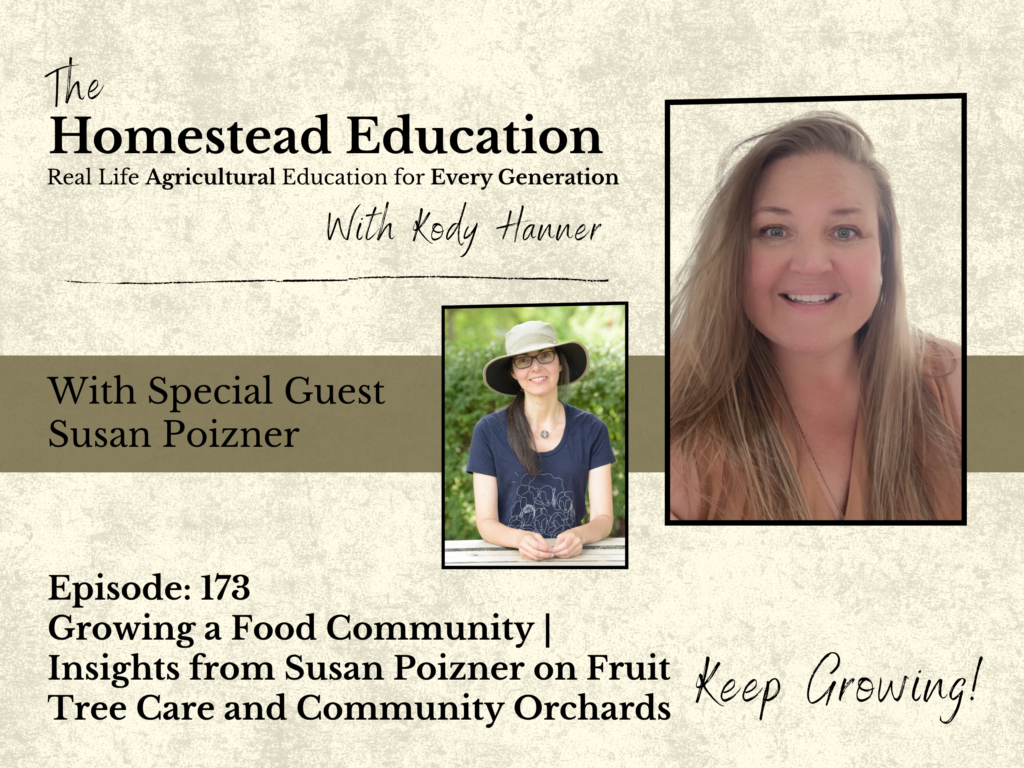
Episode 173: Growing a Food Community | Insights from Susan Poizner on Fruit Tree Care and Community Orchards
- Kody Hanner
Episode Highlights
In this episode, Susan Poizner shares her journey into urban orchards, emphasizing the importance of understanding and caring for fruit trees. Her insights are especially valuable for community groups, schools, and individuals committed to food resilience and ecological harmony.

Key Topics
- The crucial minimums needed to keep fruit trees healthy and productive
- How to select climate-appropriate fruit trees and the importance of native and disease-resistant cultivars
- The role of community orchards in building sustainable food systems
- Community-driven strategies for orchard maintenance, pest management, and soil health
- Practical tips for planting, spacing, and protecting young trees
- The emotional and ecological bonding with trees as living beings
- How to integrate food growing into small spaces, urban environments, and large properties
- The legacy aspect of perennial trees and their role in family and community traditions
- The influence of rootstocks—dwarf vs. full-size and their implications for care
- Strategies for pest and disease control using organic methods like dormant sprays
Final thoughts:
This episode underscores that caring for fruit trees is not just about harvesting—it’s about building relationships with nature, nurturing community, and fostering resilience for future generations. Whether you have a backyard or a large farm, adopting a thoughtful approach rooted in ecological mindfulness can transform your space into a thriving food forest.
Podcast Links and Resources
Susan Poizner’s Resources & Links
- Susan Poizner’s Website
- Growing Urban Orchards Book
- Designing a Fruit Tree Garden
- Fruit Tree Grafting Book
- Organic Dormant Sprays
- Orchard Nurseries & Resources
Connect with Susan Poizner
Kody's Links
Homestead Education Curriculum:
https://thehomesteadeducation.com
Shop Books & Resources:
https://thehomesteadeducation.com/shop
Join the Email List for Resources & Updates:
https://www.thehomesteadeducation.com/subscribe
Follow Along
Instagram:
https://www.instagram.com/homestead_education
Facebook:
https://www.facebook.com/thehomesteadeducation
Hi everyone, and welcome back to the Homestead Education podcast. Today I have Susan Poizner with me. She is a award-winning author and podcaster on fruit tree care. And this is such a timely conversation as we are not only heading into a lot of orchard care season, not the picking the care, and we’re looking at some food issues in the fall. So let’s start making some plans now. So welcome, Susan. Thank you so much for having me, Kody.
ShowHide Full Transcript
Yeah, I’m I think this is going to be a great chat because I love the concept of, you know, extending our like food forest around our property. And I’m really bad at remembering to do things. And so having somebody who can like maybe guide me through a few of those steps would be really great. So would you like to tell everyone about yourself and what you do and. Absolutely. OK, so.
I kind of fell into this in a funny way because I, my background is a journalist. I used to work for the BBC World Service and lived in London, England, and I’ve had a very interesting life. I grew up in Canada though, and moved back to Canada 25 years ago or something. And I decided to plant a community orchard in my local park.
I had been dabbling in gardening. I even for a while had a job as a gardener for the city of Toronto. So I knew about organic gardening and I was excited about the idea that fruit trees are not only beautiful and they have beautiful blossoms and they do all the great things that trees do in this world. They clean the air, they stabilize the soil, they cool our communities. I mean, it’s win-win-win.
And they produce food for us, which is amazing. So I decided that this local park, which didn’t have a lot going on, I wanted to start this initiative. I talked to the city. There were ups and downs, but we managed to make it happen. Here’s the problem, Cody. I didn’t know what I was doing. OK, so I think we all wake up every morning with that feelings. Yeah, exactly.
Kody Hanner (02:21.346)
But here’s the thing, if it’s in your backyard, okay, your tree will tell you it’s not happy. Either it won’t produce good quality fruit or it’ll have symptoms of disease or pest infestations. And you’ll look and think, was that a good idea? Or what did I do wrong? I have no idea what I’ve done wrong. If it’s in your backyard, that may happen. If it’s in your local park and…
People knew that I had started this initiative and I’ll be honest with you Cody, there were people that did not want me to plant fruit trees in our local park. Wow. Because they said it’s messy, you’re going to neglect the trees, it’s going to be bad for the community, children will get cherry stains on their t-shirts. didn’t like that. no. Yeah, exactly. I knew my children had a good day if they come in with cherry stains and I didn’t have to feed them. yes, you’re a good mummy. That sounds good.
So people were watching this and I couldn’t, I didn’t want to fail. You didn’t have room for error. There was no room for error. Luckily, I’m, my background is I’m a researcher, I’m a journalist. And when symptoms started to appear on the trees, I started to realize, Whoa, I think I better figure this out. And it only took me what
five, ten years. That’s nothing in the life of a tree, you’re good. No, I mean my quest was because I had another job, there were other things I was doing with my life, my quest was to discover what is the minimum I need to do in order to grow healthy and productive fruit trees. This is not my full-time job, I just need to know the minimum. And so in all my books starting from
Growing Urban Orchards, which was the first book that I wrote and a lot of people love it. Community orchardists absolutely love it because it’s written from my perspective as a community orchardist. But it tells you about all the mistakes we made and all the lessons we learned. And you can read that book and say, okay, I get it now. I know what I’ve done wrong and I know what I need to do in order to keep my fruit trees healthy. Then from there,
Kody Hanner (04:41.91)
I did other things, including write other books like a specialist book on fruit tree pruning, if you want to dig deep there or fruit tree grafting, if you want to create your own fruit trees. But that was my initial journey when I created that book, Growing Urban Orchards. And I’m so happy to share that information with you on this podcast. What is the minimum you need to do, in order to keep those trees healthy and productive? Well, I really appreciate everything you’re doing. mean, even you wrote
You mentioned that you have growing urban orchards and I immediately jotted that down because I have so many like micro schools and stuff that get in contact with me and ask how they can, you know, start growing more food for the kids at the schools. And I think that would be a really great one because that’s more of that concept. Yes. Even in rural communities, because it’s the community taking care of them. I love that for so many reasons. I
To me, and I moved from my house, we had initially some fruit trees in our backyard. We recently moved from our house into a condominium. So now we’re living a very communal lifestyle in a small space and I don’t have my own backyard. I am so happy to have a community orchard to play in with my friends that I established all those years ago. But to me, the community is made up not just of humans, but of trees. They’re part of our community too.
And we are all working together to bring abundance, to bring nutrition, to bring love to our communities, us and the trees together. So even if you have a backyard and you have one or two or three fruit trees, they’re your community and you start to tune to them and realize they have needs too. They’re not just a thing in the backyard. They are beautiful beings that want to share and have an experience with you, just like you want to share and have an experience with them.
And as soon as you learn to listen to them, then it’s kind of so much more fun. I agree. I actually jumped in between a elderberry bush and a backhoe to save it. So that means on my own property. But we had somebody come in to level out a spot and I didn’t realize it, but we had a new elderberry bush growing, which I know it is in a tree, but it’s that same, you know, their perennials and we harvest them every year.
Kody Hanner (07:04.202)
And I actually had one of our elderberry bushes die last year and I was really sad about it. And I was out near there and we had this guy coming into level a piece of land and I noticed there was about a four foot tall bush starting to grow wild right there. And I like jumped in between it and I was like, no. But luckily, he’s from our community, too, and gets it. And he’s like, I didn’t even see that was an elderberry. My wife would have killed me. So.
Um, but I love that community concept with the trees and you know, a lot of people don’t even think about this in the rural sense. And, know, we think about, uh, you know, community orchards, like in parks and, know, on city streets. And I know a guy in Montana who does, um, he taps all the trees down streets in town and gets, um, syrup out of them. And he had to, you know, get permission from the city to do that. And, you know, so I see all these really amazing things happening.
And then I look at our community that was an original homestead community that kind of ended up being a not as the whole town burned down and then they never really rebuilt. And so we have all the old homestead trees still growing in our like extended community and everybody picks them. They aren’t even if they’re on someone else’s property. We all just kind of have this like understanding that there’s plenty to share.
And we would, we also have grizzly bears in this area. So we’d rather people get all the apples off the ground and keep the grizzly bears not down in the more residential area of our community. And we actually raise pigs too. And people will bring us all the apples that are scraps to feed our pigs. And so it makes it where the entire community, we’re not only feeding each other, but
you know, we’re supporting each other in our endeavors and stuff through the trees. I love that. And then as you go step by step, one of the things that I found over the years with our community orchard, one of the best ways to work with your trees, to communicate with your trees, to help shape them so that they can produce the kind of fruit that you want to enjoy quality fruit is with correct pruning.
Kody Hanner (09:24.98)
And those community trees, again, there’s another way they will bring you guys together is that, you know, if one person gets up and running with how to print fruit trees, bringing the team and training them up, like just everybody can work together to interact with the tree to help guide its growth so that the tree is able to produce the quality of fruit that you want, because that is one of the main goals of fruit tree pruning.
to improve your harvest quality and to deter disease. So those are two of many goals with fruit tree pruning. And again, it’s all knitting together, the community, the humans, the trees and everybody, and even the bears on the sideline or the other plants keeping the wasps away, keeping the beneficial insects nearby. It’s a kind Oh, are so hard with the bees.
Yeah. Or with the bees with the trees. Yeah. Yeah. Because I’m highly allergic to yellow jackets. And so then I end up I’m a great mom. I send my children out to get the apples. Well, and you wake up around the trees, hopefully with a fallen fruit, because that’s the biggest problem. And in fact, when we were starting our community orchard, that was one of the concerns. And I got that like that is a good concern. They were saying, don’t plant fruit trees because they will attract wasps.
We do not have a wasp problem in our park. The reason is because we are always taking care of those trees. We’re always raking up fallen fruit. We don’t let it sit there and rot. Another concern was children will throw rotten fruit at each other or they’ll throw rotten fruit at the houses nearby. I’ve never seen that happen. You never know. Maybe it does. But the point is we are meticulous around our trees and that’s important. Yeah, it definitely is. And like I was mentioning, you know,
We raise pigs. don’t just raise a couple of backyard pigs for ourselves. We’re raising about 350 hogs a year. And so people bring in that the scraps for us and I feed it to ourselves. I don’t feed it to our feeder animals because I, you you know, let people know like they’re getting non-GMO and not sprayed and all those things. And I can’t always guarantee that with scrap food. However, with that, there’s so many communities that people own. And then I donate.
Kody Hanner (11:49.292)
meat back to our community every year and that’s part of our rotation with that. But so many people don’t realize that there are tons of farmers who would be more than happy to take your bad fruit. Whether it’s for chickens or pigs or compost and things like that. you know, as long as it’s not to the point of gross, but if it’s just past where you’re comfortable consuming it, that’s the one thing that lot of people don’t think about. It’s amazing.
It’s amazing. This beautiful planet gives us so much. It gives us everything we need. Right. And you know what I mean? And I think for myself, moving from a house to a very much smaller space, I realized that there’s a place for all of us. And it’s equally important. We are all part of our own ecosystem and it’s all important.
You know, just on that thought, I was just thinking about, have a friend who lives upstairs in this building and he says, in the winter, we got cold winters in Canada. He never has to turn on his heat. I can look out my window and see Canada. So, hey, feel, yes. We’re in Idaho, but we’re a thousand feet from Border Patrol. So, right. Yeah. So basically he never turns on the heat in the winter because in this building.
The heat moves upwards. So your neighbors downstairs may heat their place and they get warm. And then the heat goes up and he never has to turn on the heat. That’s good for the environment. Right. So there’s just so much. I just love the wonderful, you know, puzzle pieces when they come together in all of our ecosystems, human nature and everything. I actually read recently that people used to bring their or build their houses over the barns or bring their
cattle into or like their family milk cow like into right outside the kitchen like a room there that would actually help heat that area because of the heat coming off the cow and I was like I don’t want a dairy cow in my kitchen but I love that idea you know yeah yeah yeah I’m having like you know building your like barn into the ground where then it maintains temperature and then building your house over that so smart yeah
Kody Hanner (14:03.358)
so I get a lot of questions from people with fruit trees and I have some myself. So could I just kind of go down the list and just ask away? Yeah. So, you know, right off the bat, you know, the America continent has so many different climates. How would you suggest people find the right trees for their climate?
Thank you for asking that question, Cody, because people don’t ask that question and they go to the garden center or they go to the big box store and they just grab the first tree they find. And that’s what I did in the beginning, that kind of approach. And that is problematic because it’s sort of like the matchmaking thing. You know, you want to meet a partner to spend your life with and are you going to just take the first partner that, that, you know,
They’re there. They’re like, okay, they’re okay looking. I’ll hang out with them for the rest of my life. Sure. Why not? And it’s the same thing with fruit trees. So high maintenance and not Purdue. No, they could be totally high maintenance. I know. You know what I mean? So yeah, luckily I got a husband. He’s a little high maintenance, but I love him anyways. But, so yeah. So what I, my most recent, I do cover this as well and growing urban orchards, but I wrote a whole book called,
designing a fruit tree garden. it takes you through the steps of choosing the perfect tree for your climate, your conditions, your microclimate. And so what we know of anybody who’s a gardener, you know you have a plant hardiness zone, you’re either, you know, a cold climate or a warm climate and you need to get trees that suit that climate.
So once you start doing your research, realize that trees will, when you research, you’ll find out there’s certain zones that are appropriate for those trees. Sorry if that’s loud. have my window open and there’s a like a little airstrip right by my house for the border patrol. And so I have planes landing all day long, but I didn’t hear a thing. Okay.
Kody Hanner (16:12.264)
They’re full planes, like they’re like the little biplanes and stuff. Like, you know, just single person planes and the kids love watching them. But when I my windows open, sometimes it’s all loud. That’s OK. I didn’t even hear. Yeah. So basically you want to get a tree that is has been researched to survive in your zone. That’s a no brainer. And just because a tree is in your garden center, big box store does not mean it grows well in your zone. An example.
Do you guys get honey crisp apples in your supermarkets? They’ve become super popular, honey crisps. Yeah, yes. They are amongst the hardest to grow. Really? And there’s lots of issues with honey crisp apples, but they put them in garden centers and they put them in big box stores because they know people- recognize the name, yeah. Yeah, and they’re like, I love honey crisp. They’re so sweet. They’re so crispy. We live very close to Washington, so we have lots of apples and potatoes where we live.
Yes, I know. I’ve been to Idaho. I really enjoyed visiting. my gosh. So interesting. So yeah. So basically, you can do your research by going online and finding a local fruit tree nursery near you on my website, orchardpeople.com. Just put in the little search bar nursery or nurseries. And I have a list of them across North America. You go to their website and you find their catalog and in the catalog, was
specify what zones grow well, what trees grow well in your zone. For each tree, you’ll look up Honeycrisp and you’ll say, it important for, is it relevant for my climate? Honeycrisp has other problems too though. Anyways, so that’s one thing. Then you have to be concerned if you’re in a warmer climate about chill hours. Fruit trees need cold weather.
So if you’re in Florida and there’s not enough cold weather, certain cultivars of apples, for instance, just won’t produce fruit. They may or may not survive, but they will not produce fruit. In order for it to produce fruit, for the tree to go through the stages it needs to go through hormonally, it needs cold weather and a minimum number of hours of cold weather. Okay, so there’s another mistake. But here’s the thing that I learned, because in Toronto we don’t want…
Kody Hanner (18:32.162)
worry about chill hours, we get lots of chill hours, you guys get lots of chill hours, you’re good with that. Disease resistance. Yeah. One of the biggest problems people will face when they plant any old fruit tree is it seems healthy at first, it’s doing okay. And then after a couple of years, it starts to get spots on the leaves, it’s growths on the branches, it’s not growing well.
and a lot of these things are caused by diseases and because of that researchers have developed disease resistant fruit trees. These cultivars you won’t be familiar with because you can’t buy liberty apples, freedom apples, and there’s pristine one of my favorite favorite cultivars. It’s an early apple, sweet 16, all of these are wonderful just example using the example of apples wonderful cultivars.
and they are easier to grow because they do not get those diseases on the whole. nice. Now do you know off the top of your head how many cultivars of apples there are? Because isn’t it like an obscene number? Obscene thousands. Yeah. Yeah. Even if you just flip through these nursery catalogs and see what they have to offer, it is mouthwatering. It’s like you need to read carefully because some of the apples for instance might be heirloom apples that are only good for cooking, which is great if you’re big on apple pies.
you may find the perfect apple pie apple. you know, like for, I’m sorry, for us, have crab apples on our property from this is, the old homestead ones that honestly we don’t prune, we don’t water. They’re just there. They just, this is their home, you know, so great. And so we will pick and we have crab apples. We have kind of just a, a more sour apple, but not the crab apple.
And then we get like, then we have our actual root, you know, our orchard that we take care of and we get a bigger, sweeter apple from there. And we will mix the three of them for our cider. And it is out of this world. That is so ideal because first of all, crab apples can be very hearty. And if it’s an old apple tree, another consideration you can, you think about when you get a fruit tree.
Kody Hanner (20:54.218)
is the root stock it’s on. These are not seedling trees, they’re grafted. Because if you want a specific cultivar, you have to take a cutting from the original tree or one of the descendants of that tree and you graft it onto roots of a compatible tree. So in the old days, the root stocks were rugged, full-sized trees and they have huge root systems.
And so once they get to a certain age, they need very little care because the roots stretch far and wide. They can find their own water unless it’s a total drought. And if you’re loving, you still give them water, right? But nowadays a lot of the trees you get, but you can request which root stock you want. Nowadays you can get dwarfing trees and you think to yourself, I want a dwarfing tree because I don’t want my tree to get taller than maybe seven or 10 feet tall. Yeah.
So you can get the same, let’s say Liberty Apple cultivar, sorry about that, on two different, on various different rootstocks. One would be a full-size Liberty Apple tree. One would be a little tiny mini Liberty Apple tree. But those dwarfing rootstocks make trees that are a little weaker. They don’t have root systems that are as big and strong.
And if your kid is kicking around a football and kicks it at the little mini tree with the dwarfing rootstock, it could knock over the whole tree. You don’t climb on those trees. They often need support. So that’s something that in my book, I designed it sort of as an interactive exercise. As you go through the steps, okay, first I’ll pick the cultivars I like, then I’ll figure out my climate zone. Then I’ll figure out my…
chill hours, then I’ll figure out is it disease resistant? And then I’ll figure out which rootstock do I want? And as you go through it, in the end, you have your perfect tree or number of them. So yeah, so that’s why your old crab apples do so well because they’re old. Those trees can live to a hundred plus years and you can still plant if you want a legacy tree, you can still get those tough old big full size rootstocks.
Kody Hanner (23:09.396)
then you have to think about other things. How are you going to harvest a big tree like that? How will you prune it and how will you spray it if need be with organic stuff? We definitely have trees that they’re actually on our neighbor’s property, but it’s a sloped hillside where somebody had actually like kind of cut and like leveled out. So the kids are standing on the edge of our pasture picking apples off the top of the neighbors, like 20 foot tree. fantastic. That works.
We’re on 40 acres and then the neighbors have another 40 that was originally all the like original homestead. So and so they kind of just blend together very nicely. Yeah. So the next question I have is, luckily, my fruit trees haven’t had too much issue with this, but we have some decorative trees by our driveway that I’m always worried it’s going to get to our fruit trees. And we’ve tried.
They get the, what are they called? Something moth that makes the, it looks like spider webs in the tree. Yeah, yeah. Okay. The coddling moth or? No, coddling moth is different. I know what you’re thinking of. It will come to me. I know what this is. have loads of pictures of it. And of course it’s not, it’s not a saw fly. It’s a Eastern, there’s the web.
fall web worms, and then there’s another one, the Eastern tent caterpillar, I think is what you’re That’s the one I’m thinking of, yes. Yeah. Okay. So I have some good news for you and probably a little bad news for you, but mostly good news for you. When it comes to pests and diseases, pests aren’t equally attracted to all different trees. Okay.
Just because there is a pest on an ornamental tree doesn’t mean it actually finds your fruit tree delicious and yummy. yeah, saying that, saying that I do believe on our fruit trees, the one year we didn’t do the secret to protecting your tree from pests, which I’m going to tell you in a minute if you want. Maybe I won’t tell you. Yeah. We did have some tent caterpillars up here in our orchard, but
Kody Hanner (25:33.012)
So codling moth, apple maggot, those are attracted to apple trees. They’re not attracted to peach trees. They’re not attracted to cherry trees. There’s other ones called plum corculio. They’re nasty. They’re attracted to a lot of different fruit trees. Thank goodness we don’t have a major problem with that. But between you and I and your listeners, you can
protect your trees from most of those problems with a winter dormant spray. So this is organic, organically acceptable. And this is one of the key secrets that I share in my book, Growing Urban Orchards. We use a mixture, it’s a kit, and it’s lime, sulfur, and dormant oil. That’s what it’s called, lime, sulfur, and dormant oil. You use both together.
you always carefully read the instructions on the box before spraying anything, because it goes on lots of fruit trees. It’s not good for apricots. It can damage apricot branches. So you always read the instructions. OK. But with that spray and most other dormant sprays, you spray your tree in the late winter. The temperature has to be just above freezing, not too much below, because I think then the
oil part of the spray will get a little gunky. I don’t know the exact reason why. And the buds must be tightly closed. So if you wait too long and you see those buds on your apple tree, your cherry tree, your pear tree, if you see the buds are starting to open and there’s even just a teeny bit of green or white tissue poking through, you cannot use lime sulfur and dormant oil. You will burn that tissue. Okay. But
What this stuff does, and if you can’t get lime sulfur and dormant oil kit, you can just use a dormant oil that is organically acceptable. Dormant oil spray. So what it does is it coats your tree with a layer of oil and smothers overwintering insects that are hiding in the cracks and in the crevices.
Kody Hanner (27:52.374)
and in the bark. So when you’re out there and it’s winter and you this is the first thing you’re going to do each year to protect your trees, you’re actually going to take your spray. You’re going to spray those bare branches until they’re dripping with a little bit of the spray, like, you know, completely wet and covered. And you’re going to find the cracks in the tree, the wounds, you can spray inside the wounds because that’s where stuff is hiding. And then you do, you let it dry. It’s going to be a dry day. You don’t want to do it in the rain because it’ll just wash it off. And
That alone, have done our orchard is let’s say 15 years old. We’ve done every year except for two years where I forgot or my timing wasn’t right. And those were the two years we had pests, including the 10 caterpillars. Can’t remember which tree they were on. And I can’t, I’ve got to remind myself a little bit about, you know, what they are attracted to, but it stops a whole load of insects.
Now, if the insect is a kind of insect that over litters in the either leaf litter or in fallen fruit on the ground, it’s not going to help you to spray those trees. That’s a different type of insect that you can protect yourself by in the fall, cleaning up all the fallen fruit and infested fruit and diseased leaves meticulously and taking it off the site. Do not put it in the compost because your pests will love the compost.
just come back again and again, full force. Luckily, the only ones that we’ve had is the bees and they’re just everywhere. Well, bees are great. They’re great too. You need pollination. bees, wasps. Which I know they’re great for pollination too, but they… There’s a lot of things great. They kind of don’t like wasps. Yeah, they suck. I hate to say that. With having no freeze this year, I’ve already told my husband, we are going to start… We are kind of like…
We try to be as much of a no-spray farm as possible. My husband has liver disease and that’s why we started growing all of our own food. And so we’re careful, but we also look at risk over benefit. And I have anaphylaxis to yellow jacket bites. So this year with no freeze, I already went down and bought a case of wasp spray. And every day when we do our little walks around the property and stuff, we’re starting to watch for…
Kody Hanner (30:12.746)
any type of movement or any nests we didn’t notice last fall because we have to like protect me in this sense. definitely. Yeah. But then also that’s not really happening in our gardens as much. That’s more happening on the sides of the house and that type of thing. So that’s the only place where we’re like, yeah, not happening. Like we will poison the heck out of you. And also when you say you’re not up for sprays, there are some sprays that are just diluted molasses.
So the thing that I realized early on is not all sprays are bad. Like some of them are just a wonderful way to add a boost in nutrition to your tree. But yes, I agree with the toxic stuff. Yeah, we are not even allowed to use that stuff in the park. And we minimize, to be honest, between you and I, that is pretty much usually the only spray we will use is the dormant spray.
Okay. Some of them don’t even have the lime sulfur. It’s just an oil and we use a neem oil. Neem oil is good too. I don’t know that it would, I’m not sure that it would serve that particular purpose for the winter. But neem oil is great as a pesticide and it’s from nature. Not that, I mean, there’s things from nature that can cure you too. But yeah. Like, one thing we do is we have, this is an orchards, but we have a,
some sort of little beetle thing that will just decimate my greens, like my salad greens. Especially if we have a milder summer and I can grow them further into the summer. And I mean, to the point that I’ll go out there one day and have lettuce and spinach and everything. And the next day go out and I have lace. It looks like a lace. They just eat everything in between. It’s a really crazy thing. And so when I’m trying to extend
those plants into the spring, I’ll use an essential oil spray on them. And if I go out like every day, like I water early morning and then I’ll go out once everything dries and spray all of them. And that keeps them off for the rest of the day. And then the next morning it gets washed off again. And it’s really, it’s just vinegar, essential oils and dawn dish soap. That is so cool. Yeah. That is very cool. Even if I like, you know, I have
Kody Hanner (32:36.448)
young kids where they like to grow carrots and things like that in their garden, they get their own spot in the garden where they grow their, I call them like their summer snacks, and they plant carrots and cherry tomatoes and that type of thing so that they can just eat out of the garden while they’re outside playing. And so I don’t worry if they decide to grab some of the greens and eat them because I mean a dash of Dawn dish soap, I’m sure they get more than that just off of our dishes, you know, so that always makes me feel good too that I’m not.
you know, poisoning the children. Well, there are fun, fun, interesting thing that I researched not too long ago is when I was visiting, the, an orchard in Geneva, New York, and they do a lot of research there. It’s linked to Cornell university and they were testing. exactly. They were testing a pesticide based on time, the herb time.
And I know here in Canada, there is a fabulous company that makes a disinfectant based on the herb time. just goes to show again, nature supplies us with what we need. And sometimes if there’s no company that can make money off it, nobody’s going to promote it. by you, you know, sharing your recipe, saying, look, it works. This is how much essential oil is in there. And this is unlike my kids eat, you know,
That’s a great way to share the good news. Yeah, I mean I travel and speak a lot and that’s one of the things I really talk about is if nobody can make money off of it, they’re not going to promote it, but pretty much, know, Earth or God or whatever made it the way we already needed it. It was beautifully designed. A lot of times we say, you know, in our talks is don’t eat food that’s more than five steps away from the way God made it.
that’s going to keep you in that healthy food and whole food. You know, if you can bring it home and process it further. But if you’re buying it at the store, process five steps beyond, then you don’t want anything to do with that. Beautiful, beautiful. So the next, let’s see here, the next question I have is I’m so bad. I should have. We moved on to our farm 10 years ago and I thought all I want is peach trees.
Kody Hanner (35:01.844)
I did some research, peach trees can grow in this area, we have some neighbors that actually have a great peach orchard, and I could live off of peaches in the summertime. If I would have planted peach trees then I would probably have peaches now. cause you know, what do they say, the best time to plant a fruit tree is 10 years ago and the second best time is today. And I have bought peach trees three or four different times and let them die. Because I don’t even plant them.
I’ll literally put them in the garden, like inside my garden fence so that they are protected and get irrigation on them. And I tell my husband, like, we need to find a place to put them and make all those decisions. And then we don’t. So I guess my question is when you’re making those, when you actually get the tree home, what do do with it? Yeah. OK. There’s so much involved in what you said. I’m sorry. No, but it’s beautiful.
It goes back to what we were talking about. You know, when you bring a baby home from the hospital or wherever you have your baby, you’ve had nine months to think about it, to work about, you know, painting the walls and getting the nursery ready to you’ve been caring for your own diet, making sure you’re eating carefully. Fruit trees are really not a shoot from the hip decision. And again, that’s why I wrote this whole book, you know.
designing a fruit tree garden because it’s all about taking that time to prepare. It could be those trees also did not survive because the cultivars weren’t tough. It could be clearly in a pot, they can’t thrive. And if they were your baby, you would never leave your baby, I don’t know, the same diapers forever or whatever. Do you know what I mean? So if
And this is so human. I’ve done this so many times. So then what you did is a very common thing lots of us do. But when you start to step back and say, no, I’m not buying a fruit tree yet until I decide where is it going to go? Because I’m going to be matching that fruit tree to the place it’s going to be planted in. So what I always suggest is when you are deciding to plant a fruit tree, the first thing you want to do is find your site.
Kody Hanner (37:24.598)
It’s going to be full sun because all of the traditional ones need full sun. Okay. It’s going to have well-drained soil. How do you know if the soil is well-drained? A great way to do it is bring your shovel to that site. Start digging. Dig for a few minutes. Is there like, is it rock hard soil that it’s like takes three people with big muscles to move that soil? Because if it’s that heavy, it might not be a great place for the small roots.
of your baby tree to push through. But if the soil is okay, if the soil is almost too sandy, you’re like, ooh, I’m going to pour water into the soil. It’s going to need more and more water, right? So just by checking out the soil, you are getting ready. then it looks, let’s say that the whole looks okay. Take a bucket of water, pour it in there and then start a timer. How long does it take for the water to drain out? Great idea. Yeah. It’s a fun idea.
And all of these things are fun to do. It’s exploratory. And if you’re anything like me, curiosity drives you. Do you know what I mean? It’s just like, and especially when you start to see trees as beings rather than as furniture or, you know, something nice that’s going to give me fruit. When you realize you’re making a new friend here, you want to make sure it’s nice.
Like if I was coming to your house, I’m going to be a guest in your house. You would make the bed for me. You’d be excited. You’d say, Hey, Susan, do you have any allergies? You know, blah, blah, blah. You take that time and it’s the same with the fruit trees. Right? So already you found the perfect location. You’ve checked the soil. You may even want to do one soil test, just one to make sure that the soil has the nutrients that fruit trees need. And then.
You go through the steps to choose the right peach tree, not the one. And guess what? It probably won’t even be in a pot. My dear Cody, it will be a tree. It’ll be a bear root tree that you get in the early spring or late fall. And if you forget to plant it, it will die within days. So it changes everything. Bear root trees grow faster. And with pruning, especially you prune them on the very day you plant them. Okay.
Kody Hanner (39:47.49)
They grow faster, they adapt to the soil better, and they will grow like gangbusters. So you use it early spring or late fall? Yeah, they have to be dormant. Bareroot trees have no leaves. The buds are tightly closed. They have to be fully dormant. And that’s what you get from specialist fruit tree nurseries, these wonderful bareroot trees. They are so worth it, and they’re actually cheaper than potted trees. But
for you knowing that your pattern was, okay, I’m gonna plant it. It’s a cutie. I’m just not sure where I’m gonna plant it. And maybe I’ll do it to next week. I know this, this is me. I get it, right? But when it’s a bare root tree, you’re gonna play a game of what we used to call it. There was a game show to beat the clock. Okay, you get the tree, you look at the tree, you say, how soon can I plant this? Because if I wait five hours too long, usually you’ll plant that tree within three days, if not.
the moment you get it home, like that moment. So you will never again forget to plant a free tree if you’re getting bare root trees. Okay, that’s… Yeah. So that definitely makes the difference. And we’re even really lucky we have a tractor with an auger. That’s how we dig holes for like our trees and stuff. So we don’t even have to get up and dig. Yeah. And yet if you need the auger, it might not be a great place for the tree. yeah. No, we don’t need the auger.
But just as an extra bonus, full-time farmers, anything that saves time in our backs. gotcha, gotcha. OK, I get it. Yeah, that makes sense. Yeah, so like I could plant 10 trees in a day if I wanted to. totally. Yeah, totally. As long as you take that time to go out and really feel the soil and check it out, because some soils are great for lots of things, but not fruit trees. Fruit trees are fussy.
Maybe because they’re grafted, maybe because they’re little franken trees. They’ve got different roots from a different plant. They’ve got a different top from another plant. can be a little bit delicate, even though we know the old ones on the big tough root stock can live a hundred plus years and feed people all that time if they’re well cared for. But yeah, they need extra special pampering. So that I think is your answer is just to have that system.
Kody Hanner (42:04.514)
that you are adopting a baby, right? You’re adopting a baby. want everything to be just fine. You’re going to get just the right baby too.
Kody Hanner (42:15.79)
Bring home, baby. I’m taking, I am a notes person. Me too. Like, I mean, see how much I Oh my gosh, beautiful handwriting. I love it. Oh, thank you. As a lefty, it’s very hard. So. Oh, really? I’m not a lefty. My handwriting is terrible. I type fast though. So then I think I have one more question. So when we bring our tree, like, so we’re trying to decide where to put our trees. And as I mentioned, we have 40 acres.
that have trees all over, but we want to put our trees in a place where we already have irrigation set up. And I already have a small orchard there, but I have some concerns because on one side of the orchard is walnut trees, and then on the other side is my apple trees that have been doing great, except for I didn’t prune last year and I got, and there was a lot of rain and we had such big, healthy, beautiful fruit that it broke my apple tree in half. I’m very sad. I’m sorry.
Yeah, but the other side seems to be very healthy this year and we cut it off and my husband is using the wood to smoke some pork. So we’re just we’re calling it, you know, making lemonade. Yeah. So I want to put it kind of in that area because we already have irrigation set up. I already know that it’s good drain soil. We actually we on and off pasture pigs in that area, but I have little fences around all my trees. But I’m worried about putting
peach trees near the walnuts. They’re black walnuts? Is that the thing? That’s the thing. I don’t know what kind of walnuts they are, but they’re edible. They were put in before we moved here and we just now started getting walnuts off of them. You see, I doubt they’re black walnuts. Black wal- yeah, they’re not. I doubt they are. I don’t personally see any problem with that. It depends how near you’re talking about in terms of near. It depends on what the root stocks are. If you’re
concerned about shading. You just think about where the sun comes up, where the sun goes down. I’m put them at the end of my walnut rows, but then they would be the ones that got the most sun the way. Yeah, right. Because it’s kind of like a hillside and like the walnuts are all on the like a little bit of a sloping part and then it goes down and then the sun it goes towards the west. So that’s where the sun is like the hottest all day long. So
Kody Hanner (44:45.038)
right. I think it’s going to a great spot. You think it’s going to be a great spot. Lost the sun sounds good. I will garden is in that little valley. So it’s, it sounds great to me. I just spaced the trees correctly. And that’s another one of those tricky things. The spacing of your trees depends on the root stock you choose. So we were talking about those little, uh, dwarfing trees that some people like, if they have a small garden, they can be planted.
pretty close together. Let’s say, depending on how you’re planting them, if it’s beautiful espalier or tight, tight together, can be six feet apart, but mostly not. Usually I would say for a pre-standing tree, it’s going to be 10 feet apart. But if you’ve got a bigger root stock, like a semi dwarf tree, which can go to 20 feet tall or a full size tree, you’re going to have to space it considering how big the canopy will grow.
So it’s the same consideration. Give yourself distance. if you can remind yourself, then you might have in your records what type of walnut trees, how big they are going to grow. You don’t want the branches of the different trees to be fighting each other and scratching up against each other. You want good air circulation around the trees. So as long as you give those trees enough space to…
grow to maturity without fighting each other then it should be fine. Okay well I feel like I feel more confident to get my peach trees again this year but I’ll wait till fall and then I will be because I think we’re past the time now and I will be very committed to having them ready in the fall. Maybe I’ll even plan to plant my garlic that day too and actually do that this year. I think that’s a great idea and you are going to send me a little email and you’re going to tell me what cultivars you choose. Okay.
And I am very curious to hear how this all goes. It’s going to be completely different because you’re just, when you don’t realize that a tree is a being, it’s so easy to just think it’s just a tree. And it’s just a flipping your consciousness. This is a beautiful living thing. Like I don’t have an emotional connection to zucchini plants. They can be cute. They can be wonderful. I love them. I love seedlings. They’re adorable.
Kody Hanner (47:09.902)
But I don’t have an emotional connection to my tomato plants. Do you? Okay. I like tomato plants. I love eating tomatoes. No emotional connection. And to season, you dig them up and you put them in the compost, right? The tree will be there for you for 20 years at least. Okay. This is going to be your family. Yeah. Yeah. And depending on what rootstock you choose, if it’s especially if it’s an apple tree,
So stone fruit trees don’t live as long, but apple and pear trees can live a long, long time. Your kids could be getting married under those trees. Yeah, that’s, that’s a beautiful part, isn’t it? So I, and just try this. You’ve got a big property. You can probably find one of those old trees. I don’t know if it’s different from tree to tree. go on tree walks every morning, give one of your trees a hug and you will feel, you will feel a pulsing.
You will feel what to me is the heartbeat of the tree. This is a beautiful living thing and it wants to be there for us. It wants to be generous. That’s all it wants. And all it needs is a little bit of love and it will give back in spades. That’s amazing. You know, I, we actually bought a live Christmas tree last year. Usually we like to go in the woods and pick our Christmas tree together. And, this last year,
life was different and so we ended up buying a live tree. we have a four, at the time we had a four and a six year old. And we told them, you know, in the spring we’ll plant this tree. And if you guys help take care of it, one day when it’s old and needs to be cut down, it might be your kids either Christmas tree or your firewood or something that provides for your family in the future. And they love that tree. So.
Yeah, I have a feeling when they get old enough they’ll cut the other ones down first. But yes, they’re probably hanging there. concept of, you know, it’ll be a tree for, you know, their animals to be under and part of our property, but the thought of like that that tree was going to have a purpose for their family one day felt very special. beautiful. That is so beautiful. So my favorite thing to ask everybody at the end of each episode is what does keep growing mean to you?
Kody Hanner (49:37.506)
Wow, could give you lots of answers to that, but the one that comes… one, huh? Yeah, this is a beautiful question and it is a deep one. So when I planted my orchard at first, I knew nothing about fruit trees and I had to keep growing. I thought it was gonna be easy. I really just thought, this is a good idea. Having a community orchard, I had to grow to learn to care for these trees, how to feed them, how to prune them, how to choose them.
how to work with them. And then I had to learn how to work with people because there’s volunteers, there’s people, and I’m quite an introvert. So I had to push myself to lead stewardship days, to teach people things that at the time I didn’t even know. I had to keep growing. And now that I have moved out of my home and I’m in a smaller place in a condominium, I have to keep growing.
And so my growth, I feel like I know a lot about fruit trees. There’s some more books I want to write, but I take myself out every morning, go to my amazing local park and I want to learn more about every kind of tree. So, you know, one week it’s willows and one I need to keep growing because if you don’t keep growing, you’re going backwards and we are so, this is such a precious place to be this beautiful earth. We’re not here forever.
I’m not wasting time. want to keep growing. So that’s what happens to me. that. I so much feel the same way. Like I am so excited for my teenagers when they go off to college, my husband and I decided I can finally get my masters. And like that is just, I am overjoyed. I don’t even know what I’m going to do my masters in yet. Cause I have to do it online. So I have to adjust my expectations as an ag major. Cause that’s what my bachelor’s is in.
And I that joy and that excitement is something that I hope everybody feels every day when they are deciding what they want to do. So would you like to tell everyone where they can find you and where they can find your books and your podcast and everything? I would love to. So people can go to orchardpeople.com and there you will find all sorts of resources. I’ve got lots of free articles on all sorts of topics around fruit tree care.
Kody Hanner (52:01.08)
how to feed your fruit tree, how to prune your fruit tree. I’ve got five books so far. So the first one we mentioned was growing urban orchards. And the most recent one that I’m really proud of as well is designing a fruit tree garden. And in between, I’ve got grow fruit trees fast, which is a quick read, the fruit tree pruning and fruit tree grafting for everyone. So I am now putting all my energy into getting all the knowledge that I have.
together into books that are fun, easy to read, interactive. And of course I also have my monthly podcast and that in that podcast I was lucky enough to every month speak to a different expert in fruit tree care in some way shape or form and have a really great conversation like this one where I could learn more. So hopefully that will help people and yeah I hope my books will help you guys too and thank you so much Cody for having me on the show.
Well, thank you for joining me and for my listeners, I’ll be linking everything down in the show notes, including each of the links to her books. And I think I’m going to be ordering designing a fruit tree as soon as possible. Everybody have a good one. Thank you.