Episode 177: Why Agriculture Education Should Be the Foundation of Everyone’s Education
- Kody Hanner
Episode Highlights
This episode dives into the crucial need to redefine agriculture education for today’s society. I share my personal journey, insights into food systems, and why foundational knowledge about where our food comes from is more vital than ever—regardless of whether you’re a farmer or not.
- The disconnect between conventional agriculture education and real-world needs
- Why understanding food, soil, and farm systems is essential for everyone
- How COVID, supply chain disruptions, and AI are shifting perspectives on local and small-scale farming
- The historical evolution of agricultural education and its current shortcomings
- Practical steps to incorporate meaningful agriculture lessons into homes and communities
- The importance of fostering purpose, resilience, and responsibility in the next generation
- The role of homeschooling, community involvement, and local sourcing in building a stable food future
Enjoy “What did Wade say?”
Podcast Links and Resources
- Courses and curriculum for agricultural literacy: https://www.thehomesteadeducation.com/homesteadeducationcurriculum
- Homesteading Summer Courses — 25% off mini courses with code SUMMER25: https://www.thehomesteadeducation.com/coupon-code/SUMMER25/sc-page/summer-on-the-homestead-kickoff-sale/
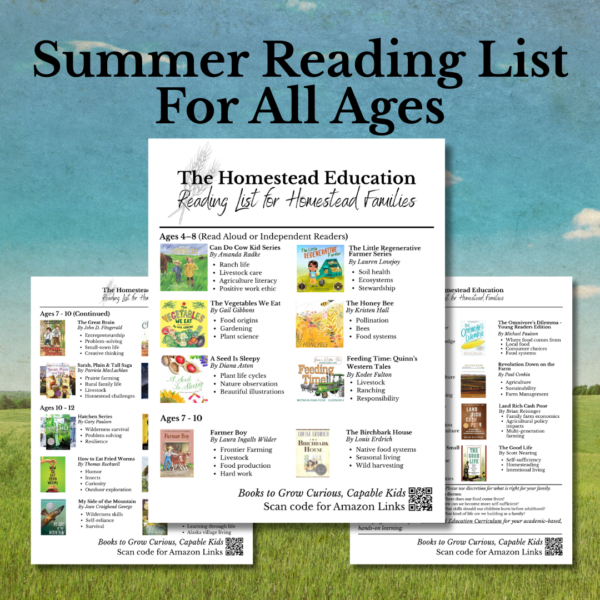
- Homestead Family Reading List: https://thehomesteadeducation.myflodesk.com/homestead-reading-list
Kody's Links
- Website: https://www.thehomesteadeducation.com/
- Instagram: https://instagram.com/homestead_education
- Facebook: https://facebook.com/homesteadeducation
I have been a little MIA lately. And if you follow my podcast, or not my podcast, my newsletter at all, you’ll know that we’ve just been facing a lot of hardships and I kind of had to take a step back from a few things. So, you know, I unfortunately had to miss a couple speaking events and
ShowHide Full Transcript
we’re just kind of resetting as a family in hopes that we don’t run into any more of these problems. You know, it’s it’s a hard one to just kind of come out and share when you’re struggling, especially when you’re somebody who is so good at guiding other people. And it’s a a well lot of the big reasons that we’re struggling are from outside sources versus things that we’re handling with, you know, within our home and our finances and our health.
And that type of stuff. There’s just been a lot of outside forces ⁓ affecting that. So it’s hard to kind of like admit it, reach out, whichever you want to call that, ⁓ and try to like get that. I don’t even know like what the word is I’m looking for. Like I’m not really looking for sympathy, but like some understanding sometimes. and definitely like prayers and I I would even say advice, butyou know, considering the fact I’m not really wanting to share everything, there’s not really advice to give. So, I mean, just keep me in your thoughts. Keep our family in your thoughts. It’s you know, we’ve it’s no one thing in particular, like, you know, ⁓ I mean my husband’s mom passed away earlier this year. That was really hard on the family. but it’s just been a lot of things like back to back. Like, you know, the engine on our truck truck blew up and so we bought a new engine. my husband and the kids put it in, but there was like a bunch of issues and we were constantly f you know, just trying to keep the truck on the road because that was all we had that would hold the family. ⁓ and so I scrimped and saved all summer, like during our busy season and last fall I bought us or you know, we put a down payment on a new vehicle. We hadn’t had a new vehicle in, you know, twelve, fifteen years. Which ⁓ you know, I’m totally fine with you know, driving an older vehicle, but I mean, if it doesn’t run, it doesn’t run.
And so I saved up and was able to buy us something newer. And I mean, almost immediately we hit a deer and did like $17,000 in damage. I mean, that’s just kind of like how ⁓ our life has been over the last six months to a year, and it’s just been one after another. Like I I’ll still be in the middle of one and the next one will happen. And I’m just kind of like burnt out personally and really trying to continue to show up. So, if you’ve if you’ve missed me at all, like I’m really sorry. if you didn’t even notice, well, then I’m glad I’m back and ⁓ I didn’t hurt your feelings at all. So I hope that made some sense. Anyways, I did want to talk to you guys today about the topic that I’ve actually been on the road with. And this is what I’ve been speaking about at a lot of conferences. And I feel I kept saying, like, man, you know, like I need to hop on like, you know, social media or Instagram.
And kind of have this same conversation that I’ve been having on the road. And I was like, Cody, you have a podcast. Liter people literally, you know, tune in to hear your thoughts on these ideas. So ⁓ I decided to just kind of it’s not like I’m giving you my speech that I do on the road, but it’s a little bit of that because I do want to follow the thought process that I have with it. And some of it’ll be repeat information for people who’ve been around for a little while. But at the same time, I think that it’s a conversation I really want to share and kind of light that fire for you guys ⁓ through my story and through the research I’ve done and like the tra and what I’ve learned and stuff. So today we are talking about redefining agriculture education ⁓ because it doesn’t always have to be conventional.
So, You know, I kind of I have to laugh because, you know, somewhere along the way, somebody decided that, you know, learning how to code was more important than learning how to grow food. And they said, you know, coding is the future. You know, that’s what’s, you know, your kids need to know how to do that. Otherwise they are not gonna be able to hold jobs and, you know, that’s what they need to have and you know, so on and so forth.
Well, you know Look at the world today. Now there’s AI where, you know, personally I can go in and be like, code my entire website and it’ll do it for me. I haven’t tried it, but I know that it happens. I was having some issues the other day with my website, and I kept Googling it and I couldn’t get a straight answer. And so I tried AI and it gave me the exact code I needed to plug in and got exactly what I wanted. So, I mean, something right there. I’ve been running my own website for a decade andyou know, some little glitchy thing that I just couldn’t figure out. That a lot of times I either have to go without it or, you know, pay a technician or something. I was able to go Google it right into AI. ⁓ or, you know, when I say pay a technician, it’s paying that guy that was told he needed to learn to code rather than learning other like life skills or soft skills and stuff like that.
So it’s kind of It’s just it’s it’s funny because it’s not funny because I feel really bad for a lot of people who work in those careers and they’re talking that AI is gonna be wiping out so many of those careers over the next several years, and we’ve already had so many careers already wiped out due to, you know, mechanization and computers and stuff like that. But we’re still struggling that people don’t have food on their tables and that people are not getting wholesome foods and that there’s still huge gaps in our supply chain and Honestly, we do not have the stable food system that we’re kind of told that we do. And so that’s why I decided it’s time to like really start like s yelling this from the rooftops. You know, when I started the homestead education, there were a lot of different reasons why I wanted to get out here and have these conversations. You know, the first one with the podcast is I really wanted to answer questions that so many people just don’t know to ask. And sometimes
I didn’t even know the questions, which is why I have brought on so many wonderful guests and you know for myself there were so many things when we were transitioning from, you know, being a commercial agriculture family to running a homestead, there were so many things I had to learn that I said, my gosh, like I can’t imagine how hard this would be for somebody who has never lived on a farm or homestead or worked in agriculture before. And I was like, you know, I might have those answers. That’s turned into an entire educational movement that I think that it’s just time to like take that one step further in that I think every single student, every single person not only needs to have a required agri agriculture education, but I mean they deserve an agriculture education. I think that’s been stripped from us as a society, and we deserve to have that back. Not that I think everybody should be a farmer. That’s honestly far from it.
I think that everybody should truly understand how the food system works because I mean, as we all know, if they control the food, they control the people. And we need to either figure out a f you know, find a way to get that back in everybody’s education, whether you’re starting kindergarten or you’re 35 years old and say, Hey, I I I’m ready to learn this. ⁓ I think everybody needs it. So a little bit of my background ⁓ is you know, I grew up in Northern California.
Which, you know, people here in California and they I don’t know what they automatically think, but I know it’s not what life actually was like there. I mean, my kids were sixth generation in a town of seventeen hundred. My dad was a cattle rancher, my mom was a taxidermist. my dad also owned shipyards in the Bay Area, like San Francisco area. And so, you know, that was a few hour drive for us, but he would go down there sometimes all week and work and but the shipyards kind of ran themselves by the time I came along.
You know, I grew up, you know, processing our own food, processing our own meat, growing a garden. ⁓ my neither of my parents were really into food preservation. My dad was really into drying ⁓ like jerkies and stuff. He had the best sun dried jerky and it just does not get hot enough in North Idaho for me to repeat that and it’s really a bummer.
But it was still I grew up very rurally. learned how to be very handy on the farm from a young age, learned to be very self sufficient, ’cause a lot of times I was just kinda on my own on eighteen hundred acres and, you know, given a quad and a Gatorade and a walkie talkie and like, you know, be home by dinner. And so yeah, I think it was just a different childhood than a lot of people have. even in today’s world. Like even those who live rurally still kind of struggle.
Don’t necessarily have those same the same childhood that I did. ⁓ not that anyone really ever has the exact same childhood, but so it what it basically was is for me, I went ahead, you know, from there I went and I majored in agriculture. I had actually wanted to work for the USDA. and then I ended up working in the private sector, ⁓ getting companies ready for USDA inspections and other food safety and quality inspections.
Before we kind of switched to the life that we have now. The, you know, because even though this is what I did in life, agriculture wasn’t content. This was my life. This is what I did every single day. ⁓ and it didn’t feel like I was doing something different. And it honestly didn’t feel like I was doing ayou know, something commercial or something that was only vocational. This was our life. This is how we fed ourselves. This is how we f you know, fed the family. and the skills that I was taught from a really young age were just kind of expected of all kids within my realm of people.
And so kind of like next part in life is I started, you know, doing some small scale farm consulting and stuff just because I really kind of started to see some issues in our food safety system that for lack of better word alienated the small farmer. And that kind of frustrated me because I grew up as a small farmer. And so I started really working with small farms and then
I got headhunted to a big food plant and I kinda just couldn’t turn it down. I was a single mom at this point and really needed that you know, the the promotion and the money and you know they were paying like a big relocation package and that type of stuff. And at that time is when I met my husband. ⁓
Kind of whirlwind relationship. You know, we’re both I’m, you know, single mom, dad’s not in the picture, long story there. if you go back in some of my episodes, you might hear that. my husband was a widower and he was kind of struggling, you know, doing life as a single parent too. And when we met each other, it was just like everything clicked. he’s still my best friend. ⁓ even when I, you know, kind of wanna wring his neck, but Very shortly into our marriage, and I’ve talked about this a lot on the podcast, but very shortly into our marriage, he was diagnosed with in stage liver disease. He that’s liver cirrhosis, it was stage four, and he was told that he maybe had a year to live and that we should really consider getting his affairs in order. And ⁓ my gosh, like I can’t even Tell you, I I I don’t even think that they even vented a word for the feelings that we were feeling at that time. I’ve heard some things like preemptive mourning or something like that. But I mean it was just shocking. he was in his early 30s, he’d never really drank. We do have some ideas that maybe like we’ve considered like burn pits in Iraq, something he was exposed to there. But basically we were told that because it was progressing so quickly that they really didn’t think he had much time. Like they didn’t even think we’d be able to stabilize him enough to qualify for a transplant. And at the time, like there was nothing wrong with him. Like he had some bad heartburn. We went in to kind of see what was going on. And then, you know, like one test led to the next and this was the diagnosis we got. So we’re like, my gosh, like this is gonna get bad fast. And we and we were scared. And I
called the hospital, like the VA hospital, probably like three times a day for the next week. Just, you know, are there clinical trials? Is there anything we can try? Like what should I do for him? And you know, it was just the same answer, same answer, same answer. And finally I think they were just really tired of like me calling and like weeping on the phone three times a day. So this one doctor said, you know, we heard if you live, you know, a cleaner lifestyle, that it could prolong his quality of life.
And that was something. It was the first thing that was given to me. And I started digging deeper into like the liver diet and how the liver is regenerative. But everything I read that said that based on the level of cirrhosis, which is scarring on the liver that my husband had, that there was that it didn’t matter what we changed, like it may not even make his quality of life better.
But I am a very tenacious person. So I said we’re gonna start growing all of our own food. Like I was an ag major. I grew up on a farm. We can do this. you know, we’re trying to buy all organic, which ⁓ well, we’ll have to have a conversation about that one day. But organic while affording like buying all the stuff that we need.
To also grow our own food and guess what? That’s not enough. You also have to process your own food, like all the way from the bottom. Like I used to think I may that I was a, you know, home cooker because I’d make chicken noodle soup and I would buy a box of broth and use it for my soup. ⁓ no. Like at this point in life, like we raise our own chickens, we raise our own herbs, we or grow our own w herbs, we grow our own carrots and onions and all those pieces. and pretty much the only thing that I’m putting in the pot that I don’t raise myself or grow myself is salt and peppercorns, which I source from very like well known clean companies. And so I mean and then I’m literally like taking the parts from the chicken and it’s going back into my compost, ⁓ that’s gonna be, you know, my vegetables for next year. Like that. Like it just goes on and on. Like I mean, we pretty much everything that I learned how to cook, I was like, how can I do this more ourselves?
And so l I mean we’re running the farm. We’re basically running a processing plant in our kitchen. ⁓ a food processing plant and a ⁓ you know, preserving everything and we’re making our own cleaning supplies and our own ⁓ herbal medicines and I mean we were doing it all. ⁓
And we were doing it all at once, which a a lot of people ask me now, and you’re like, What’s the first step to become a homesteader? Do not do what we did. But we didn’t have a choice. This wasn’t like we want to make this change for our family and it’s a positive thing and yay, like this was if we want that in our lives, this is what we have to do.
I do have to say that, ⁓ let’s see. So it’s almost 10 years ago, so six years, seven years into it, he was still alive. So, you know, it wasn’t a demise in one year. ⁓ I think it was a year into it they stopped or two years into it, they stopped doing regular testing. They were like, ⁓ you know, like things are gonna looking pretty good, so you’re stable. ⁓ a few years after that, he had wanted ⁓ a surgery that they was you know, anyways.
He went in for surgery and they decided to do like a you know a full scope of his liver, look at both sides and the lobes and do ⁓ a couple of different biopsies. And everything came back where they said, We have never seen a recovery like this before. You have fully healed liver except for a tiny bit of scarring on one of your lobes. I mean, like, ugh. We did it. Like we call that day the undiagnosis.
The thing is when people talk about homesteading, when they talk about agriculture or, you know, moving to a rural location, sometimes it can people think it’s a trend. For us, we weren’t saved by a trend. We were saved by returning to the knowledge of how humans lived for thousands of years, the way we were designed to use our food as medicine.
The way the food was designed for us.
And that’s when I realized that everything needed to change. We are still working with a lot of his doctors, but less on them helping us and more on us helping them.
A hundred million Americans are diagnosed with non-alcoholic fatty liver disease or NAFLD. There has been a 50% increase in this diagnosis in adults over the last decade and a hundred percent increase in children over the last decade. And, you know, I always kind of make a little joke when I’m giving this speech. Like, you know, we’re gonna have this conversation and we’re not gonna talk about my pants size. I have my own stuff.
I do have another podcast about that. It’s actually called How to Be an Overweight, you what it’s being an overweight homesteader. But I do all the same things my husband does. ⁓ my husband’s still a heavy man himself. But the health that has come with the changes that we have made, like there’s just certain things that like we’re you’re always just built the way you’re built. but I guess that’s a whole nother conversation. So the fact that children are being diagnosed with fatty liver disease.
That just tells me that the food that we’re putting into our systems is not conducive to long-term human, you know, health and like viability. And maybe that’s by design, maybe that’s by accident, but we have an opportunity to change that. So, you know, there’s the whole Maha movement, you know, make America healthy again and that type of stuff. And I think, you know, there’s pieces that I love, there’s pieces of it I’m not understanding yet, there’s pieces of it I hate.
but I think that that’s gonna be any policy, and I’d rather see somebody out there saying, like, hey, let’s start working on being more healthy, because I think that that’s just we’re just moving in the right direction. ⁓ you know, I kind of I think in so many ways in our life, we have swung so far left or right or up or down or whatever you want to call it. If you get if we have ⁓ policy politicians, so on and so forth that are in the middle, that just doesn’t pull people back.
to the middle enough. You almost like need someone that’s a little extreme to pull the general population back to ⁓ normal. And I I guess I forgot to put my phone on silent. I don’t know if you guys heard that ding or not, but I did. I’m gonna go ahead and do that now.
Alright, now we’ve got some time. ⁓ I don’t even remember where I was.
⁓ the you know, moving back to center.
So that’s when I realized that agriculture education should not be vocational. It should be foundational. Found yeah, foundational. I was like, wait, is that a word? I’m still me. Like, you know, I can’t I I’m never gonna like totally sound totally right. And there’s my California. That’s the California that’s left in me. So agriculture education, it’s you know, it’s not a niche, it’s a basis of civilization.
⁓ agriculture affects food, health, economics, politics, environment, trade, supply chains, family dynamics, mental health and community.
Does that sound like literally everything that you do all day long? Yeah, me too. So why isn’t this what is taught to us as the core of our foundation? I’m not saying we throw algebra out the window like we need algebra. I use algebra and agriculture all the time. What I’m saying though is I know how to use algebra in an applied way through farming, agriculture, nutrition, and those types of things, because I have a deep understanding of it. I
said at the beginning, I don’t think everybody needs to be a farmer, but I do think everybody really needs to be able to understand their food.
So this is kind of what I would see as an immersive agriculture education. I do not see that as
You know, them, I say them. Like, you know, the Farm Bureau coming to a school classroom on a Friday afternoon when nobody wants to be there anyways, and teaching kids to start a seed and saying this is where your food comes from and that’s it. That that’s the core of their agriculture education. I remember spending hours and hours and hours studying dates when wars were won and things like that. ⁓ and what battlefield happened when and where and which general was there and you know
Even at this point in life, I love US history and my kids and I and the travels that we’ve done, you know, as a family. We’ve gone to like Civil War battlefields and all sorts of stuff, and I think it’s immensely interesting. But imagine if as a society we spent that many hours studying like food history and nutrition and those types of things. I mean, maybe we should have a class in school called homesteading or like home sciences.
Not home economics, not consumer ⁓ science, not even ag science, like home science. Like just how to live. Like it needs to be like a truly retri required class, but with a heavier emphasis on, you know, food and farming and whole cooking and you know how supply chains work and just literally how food gets from where it’s grown to your table, whether that’s out of your backyard or from the grocery store. So
We outsourced our human knowledge. ⁓ I saw a meme or something. ⁓ I don’t know. It was like on Facebook, I think. And I mean, I know a meme’s a meme, like it is what it is. But this one just struck me. Like struck me really like I stopped, I saved it, I was just like, This is what I’ve been trying to say. And it’s that if babies started school at six months old.
Within one generation we would believe that children needed school to learn how to walk.
What else have we done that with? I know food’s one. And let me tell you let me tell you about that.
There was a gosh, I forget I always do this, I always forget what it’s called. It was in like nineteen seventeen, I think, or nineteen nine. Looking at my notes right now to see if I can see it, but I don’t. So in like nineteen ⁓ six, I think, is when the like some educational act happened and my gosh, I’m sorry that I don’t have that written down. I only have when the vocational education act started. But
From that point, right at shortly after that, that’s when I think it was 1917, ⁓ the Something Moral Act passed, and that is when, you know, more money started going to land grant colleges and you know, education was put ag education was put into the counties. And that’s because we were an agrarian society. Like the United States is an agrarian society, and we still are. We run on that calendar. a lot of the basis is of
you know, how just everything works in society is based on agrarian calendars. And so we’re still, you know, inside that. ⁓ you know, every single county has an ag extension agency. I bet San Francisco County has an ag extension agency. It’s where you can get the information that you need for how to can and preserve and, you know, what pesticides you can put on the weeds in your garden and, you know, just all that stuff. ⁓
It’s kind of like your direct link to like the USDA. I mean they’re ran by the USDA, so or the we’ll count state offices, but I don’t know. It’s kind of it’s that direct link. Or as direct as you can get to the actual USDA. And you know, then they put there was ag classes, they and they were for farm boys. And then there was, you know, preserving classes for the women and stuff like that. And I kind of
That was a little like, but you know, same goal, different roles. And and I believe really strongly in that, because you know, there’s things on our farm that I do that my husband doesn’t, and vice versa. And sometimes we share those roles and sometimes we swap roles. But bottom line is it was still part of the formal education. So then in nineteen sixty-three, the Vocational Education Act passed. And the goal was to create workforce specialization.
⁓ from high school students to work in their community. So it was for industrial efficiency. There’s a lot of feelings I have on that one. But basically what it was is they wanted students to be able to graduate at 18 and be employable, get jobs, support their community, you know, help community ⁓ economy, raise their families, afford homes, and that not everybody had to go to college unless they wanted to.
And what’s that kind of has turned into is any of these vocational educations. Cause like by the way, when I was 18, I took a lot of vocational classes and I was not ready to like start in the workforce. because I don’t think it’s a full track. It’s kind of just like here’s your electives, you can take some ag classes if you’d like. It’s not like a full track of if you want to like, you know, graduate from high school with your specialization in, you know, being an ag tech technician or something.
This is what you need to take. It’s
A class that across the board in most states, the vocational education proficiency in high school students is twenty-three percent. So, I mean, you’re getting these students that graduate that took a couple of ag classes and have a twenty-three percent proficiency in it. Like, I don’t think they’re ready for the workforce. And so many jobs at this point also require minimum an associate’s degree, if not a bachelor’s degree. And
I think there’s a lot of things that are important that I’ve learned that I learned in both of those levels of colleges. But the thing is, why couldn’t I have learned them in high school too? I could have. And then I would have been I could have been workforce ready at 18. And then it’s turned into where these vocational education is specialized knowledge. So I mean, not everybody can take an ad class if you don’t live on a farm.
Or, you know, only the Hicks take ad class. But the thing is, that could be where people are learning where their food truly comes from. But guess what? I don’t think that’s even happening in ag classes. In fact, I know it’s not, because I’ve taken them myself, I’ve seen the proficiency numbers, I’ve talked to FFA students, I’ve been a 4 H leader for years where I’m working with these kids that are taking ag classes. And I’m gonna tell you right now, it might give them a slightly better understanding. ⁓
There’s definitely some things that they get through FFA, like the public speaking and stuff, where I but I feel like sometimes the FFA part is pushed a little too hard, less so than the agriculture part. And then the agriculture part is taught more as a scenario rather than them actually doing it. So I mean, I know there’s the school farms and the kids are working on I’m not saying that that’s not happening because I did it myself. But I just don’t think that there’s a full picture of what’s happening.
and there’s definitely no ownership in what’s happening. Whereas agriculture education, like pre-1963, in order for these farm farm boys to get their, you know, ag certificate, they had to have their instructor or the extension agent come out to their property and see their farming endeavor that they were doing. Again, I know that everybody can’t do that, but is there something similar that could happen? You know, I mean, even like a senior project style.
Whether and that could be you know, creating a food or some sort of, you know, political movement or something through agriculture. I mean, I really think there could be more.
And I mean, from my point of view, we’re homeschoolers. I know that we can teach our kids differently. I know that I provide ⁓ educational material to keep teach our kids differently. But that doesn’t mean that, ⁓
I mean it doesn’t mean that
When there’s no authoritative body stating that you have to teach your kids agriculture and what that should entail. And not that I really want anybody involved in that, but I do think that there should be a little bit of a basis, which I know that there’s national ag standards. So, like again, don’t be coming at me with the like, you know, pitchforks and torches or whatever. Because my most of my curriculum follows national ag standards. ⁓ the difference is
In most states, in order for an agriculture class to quote count, it has to be taught by a certified agriculture teacher. Well, that’s really hard in a homeschool style setting or a charter school style setting. And no homeschools or private schools or anything like that, I think there’s like one, have FFA programs. And in some states, you as a homeschooler, you can’t even be involved in 4 H.
So, I mean, that’s literally excluding children and families from all forms of agriculture education just because they’re homeschoolers or because their kids are in a private school. So I mean, a lot of people don’t realize that. They’re like, Well, if you’re homeschooling your kids, you made that choice. But but nobody bats an eye when you say, I put my kid in this big private Christian high school. They’re like, that’s awesome. Well, guess what? That private Christian h high school does not have an agriculture department.
And if that so in the states that you have to be in the public school system to do 4-H, that private school student would also not be allowed to be involved in 4-H. But if they taught an ag class at the school, technically it wouldn’t count. I don’t know. I mean, when they’re trying to get some sort of certificate, like a welding certificate or something like that, of course you’d have to have a certified welder on staff to be able to teach them. But some of these things are just, you know, like ag technicians.
⁓ which when I say technician, it’s basically like can you work on a farm? You know, like it’s the real basic stuff. I don’t know that you need a certified ag teacher in order to do that. In order to teach that. Because here’s the thing, as a homeschool mom, and in many states it’s like this, I can teach my kids biology, and that counts for their high school transcript, and it would count like in the workplace.
And I don’t have to show any proof of that. I mean, I do have to show some proof, but it’s not like agriculture where you have to have a certain section. So agriculture education, the standards, it’s a three piece like pie or whatever. And you know, a third of it is your actual education, a third of it is SAE, which is supervised agriculture education. And that’s technically the part that you need a teacher for, but I really feel like that could be done either as a parent sign off or
as a you know, I don’t know, volunteer to animal shelter or something and you get that signed off if that’s what your supervised ⁓ agriculture education is about, you know, is working with small animals, like I think that volunteering at a shelter and getting your hours checked off could be totally sufficient. But again, what are they even working towards? This doesn’t count to get into college. This most of the time doesn’t count towards any type of technical certificate. So why does it still have to be a certified teacher? Some
Cl some schools do have certificates and I’m not s you know, but this isn’t like an across the board thing. So why are we excluding students from this education? And then the third part is the FFA part. I can’t really help with that because yeah, they don’t even allow like like local homeschool communities to do like, you know, cooperative type FFA and it’s less that they don’t allow it. It’s that in order to get the funding to have a large enough
you know, greenhouse and farm and, you know, travel and do all the things that they need to do, you get government funding. But you know, a homeschool co op is not an actual school. So they can’t get that government funding. And like I said, in some states, high school students can’t like go just be an F FA unless they’re going to the high school. Even in Idaho, I mean, they can go, but they have to take at least one other class at the high school. And like for us, we live forty five minutes from town. There’s a reason our
We I mean there’s lots of reasons we homeschool, but that’s one of them is that we don’t want to go to town every day. And so for the kids to go take two classes up there just to be able to take FFA doesn’t seem reasonable. So I in I mean fa let’s face it, most homeschool kids, they’re putting more time and effort and hours into their education than public school kids are. So why can’t they be gaining some tor sort of ag certificate where they show that they’ve completed a certain number of classes and then do some SAE with someone in the community?
And they could be graduating with vocational certificates that, you know, a lot of them if they go to work in their community, like great, they probably already know the kid. But what if they want to move outside of their community and get a job? Or what if they do want to go to college, but they also want to, you know, work at a farm on the side. But all they say is, yeah, I was homeschooled and I took ad classes. I don’t know. Will they take it? Will they not? I wish they would. I wish there was some sort of
certification for that and ⁓ maybe that’s the path that I’m on right now with ⁓ my business, but I don’t know, ⁓
I don’t know how to do that. I I’m not don’t know how to do that, because I do know how to get ⁓ accredited, but the whole ⁓ agriculture teacher thing where if I’m putting agriculture curriculum out and then a parent is teaching it, I don’t know. That’s kind of maybe that’s something for me to think about a little bit more. Or if you have advice for me on that, like I’d love to hear it.
Because I have the resources and I have the people, I just don’t know who to talk to. So I think I totally went off track on that, but I think it was a really important conversation. So something else that was said during this time when the, you know, Vocational Education Act happened is that
They didn’t feel that students still need to be taught these subjects in school if they weren’t vocational because they would learn them at home. But here’s the kicker. If they stop teaching home at home and the moms are being told that they need to go to work so that they can afford the conveniences of like a vacuum cleaner or whatever, who is gonna teach home economics at home when mom isn’t there and the kids aren’t getting it in school anymore?
And suddenly we believe that you don’t know how to like run a home unless you’re being taught that at school. And if you look at the ⁓
You know, the state of families and marriages and nutrition and all those types of things. I mean, I think that tells you right there that this needs to come back.
⁓ So again, I just wanna circle back to this one.
I this is not an attack on commercial agriculture. I just don’t think that agriculture should only be commercial. We’re not trying to replace commercial agriculture through encouraging more people to farm and building local food systems and stuff. We need to look at it as expanding commercial or
Yeah. There’s no way that like me growing a backyard garden could contribute to feeding eight point three billion people in the world when two million ⁓ acres of farmland are lost each year. Do you know what that equals? In the US, that is 40 acres per hour of usable farmland that we lose. Me growing a backyard garden is not going to change that.
I mean, and they’re starting to take property. I mean, some of it’s for housing and industry or data centers or whatever, but they’re actually starting to take some of it by imminent domain. So I mean, what do we do with that? Like they’re literally taking our farmland and then also taking like disconnecting us as humans from our ⁓ like ag you know, agriculture education.
And the one percent of people that are farming in the commercial industry that’s feeding the entire rest of the world, so many of them are in this circling loop of they have to farm the way the government says, because you need the big equipment and you have to get the loan and then you need the subsidies and you sell on futures, but if you don’t have enough money or you don’t get a good enough crop and then you have to get your subsidy payment and then you’re paying somebody back and at the end of the year there’s no money. So farmers can’t make any changes.
They’re having to just keep in that like hamster wheel and c can’t get it out of it while the rest of us are being told that we have this really stable food system when we do not have a very stable food system. I mean, just six weeks ago, a slaughter plant that slaughtered five thousand head of beef a day was shut down. Now, I don’t think all of our beef should be going through like just
certain set of companies, but I have also heard that they’re being investigated on Monopoly stuff. Maybe I should have a little podcast about what that is and what that means in the future. I’m gonna write that down right now.
But definitely look into like the cargill hormile and one other. because yeah, they’re being looked into even though we’ve all been screaming it for years. So this slaughter plant was shut down. Five thousand head a day, I mean, that feeds a lot of people. And, you know, provides a lot of other ⁓ you know, medical and leather and all those types of things. I mean, when we butcher a steer, we’re grass fed, so they’re smaller.
But I’m getting about 500 pounds of meat per head.
Hmm ⁓ so I’m gonna do some math for you real quick. So if I get five hundred pounds of meat per head and they’re butchering five thousand a day, so just
That’s two point five million pounds of meat.
And what’s the average serving of meat? Like four ounces. So we multiply that by four.
That’s just me doing like divided by 16 times four backwards, but anyways. Or times 16 divided by four. I don’t know. That’s 10 million servings of meat. No. Yeah, 10 million servings of meat a day. Just gone. Our beef herds are smaller than they’ve been since 1953. So, and that’s just one scenario. Now, I did hear that yesterday, so I’m recording this on Monday the fifth.
and it’ll be coming out on the sixteenth. I did hear yesterday that the shade of remoose hormouse, I always say it wrong, ⁓ opened back up and so hopefully we’ll see gas prices come back down. But I think we’re too late in the season to recoup the money that was spent on fertilizers and that type of stuff and we’re gonna see those crunches in the fall. ⁓
So there’s a lot of consequences to agricultural literacy besides some of these things I’ve already talked about. When people don’t understand where their food is sourced from, seasonality, n nutrition, how the labor system works, resource management, economics, land stewardship, I mean, it just turns into a lot of wastefulness. ⁓ right off the bat, ⁓ I think 30% of all the food produced ends up in the landfill. I mean
That is a huge number. I mean, just okay, let’s just look at the beef. Just that beef I just talked about. We’re gonna divide that number by three. ⁓ wrong direction, maybe? No? Okay, that’s three million, three hundred, and blah blah blah. Three million servings of meat end up in the landfill every day. I mean, are you kidding me? Like, how do we fix that? Because that is a problem.
⁓ you know, on our property, we like have this rule that no protein leaves the property. So every scrap like meat and vegetable and all those types of things, they’re going back, you know, as animal feed, compost, something that is gonna like turn around and feed us again.
I read somewhere at one point, and my numbers are probably wrong on this one, but it was something like if every you know, household that could had five backyard chickens that we could reduce food waste by something like five percent. And then you’re also getting eggs back out of that, I mean, why aren’t more people raising chickens? Like I think that there I think there’s something to it. ⁓ whether or not we could like get it on board, you know, like raising victory chickens or something like that. I don’t know. Maybe that should be a thing.
There’s so many things I’ve thought of today that should just be a thing. there’s a lot of entitlement when it comes to food. Like it’s owed to people and that it’s expected to be a certain price and when it’s not over that when it’s over that price, they don’t want to pay it, and then you government ends up stepping in and paying the difference, whether that’s through subsidies or food stamps and all those types of things. Where real true nutrient dense whole food lasts two to three times longer than the things that you’re getting from the store.
Now I’m not saying lasts, like on the shelf, because honestly, it goes bad faster because it’s actually food. But as far as like the stretching it, because like meat is not meat grown on your farm is not injected with saline that just increases the weight and stuff. when we do have things and supply chain issues, like what happened during the pandemic, I mean the helplessness that people felt, the food anxiety that people felt over it. ⁓
There’s also when people don’t understand what’s going on with their food, there’s the fears of the natural processing. Like, I don’t want to hear about how an animal is killed for my burger. I don’t just want to sit here and eat my burger. And you know, I hear that and it just drives me crazy. Cause, you know, people say they don’t want to know how the animal was killed because they love animals and stuff. If you really loved animals, you would also ⁓ respect the process and
the like food chain and how everything works together like that. And part of that respect is understanding that raising animals to butcher for us to eat is it’s ask any farmer. We love our animals. We respect them.
But they’re raised for a purpose and that’s okay. there’s also dependence on systems. Like anytime you’re depending on a system, you’re just setting yourself up to fail. Again, like when the pandemic happened, everybody’s suddenly wanting to buy, you know, eggs from their neighbors because they can’t get eggs at the store. But the neighbors can’t keep up with the demands because nobody’s been buying from them for years.
And now that everything’s stabilizing, we’re all buying eggs from the grocery store again rather than neighbors. And even the people who upped their processing to be able to accommodate for their communities are suddenly losing money because everybody went right back to buying from the stores. But if you supported your local economy and your local farmers all the time, you would have a stable food source all the time, no matter what’s going on. So consider that. ⁓ there’s also just so many people.
that are just like terrified of raw ingredients and what to do with them. And you know, children are disconnected from the responsibility of growing food within their homes or, you know, processing food in their homes. Like my kids are just as responsible for our processing as anything else.
So
We were designed to be creators. ⁓ and when we’re not doing what we’re supposed to be doing, so many children and adults, they have anxiety, they have purposelessness. you know, their dopamine cycles are off. They’re, you know, completing something used to give people a dopamine high because they were proud of themselves. And now it doesn’t do that same thing because we’re all on like.
immunity to our dopamine because we get dopamine h hits every like millisecond as we flip through social media and stuff.
We were just like we’re designed to hunt our food, not emotionally hunt for purpose through reels. Just saying. But when you involve your kids in it, they gain confidence through responsibility, contribution. They they feel capable, they feel like they’re part of something and they have purpose. And it’s just purpose is like preventative medicine. Like it keeps all of those like emotional.
⁓ and mental health issues, not all of them, but you know, a lot of them, it can keep them at bay through purpose. So I already talked about what I think, you know, public schools and the government, you know, type thing could be doing to make some of these changes with an agriculture education. But what you can do, this is what you can do right now, like on your home, you know, in your home, on your homestead. I mean, you don’t have need to have 40 acres to make this change. Like, you just need to be practical about it.
So try growing one crop. I’m not talking like you have to grow enough wheat to like feed your whole family. I’m talking like make a goal of learning how to grow tomatoes. And then the next year have that goal be to grow enough tomatoes to also preserve some for your family. And then teach your kids to preserve. And here’s the the key piece to that is be humble enough to learn yourself, to admit to your kids that maybe you don’t know how to do it and you’re learning together. That is gonna be such a huge piece.
Because then that’s something that you are like doing as a family that’s, you know, foundational in your relationships and it’s foundational as they move on to other things in life. Because when they see that you’re willing to learn and you’re willing to seek out that information, they are going to be more willing to seek that out themselves. So you can take your kids to visit farms, maybe like buy from that farm, try to buy local, like once a month. You know, even if it’s just you do one whole meal locally.
That helps the y your local farmers. Like you would not believe how much that can help. It also, you know, teaches your kids. I always say, like, maybe find one, two, five, ten products that are something that you buy all the time, every month, every payday, whatever it is, and find a way to source those locally. You know, if it’s ⁓ it’s so expensive to buy like a half a hog or something, save up a little. Go ahead and buy it.
And have sausage and eggs for the whole next week for dinner. And then after that you can afford the other stuff to go with it. Like, it’s just I think we’re really spoiled in our American diets that we have to have something different every night and it has to be like, you know, a three, four course meal, or, you know, or it has to have you always have to have your greens and you always have to have your bread and you always have to have your protein. I mean, those are important. I’m not saying you shouldn’t have ⁓ I’m saying that making sacrifices for a minute to be able to have that long term healthier food.
And to teach your kids the importance of that is absolutely worth it. ⁓ teach or cook together. stop teaching our kids that their role is to be out of your way. That, you know, go play on your tablet while I cook dinner. You know what? Who cares if they’re underfoot? Have them in there, have them helping you. ⁓ you if they’re, you know, really addicted to the tablet or whatever.
To make some of those changes, listen to music on their tablet, listen to what they want to listen to. And everybody cooks together and sings and dances and has fun and learns together. Because that’s I mean, that’s gonna make a huge difference. you know, learn any of these skills you can together. ⁓ also like integrate it into your education, whether you’re a homeschooler or a public schooler. I mean, just admit it, even as a public school family, when you can, you’re teaching at home too. I mean, that’s just what you do.
We teach the next generation, that’s our job. But try to integrate it into your science and use your garden for biology. And not in a shallow way, like, we’re gonna go plant a vegetable and that is our biology. Like, no, do it, watch it, take pictures, and then watch videos and read books about how plant growth works. Like truly understand it because, you know, especially like all of our food, everything is based on our soil. That is where food starts.
So our vegetables start, it’s where the food that feeds our ⁓ livestock starts. If kids don’t understand soil and the biology of soil and the chemistry of soil and all those things, they’re never gonna understand the next steps and the importance of it. ⁓ basically, you know, just stop separating like school and living and food all into separate categories. They, I mean, they should be one. One category. Like.
We are going to live our life through agriculture education. Like there, there it is. Live your life through agriculture education. Like maybe that is my new tagline.
See, I just I just need to talk and great ideas come.
See, I’m writing it right now. I hope you can hear that.
Anyways. capability with your kids is gonna build confidence for them. Understanding things is gonna be important for them. I just I’m tired of the agriculture industry gatekeeping education through, you know, required FFA chapters, funding education only through ⁓ extension services and separating ag from our core education. Minus
Ag in the classroom and there’s a lot of grants for that. but I don’t know how I don’t it’s not enough. ⁓
Homesteaders are ready to teach. Teachers want to teach this in their classrooms. They want to integrate it more and they’re told, well, yeah, we get ag in the classroom on Fridays, and they don’t get to integrate it in the same way that they want. Some schools are starting to jump on board, but not all of them. ⁓ if you, ⁓ you know, dig deeper than kind of these step one courses you can find online where you’re paying $2,000 to learn how to make sourdough.
Sourdough’s fun. If you really want to like, you know, maybe start a business doing sourdough or something like that, go for it. Spend the $2,000 for the course. I watched a YouTube video and I tried it and it worked. And then I did it again and it didn’t work. So then I read a little bit about it and fixed what didn’t work and did it again and it worked. It was awesome. I feel confident enough now that if I needed to do sourdough all the time, I could. And in the wintertime, we usually start a new sourdough. We keep her going for about six months.
And then my life is too crazy and I let her die and I start a new one in the fall. And that’s okay, because that’s what works for our family. Because I also know that if the whole world were to shut down tomorrow and I wanted to make sourdough bread or have some sort of leavening agent for my food.
You can catch live sourdough and start growing it in just a few days. So start digging a little deeper with yourself, with your kids, look into ecology and you know, food history and all those pieces. but I do have to say, I have built the resource I wish I had when I realized how disconnected education had become from real life. I have
you know, science courses for all ages. I have history courses. I have activity books that integrate ⁓ food and agriculture and rural living into everyday life. I created something that I wished I would have had when I was first teaching my kids. It follows national ag standards. It’s accepted in most schools. So if you’re interested in what we have, I would definitely head over to the homesteadeducation dot com. ⁓
Right now I am running a sale. It’s 25% off all of my mini courses for summer learning. And with that, you get a couple little bonuses. I will link that in the show notes. But ⁓ if you don’t catch that, then it’s you go over to the homesteadeducation.com and use code ⁓ summer25. And that goes through June 23rd. So I think about another week after the subsite.
or after this website, after this podcast comes out. there’s also gonna be a place where you can download a summer reading list that’s good for K through twelfth and mom and dad. There’s some really great books on there. ⁓
Where I mean it’s all the way from like the little kid books that you’re learning about responsibility, all the way up to like the Omnivores Dilemma, ⁓ which they have a version both for adults and for young adults. I’ve read parts of the adult one and even though I’m a very cerebral le ⁓ reader, my kids and I decided that we are buying the young adult version and reading it together so that we can have some open family conversations. So be sure to check the link to download that for free in the show notes as well.
⁓ just remember that agriculture education doesn’t have to continue to be conventional because we don’t live a conventional life anymore. And we’ve gotten away from what makes us foundationally human. The next generation, they don’t need jobs, they need a purpose. They need resilience and they need connection. They need to understand the systems that keep humans alive. ⁓ if we keep raising kids that are disconnected from our food.
labor and responsibility, and contribution, we don’t just lose agriculture, we lose the parts of us that make us foundationally American and sociologically human. I hope you got something out of today’s episode and remember, keep growing.