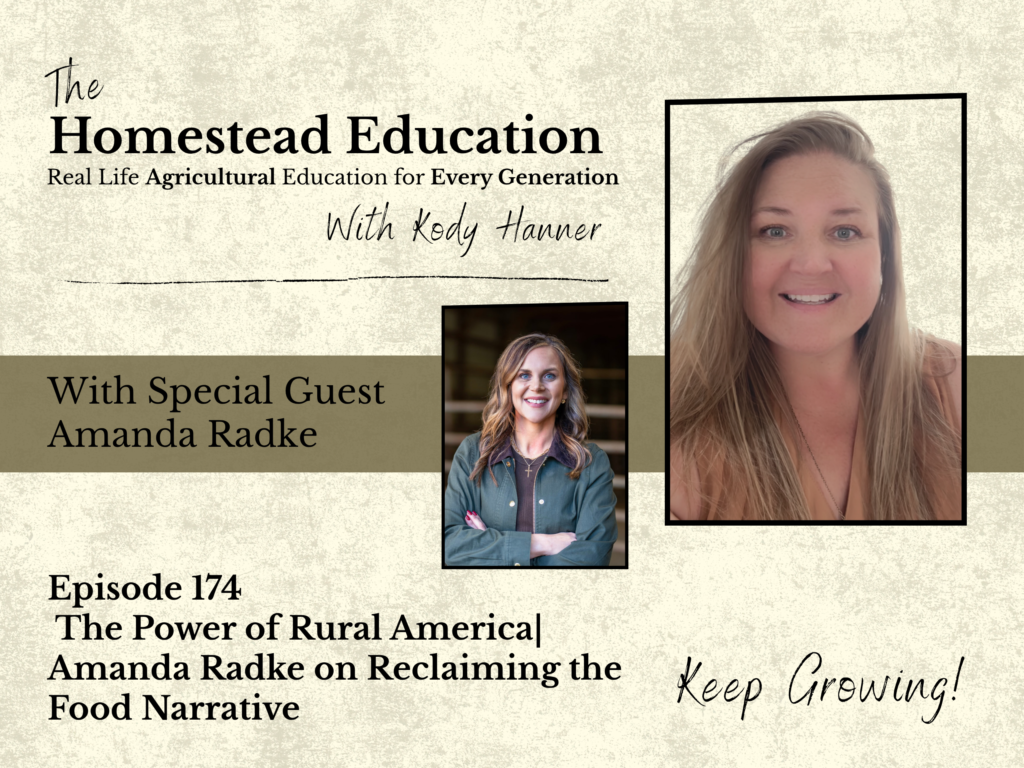
Episode 174: The Power of Rural America| Amanda Radke on Reclaiming the Food Narrative
- Wyatt Sanders
Episode Highlights
In this episode, Amanda Radke shares her journey as a fifth-generation cattle rancher, passionate educator, and advocate for the real stories of American agriculture. She discusses how direct-to-consumer beef sales, land rights, and truthful storytelling are shaping the future of rural America, inspiring producers and consumers alike.
Main Insights:
- Amanda’s background as a South Dakota rancher and author of children’s books about farming.
- The significance of direct-to-consumer platforms like Bid on Beef in reconnecting rural producers with urban buyers.
- How COVID-19 revealed vulnerabilities in global food supply chains and the opportunity for local, relationship-based food systems.
- The monopolization of the beef supply chain by large packers and foreign ownership, and the need for stronger farmer advocacy.
- The role of land rights and property preservation amid policies favoring foreign-backed projects such as carbon pipelines.
- The importance of grassroots activism, local government engagement, and courageous advocacy in protecting American farmland.
- How region-specific animal husbandry practices, like rotational grazing and grain finishing, reflect the diversity of U.S. agriculture.
- Addressing misconceptions about antibiotics, environmental impact, and industry labels, emphasizing transparency and consumer education.
- Amanda’s perspective on “keep growing” — prioritizing faith, family, and long-term sustainability over short-term gains.

Podcast Links and Resources
Amanda Radke’s Website: https://amandaradke.com/
The Heart of Rural America Podcast: https://apple.co/3BoFh0N
Bid on Beef: https://podcasts.apple.com/us/podcast/the-heart-of-rural-america/id1698761477
American Land and Legacy: https://americanlandandlegacy.org/
Connect with Amanda Radke:
Instagram: https://www.instagram.com/amandaradke
Kody's Links
Homestead Education Curriculum: https://thehomesteadeducation.com
Shop Books & Resources: https://thehomesteadeducation.com/shop
Join the Email List for Resources & Updates: https://www.thehomesteadeducation.com/subscribe
Follow Along
Instagram: https://www.instagram.com/homestead_education
Facebook: https://www.facebook.com/thehomesteadeducation
Hi everyone and welcome back to the Homestead Education Podcast. Today we have Amanda Radke on and this woman, she is making changes out there after starting her new podcast, The Heart of Rural America, although I think she was doing it before that, but people are really picking up on what she’s doing and I’m so excited to hear about the changes that she is fighting for. So thank you for coming on today, Amanda.
ShowHide Full Transcript
speaker-1 (00:25)
Thanks for having me. It’s so great to connect and I’m looking forward to sharing your interview on my podcast here later this summer as well.
speaker-0 (00:33)
Right? I’m excited for that too. I think it’s going to be, I think it’s going to share the conversations we’ve all been wanting to have. So, do you want to tell everyone a little bit about yourself? Kind of like get the ball rolling. Cause I’ve got some questions for you.
speaker-1 (00:46)
Sure, well, I’m Amanda Radke, South Dakota cattle rancher raising the sixth generation ⁓ on our farm and ranch. I’ve been a long time journalist focusing on agricultural policy issues, but now do kind of independent media and commentary through my podcast and my blogs and my website. And then I’m a 12 time children’s book author teaching kids about where their food comes from. So I’ve been everywhere from.
New York City to Los Angeles and everywhere in between trying to teach kids about agriculture. that’s a passion of thank you. And that’s kind of work-hindered spirits in that one. I’m a wife to my husband Tyler going on 16 years. We have four beautiful children. We’ve done foster care and then adopted through foster care as well. So my heart is really in raising good kids to know the Lord and to love the land and
to have those family values and we love cattle. So that kind of is the basis of our life and everything we do.
speaker-0 (01:48)
Something else we agree on, loving cattle. I grew up on a cattle ranch in Northern California, which, you know, a lot of people don’t realize how much beef there is in California.
speaker-1 (01:57)
Yeah, well, California is a huge agriculture state. You have immense amounts of challenges to staying in agriculture in your state compared to South Dakota. ⁓ yeah.
speaker-0 (02:07)
there’s a reason we live in Idaho now.
speaker-1 (02:09)
I understand that.
speaker-0 (02:11)
But yeah, we ran a cow-calf operation up in wine country in the mountains there. And that was something that was really near and dear to my heart. So you said you’re on a fifth generation cattle ranch?
speaker-1 (02:21)
Yeah, we raise Angus cattle. We have a bull sale every February here on the ranch. ⁓ It’s on President’s Day every year. And then we also have a direct to consumer beef sales company, an auction platform called Bid on Beef. And then we vet ranchers from across the country to sell on that platform. And then our family’s brand is one of them called All American Angus Beef. so…
That’s been a lot of fun and an adventure in and of itself, but have shipped to all 50 states and continue to kind of grow that those relationships with people, you know, pasture to plate, which is just so rewarding.
speaker-0 (03:00)
absolutely. So you talked about two things there that I want to like circle back to real quick. So for, you know, those of us that didn’t grow up on ranches, what is a bullsail?
speaker-1 (03:10)
Yeah, so well, there’s bulls and heifers, right? Boys and girls. They sell the breeding stock, the registered bulls, and that all the ranchers would need to get their cows pregnant, I guess, for lack of a better or simplest way to put it. But we have people from all across the country come and we put together, you know, 50, 60 bulls on a sale at auction. And ⁓ they come and they bid and they go to happy homes all across the country. So.
speaker-0 (03:13)
Yes. ⁓
speaker-1 (03:37)
We’re in the midst of delivering bulls right now. They’ll go everywhere from Pennsylvania and Ohio over to California. So we’re sending trucks here, there and everywhere with our bulls.
speaker-0 (03:48)
So, yeah, I mean, a lot of people don’t realize that, you know, they just, you know, think you have a bull and cows and but I mean, these big cow calf operations, sometimes you’re running 10 to 100 bulls for the amount of cows that you have. And so, you these ranchers, they go to bull sales, you know, rather than bringing in semen and stuff. Because, I mean, if you have hundreds ahead of cattle, you’re not wanting to AI every single one of them. And or sometimes they just come in for a live cover afterwards if AI doesn’t take.
speaker-1 (04:13)
Right, right.
That’s right. Yep. And some of our producers are ranchers on big, you know, vast landscapes where you’re throwing those cattle out on a desert or at the foot of the Rocky Mountains where it’s like you’d barely even see people. yeah, those bulls have to cover a lot of ground and territory. And ⁓ yeah, it’s something I’ve been a part of since I was a little kid. My grandpa Arnold was one of the first. There’s different breeds of cattle. So we do Angus. But my grandpa Arnold was the first.
guy in South Dakota to bring the Charlay breed, their white cattle to South Dakota. And he’s been doing bull sales since 1958. So I grew up, you literally in the seats of cattle auctions, you know, seeing cattle bought and sold, you know, that way my entire life. And it’s, it’s a beautiful tradition that I hope will carry on for generations to come.
speaker-0 (05:08)
Yeah, it was definitely one of my favorite times as a kid. And then in college, I was a cinch girl at the Red Bluff Bull and Gelding Sal all four years.
speaker-1 (05:16)
⁓
Well, and I’ve gotten to go to auctioneering competitions like the world champion auctioneers and these guys are like so good, so dialed in, but I swear you could, I mean, I could rock my babies to sleep to the chant ⁓ of an auctioneer call. if people have never been to an auction, it’s just, it’s an experience that I would encourage them to go seek out a bull sale in the area or go to your livestock auction barn and hear how they’re selling these cattle. It’s a really cool deal.
speaker-0 (05:42)
It’s a lot of fun and your livestock auctions are exciting, but you will definitely come home with like a turkey or something. So.
speaker-1 (05:48)
Yeah,
it happens. I always have to sit on my hands so I don’t bid too much and my husband will say, you know, winning means you do have to write a check, right?
speaker-0 (05:57)
I know we’ve been really looking at running down to a local auction because we do lamb every other year and I just buy feeders like I am not going to raise sheep. And I’m like, oh, we need to like run down to the auction or something. And I’m like, but I don’t think I have a, you know, a bank account big enough for me to go to a livestock auction.
speaker-1 (06:17)
Well, on my list to add to our place is guineas because we have so many ticks and I’ve been told they eat a lot of ticks. So I’m like on a mission to get some guineas around, but I haven’t quite convinced my husband yet. So we might just have to beg for forgiveness and get some birds anyway, but we’ll see.
speaker-0 (06:34)
My husband’s convinced he like definitely checks Facebook marketplace all the time trying to find some, but because we don’t want to like bring in chicks because that’s just another chore, you know.
speaker-1 (06:44)
Yep. I want the girls to go to work and and yeah do their job. So.
speaker-0 (06:49)
So then you talked about you also have a direct-to-consumer online auction, which is, mean, two whole concepts right in that. So let’s chat about direct-to-consumer a little bit, which is exclusively how we sell all of our products. Yeah.
speaker-1 (07:07)
Well, you know, I think God kind of led me into this for years and years. My family had always just sold beef direct to consumer locally in the quarters and halves. didn’t really dabble in shipping beef at all. And then COVID, the global pandemic kind of changed my mindset on that. I mean, we were seeing folks that were already in that space that were doing so well, shipping beef across the country. Shelves were bare. know, people were wanting.
to stockpile their freezers and they were wanting to know a rancher. And it was a really great opportunity for so many people raising really good beef at home. And at that time I had gotten a call from a gentleman I had met randomly in an airport a decade before and he worked on Wall Street. And we had had this great conversation about his life in the big city in New York City versus mine in South Dakota where the cattle outnumber people four to one. And I had given him my business card and I said, if you ever need
need anything or have questions about agriculture, give me a call. Well, 10 years later, global pandemic hits. I get a phone call from this guy in New York and pick up the phone and he says, you know, hey, cowgirl, remember me? And well, not really. But I looked him up on Facebook and recognized him. And, you know, at this point, he’s married. He’s got a couple of kids. Looks like life is treating him well. So I’m excited to catch up and.
And he was really kind of worked up because he had gone to the grocery store in New York City, like the biggest most powerful city in the world basically, and the shelves were bare and he couldn’t buy a pound of ground beef to make cheeseburgers for his kids. And it hit me like a sack of bricks because I thought, wow, in the United States where Americans spend less than 10 % of their disposable income on food and 40 % of the food we raise in this country ends up in a landfill somewhere wasted.
In New York City, can’t get food or ground beef to a dad of two kids. But what was happening.
speaker-0 (09:00)
Between three days and 48 hours if the supply chains stop for a city like that.
speaker-1 (09:04)
yeah, and it’s absolute anarchy and chaos. if it, what’s the saying, if you miss nine meals, it leads to absolute violence and a destruction of society. And yeah, people in big cities only keep two to three days of food in their, you know, little apartments. ⁓
speaker-0 (09:20)
my gosh, I couldn’t imagine only having two to three days worth of food. We have seven freezers just out in the shop.
speaker-1 (09:26)
Right? It’s a crazy, but 98 % of the country has absconded their responsibility to feed themselves, which leads 2 % of the country keeping our nation free and fed and really safe from anarchy and crime and violence happening because you have starving people. But during the pandemic, had the trucks weren’t running anymore. They weren’t running into big cities. Dairy farmers were having to dump their milk because the plastic bottles were stuck on a port somewhere.
You had in the hog industry because the plants were shutting down due to COVID, pigs were being euthanized and plants were slowing down on beef supply too. And so we were very, very close to absolute chaos in this country. But this gentleman, you he said, hey, I can’t get beef at the grocery store. Do you ship beef? And I wasn’t set up. I wasn’t working with a federally inspected facility. I wasn’t ready for the opportunity.
But it was in that moment where I realized this is where agriculture is going, where we need to rural and urban America. We need to build a food system on relationships and getting people connected back to the land and the people who steward it. ⁓ So fast forward a few years later, I met a great rancher named Chris Earl from New Mexico, and he does cattle auctions in the Angus business all across the country. Last year did 40 million dollars in sales in the live cattle auctions.
⁓ And he had a vision of what if we did the same to really great beef? Would people buy beef at auction? Which sounds kind of crazy at first glance of like, well, why are we bidding up this beef so high? ⁓ But the whole concept of bid on beef is the consumer gets to decide. We start the auctions way below market price and the buyer gets to decide how high that beef goes. And they don’t have to bid.
past their comfort level. And so sometimes we have auctions that go crazy sky high because two people are fighting and know, pride and ego and excitement. They’re not going to lose out on that ribeye. And sometimes there’s really, really great deals because a savvy shopper, you know, found those lots. And so whether you’re wanting the best of the best and it doesn’t matter how much you pay or you’re super shopping on a budget, Bid on Beef has attracted a whole bunch of people to the platform. And so it’s been really, really fun to see.
People get to be a part of this cowboy culture and how we buy and sell cattle, but they get to do it on the beef side and get to experience that feel of that auction that I know and love and have grown up with.
speaker-0 (11:56)
That’s so fun. And I mean, to kind of take that spin on it, I know that the direct to consumer market has exploded over the last few years. And I mean, that’s just anybody who is not using, you know, a third party or, you know, in this case, like your third party, it’s just your sales platform. And I was really surprised. Let’s see, like two years ago, I went to an ag show and it was the first time I’d ever had a booth at like a full blown ag show.
not like a food nag or you know something and I was like, my gosh, they are just going to run me out of here. But I’m here and I know what I want to say and I’m excited, you know? And I ended up having a line of families, mainly ranch wives at my booth saying, I know the homesteaders are all doing direct to consumer and we are losing money on our beef right now. They’re like, so explain it to me so I can explain it to my husband because this is what we need to do.
Yeah. And I was like, my gosh, this is so exciting. Because like, I mean, just yesterday, I was having a conversation on a podcast where I was like, why is it only the responsibility of, one to two percent of the country or the world to feed everybody else? Where’s the responsibility coming from the bottom? You know, and that’s where, you know, we can build local food systems where we can do direct to consumer. It doesn’t have to be the only way we eat.
but it also makes it where we aren’t completely reliant on a one funneled system.
speaker-1 (13:30)
Well, and so much of our systems in this country have been exported into other places. Our manufacturing, our clothing, our food, so much of that is being imported into this country. I always tell people you can vote at elections, which will drive policies to keep farmers on the land and food on the dinner table. But we also have a powerful tool in voting with our dollar. And so if you want to see a shop in your rural Main Street town,
That means you actually have to go shop at the shop instead of choosing the two day Amazon Prime quick ship. Same with farmers and ranchers. If you want these farm families in the town, which support your schools, they support your churches, they support your main street businesses, they keep a lot of dollars circulating in your communities, well then you have to support them and shop with them too. And they’re not going to be the cheapest option. They can’t. We can’t compete.
with the big corporations. need people to understand, and I talk about this all the time, but in the beef industry, our beef supply is held captive by four major players, these packers, two that are foreign owned. One comes from Brazil and they’re known to have bribed 1500 politicians and they get to operate in the United States of America and hold the cattle rancher captive.
And so as a result, have lost an astronomical amount of farmers and ranchers in this country due to monopolies and consolidation and bad policies. And the few that- my gosh. They just want, they want, they love what they do. It’s in their blood, but they need to be paid. And there is a tangible value that you are not going to get by shipping your food in from halfway around the world. And it’s worth it to shake a farmer’s hand, build that relationship, look them in the eye.
Ask them any question you can think of. Most of us are an honest book. We’re passionate about what we do. We love what we do. And I always say there is a producer for every consumer in this country. ⁓ If you don’t like one, you’re going to find another. There’s so many different ways to raise food in this country. ⁓ How I can raise food in South Dakota differs from where you are in Idaho, for sure. And so there is a rancher for you out there to directly get your beef from. And you can feel good about it.
It’s a story, it’s a conversation piece, and I could go on and on on this, but at the end of the day, my goal is to create an experience through beef where families and friends can sit at the dinner table and enjoy a meal together that’s delicious, that they feel good about, but ultimately that keeps that family and the faith and all of that community at the forefront.
speaker-0 (16:13)
I couldn’t agree with you more. feel like food should mean something, but it’s not just something you pick up at the grocery store. And I mean, thank you so much for saying how pigeonholed ranchers are. ⁓ Because I think that there’s a big conversation right now. I mean, whether I don’t know if we want to call it the maha or whatever, you know, and I mean, good, bad and ugly of that. There’s a lot of misinformation that, ⁓ know, farmers and ranchers are just evil.
speaker-1 (16:42)
rate.
speaker-0 (16:42)
And that’s like not the case because even for so I mean, whether you’re talking about the beef industry or, you know, corn or wheat or whatever we’re talking about, there’s to be able to be competitive, you almost have to follow the same model as everyone else, which even sometimes is models that you don’t want to follow. Or whether you follow it or not, you’re just not going to have the paycheck at the end of the week and or the end of the year and there.
You know, you said they’re sending it across, you know, outside of the country. Are you really paying less for that when it’s being shipped back in? The low prices at the grocery stores are not because it really cost a whole lot less to raise that animal. It’s because of like the government subsidies and things like that that go into the corn and then you feed the corn to your cows and there’s a lot lower price where a local producer could never even begin to touch on.
speaker-1 (17:38)
Right. Well, and when the government picks winners and losers in agriculture, as a result, there’s so much of this South Dakota prairie that has been tore up and you actually look crazy to have cows because there’s safeguards and guarantees to producing corn and soybeans. you know, even even just some of the policies we’ve had, we’ve had a light in my lifetime, the policies that have come out of Washington, D.C. have prioritized get big, achieve economies of scale or get out. And so
every ag conference I’ve ever spoke at in my lifetime has been basically unless you inherit a big old ranch and walk into something huge, you’re never going to make it. And so they’ve encouraged these land-grant universities have encouraged young people to go get corporate jobs, you know, for John Deere or Monsanto or whatever, Cargill, but never telling us go back home to the farm and make a living because they had decided that was impossible.
And what I’m seeing now is a shift. I’m meeting first generation farmers and ranchers who are starting with very few acres and they’re monetizing every bit of it through value added agriculture. In DC, we are seeing some positive stuff like flipping around the food guide pyramid to finally put meat, and eggs at the top. And they’re saying the quiet part out loud, which is like, you know, ⁓ for the entire history of civilization, we have eaten these products and been healthy.
And it was only until we flipped the script and told people to eat nine servings of grain a day and all the soybean oil that you can possibly guzzle that we’ve turned into a very sick, weak society with heart disease and diabetes and cancer and depression and anxiety. And so I’m excited to see some of the narrative of the Maha movement, like infiltrate the culture. We’re seeing people cook with beef tallow again and…
really embrace that and ditch the whole low fat margarine, all of that. But yet at the same time, I’m very cognizant that a lot of these influencers are beating up on really good farmers and ranchers who have done a really good job the entire time, but they’ve been demonized by climate change extremists and animal rights activists. And so I will have the opportunity here next week. I’m going to be speaking at a CPAC Women’s Warrior Summit in Washington, DC.
And there is going to be some of these maha influencers. There’s going to be a lot of these politicians and elected officials. And I take my, I take my role very seriously of being a rancher from South Dakota. I’m going to go and tell the story the best that I can of the truth of what it’s like to live on the land and being a steward of the natural resources and talk about how helpful beef is as a super food. ⁓ And try not to let, you know, emotionalism and
clickbait rhetoric that we see go viral, leave the day. I want common sense. I want people to feel good about the food they eat and not walk into the grocery store and be terrified. And to do that requires empowering people with knowledge and the truth. And so that’s where I think there’s an opportunity for young producers, for small homesteaders, for people with backyard gardens or direct to consumer stores. They have a real opportunity to tell the truth.
and tell their story and earn a premium for their product and make these really valuable relationships with the people that they hope to serve.
speaker-0 (21:02)
That’s amazing. I’m so glad to hear that, for lack of better words, you and I are having the same conversation out there in different communities. Because it’s like we’re all fighting for the same end goal, but we’ve been placed in front of different audiences. And I really think that there’s been a little bit of a division, especially since COVID, there’s them and us on both sides. But I think that that’s been the goal.
across every aspect of our lives in America is to divide and to be able to have like the conversation, which, you know, I consider myself an agriculturalist, but in today’s world, yeah, I’m a homesteader, you know, because I really believe that that’s what I do. Our farm feeds us completely. And then we also sell our pork commercially, because trust me, I am not eating 350 feeders a year.
speaker-1 (22:01)
Right.
speaker-0 (22:03)
Which even that out here on the West Coast, there’s not pork producers a whole lot at that level. Yeah, down in California a little bit more about the rest of the PNW. Like, we’re one of the bigger producers up here.
speaker-1 (22:17)
It’s really amazing what you’ve built. truly is. you know, talking about like the labels, I have such a hard time knowing, like I’m a rancher, you know, but you hear these buzzwords like homesteader or regenerative egg, and they’ve become very trendy and very like big talking points on social media. And where my struggle is, like, man, we’ve been doing this like for generations. it feels like new to me. So I almost have a hard time like even
embracing the label, even though I know it would help me like sell my products. I tell people. Yeah, and and like some of the like, as an example, rotational grazing or, you know, just the things that you do to naturally care for the land. The challenge I see now is there are government incentives now to prioritize these things, which is great. But some of the things I’ve seen at agriculture conferences is.
speaker-0 (22:50)
You deserve who you are.
speaker-1 (23:11)
Well, the people that have been doing this forever, you know, they don’t qualify for some of these programs and, you grants, but the ones who have maybe been bad operators for a long time now that they’re adapting these pro production practices. now they’re getting paid. And so to me, that’s the struggle is like when the government gets involved. It’s like great to see the incentivization of like doing good. But at the same time, I’m like.
Maybe it’s just I’m too immersed in it that I’m like, yeah, this is just what we’ve always done. don’t know. Or as a contrast, I’ll give an example because because there’s so many labels, right? You have organic and grass fed and natural and grain finished and all of these things. And, know, I look at myself in South Dakota, the grass grows four months of the year and the rest of the time we’re covered in snow. And so our grazing season is is very small. You know, I’ve gotten into.
You know, people want to attack me because we grain finish our cattle and yet that’s the abundance of the crop that we grow here. In Idaho, I know ranchers that feed their cattle potato skins because the main crop there is potatoes. My friend Chris Earl in New Mexico, it’s at the foot of the Rocky Mountains, basically in the desert. And unless you have cows on that range, it will turn into a barren wasteland where the dirt just blows. And so
Literally, like he just has the grass. But there is no rotational grazing on something like that because it’s so vast, so huge. The cows have to work so hard just to get one blade of grass that, you know, it’s and so there’s, you know, there’s intensive grazing, there’s planting cover crops, there’s all these great things, but it’s so regionally directed to. And so I remind people too of like know your region, get to know those local producers. And the great thing about the
beef, about raising beef versus maybe chicken or pork or dairy cattle even is like there is no two single ways that you can raise a beef animal because it’s so regional specific. And that, that is I think the one thing that has stopped the complete consolidation and vertical integration of the ranching business is the fact that you do have to put cows out on pasture and every pasture looks different from Florida to Washington state.
speaker-0 (25:30)
Well, thank goodness for that.
speaker-1 (25:32)
Yes, yes, absolutely. And I’m sure while you being in the pork industry, you know, like, you know what the hogs have transitioned where most guys in the pig business don’t even, they rent the barn from the pork company. They are not even working for themselves anymore. They are not independent farmers. They are contract farmers doing the work for a big, big corporation. And so it becomes very cookie cutter. All the pigs are raised the exact same way. And I think that has led to some
you know, quality drop, I would say, compared to the pork that I grew up and enjoyed eating as a kid. ⁓
speaker-0 (26:10)
I
absolutely agree. we ⁓ even went back and said, we don’t even like the pork breeds that are out there. And we found old line breeds that were from before the three way commercial breeding that started in like the 50s. Wow. So we raise, herfords, the, American heritage pigs, which everybody says that they’re, they’re medium breed and you can’t show them and stuff. excuse me, my boar is 900 pounds. So.
speaker-1 (26:37)
That’s awesome.
speaker-0 (26:38)
And then we also have a second herd that’s a more commercial herd, like they’re Berkshire, Yorkshire hams, but they’re all from old line breeds. So our pork is marbled like beef.
speaker-1 (26:50)
Wow, that’s awesome.
speaker-0 (26:52)
It’s amazingly delicious, but people see it and they go, this doesn’t look like what I buy at the store. So then, you know, it turns into an education conversation where my daughter and I, we wrote a cookbook on, you know, cooking heritage pork and you know, that type of stuff. you know, it’s, the industry is just, it’s so different and being able to have these opportunities where we get to teach ⁓ and not have to deal with, like you said, that like, you know, single line of
making everything happen one way. think that’s the beauty that we still have. But I think that, you know, you get into like the corn industry and stuff and that’s all grown in one area. So they’re all doing it exactly the same.
speaker-1 (27:32)
Yeah, and you all you mentioned the marbling and that’s kind of my like niche in the in the beef industry with Angus is like we we pick like the 1 % lines that are like marbling so I just went to an event called meat stock it was 1600 carnivores all in one place in Tennessee. wow.
You absolutely should go and have a booth. But my beef certainly wasn’t for everybody. You know, some of those folks were looking for the grass fed organic option and which I say, that’s great, you know, but this is what I raise in South Dakota. This is what works ⁓ for me. And to me, it’s a flavor thing. just say, you know, you some people prefer the taste of grass fed. Some prefer.
the taste of grain finished and like that’s okay. I don’t know, you probably have a different school of thought on it. But I guess the reason I share that is because I really, you know, one of the things I see in the meat space or the food space is like companies that will bash one producer to sell their products versus, you know, just standing on its merit. And so I’ve always thought just taste my beef. If you like it, come back for more. If you don’t, I’m not going to tell you that the guy down the road is doing a bad job.
⁓ He just has a different customer base than I do. So I try to, in my marketing anyway, I try to just stay positive and tell my story the best that I can and let the consumer decide, is it worth paying for or not? And the market will kind of dictate then your future beef or production decisions too, in a way that you’re either rewarded with great customers that like you or nobody buys your stuff too.
speaker-0 (29:04)
Well, and that market is, ⁓ that’s absolutely why we make some of the decisions we do with our stock. When we’re raising a steer for ourselves, we absolutely, we do a grain finish with barley because that’s what our neighbors grow. And they’re like, hey, come fix our tractor and you can have a few tons of barley to feed out that steer. However, when I’m gonna be selling that same beef,
speaker-1 (29:26)
Thanks.
speaker-0 (29:30)
I grass finish it to the end and I just time it right where we’re butchering them at the end of grass season. Sure. So they taste amazing. But I also grew up with my dad as a hunting guide. So I the gamey is yucky stuff. And so sometimes we’re sitting there eating a steak and I’m like, man, this is so good. My husband’s like, I don’t know. It’s kind of gamey. I. I thought it was great.
speaker-1 (29:45)
I get that.
Right? Well, that’s my husband grew up in a hunting family, so ate a lot of deer and that kind of thing. And I did not. And so I do have I don’t like that taste of that gamey. It’s like I like that sweeter ⁓ marbling profile of that green finished. And so it’s just funny what your palate is, too. It’s like what you’re used to.
speaker-0 (30:12)
Whereas then with our pork, you know, people around here, want the non-GMO, the, you know, the local grain, the only fed on peas and barley, not corn and soybean like at all, which honestly for us, it’s cheaper to do the peas and barley because it’s closer. But, you know, when you’re talking to the customer, they’re like, ⁓ do you use any of that, you know, like corn and soy? And I’m like, no, we only, and I’m thinking like that was the cheaper option for me, but yeah. ⁓
You know, however, a lot of my customers, they’re not, they don’t want meat that’s been vaccinated. So for me, I’m a little on the fence with that, with the herd health and stuff, you know, growing up as an agriculturalist, but what we do is, you know, we have our feeders and we keep everybody really healthy. I haven’t had to worm in years. I do worm every piglet that goes off the property when people buy them as feeders because it tanks their system so much. And I let them know that.
But say we had like a piglet that got a bad abscess or something and I treat it with antibiotics, it gets tagged and I sell that one direct to consumers so I can have the conversation early, like the whole in halves. I’m having a conversation with my neighbor versus the ones that I sell retail and on my website. Those I can say are 100 % right. Nothing in them.
speaker-1 (31:24)
Mm-hmm.
Yeah. And like the antibiotic thing, I always say, well, it’s like being a good mom. It’s like if your kid is sick, you might take them to the doctor and have them get help. ⁓ I don’t want to see an animal suffer. And so if they are sick, I’m not going to ignore it and hope it gets better. We’re going to contact our veterinarian, make a game plan for best treatment and make sure that animal gets back healthy again. And that’s just kind of the reality of raising cattle is.
Some of them are going to get sick. Some of them are going to die. Like some of them are just like things happen with live animals. what like
speaker-0 (32:07)
people don’t understand that all meat is antibiotic free because it’s the legalities of it. But at least in that case, I can say never given anything to anybody who’s just buying a single pork chop from me, you know.
speaker-1 (32:11)
Write it,
And that’s fair. think that’s fair. And then having those close relationships where you can just say, hey, and, know, as a mom, it’s like, don’t personally worry about it if I’m having to treat my animals. Like, I feel okay feeding my kids that meat. so I think being the mother too, it’s like, I think it’s an easier conversation to have. Like, okay, I’m discerning best decisions for my kids and I am cognizant of the worries. And, you know, if you can alleviate some of those concerns, then…
usually people kind of will shrug it. I’ve found they’ll kind of like, okay, well, I trust you because I have that relationship versus just a blanket marketing of someone you’ve never met online.
speaker-0 (33:00)
Yeah, which I mean, have you read that book, Big Chicken? It’s about antibiotic use in and how the Cornish ⁓ crosses got started. ⁓ it was like super eye opening. And I was like, OK, now I get why everybody was so upset about it. Now I get why there’s all these laws in place. But then again, I say I’m not going to let an animal suffer. And one antibiotic shot is different than mass feeding them antibiotics for growth. So.
speaker-1 (33:03)
Uh-uh.
Right, right.
speaker-0 (33:30)
⁓ I noticed here that you also have, ⁓ where did I see it? Your American Land and Legacy. Yeah. organization there. I would love to hear more about that.
speaker-1 (33:42)
Yeah, well, unfortunately in agriculture we have seen and hold on a second. think my computer’s dying. need to get here before I totally lose power. Hopefully you can cut this out. Let me see. gonna use my light source. Is that gonna look real bad? Okay, we’ll leave it. I’d rather not have the computer die, but.
speaker-0 (33:47)
Yeah, no problem.
You
no, it’s fine.
speaker-1 (34:05)
Well, so in my lifetime, we’ve seen kind of these climate change activists ⁓ kind of get a foothold into policy in Washington, D.C. And, you know, some of that has come out as like the Green New Deal and blaming climate change on Cal Farts and, you know, which is outrageous. But, you know, we know.
speaker-0 (34:25)
⁓ I had a real go viral this week about, you know, saving our farmland and someone’s arguing on there. Well, they’re like, you know, you can always like graze cattle back on it and stuff. And I’m like, well, to some extent, and somebody else goes, if you graze cattle on it, you can’t raise crops on it anymore.
speaker-1 (34:41)
⁓ my, my.
speaker-0 (34:43)
Like the kids have been laughing about that all week because it’s just such a disconnect there.
speaker-1 (34:47)
wow. Yeah, we haven’t had much snow in South Dakota this winter. So we’ve actually had cows grazing on, we had them on corn stocks grazing, you know, till March, which usually we’re done by Christmas time. And so, yeah, that’s natural fertilizer for the fields. Those cattle, they aerate the soil with their hooves. They do all kinds of things. But you can absolutely grow a crop after they’ve been out there. That’s funny. ⁓ I shouldn’t say funny, but it’s those misconceptions. But
Yeah, in 2006, there was a report called the Livestock’s Long Shadow that blamed the lion’s share of greenhouse gas emissions on cows. It was quickly debunked, but that lie has permeated the culture. And so the real truth is, like in cattle ranching, you know, we raise or we produce less than or 3 % of total greenhouse gases. And if every American were to go meatless on Mondays, you would reduce your carbon footprint by 0.26%.
And so it’s ridiculous, know, ⁓ but there has been a driving force ⁓ under the guise of climate change in the Green New Deal to really turn the screws on farmers and ranchers. And I’ve often said it’s not about saving the planet or taking care of the environment. It’s about control of the land and the natural resources. And they do that by increasing the regulatory burdens on farmers. So one of those
initiatives has come out as a 45Q tax credit, which is to fund and finance things like carbon sequestration pipelines. So in South Dakota and the surrounding states, a $10 billion foreign backed carbon pipeline company came into our neighborhoods. They condemned 160 farmers in South Dakota alone for eminent domain for their private project that is foreign backed, all to sequester carbon, which is plant food.
because there’s all these tax credits and there’s massive amounts of money to be made. So quite literally that one project brought politics to my backyard in a very, very real way where it’s going to be within a half mile of where my kids sleep. It’s going to produce nothing. It’s going to make very few people very, very rich. And the farmers and ranchers have no voice and no ability to say, no, thank you. Please go around. I don’t want this on my land. And
So that’s begun a four year battle really over property rights. South Dakota has been a leader in this. We’ve pushed back, we’ve passed legislation to ban eminent domain use for CO2 pipelines, but the fight continues. And so some farmers and I got organized and started this American Land and Legacy Organization to stand up for your God-given constitutionally protected property rights. And we’re getting calls from all across the country from people that are facing
⁓ land grabs for wind, solar, data centers, carbon pipelines, and they’re all desperate for help because these politicians and these corporations begin making these sweetheart deals at the expenses of the communities, of the people, of the farmers and ranchers, and they don’t know what to do or who to turn to. And so we’re trying to fill the gap and the need there. And so that organization is
American Land and Legacy, and you can find it at americanlandandlegacy.org.
speaker-0 (38:08)
That’s such an important conversation. mean, I think about these farmers right now at the data centers when, know, we aren’t even ranching isn’t our only income, but there’s times when money is tight. Like, are we going to be able to keep doing this for another year? And I know so many other farmers feel that way. And to suddenly have somebody come in and say, here’s enough money to take care your family for. You know, generations. And when we.
buy it, we’re going to put something in that’s going to create jobs and blah, blah, blah, and all this stuff. And people are like, well, then maybe I’m doing a good thing. And then it’s not. It’s just destroying the land. Or they say, no, I’m not selling. And then eminent domain comes in and just takes their land. So people are pigeonholed into making these choices when not only is it their personal property, it’s also how we’re literally feeding the rest of the world.
speaker-1 (39:04)
Yeah, you see stories of these multiple generation ranchers and farmers turning down like 80 ⁓ to $100,000 per acre offers from these data centers. And it’s like, don’t blame someone for looking at the financial benefit of a life-changing offer like that. And I’m always cognizant of like your land is yours. You can make whatever decisions you want on it. But where I get really concerned,
is the downstream effects. with the data centers, we’re seeing downstream effects on the neighbors of light pollution, noise pollution, a depredation of the water ⁓ increase in your utility rates, and these data centers to build their infrastructure build-outs, all their fiber optic cables and their water and electricity they need. In a lot of cases, they’re going to want to use eminent domain as well to get to their property.
They want to do a coast to coast, you know, pipeline of sorts ⁓ for these data centers as well. So we’re talking major, major impacts on the land and on prime farm ground. And so it’s not just one person, it’s impacting a lot of people. And so what we’ve learned in our fight is it really matters who shows up to your township meetings, your county commission meetings, to your state legislatures.
to advocate for your best interests is so, important. So South Dakota has been a leader in that too. We had a bill passed this year carried by Speaker of the House, John Hanson, who’s now running for governor of South Dakota. But he passed a bill called the Data Center Bill of Rights for Citizens. And that’s to proactively protect right users and…
the people and communities and to kind of safeguard the water supply and the land and property rights. And so I would encourage, if you’re in another state, talk to your legislators about getting those protections in place. Go to your county commissioner meetings and have those discussions in your local communities. Because I can promise you these companies are there doing the exact same thing and no one’s going to fight harder for your future on the land than you. And showing up and telling your story is so powerful.
But I will warn people it doesn’t come without a significant cost. When you’re going up against the biggest lobbyists in the country, the most powerful politicians in the country, the biggest players who are used to operating in a certain way without being held accountable by everyday citizens, you’re walking into a buzzsaw. ⁓ I’ve had death threats. I’ve had
a window smashed out of my vehicle at one of these meetings. I’ve had a personal slanderous attacks on my character, on my family, threats that I’ve had to report to our attorney general. Why? And it’s because they are not used to being held accountable. Early on in this fight when I got engaged, there was even an article written that the farmers and ranchers that showed up in their plaid shirts were breaking decorum. And yet these politicians
will run on how they love agriculture, but when agriculture showed up to the Capitol, well, then we were a nuisance. We were in the way. So the lobbyists get the red carpet rolled out for them while the farmers and ranchers get looked down upon. And we’ve made a lot of positive changes and the establishment is not happy about that. But I always tell people to have courage to show up anyway. You’re on the right side of history. You’re standing up for what’s good. You’re fighting for your kids and grandkids.
And by golly, grab that microphone. And even if your hands are shaking and your voice is shaking and cracking, showing up ⁓ and having that courage, it also encourages other people to be courageous. And so, you know, we always say courage begets courage. And so that is contagious. you know, having a lot of people, your community, your neighbors stand in lockstep with you is so, so important when you’re fighting these David versus Goliath battles.
speaker-0 (43:07)
You know, thank you for saying that, because I feel like so often we think if we just go to our local meetings that we aren’t really being heard. And the thing is, your county commissioner is going to hear you more than the president is. Your, you know, your ⁓ state representative is going to hear you more than your president is, you know, and it just, it could, that just trickles upstream. And the more voices they hear, the more they’re going to want to get voted back in again.
And therefore they’re going to listen to what you have to say. And sometimes it feels like our voices ⁓ just die in the wind.
speaker-1 (43:43)
Well, it’s apathy has led us to this place, right? Where our food system is kind of a wreck, where there’s very few people on the land anymore, where it seems like power and corruption leads the day. That apathy of like someone else will do it, someone else will fix it. That has led us to this position. And, you the only way out of it is to get involved. And it can be difficult. And you are absolutely right. People pay more attention.
to a presidential election every four years and they treat it like it’s their favorite NFL team, you know, and we’re divided as a country over two men who are never going to be in our communities or women, I guess, but who will never be in our communities who don’t see what’s happening locally. And yet when it comes time to voting ⁓ in local races, people are totally checked out. They don’t care. They don’t pay attention. And those are the people that will literally
shape how your community looks. And that is an entry point of politics where you can actually make a difference. And you you don’t have to fly to Washington, D.C. to do that. You can do it right at home. And I liken it to on a Friday night when the football team is playing, everybody shows up at a township meeting. It’s crickets. Nobody’s there. And yet the township meeting is the most important thing you could go to if you’re worried about a data center being in your backyard.
speaker-0 (45:05)
Yes, and honestly, I feel like those data centers are the biggest waste ever because the majority of what’s happening on there is just kids putting in make a funny face of me. And then I actually saw an article recently that said don’t say please and thank you to AI because you’re wasting data space. And you know, I was like, wow, how extreme is that? And my husband goes, unless they’re trying to train us to be less personable.
speaker-1 (45:15)
Mm-hmm.
Take away our humanity, right? as I, know, one more thing I’ll say on these data centers is, you know, they need massive amounts of land and water. And I liken it to the early days of computers, those computers would take up a whole office. Now we carry a computer in our back pocket. And so I’m thinking, why do we need 50 year tax exemptions for data centers that are going to take up acres and acres of land when in 10 years,
those models will probably be obsolete and outdated and we will have better, more efficient models. so it’s like, obviously AI is a huge part of doing business in this country and around the world.
speaker-0 (46:12)
You almost have to at this point or you’re going to fall behind.
speaker-1 (46:15)
Right,
right. And yet it’s not going to go away. But this push to get the current models through no matter what is very, very concerning. And so I would alert your followers and listeners to there is an executive order that’s come out from President Trump that we’re keeping an eye on. And under the guise of national security, he is pushing for expansion of eminent domain authority for energy and energy related infrastructure.
And our fear is that might look like a lot more carbon pipelines and data centers. So we’re keeping an eye on it. I do have a great relationship in Washington, D.C. with this administration and the USDA and Secretary Rollins. So I continue to have conversations. I’ve expressed my concerns, certainly, and I’m not sure how it’s going to play out. But any time a president, no matter who’s in the office, uses an executive order.
we have to look at how does that balance against the constitution? And property rights are absolutely foundational to our constitution. And so if this expands the authority of what qualifies as a taking through eminent domain, that’s where I get really, really concerned as a independent producer on the land that is fighting for property rights.
speaker-0 (47:32)
That’s definitely something I want to keep an eye on because, you know, for one, know, President Trump, he has, you know, he’s a landowner and that’s a big, I mean, that’s a big part of how his family has came to where they are. So I’d be really surprised if he expanded the eminent domain. But then honestly, at first I was really surprised about the glyphosate order. I always say that one wrong. So ⁓ excuse me on that. They always say if you read it wrong by read or you pronounce it wrong by reading it, then you shouldn’t be embarrassed. So.
speaker-1 (48:02)
I get that.
speaker-0 (48:05)
Anyways, I was really shocked on that one. then I, you know, two weeks later, we end up shutting down the Shredo Hormes and stuff like that. And you’re like, my gosh, this is he was bringing things home, whether or not glyphosate is a long term plan. He’s making sure that we aren’t caught with our pants down. And so, like, I always am like, sometimes things come across the board where I’m like, whoa. And then I’m like, ⁓ no, I know what he’s doing.
speaker-1 (48:25)
Mm-hmm.
The big picture stuff, yeah. You think you’re talking about one thing, but it’s like every decision has a ripple effect. saying gas prices way crazy high, but I see he’s called for a summer gas recess or, you know, tax freeze, I guess. I don’t, I’m not sure the exact phrase, but it’s like, yeah, there is consequences to ⁓ war across, know, ⁓ and that’s the other thing is in farming and ranching, people don’t realize it could be weather.
speaker-0 (48:34)
Bye.
speaker-1 (49:02)
⁓ or a war halfway around the world and that’s impacting the price you get in the middle of nowhere where every year you’re planting the seed, you’re calving out the cows, you’re doing your thing and you can’t plan for those unexpected like left field things that absolutely impact how you do business at home. So right now it’s planting season. What’s going on on Iran is impacting, you know, fuel prices and fertilizer prices which, you know, is a direct like impact on
American farmers, but something halfway around the world, you have nothing to do with.
speaker-0 (49:36)
True. All right, so we’re about to the end of our time. My favorite question to ask everybody is what does keep growing mean to you?
speaker-1 (49:42)
What does keep growing? That’s fun. You know, to me, my priorities in life are my faith and my family and this beautiful farm where I get to call home. And I like to think generationally and I like to think eternally. And so if we are growing in our faith that we’re looking at eternity, if we are growing the farm and our family, we’re thinking generationally. And so I like to make decisions that aren’t short-term. I like to think long-term impact. And so
My encouragement to your listeners is what are you doing today that could make a difference, not just today, but for generations to come. And hopefully that helps guide your steps in your business and your life and your family and your faith and everything that you hold dear.
speaker-0 (50:27)
Well, thank you so much. Can you tell everyone where they can find you?
speaker-1 (50:31)
Sure. So my website where you can find my books is amandaradkey.com. My podcast is The Heart of Real America on Apple and Spotify and YouTube. And then you can check out my beef at bitonbeef.com.
speaker-0 (50:44)
Well, thank you so much for joining us today and everyone go support her so that she can keep fighting the fight ahead of us and we need to get out there and do it too.
speaker-1 (50:53)
Absolutely. Thank you so much.