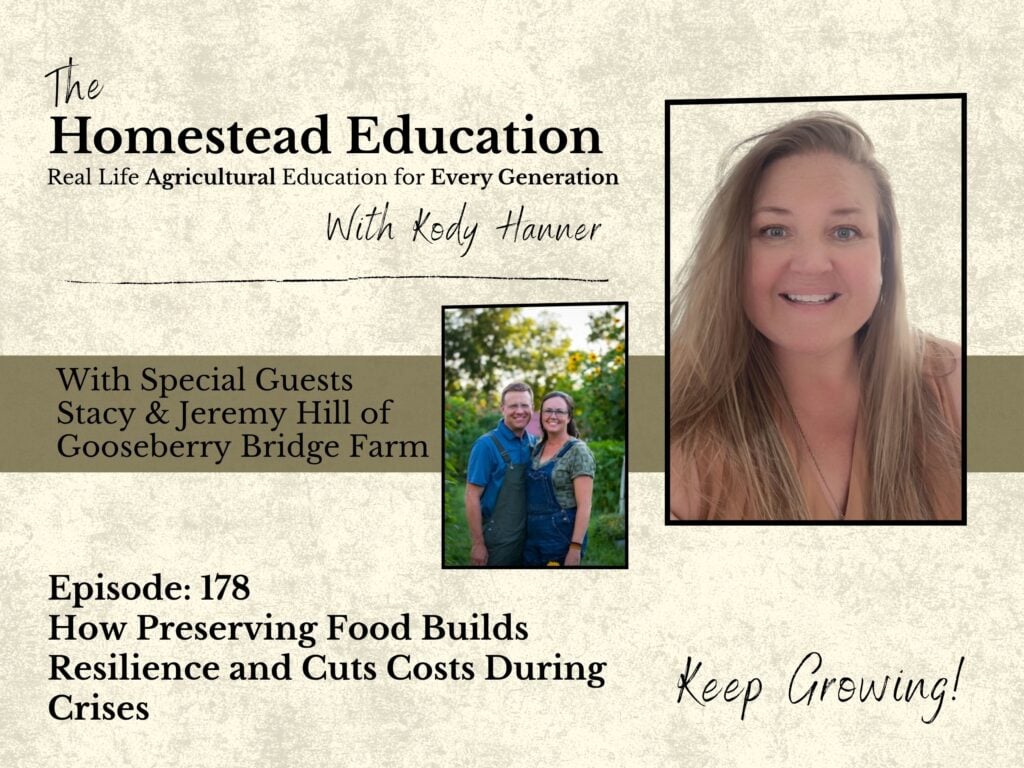
Episode 178: How Preserving Food Builds Resilience and Cuts Costs During Crises with Jeremy & Stacy Hill of Gooseberry Bridge Farm
- Kody Hanner
Episode Highlights
Preserving Food, Farming Wisdom, and Building Resilience with Jeremy and Stacy Hill.
Discover how Jeremy and Stacy Hill from Gooseberry Bridge Farm combine traditional farming, food preservation, and resilient homesteading to reconnect with nature and community. This conversation offers practical insights for anyone interested in food sovereignty, sustainable living, and farm business strategies.
Main topics include:
- The evolution of a homestead into a full-time farm business
- The mental and practical foundations for successful food preservation
- Navigating the regulatory landscape of agro-tourism
- The importance of seasonality and small batch preservation
- Cultivating a resilient mindset for farm life and self-sufficiency
In this episode:
- The story behind “The Preserver’s Garden” and food preservation as a catalyst
- How their personal journey led them from hobby gardening to a thriving farm
- The benefits and challenges of managing a 5,000 sq ft garden and multiple income streams
- The role of seasonality in preserving food effectively year-round
- How to start small with preservation projects like jam-making
- The importance of understanding your “why” to sustain homesteading efforts
- Insights into Missouri’s friendly policies supporting farm-based tourism
- Practical tips on growing what works and managing the farm’s seasonal rhythm
- The cultural shift needed to value and pass down agricultural skills

Podcast Links and Resources
Resources & Links:
- The Preserver’s Garden by Jeremy & Stacy Hill: https://amzn.to/4eCbd6y
- Gooseberry Bridge Farm: https://www.gooseberrybridge.com/
- Missouri Grown program: https://missourigrownusa.com/
Connect with Jeremy & Stacy:
Kody's Links
Website: https://www.thehomesteadeducation.com/
Instagram: www.instagram.com/homestead_education
Facebook: www.facebook.com/thehomesteadeducation
GET YOUR FREE HOMESTEAD FAMILY READING LIST HERE: https://www.thehomesteadeducation.com/homestead-summer-reading-list/
Hi everyone and welcome back to the Homestead Education Podcast. Today I have with me Jeremy and Stacy Hill from the Gooseberry Bridge Farm.
I’m bringing them on today because they just released a new book called The Preserver’s Garden, and I cannot wait to hear all about it. So hi guys. Hey, thanks for having us. Yeah, thank you for coming on. So, ⁓ you know, we kind of crossed paths because you’re ⁓ g you know, d have you already released your book? I wasn’t sure. Yeah, it came out actually a few months ago. Awesome. So it’s the preserver’s garden, and I am so excited to kind of just dive into.
ShowHide Full Transcript
What brought you to w writing this book? Because that’s always like my deepest question. Somebody always has some catalyst that like turned a page for them. But do you guys wanna go ahead and tell everyone a little bit about yourselves and Sure. Yeah, you can start your goodness. Okay, well So, ⁓ we’ve we’ve been married for twenty one years now. And yeah, I’m going on twenty two. Your lucky math isn’t my thing. ⁓ my husband always answers in dog years, so it’s great.
So we’ve ⁓ since we’ve been married, we’ve always had a garden just recreationally more than anything the first couple of years and it it really grew into a food source. you know, the the story I like to tell that Stacey doesn’t always like is that when we first got together, she didn’t like tomatoes. That is true. Because she had never had a good tomato. Yes. And you know, those little pink
things that you get at the store. Those aren’t the the pasty little like yeah. Yeah, the things that have been refrigerated. So naturally she didn’t like tomatoes, so we started growing tomatoes, heirloom tomatoes, and she’s like, Wow, these are good. ⁓ and that’s just I don’t know if there was a catalyst that led us to where we are today. It’s just been kind of one step on top of the other over and over and over. We got a bigger house, we got a bigger garden, we got a community garden plot.
when we lived in ⁓ a suburbs. Then we moved to a some land where we are now in a smaller house and we have a bigger garden. Our garden is twice the size of our house now. Yeah, it is. Actually five thousand square feet. Yeah. That’s awesome. But ⁓ I don’t envy your weeding because that’s about how big mine is and I regret my decisions every spring. So Yeah, we’re doing a lot more raised beds as time goes on. We just
Every year we find a few more raised beds. Then we’re doing a lot more watering. Yeah. But weeding is easier. Weeding is easier. But anyway, we we just have done more gardening and we’ve been preserving food since the beginning, just a little bit here, a little bit there. And honestly, the the book came about because ⁓ we had a our Stacy runs the Instagram account for our farm and it
kinda went viral a couple of different times because of our pantry. We have a beautiful pantry. it’s a converted dining room that we put shelving around it and it’s just full of it’s it’s very chandeliers that made it go. And there are chandeliers in it, but it’s the picture on the front of the book if you’ve seen that. okay. that’s gorgeous. Yeah. So the a publisher actually got a hold of it and reached out to us and said, You should write a book. And we thought, All right, we’ll write a book. Like I know how to do that. Sure.
So yeah, so we wrote a book. Y you know what though? I mean, when I wrote my first book, it was like I have never written a book. ⁓ I don’t even know where to start and now I have like twenty seven, so yeah. Yeah sometimes it’s on the I’m on the I’m never doing that again side of book writing. But he keeps going on our next book Yeah. But I mean the the book ru book writing was hard, but only because we have so many other things going, like anybody that’s you know, homesteading, you know that there’s
You don’t have time to sit down and run a social media account, write a book. The these are all homesteading, running a business. I mean, this is our full time life and income and ⁓ and homeschooling. It’s like all the things. yeah. I mean I definitely’d like let’s write a book on our on our downtime and that about drove me crazy. The other n the other night I was really excited because I got done in the garden and it it gets dark really late here this time of year, like a
ten thirty, it’s still light. Wow. And I was working in the garden until I just couldn’t handle the mosquitoes anymore. And I came in, I got a shower and I put on my jammies and I told my husband, I said, I’m gonna go work in bed. Like I’m really like looking forward to this. I’m gonna take my computer and wrap up my end of day stuff and maybe watch a murder mystery or something. And he goes, It’s eleven o’clock. And I was like, ⁓ well I’ve only been working for seventeen hours today, so I can fit a couple more in. Exactly. That’s rough though. I mean when it gets dark it
ten thirty, that probably means it’s getting light at like four. Yeah, that’s hard. It really is. It’s not enough here and we we’re getting dark at like eight forty five. Yeah. And so we’ll be eating dinner at like ten. Yeah. That’s yeah, I mean, luckily with me, my seventeen year old daughter will do anything to get out of working in the garden. So she cooks dinner most nights. Yeah. Yeah. We have one of those too, but he I mean
It’s not the best cook. He’s getting there. He’s getting there. Well, my daughter’s an amazing cook. So, like, almost to the point where she’s out there like, should I do like, should I glaze the pork loin with our homemade apple butter? And do we have any rosemary? And I’m like, go away. Just go cook something. Like, I really I don’t want to make another decision today. That’s your job. Our our oldest daughter was that one, but now she’s you know too busy to cook for us. Food.
You my daughter, she’s wanting to go away to college and we’re like, Mm, no. No. Yeah. Yeah. Nice try. Yeah. But yeah, we definitely, I mean, we’re, you know, the homeschooling the kids, we run the homestead, we have forty acres. And we homeschool, we run our local co op. And my husband’s our fire chief. And then we have the homestead business. We have a print company and we ship our meat nationwide. So yeah, we are
That’s great. Meeting ourselves coming and going most days. Yeah, in our world, it is the the things we’ve already talked about. ⁓ we run an agro tourism business. So we ⁓ Stacy does a plant start CSA. So we do plant starts that pretty much takes all of her time and a good chunk of my time through March, April, May and into early June. And then we do UPIC flowers, ⁓ open our farm up for UPIC flowers starting in mid June up until
October. End of September. September, early October. And we sell pumpkins in the fall. So yeah. And all the baby animal stuff. Yeah. We have baby animals from March through November. That people come out and pay us to play with their animals. okay. So yeah, ⁓ tell me a little. I mean, like, you mentioned the agro tourism, but what does that look like? So I’m always I hear about that a lot, but like for example, where we live, we’re forty-five minutes from town. So
We’ve looked at it differently than others, so So we we are in a metropolitan area that is that helps. Half a million. Probably. Three five or six hundred thousand people in the Greater Springfield, Missouri metropolitan area. Okay. So we’re technically in Rogers. I’ll be there in a few weeks or I guess probably like eight weeks or so. really? Yeah, I’m coming down for Ozark’s homesteading. ⁓ yeah, we’ll be there. We’re speaking too.
Yeah. we’re speaking, yeah. Yeah. We’ll see you there. Welcome. Yeah, cool. That’s about forty minutes. Thirty minutes, forty minutes from us. Okay, yeah. ⁓ so anyway, we So we’re only like twenty minutes from Springfield. Yeah so we have a really good location for people to just be able to get out of the the city. But I’ve read a study that said people are willing to drive up to forty five minutes for an agritourism for UPIC or
experience, farm experience. So that’s their that’s their limit, it’s forty five minutes. And we get people that are driving well over that. That are on the other side of town or well when I say we live forty five minutes from town, we live forty five minutes from the closest Dollar General. Mm okay. So n not not the biggest town. Yeah. Yeah. Well and probably a lot of your the people that are in that area probably already have a lot of the stuff that you have and they’re not gonna pay you to come see your animals or whatever. And yeah, no.
Yeah, so we’re we’re in a metropolitan style area, a small metropolitan area, which is nice. So it’s you know, I’m we’re twenty minutes from a Costco, which is really nice. I was at that Costco last month. I was down in Branson for a homeschool conference. ⁓ yeah. ⁓ Yeah, you should come see us. We’re it sounds like you’re here a lot. But ⁓ There’s a lot of stuff going on in our realm in Missouri, so but speaking of the home the
⁓ agro tourism a lot of it comes down to your state. Missouri happens to be friendly to agro tourism as a ⁓ way to promote agriculture. ⁓ the the legislature has has put a lot of things in place to promote small farms and as long as you’re doing a lot of things that are really traditional farming centric, there are there are a lot of good programs and not money, but
protections and things like that. We can put up some signs and Yeah and have some liability coverage. ⁓ and it’s it’s just it’s legal in a lot of states. We’ve had a lot of people reach out to us and say, Hey, I live in X Y Z state. Can you help me get started? And like, yeah, you you probably can’t do it in that state, unfortunately. Wow. I didn’t realize that. Yeah.
‘Cause I know it is legal in Idaho and we’re on ⁓ it’s called the Panhandle Farm Corridor and it’s the whole like, you know, Panhandle of Idaho. There’s a list of farms that you can pretty much go to at any point and they’re on a map online and stuff. And we’re the last one, obviously. But yeah, we’ll just have people show up and they can shop our little store and if they have kids and stuff, I always encourage my kids to run up to the barn and Yeah, you know, just kind of it’s
It’s not ⁓ planned agro tourism. It’s depends on what mood I’m in that day. Yeah. Incidental agro tourism. Yeah. Yeah, we have the Missouri Farm Bureau as a or and the Missouri Grown program is ⁓ kind of the comparable thing here. So different states have have concessions and and inducements to do that and some don’t. So we’re we were lucky to be in a state where we could do this.
And make it our livelihood. Yeah, that’s awesome. I yeah, I’m kinda blown up like I’m actually like writing illegal in some states on my notes right now ’cause I like, wow, I did not realize that. Because I mean that’s such a seems like such an important thing to be able to open up farms for people to see and like the ⁓ transparency that comes with that and the education and Yeah, we try to make it very educational. I mean it’s it’s cute to come, you know, hold a little baby pig. ⁓
But I mean we don’t make any
I mean we’re we’re pretty honest, this pig is going to be food sometime and here’s how that happens and here’s you know, it’s some people get a little weird about it, but I mean it’s it’s real and we all of the animals that we have people visit with are real farm animals that we raise for legitimate farm purposes and the Holland Lop rabbits are the the exception. Yeah. Well and our our goats could be raised for legitimate farm purposes, but
I really have forty five pet goats. You know, like I really want an alpaca. And everybody keeps telling me, like, you know, alpacas need a friend and I’m like, but I don’t want two alpacas. Like, that just sounds like a lot of work. And so my husband goes, I’ll tell you what, if you build the fence, you can get an alpaca. And I was like, Mm, I’ll think about it. Well then he told me he wanted to get a bowl and I like, I don’t want a bowl. Like I don’t want to mess with the bull thing. So he found a bowl he wanted.
And we got the bull and I said, Now you’re gonna have to build a fence for him. And he goes, Yep, no, I know I’m gonna have to do that so that we can separate him from the girls and so on and so forth. So he built the fence and I said, Great. Now our bull needs a friend. We should get him an alpaca. Perfect. But he actually our bull’s really docile, so we actually end up leaving him in with the mom and the calves most of the time. So Yeah, we finally got a bull like that. Yeah, our first bull.
Well, our s our second bull. Yeah. Our first and second ball. Yeah. We’re not friendly. And our second one had horns and he figured out that he can take any T post out of the ground with his horns. He would just get and flip up and go anywhere he wanted. It was stupid. That’s not fun. He also was poking holes in his water tubs. Our current bull is pulled, which is really nice. And a miniature. And a miniature. He’s a much better Dexter. Yeah. You know, we have a Dexter that we milk, we love her.
I mean, I have a cattle dog who will take step-in posts out and run with them, which is great, right when we, you know, move the cows into the new pasture and he grabs a step in step-in post and takes off. So yeah. But yeah, we got a ⁓ brown Swiss bull and he is he was bottle raised, which everybody says, well, you know, bottle-raised dairy bulls, like because they’re so comfortable with you, they can be dangerous. That was our first one. Yeah. And so we were really
We were cautious with him, but he’s actually turned out to be just like a big teddy bear. That’s good. Like he was trying to follow my daughter out of a pen the other day. And we were trying to we were trying to get a mom and a calf out. She had her calf early and so the boys went out there and grabbed the calf and we’re carrying her out and mom’s following all upset. ⁓ it was our dairy cow, so she’s not too upset, but you know, she’s like, Hey, hey, where are you going with baby? And so then the bull tried to follow too, and my daughter just turned and she had a
grain thing in her hand, like a the little plastic grain scoops. And she turns and punches him right in the forehead in it with it ⁓ to make him stop because he is still a bull, you know. And he like kinda just stepped back and looked at her and was like, What why did you do that? And like turned around and walked away. And I was like I was just going for a walk. I’m hurt. I don’t think he felt that at all with his big block head. No. But it hurt his feelings. Yes. I’m pretty sure his feelings were hurt.
Yeah. Bulls are funny. but so ⁓ one thing I noticed in your guys’ bio is, you know, kind of let let’s go with the whole line of nobody really does what they major in anymore because I definitely did not major in being a podcaster, although I did major in ⁓ agriculture. So I guess I’m still in the right realm. Yeah.
You guys had a couple of really interesting majors I felt. And so would you you want to tell me a little bit like why what you guys did and that was that was me. ⁓ I have a degree in anthropology with an emphasis in archaeology and a master’s in history. wow. Why not? Seemed like a good idea at the time. Yeah. I mean it really makes sense because like what I was interested in the whole time that I was ⁓ doing that was historical archaeology and like
Like pioneer stuff. Like ⁓ I was, you know, really into the Oregon Trail when I was little. ⁓ and I’m I’m writing a book on you know I’m writing a textbook on y US ag history right now. So I like that stuff. And how ⁓ how women and families were living through that like, you know, or ⁓ earlier times basically. Just yeah. With without modern everything. Well and also, you know, the other thing that you talk about a lot is
Focusing on the everyday person. Yeah. You know, not just presidents and wars and the things that are in your t typical history books, but how did the everyday person spend their day, their week, their month? That has always interested me, like far beyond. I remember having to memorize all of these battle dates. Yeah. Yeah. And it just drove me crazy because it’s like, yeah, I’ve taken my kids to a ton of Civil War battlefields. Like if we’re driving around in the South for a conference and we see
A sign that says Civil War Battlefield, we are absolutely going there. Right. Do I remember any of the dates of that besides kind of like the window of time that the Civil War happened? Yeah. No, and I don’t expect my kids to memorize that either. No, it’s it’s good stuff to study, but it’s not everything. Yeah. Well and and I would go to those Civil War museums and things and be like, like where’s the dresses? Where’s their combs? Like where’s the the things they had in their bags? Like Yeah.
How were they eating? How are they going to the bathroom? How is this house constructed? Because you know, there’s so many jointry and the square nails and, you know, the the little details. And that I mean, so that all connects to kind of what we’ve done now, like how we are ⁓ trying to live more like without the grocery store, even if it’s just something simple like growing food. Like people then were growing food. They were they were preserving food because they didn’t have
other options. They were making these scratch. In all of human history, there’s like this little dot of time that we haven’t grown our own food. Right. Yeah. And that’s like right now. Well what are we doing? It’s taken about two generations, maybe three, if you want to be really liberal about the definition, for people to think that their food comes from a grocery store or their food comes from a restaurant. And to forget how to do all of these things. Yeah. N not only to grow it, but how to be able to enjoy it
more than a week later because you have to preserve it. You have to ferment it or pickle it or can it or freeze it or whatever. ⁓ well it’s not just hand to mouth. Yeah. Well again ⁓ one of the ones I talk about a lot with that is that in nineteen sixty three when they did the Vocational Education Act, that’s when they started pulling classes like agriculture and home economics and they put them into this vocational category.
that it wasn’t for the average student to take anymore. You only took those courses if you were gonna go into that as a vocation. Almost and I’ve always felt like it gatekeeped like agriculture and home economics in a way that made it where only certain people could even do that. And they actually said while writing these laws that we don’t need to be teaching things like home ac in the schools anymore because they’ll learn that at home. But if they’re no longer if in one generation, if
they’re not being taught that in the schools when kids are literally at school all day long now and not home with their families. In one generation of people not taking those classes anymore, there is no one to teach them at home. Exactly. And, you know, there was just such a big push right after World War Two to get people into a town, into a suburb, to work in a factory and to to feed the economy that these skills just I I don’t think it was intentional, but they just went away.
Yeah. And I was lucky enough that I maybe my grandparents on both sides had all these skills. They did them. When I was a kid I w I didn’t care. I didn’t I didn’t learn about it from them, but I didn’t experience it. ⁓ I I you know, I give anything now to go back and pick their brains. But pay more attention. Pay a lot more attention. I remember like my mom saying things like Yeah, my dad cans
all his apples and stuff every fall. And I mean it’s just so old fashioned. And so then I was like, that’s just old fashioned stuff. I mean it’s kind of cool that he did that, but you know, whatever. And then, you know, kind of full circle where suddenly my husband and I are trying to produce all of our own food. Mm-hmm. And we actually were doing it because my husband was diagnosed with end stage liver disease 10 years ago. And he was told he had a year to live. And I was like, well I don’t accept that answer. So
That’s when we started like growing and preserving all of our own food. And I remember like one time his mom is in the kitchen with me, like tapping her foot, being like, I’ve never had time for nonsense like this. And I think I was making sourdough or something at the time. And I was like, I’m literally doing this to try to save your son’s life right now. Like, who cares if it’s old fashioned? Who cares, you know, any of that stuff. My purpose behind this is so much bigger. Yeah. And I mean, we’re ten years into our journey and he has a fully healed liver now, but
Yeah, that’s awesome. Well and to get I mean he always complains that I figured out how to make ⁓ homemade toilet cleaner and so he didn’t get out of having to clean toilets because he couldn’t touch the chemicals. Yeah. Well the the the whole I don’t have time for this. I mean that’s the biggest thing people fall back on and that goes back to the whole, you know, our whole society has been conditioned that you work.
You know, you work forty, fifty, sixty hours a week. You don’t have time to make your own food. You buy it at the grocery store pre made, you buy pre made meals, you buy at the restaurant. ⁓ Which barely constitutes food at this point. Well, yeah, it’s two things. I mean it’s the quality is garbage and it will kill your liver. And then and other things. But the the other side of that too is you’re just having to work that much more for somebody else to get paid enough to go buy the food.
If you can invest that time into making your own food, you’re you’re gonna get a lot more out of it. Not you’re it’s gonna be a higher quality, but you’re not having to spend that time working for somebody else to get paid to buy your food. It’s an investment. And that’s a lot of times that’s eye opening to people. Sometimes people don’t want to hear it. Yeah. Right. Well, and then we look at like the youth that, you know, their dopamine receptors are basically dulled because they get all of their like dopamine hits and three second
swipes but at the same time the like the dopamine hit from putting a lot of work into something and then getting to enjoy it or seeing your finished accomplishment is so much bigger, but we aren’t encouraging that with like adults or kids or anything anymore where everybody’s just like numb to that type of stuff. Yeah, they just want the instant instant gratification and instant everything.
Mm-hmm. And with food too, that that goes into not only is it bad for you and it’s expensive, but it’s it’s laden with addictive things, salt, sugar, and preservatives that are addictive. They make you want more. So it’s e it makes it there’s three reasons why right there it’s really hard to get off of that. my homemade food doesn’t taste like what I bought at the store. ⁓ no. Like, no, that’s a good thing. Yeah. Right? Or I hear a lot, you know ⁓
Like healthy food’s too expensive. Well, no, it’s not. It’s just more work. Yeah. And if it’s worth it to you to put that work in. But honestly, I’m sure you guys can attest to this that once you have a rhythm in place, it’s really not much more I I don’t spend a whole lot more time in the kitchen than I did before. Yeah, no. It’s
I especially don’t because I’ve ch taught my children to do all these things for me. Yeah. Well, yeah. I we have food. So you have But your point is is valid. It’s especially when you take into account the cost coefficient of it, the fact that you know you’re not buying that food, you’re you’re manufacturing it yourself, w when you take that time into consideration, yeah, it it levels out. Yeah. I mean, we take maybe one or two days a month and you know, like
We’ll call dairy days and we pull all the milk that, you know, is ready to have the cream pulled and make yogurt and you know, or we’re canning stuff in the you know, and we always go dry.
⁓ for like two we try to hit that like two month window right at harvest. It doesn’t always hit I’m gonna have a girl ⁓ Cav in July this year, so yay me, but you know, we kind of we rotate that in what we’re doing and then by the time it’s time to actually cook dinner, everything’s all there. We just have to like put it together and I s don’t spend any more time than I would any other time. I’m not having to do full day Costco trips.
Exactly. Yeah. You don’t have to drive to the grocery store. It’s right there. There’s there’s people there, you know, so yeah. Who needs that? We have so much in common. Yeah, it’s like you guys are related. ⁓ funny. So, when w d d what have you seen as far as like trends of white people I mean, we’ve talked about why people have pulled away from the preserving, but like what what are some insights that you’ve seen on
Us coming back to it.
You want it or I’m I my brain’s being slow. So you can go if you have something. I mean the the two biggest ones are health. You know, just healthier food, healthier eating. And then the second one right now is is definitely or maybe the first one is the monetary aspect of it. It’s food is getting so expensive that it’s just I mean
It’s starting to make a lot more sense to do all of the things we do. When you looked at it on paper before, like we were saving on our grocery budget, but we weren’t like it’s still you know, we could break it down and use he’s he’s really into spreadsheets. You could break it all down and you’re like, yeah, That’s where I’m with you on that one, you know. Two fifty a jar for this stuff if we have to buy food or if we have to buy extra produce or ingredients or whatever. Now that amount is basically the same.
as it as it always has been. Right. We’ve been getting less because our we’ve had the same jars for a bazillion years. Yeah. in the last five years our our spend has reduced and our family has grown. Right. Yeah. We’re feeding once you invest in the less money bias. Yeah. And it’s like it’s gr getting more and more worth it. Like the hours I’m spending in the garden make a lot more sense with food costing as much as it does now. And it’s cleaner food. Yeah.
Like even we used to be like, well, I could buy this at the farmers market and save myself tons of time but now I mean everything is so much more. I mean you can relate to you know, that one of those first times you you make a meal and you think, I grew that ingredient and how proud that made you feel. And now it’s like you make a meal and you go, Hmm, that didn’t come from here. Yeah. Like that one ingredient.
Or we we have lots of meals where we’re like, we grew everything but the salt. Yeah. Right? The little kids, they like to you know, they get dinner put in front of and they like to point out all the things we grew. And that gets them really excited. We’re kind of at that place in the year right now where like the freezers are getting kinda empty and the pantries getting a little more empty and I don’t know, we I we had to go to the grocery store and pick up some
Like more than staples and I always hate that. And we we stopped at Walmart. I mean, that we don’t have a lot of options up here. So we stop at Walmart and the kids want a taco salad for dinner. And I’m like, okay, like, you know, we make our own tortillas and we have some ground pork at home. Like, if we don’t if we run out of beef, we love ground pork. It’s actually like really yummy. Yeah. No, we do that too. Right? We make like
Well, our main thing is our pork, so we raise about three hundred and fifty hogs a year, so versus like twelve cows, so it’s a big difference. But ⁓ totally. So I was like, Okay, I just need s a couple of veggies here at the store, it’s fine. And a head of lettuce was three dollars. I was like, Are you kidding me? This should be fifty cents or yeah, there’s like there’s nothing to this. That’s when you when you don’t go to the grocery store that frequently that
inflation thing hits you a lot harder when you look at it and you go, Wow, that got expensive. When when did that happen? But for a lot of people it’s incremental and they just think, Wow, I don’t have any money left when I go grocery shopping. But we see it more. Yeah. Yeah, it’s been it’s been really crazy. And then I actually found that our little grocery store in town, which it’s a small chain store, our produce prices are way cheaper than like Walmart. And I was like, Yeah, I won’t be doing that again. Yeah. Yeah. Or
They’re sourcing loc more locally or ⁓ I mean just when I do have to buy at the grocery store, I’ll Well I’m at that grocery store. That’s just interesting. Yeah. Yeah, they do have a lot of local they source a lot from our local farmers. That’s really cool. But I’m not sure you know, I’ll be honest, like if I was to go buy like a boxed cake mix from that store, it’s gonna be way more expensive than Walmart. Right. But their meat and produce is considerably cheaper. And considering I don’t
really buy a lot from those center aisles, it doesn’t affect me a whole lot. So right. Yeah, whereas Walmart’s shipping in everything and you’re further away. We’re in I mean, we’re in Walmart Central down here, so Yeah. True. We we have to drive an hour and a half to the closest Walmart. So Wow. Yeah. A lot of times when you know, we do look at it, like if we need to pick up a few things there, you know, like shampoos and whatever.
Then we’re like, yeah, if we’re already here, let’s go ahead and grab some groceries. But yeah, the other day it just the last like two or three trips I’ve noticed that I’m like, I don’t wanna shop here anymore. Like it is not cheaper and it’s not better stuff. Right. Yeah, especially the the latter. Yeah. Mm-hmm. It’s interesting. I think within an hour and a half of our house conservatively we could probably hit forty Walmarts.
Yeah. We’re probably an hour and a half from the headquarters. we’re an hour and a half from Bentonville. So I mean why. And then we have like all the different sizes of Walmarts from giant ones and the tiny ones. And the baby ones that just pop out and just pop up on a street corner. Yeah. Anyhow. You know what though, I do have to say that when we decided to start our full homestead journey and we were always like we hunted and you know, that type of stuff, but to really go down this whole thing.
Moving to where we did in Idaho made it a lot easier because you can’t just run to the store for everything. Totally. And then So we got a lot more creative. We made sure our shopping trips mattered more and so I when I was flipping through your book, I I wanna like go to that now because I’m like I really like the way it’s laid out. I was noticing that you really focused on the seasonality of preserving and I
I really like that ’cause I think a lot of people they just kinda think like you harvest in the fall and that’s the only time you’re preserving. When I mean, I know for us, we have this island in our kitchen and it always has a dehydrator on it or a meat grinder or a or all of my canning stuff ready, like ’cause I in the fall I’m canning like small batch canning every single night with dinner. Yeah. Yeah, that’s how we do that. Yeah, it’s funny because we’re sitting at our dining room table right now.
You and look if I look past this laptop. It’s like a sea of jars and jars bags. Yeah, we don’t have a dining room table right now, so totally get that. I actually we have a sociologist that I’ve been working with who’s writing a book right now, and she wants to come she’s been interviewing me on and off for about a year, and she wants to come see our farm next week. she’s coming out here for the modern homesteaders event that we’re not doing this year, but she’s gonna come see our farm for the day.
And you know, part of me is doing that whole like we have to actually get it clean for company. Cause we are still a farm and I still have a six year old who thinks that barn boots are acceptable everywhere boots, including in bed, you know? Yeah. And you know, I’m going through those emotions of like, my gosh, we have to get all this like stuff out of our kitchen. And then I’m like, wait, no, she’s coming to see how we live. I mean, we can definitely sweep the floors and that type of thing, but
It’s hard to kinda wrap my brain around that that’s what somebody is actually coming to see in my life versus I still have the other mindset of you hide all that stuff. Right. That your house isn’t a production company at all times. Yeah. Yeah. Sorry, haze season here. No, that’s a call good. That’s that’s good perspective to remember for us too. Yeah. Yeah. Well, by the time we get to fall, we’ve got like crates stacked all over our kitchen and dining room that are just like
Storing produce that doesn’t fit somewhere else. Crates of pumpkins and onions and But it really is. We have those big like top like rubber made containers from Walmart and they’re always full of like apples and grapes all fall and then just every night I’m pulling out of ⁓ to like Yeah. I’ve been trying to figure out how to fit all of that like in a outdoor in another building that’s climate controlled ’cause I’m like, I can’t walk in here.
Yeah, the building the building where our freeze dryers are is a right now it’s where she dries flowers, but we’re trying to make it into more of a produce area. That’s our our store is where we want to put our butcher shop. It used to be a butcher shop. We turned it into a store, but all the bones are still there. You know, the walk in cooler and the whole the drains on the floors and all that type of stuff. And then we’re like, but then if we do that, where do we put our store? And yeah, yes.
Same thing. Yeah. We’ve we bought another building to put all the milk equipment ’cause we we just milk two cows most of the time. ⁓ we have the the milking machine and the fridge for customer pickup and the stuff to wash everything. And that was all happening in my kitchen for the last two years. And all of the milk jars and every the like everything just on the We do have that in the back of our store. We we definitely have that in the back of our store, but then
Like we were still kinda doing it the kitchen and then taking it out to the store for the storage and yeah. Yeah, running water lines to a building to be able to like do everything out there has been fabulous. I just need to move everything else out of the house. If the house was bigger, we’d be fine. We’d just walk around it. Like you physically can’t walk through by like October. Yeah. But I mean you know, five years ago I would not have thought that I’d be trenching water lines and doing electric and you know
Need a new skill, all right, let’s learn it. Yeah. Right. It all goes together. It’s like we can we can learn to grow food. We can learn plumbing. Yeah. Right? Well, it’s kind of like I have ⁓ that gene that makes me believe there’s nothing I can’t do. Yeah. My husband doesn’t so much have that gene. And so he thinks I’m insane and probably am, but I’m out there like, I can figure this out. And he’s like, Do you know how to do this? Nope.
He’s like, Did you watch a YouTube video on it? Nah. Like, I got this. That’s one of our problems. We both have that cheese. We both have that cheese. Like, can we do that? Sure. Do we have time to do it? No. I I always tell him, like, I think you waste more time questioning whether or not it’s possible than if you just got in here and did it. Yeah. Just start. Then problem solve your way out of it. Like I was telling you, we’re re rebuilding beds right now and
I got about halfway through it and I’m literally I realized the bottom of our beds were root bound about three inches with the root weeds. Or the roots from the weeds. Didn’t realize it, you know, because we just pull the weeds across the top and I kind of, you know, hand plow it and, you know. And we had to pull one side off and we’re like, my gosh, these roots are like five feet long and the side of size of paracord. Yeah. And it was like completely root bound at the bottom. So I’m literally
I’m taking one side off of a bed, cutting all that out, putting the side back on and doing that on all four sides. And then I’m taking like my little hand tiller thing and pulling all the middle up, and then we’ll put more compost on top. It’s been a I don’t we’ve only been at it for like four days. It hasn’t been that bad. But he’s out there talking to me about like, maybe we should just take the raised beds out this year. Maybe we should buy metal beds. I’m like, I don’t have the money for metal beds. And I’m like, you know.
You’ve spent more time talking to me about how there’s a different way we could do this than I got four beds done. So Yeah. I had a had a conversation with our oldest the other day about you know, she was kind of going into that cycle of like, well we can’t, we can’t, we can’t. It’s like look for a start with yes and then make no force itself upon you. Yes is the answer unless it can’t be. Don’t start with no.
And that’s that’s a heart lesson. I I think you’re right, it probably is a gene you’re born with. Yeah, but how would I mean how does that work with the two of us and then we end up with some of our children not having it? Yeah, it’s very recessive. Yeah, I don’t know. My dad was kind of the same way. Like I tell people a lot, Yeah, I ha I own this business and that business and we do this and this is what we do for activities and this you know, and I’m going out on the list and they’re like Nobody does that.
And they’re like, what did your parents do? You know, like where did you get this to do so many things? And I’m like, Well and I start talking about my parents and they’re like, ⁓ yeah, that that that checks. Necessity is the mother of invention too. I mean, that you get thrown in the deep end of the pool, you learn how to swim really quickly. Yeah, that’s for sure. Well, that that too. you know, I had a
⁓ my ag teacher in college we were ⁓ competing in a food marketing team and we were going around the circle and we had to say like something about someone else on the team that was gonna help us compete. And she was sitting next to me and she goes, Cody is tenacious. And I like the way she said it, like I knew it was like an insult, like disguised as a compliment. And I kind of like at that moment was like, you wanna see tenacity?
You got it. And like I think that’s been like my mantra like ever since then. Like I will push my way through anything. Yeah. That’s awesome. so yeah, like do you guys have some like words of wisdom on like how to kind of
Start down the trail of preserving all of your food without giving away all your secrets. I mean we have that many secrets. Yeah, I mean the biggest thing we we always tell people and it’s in the book too, is to start small. I I’ve I’ve said a couple of times that the book is meant to be instructional, part part instructional and part inspirational, because the biggest reason people don’t do it is fear.
And then the biggest re reason people start and then quit is because of failure. Something didn’t work, they they think it’s a failure. I’m not doing this, I can’t do it. So build your own self-confidence, understand your own psychology, start with why you’re doing it and and understand your why. Why is this important to you? Am I saving money? Am I building a healthier lifestyle for my family? Am I developing generational
knowledge that I can pass down to my kids. Is it a little bit of everything? But understanding your why so that you don’t quit the first time you have something go wrong because you will. And yeah. And then start with something simple to build your confidence. Stacy always says go to the Our house is going down. Strange noises here.
Yeah, my dogs were just all barking at something, and we don’t have AC in North Idaho, so I’m like, I am not shutting my window, but I hope everybody can’t hear that. So it’s a hundred and forty year old farmhouse. Things make weird noises. Anyway, Stacy’s recommendation to people to get started is go to the go to the grocery store and buy a bag of frozen strawberries and turn it into jam. Yeah. Or whatever you want to do is on. Like there’s frozen berries are everywhere, so it’s easy, easy to start.
Yeah, they used to cost ninety nine cents for a bag. It’s probably more now. But you make jam out of it, you build your confidence, and then you move on to maybe growing the berries next year because you’re a little more invested in how well that preservation process goes when you’ve put the blood, sweat and tears into growing them. So you know, you want to make sure you don’t mess it up. ‘Cause if and or anything you need tomatoes or peaches or whatever if you’re
Just starting out and you’d only got a little bit and you’re like, I can’t preserve this. We can just eat it all. Then like, but if you want to preserve some of them, like go buy some more. Yeah. And then the other thing to add to that would be You’ll be buying it anyway. realize what you’re good at and don’t try to force a square pig and a round hole. ⁓ we we love tomatoes and we’re pretty good at growing tomatoes. Not to brag, but you know
Reasonably. Reasonably good at growing tomatoes. And we love tomatoes. So we grow a lot of tomatoes. We sell at the farmer’s market. We preserve all we want. We eat giant bowls of them every night. But we’re not very good at growing sweet corn. Right. Okay. So we quite see like the seasonality up here. Sometimes I have great tomato harvests and some years I don’t get a single tomato. Yeah. I would cry. Yeah, so we a lot. We’ll we sell some tomatoes and use it to buy corn.
Yeah. I mean just make it easy. Don’t feel like you have to produce everything in order to make a difference in your life. Right. And where we are are we’ve planted a orchard ’cause that’s what everybody said. You know, plant fruit trees your first year because they’ll take the longest. We planted all these fruit trees and that was ten years ago. We get ⁓ we usually get about like twenty to thirty pounds of pears a year from our seventeen. Goodness, that’s not very much.
That’s it. That’s all we can get. And the and it’s because we get late freezes, we’re in a low we’re in a valley and like the they bloom early and everything blooms and freezes every year. You know, like all the trees in my little orchard, like we bought it with a small orchard. I I get good fruit off of ⁓ but it’s not they they need babying. Yeah. Whereas we live on a piece of property that was like the original homestead in our area.
And it is covered in apple trees and cherry trees and elderberry and all this stuff that I never even have to touch and get a beautiful harvest off of every year. Right. Yeah. Yeah, we h we just have trees that make nothing. Yeah. So we we basically just don’t Yeah, and then our sheep got into the trees a few years ago and killed half of them. The bark them all. The ones that were left. So we’re like the year that we got one apple and then the sheep like finished off the tree.
Yeah, I had cows get into the garden one year and eat my favorite ⁓ grapevine. Which we I mean we have others. no. They just like they grow and then like some bugs eat ⁓ and they just like struggle the whole year and then But instead of fighting it and trying a trying all the things, we just we accept that and
Just double down on the things we’re really doing. And black like blackberries do really well here. So we can we can make blackberries. We should be able to grow raspberries, so I’m trying harder on that. But definitely I love my raspberries. So ⁓ fresh raspberries on homemade raw milk. No or not or raw yogurt. Like my gosh, it’s amazing. So But yeah, I totally is just, you know, don’t don’t get overwhelmed and start small and know your why. Right.
And not every like looking at our pantry, people are like, you’re just good at all of this. Like, no, we’re not. We like everything thing as many things go badly as go correctly. Sure. For every one jar that you see of good food, we’ve probably over the years we’ve fed a bunch of the pigs. We’ve fed a bunch to the pigs. yeah. Or I so we’re really good at like, you know, making lemon or making lemonade out of our lemons. it’s
I was making ⁓ like raspberry jelly one year. man, I was so excited. My first year that I had enough like raspberries to make this big batch of raspberry jelly. And so I always people always ask me like, you know, how do you get started with the homesteading and stuff? And I say, you know, you master a skill before you move on to another one. And the way I know that I’ve mastered it is that somebody can talk to me while I’m doing it.
So I was making this raspberry jelly and somebody came in and started talking to me and I did not have it mastered yet. And I was filling up my ⁓ the jelly was already, so I was filling up the water bath canner to get it warmed up, and I turned and dumped a whole jar of water into my jelly. And I was like, Oops. my gosh, what did I just do? And I mean I was I’m like in tears and you know. And
So I I was like, what can I do with it? You know, like I tried to cook it down and just still have it kind of be like, I’ll just have it be refrigerator jelly, it’s fine, you know. And ⁓ my husband and I got to talking and we ended up turning it into raspberry chipotle barbecue sauce for our pork butts. And now we make it every year, and they just changed the direct to consumer laws in Idaho where we can sell it now. ⁓ and we are so excited from this mistake that we made. Yeah.
Years ago. You know, and it wasn’t one of those mistakes like I did it wrong, like just my kids should know not to talk to me when I’m learning something, you know? Yeah. I’ve had to tell my kids that so many times. Yeah. I’m like, I can’t teach you right now. I don’t know what I’m doing. Leave me alone. Right. But then I had like I think I had that full circle like mom mo like good mom moment recently when I was our twenty one year old’s son, he loves our daughter’s cowboy candy that she makes. And he
Loves it so much that moving back in, he cleared the pantry of all of our cowboy candy. And so his girlfriend was like, Well, maybe I can figure out how to make you more. I don’t think she’s ever like preserved anything, you know? So my daughter goes, I’ll I’ll help you. Like, we’ll do it together. So we went, ⁓ we had to go down to the restaurant supply store and get some supplies for some of our stuff. And they bought him this big flat of jalapenos and they came home.
And I was in the other room working and I was listening and my daughter taught her perfectly how to can. And she’s seventeen and you know, my daughter is and she’s talking to the girlfriend and you know, sh the way she’s just saying, like, she’s like, Hey, will you go grab some more lids out of the cabinet? And she goes over and she’s like, There’s rings and lids and then just lids, which one do you need?
She goes, just give me the lids. We can reuse the rings and the jars, but you can’t reuse the lids because of the glue. And she just, as she’s teaching her, she’s, or as they’re doing it together, she’s just talking to her. Right. And later that day I said, Wow, Savannah, you did such a good job of teaching her how to do that. And she goes, ⁓ I was just talking to her and tell her how we did it. And I was like, Yeah, because that’s how I taught you. Is this isn’t s something like I always like tell people, you know.
Be humble enough to show your kids that you need to learn it. And so as I learned, I talked to them about it. And then it’s like second nature, not something special we’re doing. And I thought that I was like really proud of her. Yeah. Yeah. That’s really cool. Yeah. And I never touched any of it. Like I was like, I don’t have time for cowboy candy. If that’s what you girls want to do today, like more power to you. But I was really proud of that moment. So and it’s gonna stick with both of them a lot better now because that’s
What I’ve always heard is that you’ve mastered something when you can teach somebody else how to do it. And when you can do it conversationally like that and not in a classroom type situation, that’s even more painful. Well it used to be when Savannah canned the entire kitchen was purple, even if whether she was canning something purple or not. Like Yeah. Yeah. You gotta you gotta get there somehow. Yeah, like our three youngest kids are they’re thirteen, ten, and seven year old boys. And last year they were doing a lot of of canning and
which I don’t really let them do too much with fire or like boiling water, but the steps leading up to that. They were making tomato sauce, applesauce, apple or peach juice. We did a whole bunch of ⁓ we got four hundred pounds of peaches like thrown at us. ⁓ from a That’s one thing I haven’t been able to get up here. Yeah, it was they had ⁓ we have a ton of peaches and the deer are eating them. Do you want We filled the back of a pickup truck. I mean it was and then we’re like, now we have to do this. Yeah.
I I bought like five flats of peaches a couple of years ago ’cause I think I could live off of peaches. And so I was gonna make peach juice and I put it in my steam canner and forgot about it and like beyond scorched it. Like there was no saving that steam canner, like or the steam juicer, which thank goodness I found one at ⁓ Goodwill last week for thirty bucks. I was so excited. Brand new. Yeah, I had somehow lived without one until last fall without a steam juicer, and I’m like, This is my new favorite thing.
Peach jelly, peach jam, peach chutney, peach salsa, peach juice, peach cider, the rosemary peach jam. my gosh. That was the best. That sounds good. But I mean like between the Huckleberries up here and the raspberries and the elderberries, and my husband drinks elderberry juice, like he drinks like a jar a week like a big jar a week. And all year long, like getting the steam juicer was game changing for us.
have so berries in the freezer. I need to run them through the He’ll do most of the canning with it now. Like I go in and start dinner and I’ll put all the berries in and whatever combo I want to do or whatever. And when it’s hot, he just comes in and puts it in the jars and starts the canner and I never even like have to touch it. That’s just part of that’s just his job now. That’s really cool. Yeah. That’s how you get all this done is by delegating like not trying to do it all with one person.
Everybody’s all like, How do you do all that? I’m like, I don’t do it by myself. Right? Like there’s other people eating this food, they’re gonna help. Yeah, well, and you mentioned the seasonality. You know, you don’t get overwhelmed with, you know, everything that’s in the pantry or in the garden. You know, not everything comes in at once, at least not here. I mean, I know maybe more you probably have a lot more coming in at the end of season where you are. But we also have seven freezers, so I always make sure I have one freezer completely empty. Exactly.
Yeah. And it’s much easier to peel when you like freeze them. I just cut the like green part out and freeze them. And when you go to just dump the water off. Yeah. Yeah. I mean you can just squeeze the s squeeze them out of their skin. Yeah. And it’s so much easier. And I’m not trying to s get all that in. I just h handle all my juices in the fall. Yeah, and you’re not trying to can tomatoes when it’s a hundred degrees outside. Mm-hmm.
And we do the juices in the small batch because we’ll go out like huckleberry picking all day and then come home and I just immediately turn it into juice, even if I only do two cans. Mm-hmm. So Huckleberries. We just We don’t have those here. We just don’t have those here. Yeah, it’s an Idaho thing. The or you know, Idaho, Montana, kind of Pacific Northwest, so it’s a more north thing, yeah. Mm hmm But
So usually at the end of my episodes I always ask people what does keep growing mean to you? But I really feel like you kind of answered that with your with your steps. But ⁓ do you I mean, do you have anything to add to that?
Keep growing. That’s ⁓ I my my I get my first reaction is, Well duh. Yeah I mean that’s I mean in all in all ways. I mean you just keep growing. I mean, yeah. I really feel like like you’re you know, start small, build your own self confidence and understanding your why. Like I was like, my gosh, that like right there. That’s an entire chapter in the book.
Before we even get into the technical parts of, you know, the seven different preservation methods and twenty two profo produce profiles and which varieties of everything to grow and which way which one prover pro preserves the best, we lead it with a whole chapter about just building that foundation of why you’re doing this. What your goals are. Yeah, because if you don’t, the world is against you to do this. I mean I hate to say it like that, but no, it is.
The world is against you doing this. You really need to psych yourself up. You need to build your confidence. You need to have a firm foundation for why you want to do it. Because if you don’t it helps to be really stubborn. Be like I’m stubborn. Well, and you know when you say the world’s against you, like I posted a reel recently where I just ⁓ like panned across my pantry, which, you know, has all the bright colors and it’s real pretty. And
I said my three steps for I don’t even remember being three simple steps for being prepared. And it was, you know, something I I don’t even remember what all I said in there. It was really basic, like buy a little extra when you can and, you know, that type of stuff. ⁓ you know, find one protein source that isn’t from the grocery store. And it went like totally viral. I mean millions of views because people thought I was rage baiting.
Yeah, isn’t that frustrating? Yeah. They’ve been fighting over it for six months, which has really helped my follow count, but you know. But when yeah, we post a video like that, you get comments like, You’re a hoarder. Like, No, we’re gonna eat all this. You should you should give that away. You shouldn’t be keeping all that food. Like, but we but we need to eat throughout the year. Yeah, I think what people don’t realize is you’re not going to the grocery store and taking food away from somebody else. No. You’re creating it yourself and that’s what you eat for the whole year.
Right. They have no concept of like what it looks like to look at all your food at once. Well, mm not only that, it’s just the concept that you don’t get that you have more than four or five days worth of food in your house is so foreign to somebody that they lash out at somebody else for it is it’s sad and scary because I mean, you know, we learned in twenty twenty, most people learned and a most people have forgotten that most
Municipalities or most cities have like four days worth of food within the city limits. Three. Yeah. Even worse. Sorry, my husband’s in a ⁓ he’s a first responder. So that’s the they get like taught constantly. Food and medicines. There’s three days. I’ve heard yeah, I’ve heard the number four, but three’s probably more accurate. Yeah. I mean they say nine meals away from anarchy. How does that not scare the crap out of you? Like I know, I talk to so many people, they’re like, Well, yeah.
The supply chain collapsed in twenty twenty, but we’re good again. ⁓ no, it can’t happen again. Yeah, that’ll never happen again. Right. It’s not like there could be some sort of war in the Middle East that could cut down oil supplies and it ⁓ wait a minute, never mind. Right? I mean that’s it’s like that’s why I keep telling them like this is literally happening constantly. There was a s a beef slaughter plant that was shut down two months ago that was s slaughtering five thousand head of cattle a day. And they’re completely shut down. That’s five thousand head.
head a day that is not going into our food system. Mm-hmm. Like how many things like that do you need to our beef herds are smaller than they’ve been in 75 years. I mean, it is scary, scary numbers. I mean it’s not gonna get better for a long time. Yeah. Yeah. And then even as producers, like, you know, right now burger is ten dollars a pound at the store. But like last summer I ⁓ not even last summer, last fall I was selling
bulk beef for ten dollars a pound and people are like, you’re robbing people blind and I’m like, that was a really good deal. Yeah. I’m thinking people are wishing they would have bought more of my beef. Yeah. Yeah. It’s it people are so short sighted, I guess. And it you know, I don’t blame people or I don’t want to say, you know, people are dumb. I mean it is it’s a it’s generations of conditioning that have led us here. It absolutely is, and you you get a lot of must be nice.
yeah. You know how much work I put into that? Like Yeah. You know, and like we run seven freezers at all times. Like, do you think that my power bill is zero? Because it’s not. Yeah. Like we have five. Yeah, we have five freezers and four or five refrigerators with freezers on them and that adds up. It does. I mean Yeah. Yeah, between running all the equipment all the time and
You know, the milkers and the freezers and the walk-in cooler and the yes, I’m also running a business, so it’s not just you know, and then we have ⁓ seven printers that are usually running all day long too, because we run a print company along with our education company. Yeah, my power bill is like five hundred dollars a month. Like that’s not a must be nice. Like I work for it. Yeah, you know, my butt off of this. Don’t say must be nice.
Talk about rage baiting. Right. Yeah. Yeah. Did you want to see the crazy side of me? Yeah. Yeah. Like what hang I can hang. We’ll we’ll flip rage baiting over on you. Right. I know I always am like, I want to say so much more. Maybe I should. Yeah. Well guys, ⁓ with engagement. Definitely. Right. My my my garden beds are calling me, so
⁓ it was really great having you on today. Do you wanna ⁓ tell everyone where they can find you, where they can get your book, like all those goodies? Yeah, we’d love to. So our the farm name is Gooseberry Bridge Farm. That’s Gooseberry Bridge with a B, not ridge. ⁓ so on all of our all of our social media accounts are under the farm, Gooseberry Bridge Farm, Instagram, Facebook, YouTube. ⁓ we’ve got some good gardening content on all of them. All of them, but YouTube.
⁓ I can’t have a YouTube ’cause my husband’s a veteran, so there’s zero filter. ⁓ not really in the videos. Yeah, I I don’t do a lot of the videos. I I have a little bit of a filter. ⁓ our book is called The Preservers Garden and it is anywhere you buy books, if you’re in the lower forty eight, ⁓ and buy it from us, we will sign it and mail it to you. And you can get that at the preserversgarden dot com. ⁓ otherwise it’s on
Amazon and all those. ⁓ but yeah, we haven’t talked a lot about the book, but it’s it’s a good resource. ⁓ I would like to say that it’s a great resource for somebody who’s getting started and it’s also got a lot of information in there for people who ⁓ who have been doing this a while. I mean I’m hoping that you’ll find something in it. Even though you definitely know what you’re doing, it can be some there’s some reference. Wait the other night Stacy was in the kitchen, she said, Where’s a copy of the book? I need to look something up.
My kids do that. But I knew where it was in the book. Yeah. But you know, I’m actually really looking forward to reading it because it’s one of those ones where yeah, I’ve been doing this for a long time as well, but always getting someone else’s perspective to reorganize myself or streamline myself in some ways. Like I’m excited to flip through it. And my daughter has already like ⁓ claimed ⁓ you know, she’s like, I’m next. So
She’s really excited and cool. But yeah, we’ll she’ll be excited to meet you guys. She gets she likes to come and chat with everybody and she comes to all my events with me. She’s my right hand girl. So Yeah, very cool. Yeah, look us up. We’ll ⁓ I think we’re gonna have a booth set up selling some of our farm goods and we’ll be speaking at least once, if not twice, during the the one. Yeah, I know. I think I’m speaking I’m speaking one time on home schooling. It’s it’s on it’s called the last generation that knows how.
And then I’ll be on a panel as well. So we’ll definitely have to meet up and I’m not sure where Cheryl’s putting me this year. Usually she puts me in the like sponsor hall so that my books are protected if we get any rain. Yeah. But ⁓ we haven’t chatted that out too much yet this year. But Yeah, we need to get a hold of her too. Yeah. Yeah, exactly. She keeps going, We’ll talk later and hopefully. But I I didn’t go last year and ⁓ but I’d gone all the other years before that. So I’ve been there for a while and so yeah, well I look forward.
Four years. Four years. Just okay. We must have just missed each other. Or you know what we probably talked and forgot because when you meet ten thousand people a year, you know Well it happens, yeah. And it’s different perspective when you’re, you know, on the other end of it too. So Yeah, we were just selling stuff on the other years. And vending. Yeah, and I try to make it around all the booths, but yeah, it gets a little crazy sometimes. So Well, like I said, it was really nice meeting you guys and
I can’t wait to chat more and ⁓ everybody go check them out, grab this book. I think it’s a wonderful resource and they’ve been really great to talk to. So thank you guys. Thanks for having us. We really appreciate it.