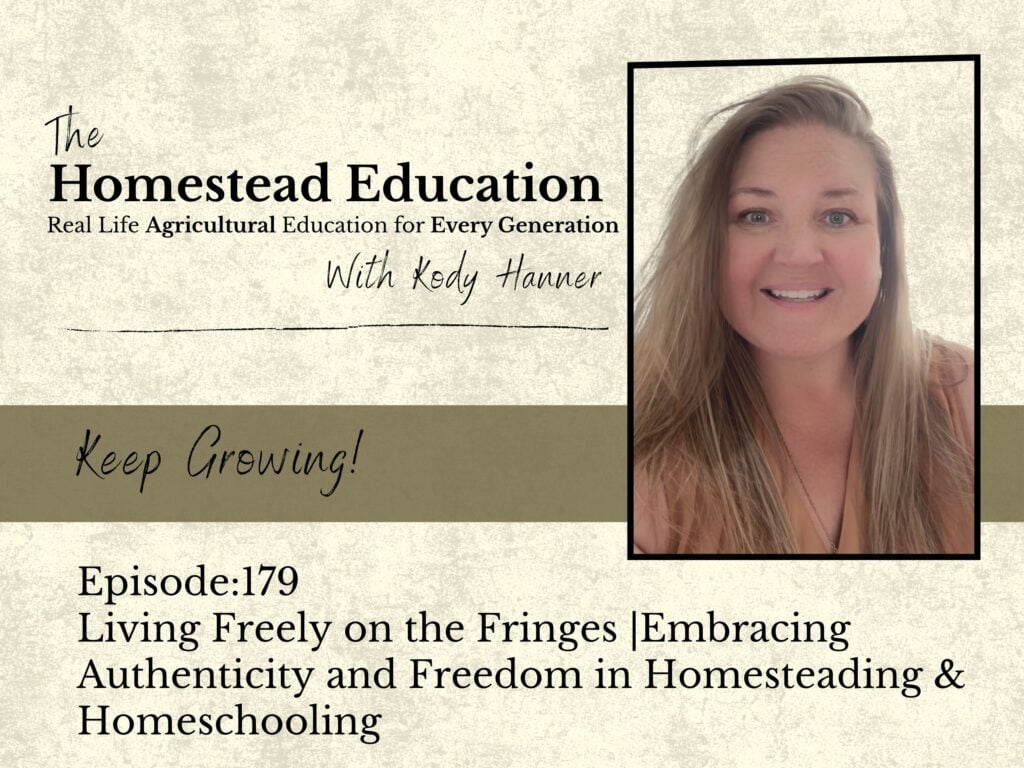
Episode 179: Living Freely on the Fringes: Embracing Authenticity and Freedom in Homesteading & Homeschooling
- Kody Hanner
Episode Highlights
In this episode, Kody Hanner shares her raw, honest journey of redefining success, identity, and freedom within the homestead and homeschool lifestyle. She explores the pressures of social media, the importance of authenticity, and how to stay true to ourselves without falling into societal traps or comparisons. This episode is a powerful reminder that true freedom comes from living in alignment with your values, beyond public approval or perfect appearances.
Key Topics:
- The shift from chasing societal success to embracing personal authenticity on the homestead
- The pressure to perform and curate a perfect life online versus real, messy life
- How living on the fringes offers freedom and independence from mainstream expectations
- The importance of privacy and choosing what to share in a digital age
- Redefining success based on real-world outcomes like capability, health, and joy
- Overcoming the comparison game—garden wins, follower counts, and perfectionism
- The emotional journey of living through hardship, illness, and rebuilding purpose
- The significance of community, family, and land in cultivating a meaningful, free life
Podcast Links and Resources
- Homestead Education Curriculum – http://thehomesteadeducation.com/homesteadeducationcurriculum
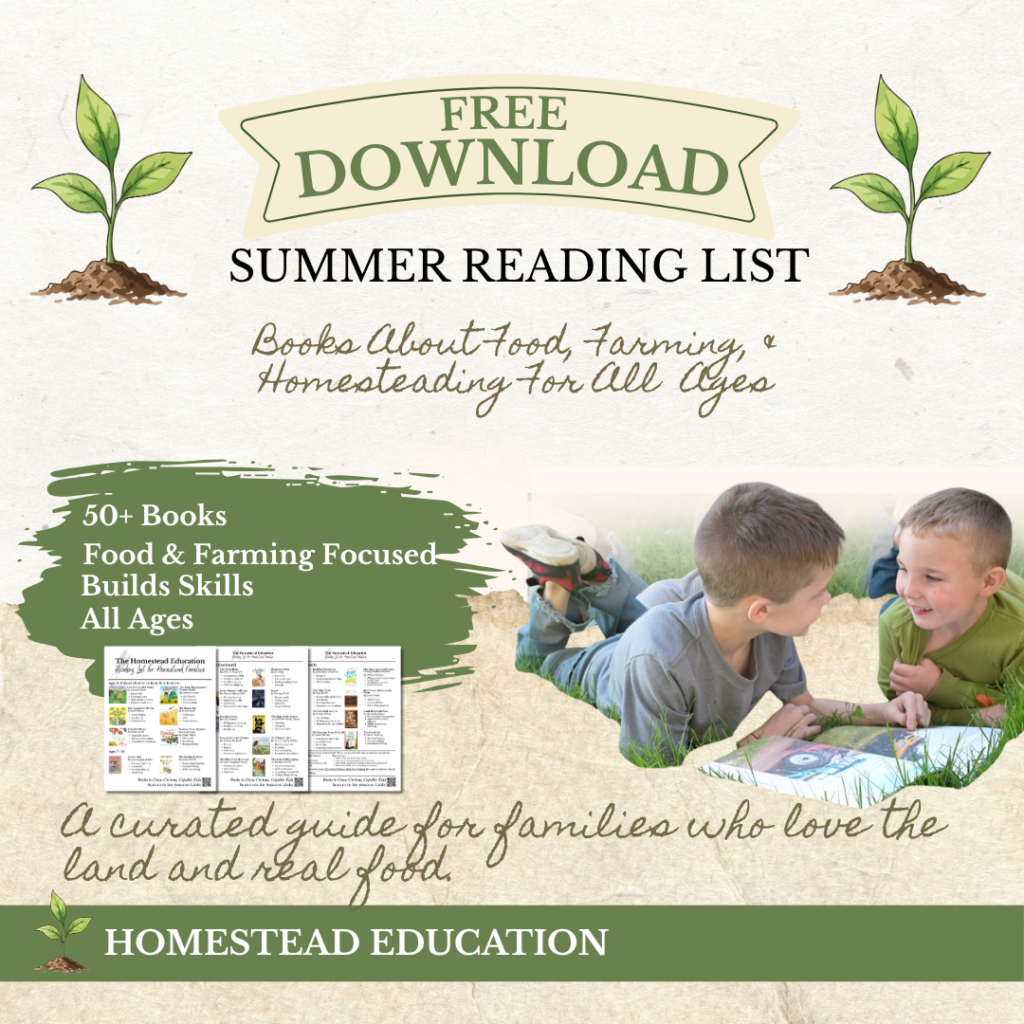
- Homestead Family Reading List – https://www.thehomesteadeducation.com/homestead-summer-reading-list/
Kody's Links
- Instagram – https://instagram.com/homestead_education
- Facebook – https://facebook.com/thehomesteadeducation
Homestead update
So I always love when it’s a solo episode to just kind of give you guys a little bit of what’s going on on our farm homestead. Cause there’s always something. And I wish I hopped on enough that I could give you, like, you know, the play-by-play of what’s actually going on, but between guest podcasts and my crazy life. Sometimes that just isn’t always the way things work. But ⁓ last fall we had the bet out.
He preg checked all of our cows. And, you know, every year he’s really spot on. And every single one of our cows or heifers freshened right when I thought they would. I mean, within just a couple of weeks. And so we’ve been watching this one heifer who I’m not sure is a heifer; no, it’s she’s one of our big Angus cows. I’ve been watching her for a while, and I’m like, yeah, she’s I mean
ShowHide Full Transcript
Like this girl, like she looks like a saucer. Like at this point, I’m like, my gosh, she’s having twins, but I don’t know. and the boys have been doing the rotational grazing this time of year, and we had so like we were having a anthropologist come ⁓ interview the family, because she’s doing some research on Pacific Northwest self-sufficiency. So that was really cool, and I had wanted the cows up in the main pasture.
when she came to visit, because when you pull down our driveway, then the cows are all standing out there and they have their summer coats and they’re in, you know, knee deep, lush grass. So, you know, I thought that would just be like a really nice look for when she comes in. And it was. But while I was ⁓ giving her the tour of the barn, I looked over and realized one of our dairy cows was still in the old pasture. And like when we move them, we have to move our water system right now because one of our floats is down.
And I was like, ooh, she’s been over there for a few hours without water. Like, I need to tell the boys. So that lady left about an hour later and I was like, Hey guys, Blue, which if you followed it for any amount of time, Blue is ⁓ my son’s brown Swiss cow that he’s been raising for almost five years now. and I mean, we’ve it’s it’s his, you know, line of breeding for his dairy. And, you know, Blue was on our old podcast cover and
You know, so she’s kind of like an important animal on our farm and so I was like, Hey guys, you know, like now that the lady’s gone, can you guys go move Blue? And they were like, Yeah, we wonder how we missed her this morning. Like, why wouldn’t she follow everybody else? And I was like, I don’t know. So they go up to move her, and all of a sudden this little white bull calf bolts out of the pasture, runs through two hot-wire fences, across an entire pasture, and off an embankment on the other side. And we’re like, where did this calf come from? I mean it was I’m standing down at the house watching this happen and I’m just like, what did I just see? And so my daughter and I go up there and turns out that, you know, Blue had a calf. That’s obviously like what had happened. but I wasn’t expecting her to freshen until the end of August. And it’s, you know, like that was July thir or June 30th.
And so I was like, what the heck just happened? and you know, he’s actually more of a tan color because, you know, his dad being a brown Swiss bull and stuff. But like we literally, like the boys had to go into the canyon behind the pasture and carry this calf out because it just bolted and was gone. And then, you know, my my husband had been taking a nap, and so I woke him up and he comes up and he’s all worried like, did the calf get any?
Colostrum and blah blah. We’re like, well, honestly, we don’t even know when it was born. It could have been born yesterday. But I’m gonna say that it’s pretty spry if it can like bolt across two pastures and down an embankment. But so we’re excited. We have this cute little bull calf, and we’re getting milk a little bit earlier than we had planned. We had actually we were planning on letting one of our other cows go dry and take a break over the summer, but ⁓ the other cow has a nice big udder and
Now we have this girl, so I guess we are dairying early this year, which isn’t necessarily a bad thing. Like money’s been a little tight and we kinda have been missing like, you know, all of our raw milk stuff. You know, we’re just really we’re not the type that like if we don’t have raw milk, we don’t drink conventional milk or we’re buying raw milk. I buy what I can afford and I know that raw milk is better for our family, but I also know that I can’t put our family into the hole financially.
for every decision that we or for every, you know, food product that we consume. I mean, like, let’s be really honest, my six-year-old likes to make eight-layer honey sandwiches, microwave them, and feed them to the dog. I’m not baking that many loaves of bread for him to just feed them all to the dog. So yeah, I absolutely buy like the dollar bread and that’s kind of the kids like making their peanut butter and jelly sandwiches for lunch every day and that type of stuff. And then we have homemade bread for
you know, our you know, just better meals, you know, for us for the adults to have you know, turkey sandwiches and that type of stuff. I I mean I would love it if the boys only were eating homemade stuff, but ⁓ yeah, they’re not eating it anyways. They’re feeding it to the dog. So I guess we’re good there.
So I mean, there’s a few other things like the raspberries are ripe, which is really fun time of year for me. My garden still isn’t in because we’re redoing the beds and it’s been a disaster. Like there’s only so many hours I can work in a day. But my starts are really tall, so I think we’ll be good. But it kind of kind of going back to this conversation of that we don’t, you know, like if we don’t have raw milk, we just drink whatever. And if the kids are gonna feed,
bread to the dogs, then I’m not making homemade bread for my dogs. There’s like an identity piece that I think has really settled into the homestead, homeschool world that originally I was like, this is amazing. And now it’s kind of become like I’m ashamed to say that I buy dollar bread sometimes or that we drink conventional milk when our cows are dry.
And you know, I mentioned in the last s saw ⁓ single person episode that I did where I didn’t have guest. you do I do have to apologize. I’m recording this after I’ve been at the lake all day with my kids. It’s like ten o’clock at night. I just wanted to make sure I had an episode out for you guys. So, you know, if I’m fumbling over my words a little bit, it’s just because I’m brain fried. But
I’ve just been thinking about how
There’s like a stigma that we need to
I don’t know, meet. And I had mentioned, you know, my last single episode that I was having some hardships, like, you know, personally, financially, time-wise, like life was just kind of getting to be too much. And I’m doing a lot better now. ⁓ I’ve done some things that are really positive for myself. maybe a conversation for another day, but
Right at the moment, like I’m in a really clear headspace and what I’m really feeling is that there’s a lot of my identity that is obviously really tied into what I do. You know, I mean I have a podcast that’s just me talking to you guys. I have ⁓ you know, social media platform and you know, my curriculum pods.
Okay, let me get my thoughts straight. I my kids had to come in and grab something out of here and I pff I edited it out, but I don’t remember where I’m at. So just you know that basically
Our lives are really tied to this identity that I have online. And I’m not saying that it’s a fake identity. I’m not s saying that I feel like I have to put on a show because one thing I really do is try to be authentic. however there are a lot of pieces that I leave out and ⁓ it’s not that you guys don’t know me because the pieces that I leave out are just because it’s they’re just too messy, you know? And like, you know
I do a lot of videos of my kids and sometimes my kids are wearing their shirts backwards and no pants and that’s just life, but it’s not really Instagram authentic or aesthetic, I guess. And so I mean those things just don’t come out and that’s okay. However, I wanna just like kind of go backwards a little bit and talk about something with you guys because I feel like there’s a lot of
If you’re a homesetter, if you’re a homeschooler, there’s a certain stigma or bar that you need to hold up. And whether that’s to prove yourself to somebody else or that like you’re setting the bar for somebody else that is wanting to come into it. And if you are not representing it perfectly at all times, then you’re just proving that it’s not good enough. And that just doesn’t really it doesn’t work for me anymore, and I don’t think it should work for any of you.
So I’m gonna tell you a bit about some of my background. but then I have and just kind of understand where I’m coming from, and I think a lot of you will really resonate with it. However, towards the end, I have just some things that I think will really help everybody shake off those chains. And basically what I wanna tell you is that you can live your life on the fringes without having to turn your life into a spectacle.
So when I say fringes, I have always lived my life on the fringes. And not because I was rejected by the mainstream. Honestly, I’ve always just kind of enjoyed standing on the outside of it. And when I say fringes, I’m not talking like being reckless or you know, sometimes I’ll use the word like outlaw, but I’m not breaking any laws. Like I’m not a criminal, I’m not antisocial.
Someone I just I’ve questioned what everyone else accepts all the time. I was never really interested in like, I don’t know, maybe what all the other little girls were interested in. I was always just kind of drawn to like the difficult, unusual, maybe the misunderstood things. And I was not the girl who wore black in high school. Like, okay, I’m wearing black right now. But like I you know, like I I I didn’t like, you know, go through an emus emo. I guess I’m going through an emus emo stage now because I’m a homesteader. But
I didn’t like go through the emo stage where I wore all black and questioned society. I actually really liked where I was. I just enjoyed doing things differently and I enjoyed doing it well. I mean, basically, I never wanted to like burn society down. I just never wanted society to decide how I shaped my life. and this probably like goes back to probably like a lot of how my dad was. So I
I t I’ve told his story a couple of times on here. I don’t remember what parts I shared and what which ones I did.
Did or didn’t, you know. But so my dad grew up like dirt floor poor. He was born in nineteen forty two in a little town called Ripley, Tennessee. So it’s very it’s very tiny. It’s kind of on the western side of Tennessee. I’ve heard it called like it’s on the fringes of like Middle Tennessee, which I mean I guess has its own like aesthetic or something, but
When his parents got in a divorce and his mom had actually married his dad’s brother and they moved to California. Like I know, does it get any weirder than that? it does. I actually have gone down my ancestry family tree and it gets a way weirder than that. So anyways, they moved out to California. My dad was the youngest, I believe. He didn’t really tell me a lot about his life. So
The pieces I do know are pretty cool, but there’s a lot of things that he never really like filled in the gaps for me, and he died about nine years ago. So anyways, at 13 he didn’t want to live with his dad anymore. I guess his dad was kind of abusive. And yeah, they were like dirt floor pour. I believe his dad had remarried at this point. His wife had like three kids and he ran away from home and hitchhiked out to California in nineteen fifty-five. Yeah.
I’m I’m really not that old. My dad was. I was a late in life child, but you know, and he told me all these stories about how he stole sugar beets out of somebody’s field and like cooked them over a fire under a bridge and then tried to eat them. And he’s like, I still can’t like get that taste, like the thought of that taste out of my mouth. So I mean, those were fun stories to hear as a kid. But when I got out to California, he started working for shipyards. And by the time my brothers were born, when he was in his early twenties, he actually owned his own shipyard.
And a lot of people like don’t I actually had somebody tell me the other day I didn’t know you could own the shipyard. Like I thought that like belonged to the city or whatever. and on I mean, it’s been a long time since he was in that business. Obviously, if he passed away almost a decade ago and I was quite a bit younger. ⁓ whether or not he actually owned the property or maybe like rented that space but owned the business that was there, he had a business that was a sandblasting and painting business and he had a lot of the navy contracts, painting ships and
painting bridges in the Bay Area and stuff. By the time I was born in his 40s, he owned shipyards all down the West Coast. Like I know we had them in San Diego, Vallejo, Portland, and I think there was one in Wa like Washington too. we had this amazing, you know, 1800 acre cattle ranch in wine country in California. my dad, I mean he on the weekends like after he got his business going and he was stable
He rode with the California Cowboys. He he and my mom ended up they were big game hunters and I mean they still hold some of the records like around the world for Safari Club International and the Grand Slam Club, which are both like hunting organizations. ⁓ we had the cattle, like we just my mom was a taxidermist, like we just had this really different life and we’re like, you know, sitting on this, you know.
When you hear about ranches in wine country, you don’t think about the Beverly Hillbillies who you know, my dad drove the same Jeep for forty years and fixed it with bailing wire and duct tape all the time. And every year we had a hog and frog feed where my dad took everything that he had killed over the years ⁓ over the year and put in the freezer and fed all his friends, which, you know, the main course was hog and frogs.
But we also had rattlesnakes and deer tongue and Rocky Mountain Oysters. And I swear it was like something out of the bio. And that was what my dad thrived on, is kind of just being this slightly different person. But he loved the storytelling. He loved the shock factor. you know, and he but he like worked hard. Like he didn’t just do unusual things. I mean he it
It’s not that he had a need to like prove anything, but he liked to live outside the box and be excellent at it. And he was a very successful man. I mean, apparently the rebellion that runs in our family comes with a little work ethic too, because I fall right into that. I do like, you know, living on the fringes and I like being really good at it. so, you know, this is where we never really fit into like any stereotype.
Like we were rural, but we were wealthy. And when I say wealthy, again, like I wasn’t born with a sil silver spoon in my mouth. Like I had the duct tape and bailing wire. you know, we went to rodeos on the weekends and I wore like wranglers and boots all the time, but we also owned a mini yacht. And, you know, I’ll mention that to people sometimes and they’re like, wait, you owned a yacht? And I’m like, but it was a mini one. And
You know, my life wasn’t always like that. You know, my parents, when they finally finalized their divorce, there was a lot of you know, money that had to be divided and there was a lot of struggles and everything like that. But it definitely just kinda like set me up for being
Just being different. I know I was really comfortable in rough spaces, you know, like being a little girl growing up in a shipyard. I was never a prim and proper little girl. I was like a little like street urchin. I don’t even know if that’s right. I mean, it was just a different lifestyle from day one for me. And I think I just learned really quick.
that being different gave me a story. And telling that story gave me a place in the room. And, you know, kind of being a little different, it
It made me stand out sometimes not always in the best ways. sometimes it you know, I was like the weird girl because
Yeah, I mean who lives in a taxidermy shop? Like not everybody. So
I mean I’ve always I’ll admit I en I enjoyed the shock factor. Like it was fun. ⁓ I liked watching people realize that the woman standing in front of them has lived a life that they could never even imagine. the good, the bad, the all the things in between. I mean, I recently I was visiting with a woman at a homeschool event.
And I was telling her just a little bit about my life and some of the hardships that I had overcome. You know, if you’ve been here for a while, you know that I was like a domestic violence survivor and you know that my husband was diagnosed with in-stage liver disease and we had to overcome that and there’s just all these different things. And she go like she looked at me like dead in the eye and like her face just like softened and she goes, I’m sorry. You lived such a hard life.
And I was like, I I I don’t think of it that way. And she’s like, Well, you may not, but you have. And, you know, I kind of thought about it for a second. I’m like, ooh, maybe I need to like embrace that and work through it for a minute. And I decided that no, I d I didn’t want to do that. The and not that I’m not dealing with anything that I need to deal with, because I have. you know, I’ve had I’ve done the therapy, I’ve read the books, I’ve, you know, worked on my self-confidence in so many ways. And, you know, if you’re going through anything like that, like I
You know, know that there’s a lot of support out there. I actually have some other podcasts on here that might be something that can give you support. And you’re always welcome to reach out because I don’t want anyone to feel alone through those moments. But I never felt like it was defining moments for me. that I never felt like those were my story. They were parts of my story, but they weren’t my they that wasn’t my whole story. That wasn’t my whole identity.
So through this time, after college, or after high school, I worked, ended up going back to college, and that’s when I really found agriculture. I’d grown up branching, hunting, 4-H, those types of things. But when I kind of found this, you know, this major, this lifestyle that was completely surrounded with only the things that I cared about, like I was like, wow, like this is where I belong.
You know, sometimes like and I can say this because I have an autistic kit, but I sometimes I felt like I have maybe been autistic my whole life and suddenly somebody put me in a train store and now I finally fit in somewhere. And who knows, maybe I am. I know I have really bad ADHD that I didn’t learn about until, you know, later in life, but anyways, that was a complete side note. so
You know, I really felt like I had found my place. And I thrived. I mean, I was a straight A student without even like putting work into it. I was doing 24 units as a time at a time as a single mom at a four-year, you know, my senior year of college, working an internship. I mean and I just plowed through it. I mean, it was I was 100% in my element.
And then I got and got out into the world where I was working in agriculture and food. And I kind of ran into something that I didn’t expect to find as much as I did. because this had never really been a thing for me. But I was well known in my community, like either through my dad or myself. And so kind of getting out in the real world, I realized that Ag really still is an old boys club. And I think more the more we’re learning about agriculture.
And I, you know, this isn’t one of these moments where I’m like down on the farmers and stuff. You guys can listen to some of my other things. I 100% support farmers. but just kind of the whole concept is like, you know, it’s an elite old boys club. And I’ll admit, I understand that culture better than a lot of women, because a lot of women didn’t grow up in a shipyard, you know? So I could navigate it. ⁓ but fitting into a system isn’t the same as belonging. So like I knew how to survive that world.
But surviving it and belonging in it are not the same. And that really just sets people up for in any place that you have to survive and not belong is not good for your system. It’s not good for your psyche. It’s not good for your health. and we’re learning so much more how mental health affects our whole physical wellness. So find a new room.
And that is really what my husband and I did when
He got sick and we had to change our different lifestyle into our necessary lifestyle.
Before this point, the life that we lived was like part our identity, part instinct, part preference. But like all in an instant it became survival. And that had to be our entire identity. I mean, when he was told that he had end-stage liver disease and a year to live, I was like, I do not accept that answer. I had just lost my dad to liver disease and
I wasn’t gonna lose my husband too. And so, like, really quick, food became like our culture, our lifestyle. Like, that’s all we thought about it. It’s all we thought about, and not in like a fat kid way. Although sometimes it’s still in a fat kid way, but I mean, it was we had to structure our entire lives on how we get food on the table and that we make sure that food is wholesome. And so
W that’s when we we had to begin questioning everything. Everything that we put into our bodies, onto our bodies, medication, our lifestyle, even how we worked out. And you know, we began homesteading, we began homeschooling our kids so that we could just have more time with them, have them more in our lives.
We completely had to rebuild our family, like around like health, land, food, our education. And thank God Ron survived and he he healed. there was a lot of work, a lot of big changes, a lot of questioning who we were when the people in our lives, the people who set expectations on us.
didn’t understand what we were doing and honestly didn’t support it most of the time.
At that time, homesteading was no longer an like aesthetic for us. It was our answer, our answer to everything. And it was right during that time. It was very lovely timing. Because all of a sudden our fringe lifestyle that we were living became very fashionable during the pandemic.
And again, I found this place that was home. I mean, it was very validating. People finally understood like the appeal of what we were doing. Like growing food became an amorable, I can’t ever say that word. Admirable. homeschooling became super accept acceptable. Self sufficiency was inspirational rather than ⁓
We were some crazy peppers or something. my outlaw life was suddenly something that everybody wanted. And it for a while it was like, wow, I know how to do this and I can teach this. And so yeah, you know, I jumped on the bad bandwagon of the podcast and the, you know, Instagram account and all those things. And you know what? It’s done wonderfully for us as a family.
And I have enjoyed so much like sharing my life and my interests with all of you in hopes that that will help you through your harder times, help you, you know, find a path in your business or in your homeschool or whatever that may be. Because I, you know, I started the podcast to kind of answer all these questions that so many people didn’t know to ask as they were rushing into this homesetting and homeschool lifestyle.
I mean, you don’t know what you don’t know. And I had this position where I felt like I may not have all the answers, but I know where to find them. I know how to share them. And I’m here to share them with you. And I’m not like, you know, coming out and being like, and so this is the end of the podcast. Like, no, not doing that. It I mean, if anything, it like is kind of getting me more excited about some of the things that I want to share with you guys. some things that I can do to help just help more. But there kind of this became this unintended consequence with this.
And it was that my lifestyle that always made it where I could stand on the fringes and not have to worry about what was fashionable and what was popular because I was just doing me and being really good at it. I suddenly had to meet follower metrics and algorithms and branding and sponsorships and up against homesteads.
Celebrities at this point, you know, because they have millions of followers and there’s movies made about them. And I don’t want to say up against, because I highly respect them and consider them co-workers because you know we end up speaking on the same stages and stuff. But I mean, it’s just a whole nother level. Like, how is suddenly my fringe lifestyle so public that I consider
People who are now celebrities in this field as my coworkers, but at the same time trying to keep up with them in my marketing and my followers and my analytics. It was just performance and comparison and the pressure to make my life a consumable product. And that was that has been wearing on me big time. Not that I still don’t want to share. I love it. I really, really do.
there’s definitely times where I think I could be funnier, I think I could be a little edgier. Not that I am not that person, it’s that I am not that person publicly. and I don’t know how much of that I will embrace at this point. I’m just kind of talking about how like I I do feel like I have to fit into this box all the time.
You know, think there’s a little like rebellion in me. Like if I move my head and you’re watching this on YouTube right now, you’ll see that my office is a little messy. sometimes I clean it up before a podcast, sometimes I don’t. And that just really comes down to I just need one space that is authentically me. And, you know, authentically me is I’m gonna be so organized and put everything in binders and then put them in a giant stack. You know.
But I think what bothered me the most about all of this is that my freedom, like, and when I say freedom, I escaped so many expectations when I kind of found this like homestead, homeschool world. It was I was finally able to just shed all the expectations that had been put on me my entire life and have it be okay to be this person that I had found in myself.
And love.
But that freedom was now suddenly being put into another cage.
And that is what I was not okay with. And I think that there’s a lot more people starting to feel that way, whether you have a homestead that is a public homestead, you know, like you’re on social media, you’re sharing what you’re doing. Or even if you don’t share that with anyone outside your family, there’s suddenly this need, you know, I f I see it all the time where
I don’t know, I go somewhere and someone’s like, what do you do? I’m a homesteader, I’m a homestead educator, whatever. And immediately they start listing off all the ways in which they are better than me at it. Not even they’re not wanting to share, they’re not wanting to ask what I do. they’re not wanting to bounce ideas off each other, or like you know, me and them. They just want to make sure I know that they’re better at it than I am. Great. Like maybe you are. But there’s a really good chance you are.
Because sometimes I really suck at homesteading. I mean, because I it just as a farmer, you know, like it is the first week of July and I do not have my gardens in. And, you know, my gardens are not a couple of little planter boxes. I probably have close to an acre work of worth of gardens and orchards. And that feeds our family, and we ⁓ sell it and that supports our family. And I don’t have my gardens in, and I feel pretty sucky about that.
⁓ so if your garden is in at the proper time this year, you are officially a better homesteader than me and I applaud you for that. But I I just I didn’t see it as a competition. I loved how everybody was just so excited to be a homesteader that they just wanted to share and they wanted to teach and they wanted to learn. And we had so many things to talk about and we could talk about what all our goals and aspirations were within our homesteads. And suddenly it became a competition.
a popularity contest. And that just wasn’t it’s still not something that I’m okay with. It’s not something I really want to be a part of. that doesn’t mean I’m leaving homesteading or anything like that. I’m just not interested in playing that game anymore. Because what made me love and so many other people love the homestead lifestyle, the moving out of their hometowns, whether they’re big cities or small towns or whatever.
And starting this fresh new life that there is no weight of expectation except for their own was so liberating.
We escaped conventional schooling, conventional food, conventional health systems, conventional family rhythms. And I mean when I say that, like, do you love the like public school pickup line? Cause I know I did not. very happy to have shed that. And conventional definitions of success. you don’t have to have your PhD to be successful. You don’t have to own a mansion to be successful.
You can be successful in your own ways. And I don’t know. Ugh. And you know, I’m kind of like, I’m burying my heart right now because yeah, part of this like really like hard hardship that I’ve gone through lately has been that there’s this identity piece with it that I, you know, have to, you know, keep my family running, keep my business running, somehow keep myself alive, and win this popularity contest every day. And that is exhausting.
There’s just this like should my garden look a certain way? Does my house photograph well? My house is never clean. I have six kids. I have seven dogs now. Did I have did I tell you have seven dogs now? Like, ugh. Like, my husband’s like, fine, which one do you want to get rid of? I’m like, none of them. I don’t want to get rid of any of them. Just stop bringing them home. Like, that’s step one. Like.
The the first step to admitting that you have a problem is acceptance. So when you when you accept that you have too many dogs, maybe you will stop collecting dogs. and I mean they like they don’t even My daughter’s cattle dog, he chases rocks and steals stepping posts when the boys are trying to set up our rotational pastures. Like, great cattle dog there, kid. Good lord.
So, you know, I feel like every meal that we make should be content. And, you know, even if I’m not planning on doing a blog on how to make cheeseburgers, what if I need to market my beef next summer? Or what if I want to show everybody how to make homemade hamburger buns? Or I don’t know, maybe I just need like some background picture for something else. Like, my gosh, why am I
Photographing my cheeseburgers.
And that’s like my camera role is just I go through my phone and I’m like, what is all this stuff? And then I try to find like a really pretty aesthetic video of my kids doing something with animals and they’re just in like my dirty barn in their dirty clothes messing with a dirty animal. And then I’m like, it is a farm. They’re supposed to look like that. We aren’t raising pristine show stock where I’m out there scrubbing my pigs every day. No, I am raising farm pigs. I’m raising heritage pork. I am proud of that.
I am not out there washing my pigs unless my kids are going to the county fair. it’s just so much.
You know, I and then for my kids, like I feel like if they aren’t performing at the level that is acceptable in school or socially, and honestly, like how well I run my family or like shouldn’t be based on my number of followers. My values should not be marketing assets. They are it’s good, but sometimes
okay. Basically, I did not leave a conventional life so that I could become conventionally successful at my unconventional one. So if you’re feeling this, like, can I get an Amen? Okay, you’re you’re not actually there, but pr like you’re if you’re in your car driving down the road right now, be like, I give you an Amen. Like put your hands out the window. Like feel that freedom that we are done.
With conventional lifestyles. That is why we embraced what we’re doing. But yet here we are recreating a conventional lifestyle.
To meet follower numbers or to prove to the Joneses? Like, yeah, keeping up with the Joneses. If you haven’t heard that phrase before, look it up. But you know, suddenly like it’s all on followers and Joneses on whether or not your garden is acceptable. Did your garden feed you? Did it bring your bring you joy? Did it teach your kids a skill? Did it pay some bills? Then you have a successful garden even if it looks like a dumpster fire. Let me get another amen. Okay.
We’re moving on. I’m done preaching. I don’t know. I may not be done preaching, but I I’m done with the amens. We’re moving to hallelujahs next. So gosh, I’m cracking myself up tonight. I I am don’t let me record at ten o’clock at night again. Or maybe I should. Maybe you’re loving this. so my best friend is visiting right now. That’s probably where my goofiness is coming from. ⁓ I just, you know
Building on her energy. We’ve been best friends since we were two years old. My grandmother moved in next to her family. and I mean, yeah, she’s like family to me. Our kids call each other cousins. And she comes and sees me a couple times a year. It’s kind of hard for me to get down to California and see her. So we split the cost of her family going on vacation twice a year. And it works out really well for both of us. But ⁓
We were driving to town and we were talking about just people we grew up with and you know, she keeps me up to date on all the gossip. And she’s like, Yeah, have you talked to so-and-so lately? And I was like, Mm, no, I haven’t talked to her in years. And she’s like, I didn’t realize that. Like, you’re still friends on Facebook. And I’m like, Yeah, I mean, I don’t have I mean, honestly, I looked her straight in the eye and said, I still love those people. Like I still love her, like this friend we were talking about. But I cannot be in this life while also being in that one.
I’m not, it’s not a moral superiority. It’s not pretending like my old life was bad. It just means that I can’t rebuild dependence and maintain my freedom at the same time. If I return to those habits and that lifestyle, it would destroy my family, like health-wise, the structure we’ve built. And you know, you’re like, would a phone call really do that? Yeah. I would be, it’s too easy to get sucked back in.
I just
I can’t have like two sets of values and like not that we were bad people before, like we weren’t. But you just get sucked into that small town drama and we just don’t have we don’t have anything in common anymore. And that’s okay. I just I don’t want the chains of what my old life was. I didn’t stop loving those people. I didn’t stop loving the life that I had in a different space.
I just stopped being willing to lose myself in it.
So how do like the real boots on the ground homesteaders and homeschoolers keep living freely under this like Instagram microscope? First off, decide what remains private. You know, you don’t need to show every tomato you harvest, unless you want to. If that is your like thing, go for it. I don’t show every round of piglets that we ferrow here. And honestly.
Sometimes we lose piglets. Sometimes I’ve we have a we’ve had a litter on the ground for a week and I haven’t been up to the barn to see them yet. So I can’t document a new litter if I haven’t even seen yet. I don’t need to show every lesson my kids do as proof that I’m homeschooling them to the internet world.
And I don’t need to share every hardship that my family has.
You know and you know, so like I’m gonna share one right now. But in all the we talk about how my husband got sick and through all of our lifestyle changes, you know, it saved his life and all that stuff. But there was a lot of hard moments during that. Like he went into a really severe depression. I’m trying to drag him, like, Bucka buttercup, we’re gonna like make this all right and
Like I had to keep that mood up to keep us moving. But a lot of time that led to terrible fights. Terrible fights that we still have today sometimes as we are still understanding each other’s role in our marriage. we’re good and we’re we’re better than good. But that doesn’t mean that we completely understand each other and we completely re understand our responsibilities.
especially in setting the tone for the family when for the largest part of our marriage it has been me carrying that. by choice. Like it wasn’t that I was hiding you know, it wasn’t that I felt like I had to. I did this because I wanted to, because I loved my husband and I loved our family and I wanted to keep us moving.
And that might be a big part why I’m feeling like super deflated right in this moment is I just reached the end of what I was capable of and need time to rest. And you’re probably thinking, like, yeah, Cody, take a damn nap. Like But I’ll tell you what, like I sneezed once last week and my eyes closed and it almost felt like a nap. So you should be really proud of me. Anyways, privacy is not dishonesty. it’s
choosing what you want to share. And at what what at what times. But you can So step two would be measuring success in your real world outcomes. So are your kids becoming more capable? I’m not talking about their grades. I’m c talking about are you spending less time wiping noses and more time applauding
Things that they are handling on their own? Is your family healthier? Is your marriage stronger? Do you know your neighbors? Can you feed people?
Can you solve problems? Can your kids solve problems? And does your life feel meaningful? That matters way more than whether or not your followers see your life as meaningful.
You’re not worrying about whether or not you’re real performed. Does your photo look rustic enough? Does your audience approve of who you are? Cause guess what? Your tomatoes don’t care how many followers you have.
And your tomatoes really don’t care how many followers watched you plant it. So stop performing authenticity.
Real life is absolutely inconsistent. And I like to share that where I can, but sometimes the garden fails. Sometimes we buy our bread from the grocery store. sometimes we don’t do school for weeks, and then I’m like, ⁓ kids, guess what? If you don’t want to be dumb, come here. Like Sometimes our freezer is full and sometimes like right now they’re empty.
The laundry is never folded. Like I wrote my notes for this and I was like, son sometimes the laundry is not always folded. No, the laundry is never folded. I try. I try so hard.
it’s not whether your children are brilliant, more brilliant than other children because they’re homeschooled, or more feral than other children because you’re homesteaders. Cause my children are brilliant and they’re feral. And that is all wrapped up into one sometimes. I am they are brilliantly feral, and that’s okay. You know, I mean, the six year old’s going through a phase where he needs a life jacket to play in the sprinklers so he doesn’t get around.
And you know what? Keeps them busy. So whatever. protect n you know, noviceness or beginnerness, beginnerhood, whatever word you want to call. It’s okay to be trying something and failing and sharing that. It’s okay to change the way you want to do it. It’s okay to learn how to do something before you share it with somebody. And that I’m, you know, if you’re like Cody, I don’t even have a social media, like, how is this?
You don’t have to like go to your neighbor and say, Hey, I’m gonna learn how to can applesauce from all these trees out here in the yard. And then you don’t do it and your neighbor’s like, Wow, you suck. No, no, it’s okay to just do it. And then when it turns out good, share that with your neighbor. Share applesauce with them.
It’s it’s okay to be really bad at stuff. I’m really bad at some stuff.
My poor, poor berries and trees that I buy every year that die a slow and painful death. I’m bad at that.
It’s okay to have hobbies that never become income streams. I don’t do it as much as I should, but I have a needle point that sits next to my chair and I really enjoy just doing needlepoint. I have never shared that on social media, like anywhere. not that I’m ashamed of it or anything, but it’s just it’s just there. It’s not great. I like buy the little like looms and thing at the dollar store or, you know, dollar journal or whatever.
And I do them just ’cause they’re fun. Half the time they end up in a box in my closet or the dogs like get a hold of it before I’m done or something.
And I’m okay with that. My daughter has a loom too. And she or no I don’t know if they’re called a loom. The round things that we put the like tea cloths on. My daughter does it too. We aren’t trying to sell our designs. We’re not trying to like convince people that you should, you know, do needlepoint rather than or cross stitch rather than be on social media. No. It’s just something we enjoy doing. We enjoy doing it together. We have fun.
And it does nothing else for us besides.
And joy, you know. So I do want to say it is okay to keep people in your life who don’t understand maybe what you do, or okay, no. It is okay to keep people from your last life in your life. Especially those of you who are like creators and stuff. Cause having someone in your life who knew you before you were a brand matters.
Like my best friend coming to visit. She knows the person who I am beneath the platform. She remembers like the old Cody, which I’m still the same Cody, but I don’t know. Maybe the old Cody was a little more fun. Maybe she wasn’t. Who knows? Whatever. She can see like the good things that have changed about me. She’s proud of me.
But she’s not impressed by my follower numbers. Now her kids were today. They didn’t realize I had so many followers and we were talking about it at the lake and they were like, Wow Which I still think is a really low number, but they were really impressed, so it was cool. I got to be like the cool aunt, you know.
But I didn’t do this to be admired. I did it because my husband was sick and I needed an outlet to share that.
I did it because my family needed healing, both mentally and physically. I did it because my children needed a different education. I wanted to have control over my food. I wanted a life that gave me purpose every day. And something that I just
I wanted freedom from the systems that were failing me.
So it’s cool. I have my notes. I’m not even gonna lie. I got my notes ’cause I’m not I wasn’t gonna remember all this. It’s been bounced around in my head for so long.
I just
I was tired I’m tired of getting approval from
like the mainstream or the algorithm or whatever we want to call it. And still try to call that freedom. Cause it’s not.
⁓
I enjoy sharing. I love telling stories. You know, I guess that makes me an influencer.
But
I I don’t like the word influencer. I prefer educator, maybe content creator, but I don’t like the word influencer. The thing is though, I am not wanting to be smaller to stay authentic. I want to be more authentic while becoming more influential without losing more freedom.
That I don’t I don’t I don’t know how to do that exactly. I know the answer is not disappearing from the internet.
It’s making sure that I don’t let the internet become an authority over my life.
Because I mean living on the fringes was never I don’t even know like it was never about being different just for the sake of being different. It was about staying close enough to the edge where I saw where the system stopped making sense. Homesteading and homeschooling absolutely gave me a way out. But I have to be careful not to just like rebuild those same pressures.
In a prettier package. Cause the point was never to have the best looking garden or the biggest platform or the most impressive children. The point is that my family was healthy, capable, connected, and free.
So it’s okay to plant your garden and not film it. I am absolutely not a zero because I’m so tired. it’s okay to teach your kids without waiting for applause. it’s okay to like serve an ugly meal because you are building a life that still matters when the phone is turned off. You know, freedom is not being watched while you are living differently.
Freedom is being willing to live differently when nobody is watching. I mean
I say that a lot when it comes to integrity. Integrity is doing the right thing when no one is watching. And I really feel like freedom kind of falls into that same, or at least this freedom that we’re talking about.
My truest outlaw life is to n is not to get the most attention. It’s the one the it’s the life that cannot be bought, pressured, or performed into becoming something that it was never meant to be.
I still want to tell my stories. I still want to build something big. I want to stand out. But I refuse to ch to trade one set of chains for another.
I am not rejecting this. I am reclaiming my authority over it. And I hope that you guys can do that too for yourselves, for your own lives, if you are feeling this same pressure of a life that once set you free is now putting you back into another box. I’d really love to hear your thoughts on this. Leave a review, come over, give me.
you know, a comment over on social media when I share about this or on my blog page because I would love to hear your thoughts on all of this. Until next week, I hope you all keep growing.