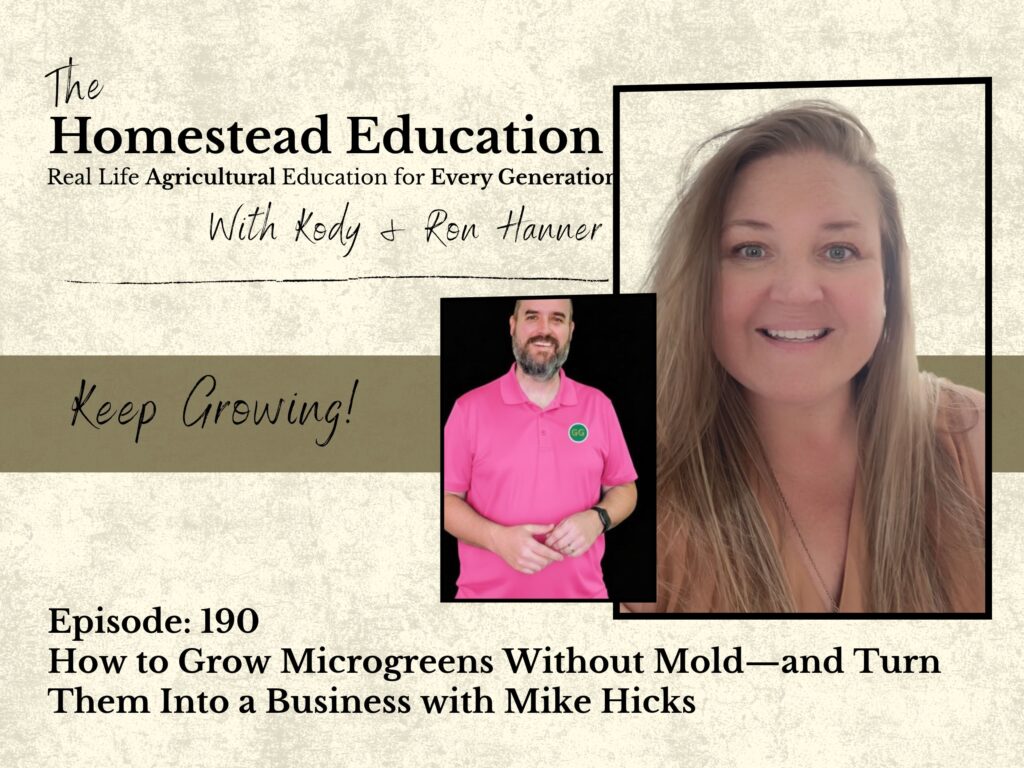
Episode 190: How to Grow Microgreens: Beginner Guide + Business Tips
- Kody Hanner
Episode Highlights
Can you really grow a profitable crop in a few trays, indoors, without acres of farmland?
And maybe the more important question for some of us: How do you grow microgreens without turning the whole tray into a science experiment full of mold?
In this episode of The Homestead Education Podcast, Kody Hanner sits down with Mike Hicks of Microgreen Business Coaching to talk about how to grow microgreens at home, troubleshoot some of the most common growing problems, and potentially turn those tiny greens into a legitimate small farm business.
Mike spent more than two decades working in the restaurant industry before deciding he needed a career change. What started as a plan to grow microgreens and sell them at farmers markets quickly expanded into restaurants, grocery stores, expos, and eventually a full-time business.
Now, he helps other growers learn the same process.
In This Episode:
What microgreens actually are
The difference between microgreens, sprouts, and fodder
Why microgreens are grown in soil and harvested above the soil line
How to grow microgreens at home
The basic equipment you need to get started
Why Mike recommends broccoli microgreens for beginners
How much seed to use in a standard 10×20 tray
Why weighting trays during germination matters
How long microgreens generally take to grow
The most common causes of mold in microgreens
Why overwatering may be ruining your trays
Choosing a good potting mix
How temperature, airflow, moisture, and seed density affect growth
Why you should learn to grow successfully before investing thousands of dollars in equipment
When inexpensive trays make sense—and when commercial-quality trays are worth the investment
How color-coded trays can make a growing system easier for employees or kids to manage
Selling microgreens at farmers markets
How Mike moved from farmers markets into restaurants and grocery stores
Why population and location matter when choosing a highly perishable farm product
How to approach chefs and restaurants with samples
Why confidence can make such a difference in direct sales
How grocery stores discovered Mike’s products
Working with state agriculture departments and Extension offices
Finding grants and resources for small agricultural businesses
Using AI as a research and editing tool without letting it replace your own experience and voice
How Mike built Microgreen Business Coaching
Why there is still room for new growers in the microgreen market

How to Grow Microgreens for Beginners
Mike’s advice for someone who has never grown microgreens before is refreshingly simple:
Start small.
You don’t need a warehouse, elaborate hydroponic setup, or thousands of dollars in equipment.
Start with a tray, good-quality potting mix, seeds, water, and light.
Mike recommends broccoli as one of the easiest microgreens for a beginner. Spread the seed evenly across the soil without creating dense clumps, water it in, cover and weight the tray during germination, and then move it into light once the seeds begin growing.
One of the most important lessons?
Don’t love your microgreens to death.
Overwatering and overly dense seeding can create exactly the warm, damp environment that mold loves.
And yes, Kody may finally have figured out why every tray of microgreens she has ever attempted eventually looked like a biology project.
Can You Make Money Growing Microgreens?
Mike didn’t originally set out to build a large operation. The plan was farmers markets. Then customers started asking questions. Restaurants noticed the product. Grocery stores approached them. Expos created more connections. Eventually, what was supposed to be a small side business developed into a full microgreen operation.
His advice for anyone thinking about doing the same is important:
Grow them first.
Eat them.
Learn the process.
Figure out whether you actually enjoy doing it.
Then invest.
Buying thousands of dollars worth of equipment before you’ve discovered whether you even like growing microgreens is an expensive way to learn that you hate your new business.
Selling Microgreens to Restaurants
One of my favorite parts of this conversation is Mike’s approach to restaurant sales.
Instead of waiting for chefs to discover him, he researches restaurants that already use microgreens, identifies businesses whose menu and price point make sense, brings samples, and starts the conversation.
That willingness to simply walk in confidently and put the product in front of the right person can be the difference between endlessly planning a farm business and actually building one.
It’s also a great reminder for any direct-to-consumer farmer:
Sometimes the next customer isn’t going to find you.
You have to go find them.
Is the Microgreen Boom Over?
Microgreens exploded in popularity during the growth of the modern homesteading movement, which makes it easy to wonder whether the opportunity has already passed.
Mike doesn’t think so.
Instead, he believes the market has matured.
Consumers understand what microgreens are now. Restaurants already use them. Grocery stores carry them. That means growers don’t necessarily have to spend as much time explaining the product before they can sell it.
The opportunity is still there—but, like almost every small agricultural business, success requires producing a quality product and being willing to hustle to find customers.
Resources Mentioned
Mike Hicks – Microgreen Business Coaching
Mike offers microgreen growing and business education, including:
Weekly live Q&A sessions
Growing and business training
Templates and workbooks
Business-planning tools
Restaurant and market sales strategies
A beginner ebook designed to help growers through their first 30 days
Search Microgreen Business Coaching on Skool, YouTube, or online to find Mike’s resources.
Mike also discusses suppliers he has used for trays and growing equipment, including Bootstrap Farmer, True Leaf Market, and Greenhouse Megastore.
If you’ve ever considered growing microgreens for your family, adding them to your homestead income, or building a small agricultural business without needing a hundred acres, this episode is a great place to start.
And if your previous microgreen experiments ended in mold…
You’re definitely not alone.
Until next week, keep growing.
Podcast Links and Resources
Microgreens That Sell, a $27 guide to growing microgreens that actually sell:
https://www.
Coaching website: https://www.
True Leaf Microgreen Kits: https://trueleafmarket.com/collections/micro-green-kits?_gl=1*5lqpeh*_up*MQ..*_gs*MQ..
Bootstrap Farmer: https://www.bootstrapfarmer.com/
Greenhouse Mega Store: https://www.greenhousemegastore.com/
Kody's Links
- Homestead Education Curriculum – http://thehomesteadeducation.com/homesteadeducationcurriculum
- Homestead Family Reading List – https://www.thehomesteadeducation.com/homestead-summer-reading-list/
- ESA Funding: https://www.thehomesteadeducation.com/funding/
- Instagram – https://instagram.com/homestead_education
- Facebook – https://facebook.com/thehomesteadeducation
- Raising Self-Sufficient Kids Book – https://www.thehomesteadeducation.com/product/raising-self-sufficient-children/
How to Grow Microgreens and Build a Microgreen Business
Kody Hanner
Hi everyone, and welcome back to The Homestead Education Podcast. We are going to have a really interesting conversation today about something that has been one of the biggest conversations in homesteading since the modern homestead movement really took off. Today I have Mike Hicks from Microgreen Business Coaching, and I am excited to hear all about what he is doing – and maybe score some tips on not having moldy microgreens. So welcome, Mike.
ShowHide Full Transcript
Mike Hicks (00:32)
Thanks for having me. I appreciate it. We have been doing this as a business for six-plus years now, going into our seventh season of growing. I love sharing information and helping people as much as we can, because if you make the industry better for everybody, it is better for you too. That is kind of our mission.
Kody Hanner (00:52)
Of course. I think it is what, noon for you?
Mike Hicks (00:57)
It is eleven.
Kody Hanner (01:00)
It is nine o’clock here, and I worked until three in the morning because I only get work done when all my children are asleep. We are butchering a hog right now, so it has been a two-day process. Everybody forgive me if my brain completely shuts down. Tell us how you got started in microgreens. What turned that page for you?
Mike Hicks (01:05.88)
Yeah, yeah.
Mike Hicks (01:23.292)
well, yeah, I was looking for a career change. I was in restaurants for probably twenty four years or so, something like that. and just burnt out in that industry. Like it’s it’s a seventy hour week working job for somebody else. You’re not making as much money as you should probably should be. and it kind of just wears on you. I was looking for a change. we kinda just decided to leave that. It was in no November of nineteen that I left that. I was searching for some things. I was doing some good work, I was doing some over the road stuff. Deliveries and stuff, and just searching for the next opportunity and everything else. And we stumbled across it. We knew about microgreens. We’ve grown them in the past here and there, little tiny trays, little five by fives or whatever else for ourselves. And then we decided that we would give it a shot to see if it would work as a business, and decided we were just going to do farmers’ markets, right? That was the only thing we were gonna do,. work two days a week, farmers markets only. Gateway dragon. yeah, we just started doing that and everything else and it just started taking off and then grocery stores started getting a hold of us and like they reached out to us and wanted to carry our microgreens because I seen them at the farmers markets. we went to some expos and bigger re grocery stores wanted to see them and stuff, and then restaurants came along. it just kind of snowballed and took its own effect and everything on it. it’s kind of just ground swell, and within 2021 we had a full flush business going. Growing microgreens, supporting the home, raising poor kids, finishes they’re finishing up their young adulthoods in high schools and all that stuff. And yeah, then we just try to turn it into showing other people how to do it as well because if we can bring the industry up and show people how to do things the right way, I believe that’s the way to do it and to give back some of your knowledge as well.
Kody Hanner (03:11.702)
I agree completely with that. We just kind of a sidebar, we don’t have a meat inspection service in Idaho. And we’re pork producers. I’ve been trying to get a retail U USDA retail exempt shop set up on our property so that we can sell more custom products and because there’s one USDA butcher in all of North Idaho. Yeah. it’s a we have a good relationship with them. we can get our hogs in, we have a monthly like slot. Yeah. But they only do like you get your bacon one way, you get your sausage one way. then everybody in the panhandle is selling the exact same product. I went to our health department and was like, okay, how do we get this retail exempt? And she’s like, I have never dealt with anything like this. You have to have a HACCP plan. Do what a HACCP plan is? And I’m like, I’m actually a HACCP trainer, so yeah. Nice. And she’s like, if we could get you going, would you help me teach other people? And I was like, well, yeah, because I don’t see them as competition because the point of this is all of us want to be doing something different. But we’re like bottlenecked into the same thing. I actually feel like it would help the industry as a whole if we weren’t all peddling the exact same product. Yep. Like have you ever seen it’s a like cheerleading movie where like Yeah.
Kody Hanner (04:35.106)
The guy goes around and pedals the same dance and then they get to competition and everyone’s doing the same dance. Like that’s what it really felt like. I agree with you on like raising the whole industry. Yes. I think more people need to have that mindset and just would make it so much better. Mm-hmm. And some people they give their information away for free. Some people are happy, charge for it. It’s but it’s okay either way, and because some people have that time or availability or feel the call to it. And some people like us, we found something that works for us and we’ve made it a business that we love and are passionate about. I’m gonna back it up just a little bit for like listeners. Tell us the difference between like or Like tell us what a microgreen is and how that’s different from say like sprouts and fodder. Yep. microgreens are still grown in soil, just like you would grow outdoors, but you’re growing indoors in like ten by twenty trays is what we mostly use. we do wheatgrass in like five by fives, but so you’re grown in soil, you’re just seeding it, you’re watering it in, and it just you’re growing it to two, three, four inches tall, depending on which crop it is. you’re getting all that nutrient packed in that. sprouts are grown warm, wet in water the complete whole time.
Mike Hicks (05:54.52)
it’s just highly more risk for it. But in microgreens, you get the same benefits of eating spray. There’s been lot of outbreaks of like E. coli in sprouts, right? Yes. ‘Cause people don’t know what they’re a hundred percent doing. did you clean it correctly all the way? Did you get to it in time, ’cause you gotta do that every day. I believe no, not to bleach no bleach. To bleach them, right?
Kody Hanner (06:16.462)
Actually, there’s some there’s like commercial cleaners that kinda have that same idea that it’s a very low ratio. But yeah. D don’t be putting bleach in your own personal sprouts. Don’t want to do that. it’s just such more risk with sprouts. in microgreens you get the same benefits with very, very, very low risk because you’re cutting above the soil line. you’re nothing in there, as long as you don’t have any mold in there. I know pre sometimes you can get mold if you’re not if you’re not careful with if you’re not knowing what you’re doing and then you d obviously wanna cut that part out and you don’t wanna eat any part that was in that as well. But Yeah, exactly. That’s where it all went when we first started. Went out to the chickens. And then there’s also do you ever or work with fodder at all? no, not really. we toyed around with it for a little bit on the fodder, but we didn’t stick with it.
Kody Hanner (07:13.208)
We’ve always had big dreams of it because especially in North Idaho, when we have a hard time with grassy around and we have a dairy operation, being able to grow fodder and, give my cows a big slab of nutrient packed, like barley or something, would be amazing. And we’ve yet to figure it out because if I can’t even grow microgreens, but I’ve and I’ve tried to grow the fodder or a few times and like, I set it up basically like a microgreen operation. Yeah. Just some differences, but. Yeah. And I got this barley from our neighbors because they grow it. they’re like, yeah, just take a fifty pound sack, like, do what you want to do with it. Let me know what you figure out. And I tried to grow this barley for like two years. And I’m like, Okay, maybe we’re just getting to the point where it’s too old of barley or whatever. And my like at the time probably about four year old, which people who listen to my podcast have heard of tons about my feral child, went out to my garden room. Or it’s like my where I start all my seeds in the spring, and dispersed this barley seed into every single like soil block and everything. And you would go out there and think that I was growing hay and there was like tall barley coming out of a single thing. And I’m like, how can this kid basically grow barley being like a spaz and I can’t grow it under like perfect conditions? wow.
Mike Hicks (08:40.046)
it’s with the fodder it’s it’s so compact the way you gotta grow it ’cause it’s you’re not growing it with any soil or anything else. you’re you’re growing it so you got more risk because it’s all just so clumped together. and we just found we tried to do it. We almost started trying to do it, but and we couldn’t get anybody that would commit to buy it to grow it at a commercial level. they didn’t want to do it. We were thought it’d be great in the wintertime for people with having animals locally here that’s hard there’s no grass growing in middle of Illinois in December, January and February. but they didn’t really want it. we just do the pet grass. Whole solder operation with our dairy in college. Like it was a whole truck and trailer setup. And I’m like, man, if these guys can do that I can do that. We grew it a lot. It was just moldy. Or like half the tray would grow and the other half wouldn’t and Yeah. Yeah, thank you.
Mike Hicks (09:36.718)
Apparently you should have the four year old just do it. Right? This kid, I don’t even know. He got a weed eater going the other day without a carburetor on it. Yeah. And then when he ran out of ether to spray in it, he sprayed sunscreen into it, which still worked, but shot out a flame ball. And yeah, so Wow.
Mike Hicks (09:56.568)
It’s probably time to stop doing that one. Yeah, don’t don’t don’t use a sunscreen. No fireballs. Yeah, just I just don’t leave him unattended. That’s he’s not necessarily naughty. He’s a my friend at one point said he is a at the time four year old stuck in a forty year old body and he is peed off about it. Yeah.
Mike Hicks (10:13.71)
It sounds right from the quick quir points I’ve got from him. All right, so g will you give us the rundown on how to start just start microgreens in general. Like if I just wanted to grow microgreens for my salads. Yeah. Yeah, certainly. I would get yourself a ten twenty tray, it works better. Our little five by fives, you can do them as well. get yourself a good soil potting mix because it’s going they’re gonna grow so much better than that, than any mats or just by their selves or anything like that. You want just a good solid po potting mix. It doesn’t have to be anything fancy. put it put a little bit of soil in there, just fill it up with soil. seed their seeds so they’re not clumping. over when you put them on top, you’re just gonna you’re gonna flatten that soil and then you’re just gonna put the seeds on top. like say if you’re doing broccoli microgreens, which that’s the ones I recommend completely to do first if you’re doing it. And if you’re doing it in 1020 tray, you’re gonna seed it about 20 grams in there. just make sure it’s evenly seeded across it, no clumping or anything else because that’s where you’re gonna get mold issues if you got it clumping or anything like that. then you water it in, cover it, wait it for three days, pull it out. Water it, put underneath some lights or a kitchen windowsill if you’re doing it personally at home. Find huh? Yeah, you’re gonna want to weight it because you’re gonna s we’re gonna simulate the pressure of soil. Like if you’re planting outside. Okay. You put soil on top of it, right? yeah, you’re gonna bury it. this is simulates that. it gets the seeds knows, hey, I need to start growing and pushing up. it starts pushing up the tray instead of soiling.
Kody Hanner (11:38.658)
Wait it.
Kody Hanner (11:56.014)
Do you put like a single tray on top or do you put a little extra weight with it? you can put a single tray on top. You want a single tray on top and then we use like a fifteen pound paver. but if you got little bricks or weights, lifting weights, you can just put that on there. whatever weight you got, just assimilate it. You don’t have to go out and buy anything special. Just put some put a book, a heavy book on it,. Just grab a book, put on it, even I’ve we did that in the very beginning. We had s some good heavy books and cyclopedias. Diving weight the weights that you put on your like scuba gear. Yeah. But I guess in Illinois you probably don’t do as much scuba diving as we did with me growing up in California. Yeah, no. In the mi in the middle of America, it’s not really scoopy. No, no gear out here rather than that, weird. But yeah, just to wait on top of it, just to simulate that pressure. You’re gonna take it off after three days. You’ll start seeing it stick out the sides and stuff. That’s great. You want that. Three days. Three days. and then you’re gonna put it on in light windowsill or something for like seven days. And then you’re just gonna cut it above the soil line. after thirty days you said? Three days, okay.
Mike Hicks (13:01.976)
I need it. Awesome. That’s it. Yeah. I love the broccoli ones. They just I think feel like they just have like the greatest flavor. I tried like a spicy salad mix one time and that one was really good as well. Yeah, them are our t most two popular individual kind of crops is a spicy solid mix and a broccoli. By far. Broccoli by far. Broccoli doubles that one and it’s the second most popular one. wow. is it like you say like nutrient packed, like what’s like the nutrients we’re talking about versus like a more like like a lettuce or something? Yeah. not claims, but there’s been studies that have been done. Fort River Institute’s done studies and overall microgreens are forty to a hundred times more nutritional packed than a full vegetable, full broccoli. Broccoli’s probably on the higher end of that. there’s no they can’t really claim it, but they did do their studies and they’re it’s out there. You can look it up. broccoli is the most because it’s got that sulforaphane in it, it’s got that cancer fighting stuff, stuff that
Mike Hicks (14:05.432)
probably we all need to be making sure we’re doing at all times. it’s the most studied and the most widely known about that. somewhere in that range. Okay. I was thinking about those recently. I have some stomach issues where I can’t eat large amounts. and sometimes and I feel it, like I feel the nutrient like deficiency that I have and stuff. And I’m like, but I love salads but to like try to sit down and eat a big salad to get enough that’s does anything. Yeah, I was like, maybe I need to get back into those microgreens. Yeah. But whenever I grow microgreens, they mold. Like every time. Like and I have them in my mud room and I’ve done it like higher temperatures in there, lower temperatures, the airflow. Yeah. we have scientists at heart, I and by degree and I cannot like master that. I don’t know if it’s our weather or what I’ve got going on. Do you have any like what is like the biggest culprit usually? the biggest culpr usually starts with seeding. good soil. Let’s good soil. Make sure your soil’s good and cleaned. you don’t want to just go grab soil from the gar garden or anything like that. Yeah.
Mike Hicks (15:23.366)
Yeah. None of that. Yeah. it’s got a little crack in it and there’s stuff growing in it already, how that happens. and then seeding it evenly. and then don’t overwater it. I know a lot of people, my wife included, she loves to overwater, houseplants, loves them too much. This you don’t want to love too much. You don’t want to love the microgreens too much. You just want to give a nice I do the exact opposite. I have like a dead plant over like beh I sit in front of it because it’s like dead. and like I sell I s my husband used to save it for me once in a while, but my mother in law used to say, If you want to kill a houseplant, give it to Kody. I can do I like four acres of gardens, like they’re beautiful. But Yeah, yeah.
Mike Hicks (16:06.36)
Beautiful, yeah. House plants, you forget about them. They don’t cry when they’re hungry. No. No. Yeah, the kids kinda do that, right? They let. And then the garden gives me an excuse to get up from my desk and walk away. like that’s my I have to go water my garden. Sorry guys. I gotta go. But they’re the biggest culprits, yeah. Yeah.
Kody Hanner (16:26.542)
Yeah, so overwatering. Okay. That’s probably what I did. Yeah. all these things like super meticulous and but yeah, that’s probably my biggest one is overwatering. I’m always afraid they’re gonna like shrivel and dry. And a lot of my other ones do because my other my tomato starts and stuff, because where I start, I do about two thirds. thousand vegetable starts a year. Nice. and then we sell them at our farm store and stuff. But because I have to run a space heater in my mud room to keep it a reasonable temperature, I have a lot of drying out issues. Yeah. I’m always running a fan in there and that type of stuff. And I end up with a lot that dry out. I’m always like s hyper vigilant on watering everything. and maybe because they’re these are like covered, they’re not having that like moisture loss like the others. Yeah. Especially during germination, if you get them covered up top, they don’t really lose the reason why you got, three, four days before you have to you don’t when they’re germinating you don’t have to water ‘Cause they’re gonna contain that moisture and stuff. Yeah. You’re getting me excited. I’m gonna go out and like start some microgreen. my my daughter would probably be really mad about it because then I should not have the space heater and she wouldn’t have her giant walk-in cooler anymore. She does a lot of prep cooking, but she’s a typical teenager where she preps a whole bunch of stuff, which not I guess not typical teenager because she loves like making lard and stuff, but she’ll prep cook a bunch of stuff in the wintertime and our mudroom is so cold, we can just Yeah, like we’re trying to thaw out like a whole hog right now. Also
Mike Hicks (17:56.216)
Yeah.
Mike Hicks (18:01.388)
Leave it in there.
Kody Hanner (18:05.39)
Like it’s in quarters, but like we had to turn on the space heater because it stayed frozen for two days sitting in our mudroom. Wow. That is pretty cold weather in it. it’s nice in that sense, but yeah, she’s always so mad in like February or so and I’m like, Okay, it’s time to start all my starts. Gotta turn on sweet. He’s like great, now I have to finish my projects. Great mom.
Mike Hicks (18:26.83)
It’s time for you to finish anyway, probably. man, you’ve I kinda wanna circle back to like the trade shows and things like that because I think that there’s this like there I’ve worked in commercial food, I’ve worked in small scale farms, and even for myself, sometimes I miss that little window of where do you take your small scale to large scale or commercial? And even when I say commercial, a lot of people like I say we have a commercial pork operation because I’m raising three hundred and fifty hogs a year. Yeah. But I’m doing seventy five percent of it direct to consumer. that still kind of puts me in that small farm bracket. Yeah. But where’s that window where you start where you cross that line of like small producer hustling to local restaurants or whatever to getting into these like trade shows and stuff. I think it just kind of it naturally happened kind of for us. we’re just we’re out doing farmers markets, people start coming up to us and asking questions about it. You run into restaurant chefs come in, owners come to the farmers markets. if you’re presenting your stuff correctly out there, and you’re showing what you got and everything else, it usually just kind of people will attract you. I guess you’re putting yourself out there, you’re going to stuff like obviously we’re going to expos, we’re going to farmers markets, we’re going If somebody said, Hey, we want you here, we said yes. Right? you wanna come to this event.
Kody Hanner (19:55.502)
You’re in a l you’re in a larger area, right? not really. We’re in the middle of Illinois. Alright, do you have access to larger ones or Yeah, we can go to St Louis and Chicago with, two hours, three hours. We can get to Indianapolis in, three and a half, four hours. I look at like where we’re at. We’re we personally live forty miles from the closest town. A town of about fifteen thousand people. for us, yeah, we get those opportunities once in a once in a while. But, that’s not the norm. Gotcha. Gotcha. It’s like we would have to drive three hours probably to the closest farmer’s market that’s large enough to just kind of get
Mike Hicks (20:17.163)
okay well compared to
Mike Hicks (20:21.856)
Okay. comparative, yes.
Kody Hanner (20:40.76)
Found. Just yeah, just to yeah, justify it. Yeah. Yeah. yeah, we have quite a few farmers’ markets and I I guess comparative I’m thinking big city, millions of people. we got like a hundred and twenty thousand in our kind of an area here. yeah. Much different. Yeah. There’s a much different than yours. Yeah, for sure. there’s a lot of opportunities. The Ag Department we’re in the state capital. the Ag Department’s located here. you got good contacts with them. that’s what I would suggest also anybody that’s starting out in Farming in general, if you’re starting new and farming, definitely microgreens, is get in good with your ag department, get to know them, get to know Are you talking like the extension office or like the USTAA or your like ISDA or something? The yeah, the Illinois Ag Department one. we also have the USDA that’s here as well, so building as well. we know some of them, but we really try to work
Kody Hanner (21:30.334)
We like our county ag office, which is also the state ag office. Okay. It’s like one lady in there, but hey, it’s what it is. And the extension office, you’re like the Illinois extensions office, have them as well. We get we just met with a guy on that, younger kid, probably maybe a year or two out of college, which is awesome because he’s hungry to know stuff. Yes. and he’s finding the grant programs for us and he’s doing a lot of stuff and getting us some contacts of being able to spend more now, even more now. but you definitely Grants are so they’re a little bit hard to get sometimes, but everyone always thinks of it just as like the commodity the and like subsidy grants going to like the big producers, but there’s so much money going into small producers, organic producers, and that s type of stuff right now. Like if you’re wanting a little bit of extra money to bump yourself up, that is the place to go. Yes, agreed. we’re finding that out. definitely we tried some grants, bigger ones. And yeah, you get kinda squashed by the big guys. they kinda because they have probably grant writers and people that are that’s their full time jobs, to make sure they stay operational. yeah, you want to stay away from them. Go for the small ones. definitely Well then there’s also like this one actually it really irked me. I was working with a business coach and I was like, I really want to look into some, ag grants. I was like, but I or educational grants because my other business is educational. and I’ve been working a lot with like doing some change in like rural education and stuff. And I was like, but I’ve never written a grant before. like do how to get in touch with grant writers? I was like, I’m an excellent writer, even if I had a good framework, I think I could
Kody Hanner (23:16.876)
do that and they’re like, just use AI. And I was like, no, because I want my grant to be authentically me, which is what makes my business model right for the grant. And they’re like, well, they’re using AI too. you just you need to be com that’s how you’re competitive. And I’m like, gosh, that just doesn’t feel good to me. I’m not saying I’ve never used AI for, business planning and stuff, but I feel like when it comes into competition or marketing or Yeah.
Kody Hanner (23:46.474)
Anything that I’m creating myself that takes that unfair edge off. Or the. you use AI for your research and you get your knowledge and you find out some things and whatever else, but probably you should be writing the grant, yourself. yeah. Well and then like the other day, I don’t remember what it was. It was s I was researching something and I, popped over to GPT and researched it. And I have mindset like where it’s on truth mode and the higher thinking and that type of stuff. And I told my husband, like, okay, well, this is what I found in the research. He’s like, I don’t know how much I trust that stuff. And I was like, But here’s the thing, I trust myself. Yeah. I don’t just read it for face value. I go, Who was that resource? what source did they provide? Were they just pulling it because it had the keywords or is it an actual legitimate resource and stuff. And he’s like, I guess I see where he’s like, because I trust you with your, knowledge and stuff. He’s like, but if you can take the extra two hours out of that of digging through every article you can find where AI can just pull it and give you the article that you need. He’s like, okay, yeah, I dig that. But there’s so many people that just like blindly Garbage.
Kody Hanner (24:59.27)
We actually witnessed a really bad car wreck one time and we were right behind it. This woman came up on the highway and then took an immediate right turn across two lanes of traffic and she was in like a SUV with a bunch of kids. They were going camping and they got T-boned by a dump truck that was passing us at the time. And luckily everybody was okay. The driver broke their arm. My husband’s at EMT, so he hopped out and we were, assessing and my kids and I got the kids out and made sure they were okay and stuff. But the police got there and she started giving her report and they’re like, What happened? She’s like, Siri told me to take a hard right. I just did. Boy. My Siri just lit up on my phone. But I was like, really? Like you like there was no human Thought. Right. There’s cars coming, but Siri told me to turn.
Kody Hanner (25:56.088)
And it was like going onto this like two lane bridge that goes over a giant lake here. Like Yeah. I a little bit of a side note on that, but it’s they just it’s scary what is just accepted on the internet,? Could be so much worse.
Mike Hicks (26:12.236)
Yeah. Yeah. Yeah, definitely research doing stuff, AI using it for all that and everything else, but it still needs to be you and it still needs to be written, kinda by you,. kind of I always like I’ll write stuff but then I’ll give it to like AA, hey, did I mess up anywhere? Is there any misspellings or any like places where it does doesn’t make sense or anything like that, in stuff like that, but it’s me writing it. It’s just it’s a proofreader for me. Right, like I do that with my husband a lot because he’s our fire chief. But his entire educational background was a tanker in the army. Yeah. he’ll write up what he wants to like put out to the community or, to change policy with the board and that type of stuff. And he’s like, can you do something with this? Well, I run three businesses. I drop it into AI, it says the same thing, it cleans it up, I go through and make sure all the details are right where we’re not, Proposing something crazy. Yeah. I’m totally about wrong on there, yeah. And Yeah. And then he, takes it from there, and that’s been really helpful for us. It’s still his words. It just takes it from a tanker vocabulary to a fire chief vocabulary.
Mike Hicks (27:25.582)
Some of the people are actually gonna understand what yeah, exactly. Yeah. Yeah, I always tell him, he’s like, Yeah, I was infantry, but I did a little bit better on my ASVAB, so I got to be a tanker. And I like, you were five percent smarter than the stupiders. I bet he enjoys that. He does, absolutely. Because when you’re a veteran wife, you have to be able to like throw it back as hard as they do. that’s how we show love in our house. Like there you go. Who can like burn the other ones the best? My nine year old is currently winning, so Yeah, yeah, they’re they’re probably ruthless.
Kody Hanner (27:59.094)
Yeah, and he is smart. Like he picks up on everything. We’re like, ooh, he’s gonna be spicy. tell me a little bit about your coaching program and like kind of how you’re providing that out there and like do you have like different levels or we don’t have any different levels. we used to do kind of different levels, but yeah, I just want to give everybody the same kind of teaching. we charge just forty nine dollars a month to get in on it on the coaching. and you get everything. we do weekly live QA’s where you bring your questions. It’s usually around two hours that we do it, sometimes a little longer if the conversation’s going good. and we got a full classroom of everything in there. We got templates, workbooks,. You could learn everything in there on your own. but then you got the guidance of us being there and doing the live Q and A’s with it and everything like that. it’s all on school S K O L dot com. just search up awesome platform. Just search up Microgreen Business Coaching, you’ll find us. you Google it, it’s probably all gonna come up there. I’ve Googled it and we’re like A great platform.
Kody Hanner (29:10.86)
I wish I had something I could put on school right now just because it seems so engaging. It is, yeah. It’s a great discovery tool. A lot of people will discover you on there just being on school and then they discover you when they’re searching for stuff. That ’cause like, you I’m in programs sometimes where they use Kajabi. You can’t really go to Kajabi and search. You have to find who you want and then get entered into their Kajabi program. Yeah. Yeah, that’s a great thing about school. Like you could be somebody could be on something else program and then be like, Hey, I’m interested in microgreens and then they go and search up in microgreens and boom, we show up and they join the group and then they start growing microgreens and start a business. it’s kinda cool. Yeah, that is awesome. And I’m definitely one of those people who I like to learn in my own time, my own pace. I like to print things out and like write all over because what I’ve learned being an adult with like ADHD and stuff, they always like little ADHD boys, they’re like they’re kinetic learners. They have to do it hands on and so on and so forth.
Kody Hanner (30:12.982)
A lot of girls are actually kinetic learners, but they have to do it through writing. I need that physical, like I have to like solidify it that way. my poor family, my desk area is like piles of papers because I need to like hold it in my hand to comprehend it. I do like that about these types of programs that I can learn independently. And then if I have time, I hop in and listen to the calls or if they’re recorded, I do most of my work after the family goes to bed. I’m the first one up and definitely the last one to sleep to sleep. I get everybody out of bed and rolling in the morning and then I do all the mom stuff, home school and run the house and then everybody goes to bed and I work for my business. Yeah. Yeah, that’s sounds about right. Yeah. Especially when you have younger kids. Yeah. Yeah, and with having a big enough crew in the house that if I burn myself out a little bit, I can like, Okay, I’m gonna go take a nap today and like mostly everything keeps running, so Enough. Keep trying, right?
Kody Hanner (31:14.604)
I grew up as like my dad was a rancher and a hunting guide. we were up early and we would come back and nap and then turn back around and work really late and a lot of times like hard physical work, like hiking out of canyons and stuff. Yeah. I got really good at like adjusting my sleep in that way. let’s hear. Like your school platform, one thing like, man, I swear I could I could make a whole business just making business plans on other business ideas because there’s no way in my lifetime I could complete all of those businesses, but I have such amazing ideas. do you have like a starter business plan on that? Yeah. yeah, it could take you all the way from the beginning of going and everything else. I actually just got done writing a book two days ago. Ooh. it’s an ebook right now. basically starting you from the beginning, in your first your 30 days, get you going and everything. and then in our school group, I took that book and made templates and software out of it so you can actually just use that. You read the book and then you could use the software to put all your stuff instead of write in paper, or you could print it out. I guess if you wanted to and you can put it all in there and it’s gonna build your plane for you, it’s gonna help you out and you’re gonna have everything in a platform now. that’s awesome. like and is your book gonna be avail is your book available on your site yet?
Mike Hicks (32:35.712)
It’s available it’s right now, yeah. I have a have a link that I could share with you for that. Make sure we get that in the show notes because that sounds good. Yeah. it’s twenty seven dollars is all it is. not trying to make a ton of money off of it. Just want to help people get information out there and just make a little bit back from my time of writing. If you anybody’s ever written a book, it takes a while. Even even only ten thousand words takes a while to write. It really does, and I kinda laugh. I’ve written like I don’t know, probably like twenty, thirty books at this point. Nice. Some of them e books, some of them curriculum, some of them like parenting books and stuff. And my kids all assign them like, a five hundred word like writing and they like act like, and they’re like eighteen and they’re like, Mom, five hundred words. I’m like my average like Facebook Yeah.
Kody Hanner (33:31.574)
caption is five hundred words over yourself. It’s not that much. Really it does. It just sounds big. if you like if, someone came to you like today and they were like, What’s like how what’s my trick? Like what like what’s your like what’s the best advice you have for somebody who’s interested in this? If you’re interested, best advice is to get the supplies to start and growing for yourself, eating it, tasting it, doing all that, and making sure this is what you want to do. you don’t go out and buy ten thousand dollars worth of equipment and you start this and you’re like, I hate this. Like, but you got ten thousand dollars worth of equipment and you’re not gonna make money because you’re gonna be you’re not gonna be happy doing it. Mm-hmm.
Kody Hanner (34:19.746)
Well I know like for example, True Leaf has like these really great kits you can Yes. Yeah, True Leaf’s awesome. Yeah. Yeah, so start with a kit from True Leaf. That’s perfect. I like that. or are the kit in general, just and make sure that you like to do it and you can do it within your lifestyle and everything like that. And if it’s something that you want to do, then go out and buy a little bit of s nice trays from Bootstrap Farm or trays and get a get a shelf that’s dedicated for it. Yes, they’re awesome. I’ve I’ve spent tons of money with them. Maybe I’ll link one of those.
Mike Hicks (34:52.078)
and then you get the stuff and you slowly build up Like what is it? Greenhouse warehouse supplies? Mega store, yeah. When I’m needing just like trays, especially trays that I’m gonna be turning around and like selling my starts in, those are the best ’cause like, seven cents apiece I can get, a thousand of the little like two inch pots and stuff. Like those are Greenhouse Mega Store? Yeah, yeah, yeah. That one
Mike Hicks (35:20.046)
Yeah, that’s where we get our five by fives from, for our wheatgrass that we do because we sell them as live wheatgrass. ‘Cause if you get the nice bootstrap farmer stuff, like his is a like it’s quality. Yeah. those are the ones you want to keep for your own processing year after year versus the ones that you’re gonna hand off to a customer or like even me, just my regular ten twenty trays, I take out to the garden to start my garden and I’m like, kids, take everything inside and they do not,. And yeah. But you don’t want the expensive ones out there like that, yeah. Yeah, the sun’s like baking down on the dogs are running across and I’m like, I can’t tell you how many I throw away every year. Yeah. Yeah, but if you’re going to do it as a business, they definitely want to get some bootstrap farmer trays because they’re gonna last you forever. Like we got calculations that we put in so you can figure out your costs on some of the software. And I literally if you’re using bootstrap farmer trays, I put it at one cent usage for life on it because you’re never gonna throw it away. Like very, very rare. We’ve had
Kody Hanner (36:21.506)
He has the really great colours too, right? Yeah. Yeah. We got multiple colours. We got all the c most of the colors. You mean there’s just the girl in me that’s like, I want all the pretty colors, but then it’s also really nice ’cause you can mark by Right. Yeah. Yeah, we did that for our employees spec when we started getting employees working for thus our kids, but still employees. Yeah. they knew what varieties which color. it wasn’t confusing. I always go like, if I can get it where my like nine year old can do it, then my teens can do it. although some of that comes from just how much they feel like pleasing mom that week.
Mike Hicks (36:57.966)
Of course. Yeah. I o don’t always have money to like write them a paycheck and I’m sure they love that. But then like I turned around and had this really great sale one time and bought my daughter who does like all of our, running packages to town and all of our shipping and logistics and picking up supplies and running the little boys everywhere. I bought her a pretty decent little car. And then she’s like constantly like, Can I have gas money? Can I have gas money? I’m like No. Right, like if you’re running errands for me, yes. If Yeah. But I felt like buying the car for her was a great investment for myself because then she can run the errands and I’m not having to drive forty minutes to town just to go to the post office ’cause that turns into three hours out of my work day. I was always gonna say it’s not just forty minutes. And then when you get to town, you’re like, well I’m here and I wanna co we don’t we don’t get fancy coffees in the middle of nowhere. I’m getting my fancy coffee and you run into someone at the grocery store and always. And in a town of fifteen thousand, it’s even worse. Like we do like our business planning and our homeschool planning and our for each planning, like the flower aisle, yeah. reaching out to you said that like at the farmers markets you had
Mike Hicks (37:57.556)
yeah, always.
Mike Hicks (38:05.902)
In the grocery.
Kody Hanner (38:15.458)
like restaurant owners and stuff coming to you. Yeah. But then after you kind of established a little bit, how did you do outreach with additional restaurants and stuff? mostly we kind of guerrilla market it most of it. we’ll search them up, we’ll look them up online. Obviously, the easiest tool. Are they already using microgreens? What’s their price point? Making sure they’re in the higher price point of that’s who’s gonna use microgreens. it doesn’t have to be crazy high point, but it’s gotta be the upper ones usually. and then we will do that. We see that you use them, and then ninety percent of the time we’ll go through the back door. And we’ll just say, Hey, where’s Chef at? I’m here with their microgreen samples. They’ll point you to the chef because they think you belong there. They think you already ha like y okay. I was talking to my son last night. He bought himself this gorgeous truck and he was like fair king this year and he, finally got his license, which he just turned eighteen, but that was a whole nother we’re just busy and up in Idaho, if you own a farm, you can drive for the farm. but he has a license officially now to like go out and do social things and stuff. And he’s like, Hey, there’s this girl that she was actually the fair queen. And he’s like I’d really like to ask her out to dinner. He’s like, So what should I do? And he’s like, I was like, I’d she can congratulated you on getting your license. I would reply back with, Well, now that I have my license, when do I get to take you out to dinner? And he goes, Well, I was thinking about maybe saying something more like, I’ve been thinking about this for a while and I was like, Nope. Stopping you right there. Yeah. I was like, ‘Cause she wants the confidence. As soon as you start doing that, it gets weird. Yeah.
Mike Hicks (39:44.706)
Hehehehe
Kody Hanner (39:59.678)
I was explaining to him, like, basically how you said you walk up and you just pretend like you belong here. Here’s your samples that you,. And it’s kind of that same concept. And we actually went into like an hour long conversation about how marketing is very similar to dating,. And I was like, Trust me, dude, mom’s got game. And he was like he was like, really? And I was like, Look at this. I’ve been married to the, the same man for a very long time. And I have, this Yeah.
Kody Hanner (40:28.77)
fifty thousand person following online. That doesn’t happen by not having game. Yeah. that’s like you that confidence of just walking up and saying like you word it where you were already expected. Yeah. Not they have to think about you or get permission. I really like that. Exactly.
Mike Hicks (40:50.05)
And then you just start the conversation with the chef at that point, be like, yeah, act like you still start and act like you belong there. Like you they that they ordered them and they may be like, did the owner do it? Did I do it? Did I don’t remember because they get busy, right? They you some people call all the time. They may not remember, even if they set an appointment with you or not. just go at the proper times, obviously, at a restaurant. there’s a place in town that they love our bacon. it’s not a restaurant or anything, it’s an auto body shop. But we were in there getting our car fixed after we hit a deer and we’re talking and we’re like, yeah, we make our own bacons now, and then there’s new laws in Idaho where we can sell our own bacons as long as it’s butchered at a or slaughtered at a USDA. And he’s like, Ooh, bacon. He’s like, I love your meat, I’ve been buying it for years, but I’ve never really loved the bacon, but if you because we have to get it from that place. And we took him a pack, like just a pack for free. Yeah. And he like when we went to pick up the car, like, hey, thanks for,. Now he buys like 10 pounds every other week. And he goes, Do you do hams too? And I he’s like, ’cause I’ve been thinking about some like Christmas hams for all my guys. Well, we just started doing hands. Like we actually last night tried our first ham that we did. Cause we do it like a ham is a 21-day dry cure where then and then we smoke it for two days. Like it’s a very artisan product. I said, well, let the kids have some, but then go ahead and let’s cut it down into like lunch meat like slabs and seal it. And just go straight down to him and say, Here’s the ham samples for your Christmas ham order. Let us know how many you want. We need to get them in right away. Rather than giving him that window of not doing it. Yeah. And there’s always that chance that he would say, we decided not to do it, but I’ll buy one for my family or something. Yeah. But there’s still a chance that he might come back and want twenty hams. And we sell our cured products at like twenty dollars a pound. that’s a really good That would be an amazing order that we absolutely need this time of year. So
Mike Hicks (42:53.345)
Ha ha.
Mike Hicks (43:00.31)
Yeah, that’s awesome. Well, this has been a great conversation. I think w one other question I had that we kind of talked about a little bit before, before we started recording, there was a huge microgreen boom when like the kind of modern homestead movement started. And then I haven’t heard a ton about it in the last little bit. is it waning? Is it too hard? Do people not like it? Like I think you it’s like kind of the bell curve with like anything. you people know about it and then it kind of gets exciting and it just takes that crazy curve up and everybody in the world knows about it and everybody do you feel like everybody and their grandma are doing microgreens at that point. and then it levels off and it kind of and I think that’s kind of where we’re at now. We’re just kinda at the leveling off point to where people know about it enough that they will buy it. From you if you’re making it and everything else, it’s not a foreign thing anymore, which is a good thing. That’s where we wanted to be at,. and there’s still plenty of room to for other people to grow it and grow a business in this. We live in a town of like 115,000 people. I literally do not have enough space, even in a big warehouse, to grow enough food. If everybody in this county wanted to grow have microgreens and eat microgreens as part of their diet. there needs to be plenty of more growers. there’s Plenty, plenty of room out there for it. and if you grow it and you go out and you hustle, you can get the business.
Kody Hanner (44:35.436)
Yeah, I definitely believe that. and i think the key that you kinda just said there is a product like microgreens living in a larger community. ‘Cause they have what, a five day shelf life? we get in a grocery store, we’re in twenty four grocery stores and we get over two weeks in there. At two week point we kinda pull it if it’s still on there. but very rarely we kind of manage the shelves where it’s doesn’t usually happen a lot. because by the time they get it to their home, you need to have four or five days for them to be able to use it, right? it’s still a fairly short Yeah, it’s like no longer than three weeks. The max is three weeks. you with that shorter shelf life, people who live extremely rurally, you just can’t push them fast enough or you’re having to do some extreme traveling to make it happen. Where, for example, like our pork, the shelf life in a good deep freezer is a year or more. Yeah. a year officially, but I eat meat two years old out of my deep freezer. it’s, such a difference in what you’re selling a customer. because like
Kody Hanner (45:41.282)
The meat they see is an investment, I can sell that, any time of the year. But when you have, a larger population base, there’s always a new customer to find. Yeah. And people are going through it fast if they’re enjoying it. there’s definitely that when you’re looking at your marketing and, business model. yeah, having population helps for sure. You don’t you can’t really sell a product if you have no one to sell them to. Yeah, it’s difficult. I’ve had one foray in selling microgreens, and that was we were at the Modern Homestead convention a few years back and our booth was right next to like the book signing booth. we were just we sold out like the first day, it was totally slammed, everybody’s happened to like fill out orders to have shipped home. it was a wonderful experience. Not with our pork, it was with my homeschool curriculum.
Mike Hicks (46:38.605)
Okay. I don’t know if you picked up on that. I do write at agriculture science homeschool curriculum. And I needed like a break. I needed to go walk around, talk to people. I have my husband and kids,. I kicked my shoes off. It was nice grass. And I went and walked around and was visiting with people. And I ran into a lady who was selling microgreens. then I started asking her about fodder, because you already figured that out that’s what I want to grow and can’t figure it out. she’s from North Idaho as well. I’m like, okay, I’m gonna pick your brain. Well, about that time this country singer who was at the event came over and started asking her about microgreens and she is absolutely fangirling. I she’s like over there talking to him, but she’d already given me like her little bit of like business model and pricing and everything, like just tell and telling me. Well then she started getting a line and she’s kind of panicking. I just got behind her booth and started selling her microgreens for her. Nice. Like ringing people up and everything. And she’s talking to him and she’s just like, Thank you. And in that time my phone starts blowing up and I answered it’s my husband. He can see me from across the way. And he’s like, What are you doing? And I was like, selling microgreens. Joel Saladin just got out of his talk. There’s like two hundred people here. We are like losing our minds and you are selling microgreens. And like, I’m selling microgreens barefoot and a big hat too. What?
Mike Hicks (47:53.75)
Yeah.
Mike Hicks (48:05.646)
Mm, yeah. He was not happy, but I that was my big for A in selling microgreens and I still kinda get teased about it. Like please try not to get distracted selling microgreens at this event. Yeah. I’m like, but it’s so fun. I’m sorry, he’s a little frustrated.
Mike Hicks (48:22.286)
Were you having fun? Yes. Right. I love my booth, but sometimes when you talk to a couple thousand people in a day, you’re just burnt out like conversation over and over again with the same smile and the same enthusiasm,. all right. Well, my favorite thing to ask everybody at the end of each episode is what does keep growing mean to you? Not the same exact thing all day.
Mike Hicks (48:48.262)
just get up every day and do and do it. just keep moving forward, and keep getting more and new accounts. and just keep going. Yeah. Just move that needle a little bit more each time. Yeah. I love it. tell everybody where we can find you. What you’ve g windled down it a little bit, but let’s get the full rundown so that they’re ready right now. Every day, yeah.
Mike Hicks (49:12.802)
Yep. If you just if you go to Skool. com, Skool. com and just search Microgreen Business Coaching, you’ll find us. if you Google it or put it in any search on the internet, Microgreen Business Coaching, most likely we’re going to be at the top of that. we have a YouTube channel as well underneath Microgreen Business Coaching. Search that up. We have tons and tons of videos. been doing that for five or six years now. a lot of information out there about almost anything you want to find out, you could probably find out on there Micro and Business Coaching. we just got the ebook done, which I’ll give you the link for that for the show notes. to get that. just take you from the beginning and then if you want to go deeper, we got that school group where it’s got the templates and everything else that goes along with the book and everything. that’s all in the link. You’ll be able to sign up for the school group as long with that plus school with that book link as well. If you buy the book, it’ll give you another prompted join the group as well. Awesome. Well, I think this is a beautiful business model. And like you said, there’s always room for more. make sure you guys hop over and check this out. because he has put together something amazing and not everybody has the time for that. use the knowledge that is that somebody else has provided for you. thank you so much for coming on and until next week, keep growing.