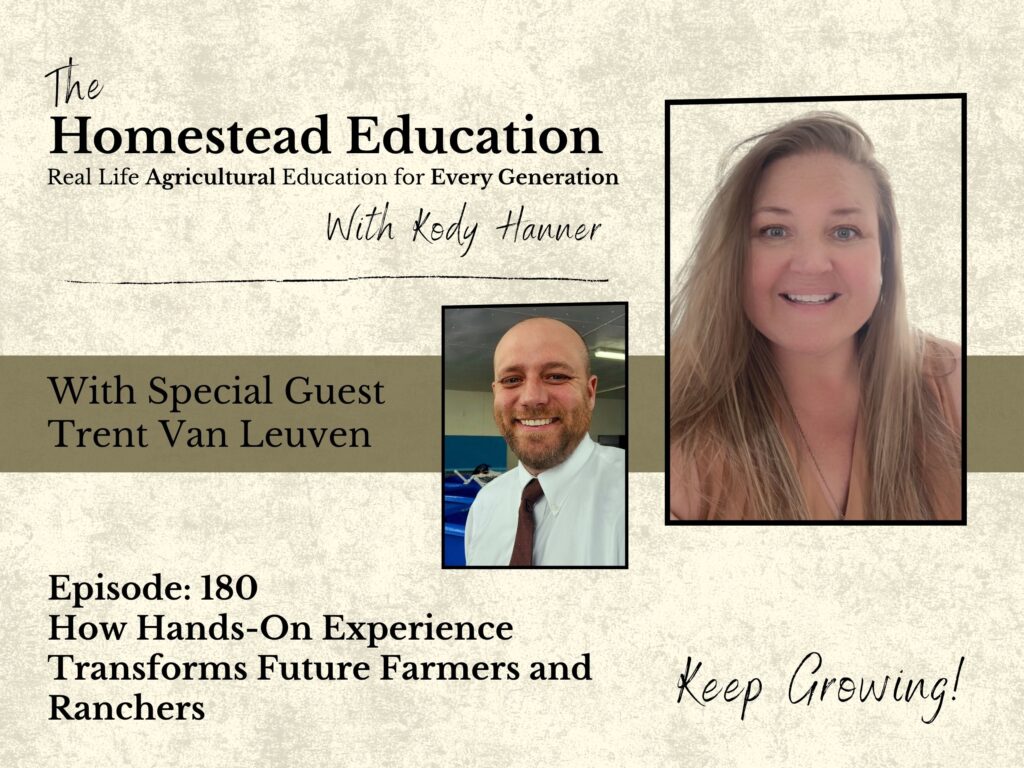
Episode 180: How Hands-On Experience Transforms Future Farmers and Ranchers with Trent Van Leuven
- Kody Hanner
Episode Highlights
In a world increasingly driven by screens, automation, and artificial intelligence, hands-on learning has never been more important. In this episode, agricultural educator Trent Van Leuwen shares how experiential learning, field trips, student entrepreneurship, and real-world agricultural experiences are helping students develop problem-solving skills, resilience, and career readiness. Whether you’re a homeschool parent, teacher, or agriculture advocate, this conversation offers practical ideas for bringing meaningful hands-on education to today’s students.
Key Topics:
- Trent’s background growing up on a dairy farm and his journey into agricultural education
- Differences between urban/suburban and rural agricultural experiences
- The importance of vocabulary and foundational knowledge in agriculture
- Unique programs at Mackey High School, including fish hatcheries, greenhouse projects, and fish monitoring
- The role of community, authenticity, and passion in effective farm tours and field trips
- Strategies for teaching ag without traditional farm access, including creative lab solutions
- The significance of teaching financial literacy, entrepreneurship, and career pathways in ag
- Cross-disciplinary collaborations between ranchers and fish biologists to promote sustainable practices
- The impact of experiential learning on students’ future careers and community involvement
- The “Keep Growing” philosophy about overcoming failures and continuous learning

Podcast Links and Resources
Connect with Trent
- Take a Little Field Trip (Book) – https://amzn.to/4fq3CXE
- Author Facebook Page: https://www.facebook.com/p/Trent-Van-Leuven-Educator-Author-61580158103061/
Kody's Links
- Homestead Education Curriculum – http://thehomesteadeducation.com/homesteadeducationcurriculum
- Homestead Family Reading List – https://www.thehomesteadeducation.com/homestead-summer-reading-list/
- Instagram – https://instagram.com/homestead_education
- Facebook – https://facebook.com/thehomesteadeducation
Hi everyone and welcome back to the Homestead Education Podcast. Today I have Trent Van Leuwen on. He was the Idaho Agricultural Teacher of the Year in 2024. And he is here to talk about teaching kids in a more hands-on way. And I’m really excited to have this conversation with him. So welcome, Trent.
ShowHide Full Transcript
Trent Van Lueven (01:24)
Thanks. And I was actually the Idaho State Teacher of the Year.
Kody Hanner (01:27)
Not just the agricultural one, that is even better. Yeah. So tell us a little bit about yourself.
Trent Van Lueven (01:35)
Well I live in Mackey, Idaho. I grew up on a dairy farm in Roberts. We grew up and we had two hundred milk cows that I got to work with. And I study at the University of Idaho Agricultural Education, and I spent five years right out of the financial crisis in 2009. I was teaching the West Ada School District in Meridian, Idaho, and I was the traveling ag teacher. So I went from working in the
Probably the most populous school district, the largest school district in the state. And then I moved to Little Mackey, Idaho, where last year we graduated fifteen. So I’ve, you know, experienced education and agriculture at the largest school district where I was teaching students that were just in subdivisions to now we’re up right alongside the state’s tallest mountain range. So it’s different.
Kody Hanner (02:29)
Yeah. I mean, that’s gotta be a huge difference because you’re teaching a whole I mean, when you’re teaching in a suburban neighborhood versus a rural neighborhood, you’re teaching a whole different agriculture.
Trent Van Lueven (02:40)
yeah. You know, you grow up with vocabulary working on a dairy farm and I mentioned steer at one particular point in my last school district and I had a bunch of kids looking at me that had no idea what I was talking about. And so then that moment I realized I needed to, you know, teach the vocabulary I thought everybody came with.
Kody Hanner (02:59)
Right? You kinda have to dial that back. I always like the question, how many steers are born in the US every year? I actually just had a little bull calf the other day and I had a friend up and she kept referring to him as my little steer and I’m like, Well, one day but I well, I don’t know. Actually he’s a a full blood
Trent Van Lueven (03:14)
Soon.
Kody Hanner (03:23)
Man, like I said, like an hour’s sleep last night. brown Swiss that’s A2A2. So I may put some feelers out before I decide to ban him.
But so what has what was like the biggest difference you saw when you started working with the rural kids?
Trent Van Lueven (03:45)
Well, I I think they’ve had a lot more experiences and I think that’s kind of an important thing is that students in subdivisions they have the opportunity to be consumers and they consume everything, right? So we’re not just talking about food, but we’re talking about media and you have an opportunity to produce when you’re in a rural area. So many of my students, you know, showed at the fair, even students that lived in town, they have opportunities to have livestock.
And so and they do everything. I mean, I I would have students in these subdivisions and provide some incredible opportunity and they were all so terribly busy that they couldn’t do it. But you know, the students in our small school districts, they’re on the football team, they’re on the basketball team, they’re the student body president, they’re the FFA chapter president, and they do everything. I mean they’re well versed in a lot of things. Yep, and I’ll get a phone call.
Kody Hanner (04:40)
And they just keep piling it on.
Trent Van Lueven (04:44)
sometimes. Hey, do you have a student that perhaps could come and help me this weekend? I could pay And it’s like, you know, I’ll see what I can do. But the students that are, you know, really motivated to do that stuff, they’re already working two or three jobs. I mean, they come at a premium.
Kody Hanner (05:01)
So yeah, I know that one. I have five boys that are all they all do the fire department and my daughter’s right there with them. They call her the goat. Because she’ll run up and down that mountain with hose a hundred times if she has to. And yeah, I mean, it’s d interesting to see like when I’m out on the road, I have a lot of parents ask, you know, how do I get my kids out of the house and doing something? How do I get them to have more responsibility? And my first thing is usually just go ahead and take that phone or
Xbox or whatever away, they’ll find something to do. Yes. But it is a difference because, you know, I have friends come visit or I talk to people and they’re just in awe of how much like my kids and their friends work and are trusted by adults. And that’s the thing that I find that I love the most about working with rural kids.
Trent Van Lueven (05:51)
Mm-hmm. And, you know, they walk down the street and the people know them. My kids act a little bit differently. We had them in Boise House at a teachers conference. And I mean, they’re friendly, they’re talking with everybody, right? Because they’re used to having people everywhere know who they are as they go around town. And as we go to the grocery store, everybody says hi to So, I mean, they’re personal kids.
Kody Hanner (06:14)
Yeah. I was driving out to the fire line last night. I kept stopping to talk at all the checkpoints to let them know that I could be going out there. And my six year olds in the back seat with the window down trying to talk to all the firemen. Yeah. Like no fear whatsoever. Like giant fire in front of me. How are you doing tonight? Yeah. So you have a pretty awesome setup at your school, right?
Trent Van Lueven (06:39)
Yeah, we do. Yeah. agriculture’s been taught since nineteen eighty seven at Mackie High School. Mr. Vernon Roach is the first ag teacher that we had there. before him we had Pratt Pearson and he taught welding and automotive and and engine theory. And I took over in twenty fourteen and I came into a pretty awesome facility. They had an old fish lab, so they were raising trout.
he has a hydroponic greenhouse and we have currently we have a conservatory. We built a new fish lab that’s fourteen hundred square feet and we have a partnership with the IDO fishing game and the US Forest Service. And it’s pretty unique because the Mackey State hatchery has probably the most variety out of any state fish hatchery in the state.
And so we’re raising some really cool stuff like California golden trout and Arctic grayling. And we’re raising them up to a size that’s a little bit larger than what they traditionally do at the state hatchery. And so my students have the opportunity to help those fish make it to some alpine lakes. And so we do a little bit of bat backpacking. Had the opportunity to take some up with a helicopter to airplane lake for a research project. So
I mean, these fish are coming out of our disease free facility and they can go anywhere in the state of Idaho. they’re the state fish. And so besides having that high
Kody Hanner (08:11)
kids getting to backpack in and stock lakes too.
Trent Van Lueven (08:14)
Yes, they are. wow. And so each fall we have this little fishery that was created by our student Callie Gamut over a decade ago. And we’ve been maintaining that fishery. That was the first time California golden trout had successfully been released in a stream in Idaho, and it’s a really awesome fishery. So my students do the monitoring of it in partnership with the US Forest Service in the fall. We go do some electro fishing. And so somebody’s got a back
pack and anode and a cathode and you know there’s some electrical pulses and the fish come up to the top of the surface and my students have the opportunity to net them out and then they do the weighing and do some link checks and we are able to predict how many fish are there so we know how many to release the next year. So we do that and we have a very large greenhouse and for our town kids they have the opportunity to raise some market lambs at the school. And
You know, we have a tractor and some drones and some other equipment and our own FFA bus.
Kody Hanner (09:18)
Right.
Trent Van Lueven (09:19)
Yeah, it seats fifty-nine and since nineteen eighty seven we’re coming up on our fortieth trip going to the National FFA convention via bus. Out of all the schools we travel the furthest out of any school that’s traveling on an annual basis. And so that fortieth year that we’re gonna be going is going to match up with the one hundredth national FFA convention. So we’re pretty excited about that.
Kody Hanner (09:44)
That’s amazing. So where’s the one hundredth being held?
Trent Van Lueven (09:47)
it’s in Indianapolis and since they moved it there and that’s where the FFA Center is, I predict that we’re not gonna be leaving Indianapolis for some time.
Kody Hanner (09:57)
That sense. Yep. So one of the things that frust you know, it’s been a frustration for me with agriculture education and not in a necessarily bad way towards anyone in particular, but kind of just how it’s viewed culturally is, you know, it’s set up to be a vocational program, but then, you know, I was looking at it at one point and like the state average for Idaho on
re retention or proficiency in the different standards was like twenty three percent or something like that. So I really love that, you know, I’m of so many programs, the kids, you know, they graduate and they’ve taken all these vocational classes and are supposed to be able to the thought is go out and find jobs. And when they have a twenty three percent proficiency, that’s not happening or it’s not happening well. So I really love that you’re giving
the kids that you’re working with is like really like hands on experience where they’re not only learning about it, they’re doing it, they’re making the choices, they’re doing the research, which is something I haven’t seen in a lot of bag programs.
Trent Van Lueven (11:11)
Yeah, y I I think our ag programs are getting more successful. I mean, we just saw a huge climb in the technical skills assessment scores from this last year. And some of it’s just figuring out where the standards are and kind of figuring out the tests. But there’s a lot of ag teachers that are striving to do better. but also, you know, students I I think a lot of times they’re not sure what they want to go into. And
That motivation factor sometimes isn’t there to do well on a particular test. But I’ve I’ve had
Kody Hanner (11:46)
Ag classes are kind of either you’re doing it ’cause your friends are or because sometimes it’s the easy science credit or you know, easy with quotation science credit. and then there’s the kids that really care.
Trent Van Lueven (11:58)
And and sometimes
And they’re not ready to receive that particular instruction at the time. I I’ve had number of students that have been in, you know, our fish and wildlife class and they’ve worked in the fish lab and you know at the time they’re scrubbing some fish tanks, they gotta do some cool things and it’s like, you know, I d I don’t think I want to do this. And then they get off to college pursuing that other thing that they want to pursue. And then they realize, you know what? I’ll work.
All jobs become work at some particular point, right? And they have that big realization and they’ll look back and say, you know what? I actually really enjoyed that fish lab. At the time I wasn’t, but now I am. And I’ve had students that were studying something else, but then they ended up working in the fisheries later. And you see that, especially like my greenhouse. I mean, it it’s phenomenal. We’re out in the greenhouse every day. We probably one run one of the largest
plant sales in the state of Idaho. We have people that travel over a hundred miles one way just to specifically shop at our greenhouse. we boast a huge variety. And in the moment, the students, I think they think that this is an opportunity that everybody else has, right? And I’ve got students that drag their feet. It’s like, no, do we have to go out in the greenhouse and work again? But then I see five, six years later and now they’re homeowners.
And it’s almost like a giant reunion and they’re in the greenhouse shopping for their own property, asking questions. You know, I couldn’t get and ask those questions when they were in high school, but now that they’re a homeowner and they have a new lens, it all clicks for
Kody Hanner (13:41)
You know, I mean, I can completely understand that. When I was taking ag in college or in high school, it was we had we were digging these like little tiny potato plots on the side of a hill and it just seemed and we each had our own plot or we had a partner with our plot or something and I felt like this was this was horrible. And then our class was just like learning what a leaf was and I I was like, I am not interested in doing this at all. I mean, I grew up on a ranch, but I was like, this is not gonna be like what I do.
when I grow up, you know, and went to college as a business major first. And before I knew it, I was right back on the ag track and ended up working in food plants, being the annoying food safety specialist.
Trent Van Lueven (14:26)
Yeah. There you go.
Kody Hanner (14:28)
Which I loved. I actually really enjoyed it.
Sorry, I I blinked. I had a question already.
So w how are you seeing more of your students, the ones that do end up pursuing ag, are they going into more commercial or are you seeing more of your kids kinda going more towards just like small farming?
Trent Van Lueven (14:58)
So this particular valley that I’m in, I mean, people have to be related to individuals, but it’s also kinda like yeah, I think it’s the University of Wyoming’s got a new program where they’re offering a bachelor’s for people to become ranch caretakers. wow. All of a sudden they’re they’re selling, you know, their kids might not be interested in it. Or you know what, they want to
have a a life, a great retirement. And so they sell their operation you know, afterwards they they want to retire. And so what they’ll do is they will sell the property or even their grazing allotment to somebody who’s got a lot of money. And so we’re seeing some of these ranch ranches sell for millions of dollars and then they’re hiring caretakers for them. And so that’s kind of the complicated
Kody Hanner (15:55)
That
sounds like a great opportunity.
Trent Van Lueven (15:57)
It it does for local economies, you know, if you have somebody that buys a ranch and they’re not exactly interested in it producing or paying itself off ever, because how do you do that with a few hundred beef cows, right? For what kind of money they spend on it’s a vacation place, right? when production stops being the main focus of these ranches, then they don’t produce as many animals. Equipment doesn’t break down as often.
And you know, there’s a chain reaction throughout a community. So I I I personally don’t like seeing them sell to I I’d like to see stay with young families and people that are investing in the community, but that’s the nature of what we’re seeing in these beautiful scenic places in Idaho and beyond, is that these ranches ranches are getting bought up. So, you know, for some of these students, they’re not related to the the
ranchers that are in the area. I have students that are studying plant science and horticulture. You know, I’ve got students have gone into vet tech. But when you are the only career technical educator, you try to prepare students for anything and whatever you can. At a time we didn’t have anybody teaching these kids how to cook. And so, you know, we do quite a bit of cooking in the classroom. And you know, we try to teach them some economics.
Kody Hanner (17:16)
that’s great.
Trent Van Lueven (17:21)
try to teach them a little bit of personal finance when we can. we also try to prepare these students for the trades. And so I’ve got a number of students that are going and studying diesel. And my hope is that we’re providing these students with skills and providing them with opportunities that they can come home and work if they want to, that they can return home. Probably our chief export in this little valley are our kids. Yeah. And sending them off. So we’d like to make sure that we’ve
Produced them. Yeah, we we want to make sure that they can be successful anywhere, but that they can come home and be successful in the careers that exist.
Kody Hanner (17:58)
That’s definitely a really hard one, is there’s just not work for you know kids in small towns anymore. And like you said, if they’re not related. And that’s why when you told me about the degree program, I was like, what a great opportunity. Because yeah, it really is hard to get into farming or ranching when your biggest capital input is your land. And so if they can work and learn how to run a ranch, and a lot of times I know these ranchers let them start their own small herds and things like that.
Where after a certain amount of years it’d be much easier for them to apply for ag loans and things like that when they have, you know, fifteen years of experience running a ranch before they are going out and looking for big land loans.
Trent Van Lueven (18:39)
And you touch something very interesting, ag loans. I have students that come up and say, Mr. Van Liven, I want to get into ranching and farming. How do I do that? I say, Well, you know, because where you’re at and your family, what I recommend is go study agricultural economics or ag business at a university. Come out and get a job with the farm credit services, and then you have the opportunity as you’re approving these people of loans to understand
which operation is making money and who happens to have a single son or daughter, right? And you can marry into that. That’s probably the easiest way to get into farming and ranching today, right?
Kody Hanner (19:14)
There’s so much truth to it.
Yeah, sometimes that is the only way, but you know, it’s actually an interesting conversation. I have my son’s girlfriend is spending the summer here with us. she’s going to college over in Washington, and she is literally getting baptism by fire on what it’s like to be a full-time farm wife, EMS wife, like, you know, that type of thing. This poor girl has we have ran her ragged.
And I said, Well, you know, this is the best time to find out if you’re one of those people that’s cut out for this or not. Yeah. I I say that my life is everyday a surprise marathon that I didn’t sign up for.
of course in our case, I’m the one who grew up ranching and my husband is always asking me what to do.
Trent Van Lueven (20:07)
Yeah.
Kody Hanner (20:11)
So as you’re seeing like kids go out into the real world, I guess is the best way to put that. What’s something that you are either trying to focus on more or that you’re seeing that you need to implement more for these kids, whether they’re going into agriculture or just any type of career?
Trent Van Lueven (20:30)
Well, I think resiliency, you know, they gotta be resilient. They’ve got to understand how to ask questions. I mean, we’re in the age of AI and AI is supposed to solve our problems, but you have to know which questions to ask. And you’ve got to have some kind of ability to see what quality workmanship is and to understand where you can find those resources. I mean, the students that were graduating, they have to be able to ask the right questions.
And what’s unfortunate is with AI, a lot of times they are missing out on doing the hard things, whether it be digging potatoes on a hillside, right? I mean
Kody Hanner (21:12)
You
and now I do that for fun. Yes. Right. My husband’s like, We don’t need a potato patch. And I’m like, I love it.
Trent Van Lueven (21:18)
Yeah. I mean the hard part of doing research and things like that, right? I mean they need to have those struggles so that they can appreciate the tool, right? I mean you can really appreciate a backhoe when you’ve done a lot of shoveling.
Kody Hanner (21:32)
yeah. I mean, I really appreciate that because one of the things that I say all the time, like as a you know, when I was a science major and then like working in the field and stuff is I don’t have to know everything. I just need to know where to find it. Yep. And I think that that’s the key is you know, even whether it’s using AI or in, you know, any type of, you know, Google search or just blindly believing what someone’s telling you, if you don’t know the right questions to ask.
you’re not going to find the answer. And it’s like between that and ethics of, you know, using you know like AI for creation and stuff like that, there’s a really fine line that I don’t know that is being taught or respected at the level that we kind of need to.
Trent Van Lueven (22:20)
Absolutely. I mean, but we we have to have the right questions, but I mean, we need to have authentic experiences and you know, I believe that a lot of kids today are, you know, starving to have some empathy and to develop empathy for other people. I think we’re pretty deficient in the amount of empathy that people have for others. And so, you know, those authentic experiences working alongside other people and being able to see things from a different point of view is
really incredible awesome. And, you know, the one to one screen time is robbing us of those opportunities. If we can get kids out in the world to talk to their neighbors and help in a community and do community projects, they start to see themselves in a community and as individuals that, you know, are helping develop a community. And I think that community’s something that we’re missing out on. That we should be replacing the sense of community with people that are
our peers and people that are around us, we shouldn’t be replacing it with social media with people that are, you know, just promoting random things, right?
Kody Hanner (23:28)
Right. I I mean, even myself, you know, I I get on social media sometimes and usually my scrolling is work related, but sometimes I just wanna scroll. You know, I tell my kids all the time that our phones are amazing tools and one of those tools is education or is entertainment, but it’s using it it’s just one form of entertainment. Absolutely. And I
I was trying to scroll myself through the night and every single thing was trying to like sell me something, convince me of something. And I was like, I just I wanna see pictures of like baby cows and you know like sometimes you just want like that relax and I I feel like it’s just constantly being, you know, pushed at us all the time.
So you have recently wrote a book, correct?
Trent Van Lueven (24:26)
Yeah, that’s correct.
Kody Hanner (24:28)
On helping other ag educators teach ag or teach like you know, hands on experiences. you wanna tell us a little bit more about that? Like I am ’cause I’m tr really interested.
Trent Van Lueven (24:43)
Okay. So I I wrote a book. It’s called Take a Little Field Trip and I wrote it not just for ag educators, but for anybody in career technical education and elementary and high school education to kinda help them in planning and preparing for field trips or student travel. So I, you know, kinda wrote it as a way of first off killing the boredom of the Mackie Winters, ’cause I mean, we’ve got like eight, nine months of
winter and cold. So I wrote it for that for myself. But also I’d been asked many times, hey, how do you do a field trip or how do you take students across the country? Because I mean, we’ve traveled over fifty thousand miles or thirty-three states with students. And I’ve taken students from many different places. I’ve been counting up all the different tours and field trips, even the local ones. I think I’m up to a hundred and fifty different types of field trips that we’ve gone on in the last twelve years.
And so how do we help others in those parts of education? I think a lot of times we’ve been glossing over authentic education experiences like field trips, my own ag ed degree. there may have been some conversation, but there’s not a field trip class. I mean, my student teaching year we received a list of like a hundred different techniques for teaching and field trips was one little box we could have checked off. But
Teachers today, a lot of they have been prepped for all kinds of things, but they have anxiety about field trips and student travel, to the point that it’s almost crippling and they’re not taking students on field trips or traveling with students.
Kody Hanner (26:29)
a bummer. I mean, I can I can see it though, because besides just all the work that goes into it, you know, I teach at a co- at a homeschool co-op. Yeah. And a great group of kids, but you know, I get so excited about something and something I want to share with them, something I want to do with them, and I’ll sit up all night and cut out little things and have it all ready to do this like amazing class with them. And it’s either
a lot of times either blank stares or they’re like literally going bat poop crazy. Yeah. And I couldn’t imagine doing that with a group of teenagers on a regular basis. Like I’m I I could see where that would be really stressful. But if you can find ways to really have the kids locked in and excited about what’s happening, they’re going to, you know, get in line, literally.
Trent Van Lueven (27:23)
Yeah. And you know, it’s that empathy piece. You get them out of the classroom to see other producers and the things that people are doing, they develop empathy for one of the things that’s great about podcasts and the reason people listen to them is people love to listen to people talk about what they’re passionate about. Right. And when you get somebody to say a walleye farm in Minnesota, and you’ve got somebody who’s really passionate about talking about walleye, right?
Kody Hanner (27:41)
Yeah.
Trent Van Lueven (27:52)
Those kids might not have any interest whatsoever, but at that moment they all want to be walleye producers. They love listening to somebody, right? And you know, probably one of the themes of the book is the tour guide makes the tour. And if you can find the right person, their facilities don’t have to be fantastic or immaculate or anything like that, or the best facilities, but it’s really the tour guide that makes a field trip work.
Kody Hanner (27:59)
Right.
I agree. Although I do have to say, don’t take kids on field trips to the best facilities because then you’re just setting them up for disappointment and egg.
Trent Van Lueven (28:29)
And you know, often we don’t. I mean, some of these places we go to, it’s we we I find them on like Google Maps. I’m like, hey, you know what? I want to go to a cranberry farm, right? So I just start looking and I’ll contact somebody and they’ll answer the phone a lot of times and they’ll say, Well, you know, we got some really great stuff going on, but you know, just not really interested in giving a filter up. And my follow-up question is, is there somebody who does something similar to you?
that you know of that would love to give a field trip and every one of them knows the person that wants to talk about their operation and highlight what they’re doing. And so I mean, I’ve been to I I’ve been to a a fish farm and I think our own fish facility in Mackey is more impressive, but we don’t go to see that fish facility. We go to see the character that’s the tour guide for that facility, right?
Kody Hanner (29:20)
Yeah, ’cause it’s the the excitement behind it. I mean, we we give tours on our farm a lot and man, like my son can talk about his cow. He has his own line of dairy cows that he raises. You know, I can talk about our heritage pigs for hours, you know, we raise Herfords, so but then like this morning I’m out there I spent the last two days trying to set up irrigation for my raspberries because it’s so hot and so smoky and
I realized the irrigation was broke and my kids and I are my littles are like we’re crawling through the raspberry bushes. I get it all set up, realized that wasn’t gonna work. And so this morning I was like, I’m just gonna go out there and I’m gonna fix the pig hose and hook it up to a sprinkler and just get water on these raspberries. Yeah. put a new end on the hose. Got it all hooked up, have to go climb like into the pig pen, because that’s where the faucet is, turn it on and it blew the hose out and water’s shooting straight up in the air. And I was like,
That’s it. I’m just gonna burn it all down. Like done.
Trent Van Lueven (30:24)
Yeah.
Kody Hanner (30:26)
And then I looked at my clock and realized we had a podcast in ten minutes. So
Trent Van Lueven (30:31)
And that’s life in Ag, right?
Kody Hanner (30:33)
Exactly. That’s like that’s how it is, you know, most days. But the thing is when we love it, we’re gonna keep doing it no matter what.
Trent Van Lueven (30:41)
Yeah,
well, you know, just like Sisyphus pushing that rock up the hill, I mean, and having it roll down on top of him all the time, right? That that’s us in agriculture. We get a win every once in a while. And sometimes, you know, if you’re gonna fail, you gotta fail gloriously, you know.
Kody Hanner (30:57)
You know what? yeah, sometimes. I mean my win this week was a personal win as I drove by and saw that our biggest sow was out for the seventeenth time that day and she was taking a really good nap under the like barnyard and I was like, you know what? Enjoy your nap and I just kept driving.
Trent Van Lueven (31:15)
Yeah. She wasn’t hurting anything, right?
Kody Hanner (31:19)
She was good. I sent the kids up about an hour later and told to put her away, but Yeah. and when they tell you that pigs can’t jump, they’re lying.
Trent Van Lueven (31:30)
Yeah. They’ll clear a fence.
Kody Hanner (31:32)
Yo, yeah. I I went even in college. Yeah. In college they’d tell you, you know, you just need the little short, you know, like hog panels because pigs can’t jump. Yeah. Well, I raised three hundred and fifty pigs a year and I have seen almost every single one of them clear a fence. So Yeah. so when you go out, like you go out on the road, you taught you got a different
conferences and stuff, what’s something that you’re talking about and like what are you seeing people are wanting to know about like setting up ag education for their schools or programs?
Trent Van Lueven (32:11)
You know, I think everybody’s trying to look and find a different lab or something new to teach. Everybody wants to offer an opportunity to provide a more authentic experience in something that’s low cost. And a lot of times we’re looking for creative solutions for teaching and you know, there’s people that teach pig breeds, right? And their way of doing it is, you know, making some little pop bottle pigs, right? And having the kids paint and stuff and
You know, that’s probably a good use of your time, but it might not be the best use of your time, right? I mean, there’s a a good way of doing things, there’s a better way, and then a lot of times there’s a best. And sometimes we just have to choose the best way of instructing. There are so many opportunities today with curriculum and there’s expensive lab aids that are out there. I mean, there are individuals that will spend
thousands of dollars to have a fake cow that the students can practice artificial insemination on. But if you know a butcher, they’re able to, through the USDA inspections and all that, they’re able to provide you for free, a lot times, repro tracks. And they can donate them for research. And so you can get some free repro tracks and you can get some of the supplies and you can
have the kids put on some sleeves and gloves and you can throw a black plastic bag over a cow’s repro tract and you can teach artificial insemination like I do. You don’t have to invest in thousands of dollars for having something that’s synthetic to do it with, right? And I would argue that the cheaper opportunity and avenue for teaching some of these things is better than the expensive lab that’s available out there.
Kody Hanner (33:59)
Right, or my AI lab where you just got pooped on the whole time.
Trent Van Lueven (34:02)
Yep.
Right. You could get in front of the cows too, right? A lot of times, you know, for these kids it’s something to ease them into. You know, it’s one thing to start off with a repro track that’s covered up with a bag and you can get to there where they can feel comfortable, they’re learn anatomy, and then you can get to the chute. And yeah. You know, it’s it’s a point about, you know, taking students by the hand and kind of guiding them to something a little bit more difficult.
Kody Hanner (34:31)
Giving them the confidence to do things like outside of their comfort. Yeah. I mean, that’s in what you know, one of the questions I get asked the most is how do you teach agriculture when you don’t live on a farm or you don’t have all the things to teach it? And, you know, any homeschool, private school, micro school, any school that, you know, can’t qualify for, you know, grants through the state to fund their farms or
Trent Van Lueven (34:36)
Absolutely.
Kody Hanner (35:01)
It’s finding those ways outside the box to learn the same thing.
Trent Van Lueven (35:06)
Absolutely. I mean and and it’s cool. I there’s a lot of people that are raising quail today, right? If you can’t build a chicken coop, you can build a quail house and you can have many quill and still have more eggs than you’ll know what to do with.
Kody Hanner (35:21)
I raised quail during qu COVID and was making eighteen hundred a month on day old chicks. And I did it with just two styrofoam incubators in my guest room. Like so, you know, if you can think outside the box, you can make money doing about anything in ag, so
Trent Van Lueven (35:25)
That’s incredible.
There you go.
yeah, and that’s the case in aquaculture. You can go see a national fish hatchery, you know, and the feds have got the money to have the latest and greatest, but you know, probably the most profitable operations are the ones where they figured out that anything that holds water, can be a fish tank. And what do they do? The the first thing you do if you want to be a fish farmer is you find something that holds water really well, and then you put a hole in the bottom of it. Right?
And you put in a bulkhead tank fitting and you get a standpipe and you start building something. But I mean, if it holds water it’ll it’ll keep fish alive.
Kody Hanner (36:12)
I’m I know that one. I used to be a huntigun. I lived in a cabin out in the woods for the whole season. And there was this little pond, but the fish always tasted a little funky to me. So just some bass. And so I literally got one of those blue containers from Walmart and I set up a fish tank pump to it and I’d go fishing, catch the fish, throw them in there, and I didn’t eat until they’d been in there for a week or so and got all cleaned out. And that was my little fish tank in my living room.
Trent Van Lueven (36:39)
Yep. It can be done.
Kody Hanner (36:42)
Mm-hmm. So, you know, a lot of people don’t realize that, you know, fisheries are part of agriculture and that’s something you’ve talked about a lot. What are some careers kids can go into in that field?
Trent Van Lueven (36:55)
Well, you know, for our particular locale, we’ve got a brood facility that’s owned by Riverance, so that’s north of town and they’re actually producing trout row caviar, but also they pr they harvest eggs and those eggs go to other facilities where they grow out fish. And that’s kinda cool. They’re playing with the lights and they’ve got sheds so they can have spawners year round ’cause, you know, they’re they’ve got the photoreceptors and their retinas and so
you know, as they determine the change in day length, then they start producing eggs. So they have to manipulate that. We have a state fish hatchery, but also we have the U.S. Forest Service got an office and we’ve got people that work in the fisheries with them. So fortunately for us, we’ve got, you know, some careers in in fish biology, but my goal is to have my students’ applications, job applications and resumes go to the top of the pile. That the experience that they’re getting at Little Mackey High School
will qualify them in these positions beyond the other programs that are out there. And I mean they don’t have the same dual credit opportunities or the A peak opportunities, but I want an application from a kid for Mackie to go to the top of the pile. But also my goal is is there’s a bit of a divide between ranching and farming and fish.
that sometimes they’re in the crosshairs, as you can imagine with like bull trout being on the endangered species list, there’s a lot of issues where they don’t exactly these fields don’t get along. And my goal is to produce the next group of fish biologists that understand ranching and understand agriculture. And I want to produce the future ranchers that understand the fish trees and so that we can build some collaborations and be able to have great conversations about how we can do both.
Kody Hanner (38:52)
That’s excellent. I mean, you hear a lot about how agriculture is an old boys club. And, you know, some people can play the game and some people can’t, but being able to teach a group that can cross those borders and not have to like join the club. Yeah. I think is, you know, and I’m I’m not even I don’t even have an issue with the old boys club. Like I think my dad was their president for a while, you know.
but yeah, I think that that’s I one of the barriers in people wanting to go into agriculture is thinking that because they didn’t grow up with it or because, you know, yeah, the farmers don’t like the fisheries and you know, there’s always some sort of drama or dilemma and like having those can having them be able to navigate those in a different way is wonderful.
Trent Van Lueven (39:44)
No, a lot of it’s just being able to have empathy for other people, to be able to see from their side and be able to understand their arguments, instead of throwing up a wall and not hearing from a particular side. I think there’s a lot of opportunities to get together and to talk about things. So like I’m chairman for the Farm Bureau Lands Committee that, you know, talks about issues on state and federal lands. And a few years ago we had a really great tour over in the Hawaii’s
where we had people from the BLM office and ranchers were working on coming up with fire breaks, using cows to graze down grasses so that these fires aren’t as explosive and damaging in the Hawaiis. Right. And we’ve been up to Northern Idaho around Kendrick having those same types of conversations. How can we use cows to be able to put in fire breaks? And the things that they’re learning and trying to get the word out, and I think there was a a frustration because they figured out some
Really great things in that those Hawaii experiments that you try to fence off all the cows next to the road. You gotta have a road to be able to have a fire break. You gotta be able to get fire engines. You gotta be able to get tankers down the road so you can fight the fire as it’s jumping the road. So putting those fences against the road and putting in miles of fence just doesn’t work. But having areas understand that the cows like to graze down on the road.
And you put the water troughs down there, they create a nice little gradient where the grass might be really short next to the road, it might get a little bit taller. But I mean if we can get 150, 200 feet of grazed down area along the road, we can hold a fire. The other thing that they learned is if there was any brush whatsoever alongside the road, they could not keep that fire from jumping. Any type of brush was the thing that was going to lead to that fire going. And so
They started mowing down stuff. They started mowing down, you know, the shad scale and the sagebrush. And one thing that they learned is if they mechanically mowed down that shad scale, the cows would come in afterwards and they would browse it down also because all that new growth, it was something that the cows would actually go after. And I mean lots of great things, but there’s people in other offices that don’t want to hear anything about their successes in the Hawaii’s doing this.
Because you know what, cows aren’t the solution for anything in some people’s eyes. So, you know, that opportunity to have empathy, but be able to have conversations with other people to maybe challenge our prec preconceived notions is so important. And that’s what we need to do in education. Make sure people can converse.
Kody Hanner (42:30)
I especially with the cow thing. I really wish that there would be more open conversations about that because a lot of these places, if they would they could probably charge the farmer to bring their cows in rather than have to pay for the equipment to cut it down.
Trent Van Lueven (42:44)
Yeah. We look at the states that have outlawed hound hunting for various reasons in different states, and now we’re paying people to go and hunt mount lions because there’s problem mountain lions.
Kody Hanner (42:57)
I actually I wrote an article in Western Outdoor Weekly several years ago on reopening mountain lion hunting in California and what the revenue from the tags would do for the conservation efforts. And I don’t know if they ever listened to it, but I was pretty proud of it.
Trent Van Lueven (43:13)
And you can understand everybody’s sides, but I mean nothing happens if we don’t have conversations.
Kody Hanner (43:19)
Mm-hmm.
So my favorite question to ask everybody as we kind of get towards the end here is what does keep growing mean to you?
Trent Van Lueven (43:32)
Well, I think keep growing means just overcoming failure. A fail is, you know, first attempt in learning. And we can grow as individuals and we can figure out better ways of doing things. like one particular project we took on. we have hatched out chicks before in in our facility. And, you know, we’ve sometimes had successes that I wasn’t terribly proud of and I had a new student teacher,
this spring and we had a conversation, you know, if we’re gonna fail, let’s go ahead and fail gloriously, right? So we decided to get some emus and so we hatched we were going to attempt to incubate emus, right? So all the research that went into that and I you know, we had something like forty eight days of turning these huge emu eggs. One of them wasn’t going to ever hatch. so that’s what we’re up against. And then the other one
We’re pretty delighted. I mean, this scene is bobbing and kinda you know, wiggling up for us and we were putting a pen and pencil on it and watching the pen and pencil gyrate as this scene was stretching. But I mean, about day sixty it went quiet. And we did the postmortem on it. I mean, it was a little bit heartbreaking for me, the kids or student teacher, but we were really hoping to have an emu hatch and you know, after sixty days, that’s a long time to have your
Kody Hanner (44:59)
That was a lot of work.
Trent Van Lueven (45:01)
And you know, we did the post mortem and it was in a bad position. Its beak needed to pip internally and break into the air cell. And its beak was in the complete opposite corner. It would have had to punch a hole through its own yolk sac to be able to hatch successfully. No. And that’s what we were left with. But I mean we took the other egg and we blew it out, so now we have an emu egg to pass around and we preserved the other one so we can show how the
positions wrong, but you know, the kids understood that we did everything that we could and, you know, they all want to try again. So this next spring we’re gonna go ahead and attempt to hatch out some emus, right? I mean, the things that we’re able to learn from two emu eggs, it was immense. And everybody hatches out, you know, chickens and quail, but we wanted to try something different. So I mean, that’s us trying to grow.
Kody Hanner (45:41)
That’s awesome.
Yeah. I that’s great. You know, and even even with chicken eggs, there’s just the I think that one is such a good one that the kids learn so much. We I mean we do several batches a year of chicken or quail or whatever we happen to have going on at the time. I overwinter my chickens and then I hatch out a couple of batches and so that way we have chicks and or we have pullets in the fall to start laying when everyone else stops.
And a couple of years ago we decided to do a couple more batches and sell day olds. but we had a couple of meat birds from the year before that had escaped butcher day somehow and were hiding in the bushes and we found them and just threw in the coop and said, We’ll butcher when we have time. And apparently they had bred with our other chickens. I don’t know if they were the roosters or the hens, I don’t know. But half of this batch came out
Completely deformed.
And I I had never seen anything like this before. I mean, we had crossed beaks, we had they had giant feet and like the their like elbow bones were sticking out through the skin and stuff. And you know, at first we were like, What in the world? Like were we not did they not get rotated properly? ‘Cause sometimes you’ll get like the deformities with that and stuff. And it ended up we did like a ton of research and then we ended
Trent Van Lueven (47:10)
Yeah.
Kody Hanner (47:25)
We ended it by listening to the book Big Chicken on how the three way cross of Cornish crosses came to be and kinda were like, I think that that’s what it was, is they just couldn’t crossbreed with our chickens and end up with anything that looked like a chicken.
Trent Van Lueven (47:45)
And and those kinds of things happen all the time, right? And in agriculture it doesn’t take very long to find something that nobody else has seen or attempted to do, right? I mean, when you get into these things, there’s different ways of doing stuff and the learning opportunities that exist, like why is it that this particular lake won’t have you know, won’t keep fish alive? Or why is it and all the different conditions? I mean
It’s an incredible opportunity to grow as we have those questions. Right. And it’s gotten easier to get answers to these questions.
Kody Hanner (48:21)
That it has. That’s I mean, that’s amazing in itself. I remember hours in the library trying to go through scientific papers that now you can bring up on the internet and read and that would have been game changing in college.
Trent Van Lueven (48:36)
Yeah.
Kody Hanner (48:38)
So why don’t you tell everyone where they can find you, where they can find your book, anything you wanna add as we head out.
Trent Van Lueven (48:47)
Yeah, if you’re interested in the book, Take a Little Field Trip, it’s available on Amazon and I have a website called Take a Little Field Trip. We’re constantly trying to add some stuff. There’s a couple of little blog posts in there and then I do have a Facebook author page.
Kody Hanner (49:04)
All right. Well I will make sure that I link all this in the show notes and I really love what you’re doing and I wish you the best of luck.
Trent Van Lueven (49:13)
Okay, well thanks Kody, it’s nice talking to you today. And good luck with all the fires up there. We hope it gets contained really soon.
Kody Hanner (49:15)
You too, have a good one.
Thank you.