Episode 182: Agriculture, food policy, and county fair lessons from a summer on the homestead
- Kody Hanner
Episode Highlights
Kody Hanner shares a solo episode that mixes personal life updates from a wildfire-filled summer with a practical rundown of major agriculture and food safety headlines. She also closes with a long reflection on county fairs, 4-H, and how local agricultural education shapes capable, community-minded kids. In this episode, Kody connects homestead life, livestock management, food policy, and youth ag education into one big picture of how agriculture touches daily life far beyond the farm. She also explains why she thinks local food systems matter more than ever when large-scale supply chains, regulations, and public health issues all collide.
-
Sale!
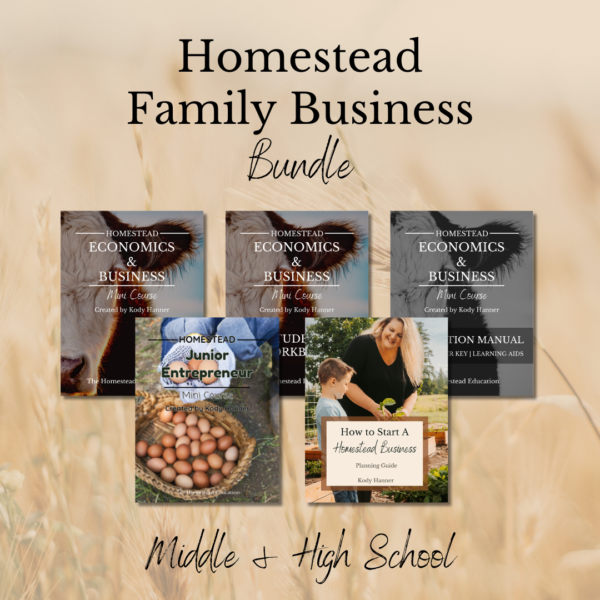
Homestead Family Business Bundle
From: $180.00 Select options -
Sale!

Upper Elementary Homestead Education Bundle
From: $264.99 Select options -
Sale!

High School Homestead Education Science & Business Bundle
From: $285.00 Select options -
Sale!

Homestead Trivia Card Game Bundle
Rated 5.00 out of 5$40.00Original price was: $40.00.$35.00Current price is: $35.00. Read more
Podcast Links and Resources
- Udder Balm Recipe: https://www.thehomesteadeducation.com/udder-balm/
- The Cargill Lawsuit: https://www.reuters.com/legal/government/us-judge-rules-beef-purchasers-can-pursue-price-fixing-class-actions-2026-07-17/
- Lactating Steers: https://members.acresusa.com/lactating-steers-hormonal-implants/
- FDA Outbreak Updates: https://www.fda.gov/food/outbreaks-foodborne-illness/investigation-multistate-outbreak-cyclospora-illnesses-iceberg-lettuce-july-2026
- GRAS definition: https://www.fda.gov/food/food-ingredients-packaging/generally-recognized-safe-gras
Kody's Links
- Homestead Education Curriculum – http://thehomesteadeducation.com/homesteadeducationcurriculum
- Homestead Family Reading List – https://www.thehomesteadeducation.com/homestead-summer-reading-list/
- Instagram – https://instagram.com/homestead_education
- Facebook – https://facebook.com/thehomesteadeducation
Homestead update
This week on the homestead has been one of those really fun weeks.
Okay. So, I mentioned last week that we were on calf watch that our favorite milk cow is starting to bag up.
And, she had her calf a little bull!
So, I mean, we’re a little disappointed that it’s a bull.
Usually, we don’t care either way, because for the most part, we usually butcher both bulls and heifers, or you know, steers and heifers.
ShowHide Full Transcript
So you know, if those flames got tall and the wind was blowing, that could have been at our house in a very short amount of time. In fact, there was another fire on the next ridge further south, about ten years ago. it was maybe eleven years ago. It was right before we moved here, and within six hours, the fire was on what is our property. So this wasn’t like a small thing. Now, my husband is our local fire chief. So literally from the moment it kicked off, he’s been on the fire.
As well as my four old or three older children that are still living in the house. So my 21-year-old and two 17-year-olds. our fire department ended up getting contracted through the federal, and they have worked this fire for over six weeks now. And it’s been like 16-hour days for them. they could work 14 or 21 days consecutively and then get a few days off. But overall, we had two tenders and a water truck over there. And we’re a very small department. So in order to fill all those positions, pretty much my family has been gone all summer, like since the beginning of July. So I have been running the farm, the homestead education. I also do a lot of the administrative stuff and social media and safety things for our fire department. as well as, I mean, we just we have kids at home. There’s dinner that has to be made, you know.
Trash needs to go out, errands need to be run, grocery shopping needs to be done. And so I’ve been doing the majority of that alone with my six and nine-year-old. And then one of my son’s girlfriends has been here for most of that. And then whatever kid has their two days off has been home to help me. even when my husband’s home, there’s you know certain projects only he can do.
Also, being the fire chief, he has a lot of jobs that need to be handled when he’s home from the other fire. There was also several large grass fires that kicked off during that time where my guys would get off the fire and head straight to those grass fires. We were helping evacuate people. It’s been a pretty crazy summer in the Pacific Northwest and across most of the western United States. So if you live in those areas or you’ve been watching anything about the fires, you know how insane it’s been.
With that, we have had a great summer, and there’s been some things that I’ve been really wanting to share with you guys, and so I’m here today to discuss that. one of them is some things that have been happening in the news with agriculture. And I’m one of those people that really wants to make sure that I research everything and have all the information for you before I put it out there. But with how busy my schedule’s been, it’s been really hard to find the time to research this.
And a lot of these I feel like are really pertinent for you to know right now. And part of me was like, This is old news, like they don’t want to hear it. But then I realized that not everybody follows every like food and agriculture website and these things are definitely not being put out on like public news channels as much.
I realized that even if I wasn’t able to do a full research on them, I could still share with you these AC headlines that I feel like affect us. When I say us, I’m talking not just everybody in the United States or world, but also those of us who are kind of pursuing more of that natural lifestyle, who definitely have concerns about what’s happening in big agriculture and big pharmacy, and that are making these changes for themselves. And so
I’ll be sharing a lot of that and giving my insight and explaining what some of these things mean. Because again, even if you’ve seen the headlines, if this isn’t something that you’ve gone to school for or studied a whole lot, you may not necessarily know all the impacts and implications of these laws or these things that have happened. So a quick little update on what’s been going on in our homestead, because I know everybody loves hearing about that.
We have been doing great with piglets this summer. We actually have four litters on the ground right now. So we have clo, let’s see, 18, 28, 23. We have 31 piglets right now, which means we can sell about half of those as wiener piglets, or we have a purebred Herford herd. they are a heritage breed that was originated in Iowa in like the 30s.
And then they quickly kind of lost popularity. So they never really went into the commercial breeding cycle, which means they didn’t have all the fat bred out of them genetically, like during the 50s when everybody was concerned about fat. of course we’re concerned about, you know, like too much fat at this point, but there was, you know, the concerns in the 50s that fat was the only thing that caused heart disease and things like that. And so they were really pushing for leaner pork to try to keep pork on the market.
And so that breeding to have the lower back fat also meant that there was less marbling in the meat, which is what makes pork chops be sometimes drier and stuff. and so the heritage breeds still have that marbling. And so our purebred Herford herd, they’re really cute. They’re red and they big floppy ears, they look like puppies when they’re born. They’re still a large breed pig. they get as big as any other show or market animal. In fact, I feel like some of my adult animals are larger than my commercially bred animals.
which we do I say commercially bred. We run two herds. Our other herd is also partially heritage. Our boar is an old line genetic boar. But then my girls in that group, I have I have Yorkshire’s, I have Hampshires, I have Berkshires, just like a little bit of everything. because I sell a lot more of those as 4-H pigs, but and so they need to be a little bit more show quality.
However, I am still focusing my breeding on meat. Mmm. And my drink just made a loud noise.
so that’s been really fun, having all these different animals.
On the farm this summer, we’ve definitely upped our breeding program and I’m excited to get a lot of pork in our freezer this winter and be able to start not start marketing our meat online, because if you’ve been listening for a while, we have been doing that for on and off for like a year, year and a half. We don’t always have the inventory to be able to consistently market. So I’m hoping to be able to consistently market and have, you know, pork and Hanner Homestead be a little bit more of a family name when or a household name when it comes to getting quality heritage pork. We have some new calves. we weren’t expecting our dairy cow to calve until the end of ju no, the end of August, which was like perfect for us because, you know, our lives kind of start slowing down at that time of the year and then we can handle all of our dairying. But no, she decided to calve right in the middle of fire season.
She had the beautiful white brown Swiss purebred brown Swiss bull calf. we’re gonna get him tested to see if he’s A2A2. If he’s not, we’ll just castrate him and raise him for beef. because you know, just keeping an extra animal on the property that doesn’t have those long term uses is not something that we can really have in our management program. So we are gonna get actually everybody tested because I think that my herd is A2A2, which is the protein, beta casein in milk that a lot of people are allergic to non-A2A2 milk rather than actually being lactose intolerant, making these animals a little bit more desirable. So just need to decide what we’re doing there and that’ll help us make some management decisions with some of our other heifers that we’ve been raising out and deciding if we wanted to sell them, sell them as bread heifers, and how much work we want to put into them. When I say that meaning making sure they are like fully halter trained and you know. Those types of things where if they aren’t A two A two and I’m not gonna get the top dollar amount that I need for them after keeping them on the property for so long, I’ll probably look at, you know, like selling as is with a light halter braking rather than ready to walk right into the stuncion. We are finally getting some meat birds in for ourselves this year. we usually like to do that in March or April and it’s August, so no judgment. Our lives have been a little crazy. But with the new Idaho state laws, it makes it a little bit easier for me to sell my chickens retail rather than having to have them all pre-sold before I even, you know, butcher them and that, you know, every state has different laws when it comes to chickens, so you know, if you’re interested in something like that, you might want to look into your own poultry exemptions for your state. But most states allow up to ten thousand birds to be sold and butchered non-USDA, but you have to have those animals pre-sold before they’re butchered, so that the person who owns the animal is consenting to you being a non-licensed butcher. But we are hoping to up that program a little bit and maybe even look into using some of our barn space that we don’t use a whole lot for feeding chickens throughout the winter, which is kind of the big thing is a lot of people can only get those fresh birds over the summer and we want to be able to provide that year round.
Another exciting one is I don’t know. Like, you know, I need a new project. Like I need a hole in the head. But I make I actually have it, it’s on my website. It’s called Utter Balm, and I will post the link in the show notes. But I make an Utter Balm that has turned into what is basically our magic cream. I have changed it slightly from the recipe that I have on the website, that doesn’t mean that it’s not still the best recipe that there is. I have just made some tweaks to it for our own personal needs. And I primarily use lard, which you know everybody’s really big on the tallow balms. And the lard bombs have kind of fallen by the side a little bit, but basically they have the same positivity as tallow. And actually, we are more closely related to pigs genetically, so I believe our skin can’t absorb that even better than they could a tallow. However, a lot of people associate lard with pigs and fat and it doesn’t have that same like, you know, grass-fed tallo versus my lard.
I don’t know. My husband has like a he’s like, that’s gross. Like, I’ll use it, but it’s gross. However, this bomb one of its biggest properties is it can take away chaf, like, overnight. Like I have dealt with guys who have had chafe so bad that their skin is actually infected, especially out on these wildfires. And they’ll use that one night and it’s pretty much gone. So I have started every time a big fire kicks off, I whip up a whole bunch of lard balm and I package it in little containers and I take it out to the guys. And it’s just been something that I’ve enjoyed doing. However, this year we had a much larger fire and I was much more closely associated to the guys that were on the fire and there was an overwhelming request to make this available to them to purchase at any point. Because they do fires all over the country.
And when they run out of what I gave them and they’re on a different fire, they wanted to know how they can get it because there’s even states that the chafe is worse because they’re in, you know, more like hotter, drier, or even wetter conditions that can make like the infections and things like that worse. And so we are looking into starting at least like just putting it on an Etsy through Hainer Homestead and seeing kind of what happens with it so that we can continue to provide that to the guys on the line.
I’m still looking for some names, you know. I kind of like the old-fashioned lard balm. a little bit of like black and white packaging, like a sketched picture of a pig. But, you know, because my husband thinks that the concept of lard balm is so gross, he doesn’t think I should call it that. the guys on the fire, I mean, I hope this isn’t a little too crass, but they think I should call it balls of fire because it works so well for their chafe.
And the firefighters really like it, but I don’t know if that is the best branding for me. So if you have some great ideas, I would love to hear them. if you’re interested in, you know, trying the product, I’d love to hear it. But if you want to just make it yourself and tweak it, I’m not in the business of keeping people from being able to have something that works really great. So, like I said, the recipe is on my website. All right, on to some agriculture policy and laws that laws and news that have popped up over the summer.
So the first one is that Cargill Cargill, I always say that wrong, along with other major meatpackers have faced a major antitrust and price fixing class action lawsuit. That was like a mouthful, that accuses them of conspiring to limit beef supplies and inflate consumer prices. Cargill ended up agreeing to paying thirty-two point five million in settlement as part of a eighty-seven point five million dollar
Joint deal with Tyson Foods. And it received its final approval from a federal judge. So that was just like a mouthful and a lot of things that, like, what does that all mean? So we’ve known, we’ve always known about this. When I say we, I talk about those of us in the agriculture industry, especially the meat industry. We’ve been having these conversations for 15, 20 years. That Cargill, Tyson, JBS, and National Beef.
Have banded together to curb production of beef and conspire to artificially raise the prices or to raise their profit margin margins, therefore the beef prices, which violates federal antitrust laws. So antitrust laws are when somebody breaks the fair market competition. And they do this through monopolies, price fixing, plotting together, and market division. So
Fair market rules is, you know, I mean, think of a game of football. If you gave all the guys like battering rams on one side, they’re gonna do a lot better than the guys without the battering rams. So that works in business too. One of So like one way of looking at that is if they conspire to have prices at a certain rate, then
No matter where you live, you are gonna be paying inflated prices for beef. Now, you could probably get lower prices through a local butcher or maybe not because their costs that go into that are pretty high themselves. And when these companies, they not only own the packing plants, they own the distribution, they own the feedlots. they usually don’t own the farms that provide the animals to the feedlots, but they’re setting the prices at auction.
And so farmers are having to, you know, take in a hundred head of cattle and the prices just keep going down. But they have large bills they have to pay for hay and transport and you know, a lot of them don’t breed their own calves. They buy their calves from somebody else and feed them to the point that they are going to the feedlot. And they need that cash influx. They can’t, you know, sit and market calves to a hundred different people every month all year long.
To be able to get the you know, a a fair market value for them. So they have to go through the auction to get these, you know, large sums of money, but that number kept going down because the packing plants conspired together to just not or the feedlots conspired together to just not pay that amount. because they’re owned by the packing plants who said we aren’t going to pay anymore for these animals.
And it just kind of goes to there where the in consumer end consumer is paying an exorbitant amount for beef and the farmers who are raising them are getting next to nothing. Like they’re actually going into the hole, even though they’re able to sell, you know, a hundred animals at the at a time, they’re not able to cover all of their expenses.
Another thing that these companies have done is they do market distribution, which is where they divvy up the various markets where they aren’t actually in competition with each other. so they aren’t having to deal with, well, you know, Cargill dropped their price 25 cents a pound, so we need to drop our price 25 cents per pound. They just aren’t dropping prices. They’re agreeing on one and then they’re only selling to certain, each of them are only selling to certain areas, so that there is no competition of people are buying Cargill more than Tyson, because they aren’t even available in the same places. And i another thing that this does, and this actually wasn’t really talked about a whole lot in these lawsuits, it does talk about the in consumer. I see a lot of sites actually out there where if you are an in consumer and you’ve bought beef over the last, you know, however many years, that you could actually be entitled to compensation. I don’t know how much that would be. I didn’t really look into it. However, there’s also this piece of what about all the other meatpacking plants, all the other small slaughter plants, the small feedlots, and things like that that have literally been going out of business left and right because they can’t compete with these larger companies that are not playing by the rules. Another one with this is.
These companies can afford to pay for all the food safety requirements. I am not saying that small plants do not need to have food safety requirements in place, but they will do things like You know, all beef needs to be treated with a certain cleansing solution that’s only sold through a certain company that has a special really high priced application system.
Well, the average you know, slaughter plant that’s anything smaller than these large companies can’t afford that equipment. and so they either have to buy it anyways, and then they have like, you know, a really low profit margin, or they’re having to go out of business, or they have to get exemptions to use a different cleaning solution, which has been a perfectly good cleaning solution for years.
But with that, because they’re the only slaughter plant in their county, they’re being watched a lot closer than these large slaughter plants that are probably, now that we know what they’ve been doing with their other business dealings, are probably paying off the food inspectors anyways. And so it makes it where local food is almost impossible to get a hold of because it’s being controlled by these forged large companies.
I’ve also read a little bit about there’s been some bad working conditions and the I mean this let’s see here, these claims they go back all the way to August of 2014. So I mean this has been going on for a while. So it’s just something to consider when we have the smallest beef herds in the United States since 1952. There is like a massive beef shortage. We’re not importing beef, especially from Mexico right now because of the screw worm.
Which is a fly that actually burrows into the animal and like basically eats them alive for lack of better explanation. so, you know, we’re definitely facing a beef crisis in the United States and a lot of this it’s made it where it’s fragile. even though these companies are very powerful companies when they are the only ones that are providing beef to the mass consumers, and suddenly they are you know, having to pay out tons of money and making lots of changes, and then we have something like the screwworm happening where there just isn’t beef herds coming into the United States. Who is providing meat to the end consumer? it makes it really hard. That’s why I always promote local food. you know, even something like this that may be a short time scenario if you are supporting your local farmers year round, whether no matter what is going on, then they have the means to be able to provide enough to feed their community even when big food can’t.
Alright, the next one. Whew. This one has to do with cattle as well. And this one is really freaky. So a multi-feedlot study put on by I think it was Texas AM. I do have some notes here. West Texas AM University. along with some other industry collab collaborators, were doing carcass evaluations across let’s see, they did carcass evaluations on twenty thousand four hundred and eighty-one finished cattle from thirty-three, yeah, 33 commercial feedlots. And with that, they found that 14.55 of all beef steers, steers are castrated male cattle. And when I say beef, I mean that they are like Angus Breed Hereford or, you know, one of the breeds that has been historically beef breed. And 19.66% of dairy cross steers.
Which means they’re like a beef and you know, like Holstein Cross or it might even be just straight dairy steers, that do often make it into the beef market, which by the way tastes the same. So, you know, definitely for burger.
They are actively lactating at the time of slaughter steers males that have been castrated. So even if we were gonna blame their natural hormones, they don’t have any. At least not sex hormones.
So they have I mean and it’s a measurable amount. it has fat, protein, lactose, you know, all the things that constitute actual milk. You know, because there were discussed in discussions are we seeing like an infection in there? Are we seeing what else were they saying that it might be an infection or just clear fluid buildup? But it is confirmed to be genuine milk.
You know, there’s a whole list of their explanations as to why this is happening. And for those of you who are only listening, when I said explanations, I used like air quotes because it does feel like it’s being pushed off or maybe swept under the rug. But the honesty of it is they don’t have answers. They don’t know why this is happening. They have ideas as to why it was happening. And the study was not to determine how many of them were lactating. The study was actually to determine just they were just doing a research project on you know carcass quality across various feedlots and this was what their can’t think the word for it like I want to say like byproduct but it’s not a byproduct like their extra findings. So one of them of course is that almost all cattle in commercial feedlots receive a hormone implant in their ear, which is a growth hormone.
it’s been controversial for a long time. It’s a slow release, growth-promoting ear plant containing synthetic and natural hormones like estradrol, progesterone, and trimbolin acetate. and these have been you know controlled over the years because they can stimulate artificial mammary development and lactogenesis in cattle.
However, if they can have that much effect on the animal, what effect is it having on the end consumer? Now, I’ve done a ton of research. I’m gonna give you the their other potential causes, and then let’s talk about like what that means for us. So another one is they talk about just their diet and environment.
These animals are fed a very high concentrate diet. So when we talk concentrates, we’re talking like just straight grains. There’s a lot of you know, plant-based fats and proteins put into this. There’s, you know, minerals. And with that, so there it’s just full of plant-based estrogen and fungal molds that do mimic estradol, estradiol. I don’t know.
I d I don’t know which way to say that. a study of wheat germ at Oklahoma State University found that wheat germ itself it has a hundred times more estrogenic activity than beef. So I mean that means activity of estrogen in the meat. So the wheat germ has a hundred times more. So I mean, should we be more concerned eating wheat germ or should we be more or and wheat germ containing products or should we be more consumed about beef?
That actually metabolizes this hormone before it actually comes to us. also alfalfa and clover, which is a huge part of where the proteins in these cattle’s mixed rations come from. it has so I wrote this one down because I’d actually never heard this one before.
Conestans and then isoflavins, which have the highest natural estrogen mimicking qualities of any other plant. So basically they have these feeds that between the actual feed ingredients themselves and the you know natural fungal molds that end up growing on these from the way they’re stored, and I mean that’s not even like a hit on the way they’re stored because it is hard to store grain for you know sometimes a year or so before an an it actually goes to the end product of the animal and a lot of animals eat feed with a little bit of mold on it and it’s not an issue. However, just the mass amount that is going into these total mixed rations for the feedlots is causing a unnormally high number of animals to be lactating, especially those that should not ever be lactating. Now I read a little bit more on this study and it was actually showing that a lot of heifers were lactating as well, which you know heifers are at least female. However, they’ve never had a calf before, they’ve never been bred, so there’s no reason for them to have the hormones that are going to cause lactation unless they’re receiving it in other ways, such as the growth hormones or the high concentrates of grain in their feed.
So you know, a way to avoid that is grass fed beef. Some organic beefs some organic beefs still allow certain feed, like they’re still gonna have the high concentrate feed at a organic feedlot. Just the grains will also be grown organically, but even organically, there are chemicals that they can still use on it. So I mean we’re not totally escaping that.
Another one is obviously to stop using the growth hormone, which you know that’s all monetary growth or monetary, you know, business decision. Because if you can get an animal to grow even 10% faster, that’s 10% less feed that you’re having to give that animal. And when we’re talking millions of cattle, that number adds up really fast. So from a management standpoint, it makes sense.
From an overall implications and, you know, long term I don’t know. I mean, I have my opinions and I’ve share, you know, I mean I’m sharing my opinions with you right now. I don’t think we should have any of these extra inputs. I think we should just be feeding cattle the way they’re supposed to be fed, which is on grass. I’m not gonna say I’ve never given grain to a cow, or you know, a steer going to solder because I wanted to get a little extra fat on it before it went out they’re not getting a really high obscene mixed ration. They’re getting, you know, non-sprayed barley from my neighbor’s farm. I actually plan on doing that with one of my steers this year. if a steer is over 24 months old when it goes to butcher, there is a much higher cost because they have to do what’s it called? The Mad Cow protocol.
Because mad cow can live in the spinal fluid, so then they’re pulling out all the ribs, you’re not getting T-bones, that type of thing, and it costs a lot more. So for us as a management practice, it makes more sense to butcher a steer before twenty-four months. But sometimes, like right now, I have a steer that will will be twenty-four months like next April. but we don’t get good grass again until like March.
So if I add up the cost of my hay over winter and the amount of gain that’s expected when he’s also using a lot of calories to stay warm and stuff, it actually makes more sense to butcher him in like November rather than try to feed him through winter. So I mean we all make those management decisions. I might get less in product meat out of him. It might be a less fatty meat, which isn’t always a you know, that’s not necessarily a bad thing, although you do want a certain amount of fat to even make the meat palatable.
So I understand management decisions at a commercial level, but you know, I wonder if that management decision is worth it, you know, long term with the ethical ramifications of giving animals hormones. I have not been able to find anything that actually states whether or not there are implications for the end consumer, us who are eating the beef that has those hormones being fed to them or you know implanted in their ears. you know, the like nanoparticles of hormones that, you know, like an adult male or female produce on a daily basis, versus how much is in beef, it’s, you know, a negligible amount. However, Americans eat a lot of beef. Like something like half of our meat intake is beef. So if you’re eating that consecutively over years and when some of these are synthetic, are our bodies flushing them out properly, or are we storing up synthetic estradiol in our systems? And if that’s the case, are we passing that on to our offspring? because that’s something to consider as well when we look at the shifting in
For lack of better word, what is a healthy, dominant male versus like, you know, the toxic masculinity conversation, as well as a lot of questioning of gender, if our bodies are inundated with hormones that we’re not supposed to have. That is just speculation on my part because there are no solid studies on any of that. But there’s a lot of things there haven’t been solid studies on over the years that we have been finding out recently that we actually, you know, kind of were right on the money with some of these things. So, you know, they came up with the term conspiracy theory over the JFK assassination because they they wanted to gaslight people into not asking questions about it. And literally over the last several years, we have found out that that was 100% an inside job. The documentation is out there. You can go find it and read it. Maybe I’ll even like link it.
I haven’t read all of myself, I will admit to that. However, if the original term conspiracy theory was put into place to get us to not talk about a certain event that turns out we were right about, that makes it really hard for me to n not believe anything else or to believe the party line that like, no, there isn’t issues here.
All right, moving on. there have been a lot of food safety outbreaks over the summer. So one of them in particular that I’m gonna bring up because I was actually having a conversation about this one and I was like, wow, is this what the consumer is kind of being fed, for lack of a better word? there has been a multi state cyclospora outbreak. Cyclospora. I don’t know.
It’s really sad because I used to be a food safety specialist, and these were the words I needed to know all the time. And honestly, I read them in my head and I never knew if I got them right or not. but this is a parasite that has been linked to iceberg lettuce, and a few other loose leaf products. There’s also been a salmonella outbreak tied to jalapeno peppers. Sorry. and what this does.
is it, you know, basically just causes the typical food poisoning symptoms, you know, nausea, diarrhea, dehydration. if those symptoms are not properly managed, it can lead to worse conditions and even death. however, there have been, I have the number somewhere. So the lettuce with the cyclosporosis and the salmon salmonella together have surpassed 9,400 cases. That is a lot of people that have gotten sick. So, I mean, this is definitely something that should be addressed. not that I don’t think food safety issues should be addressed, but after working in food safety and then turning around and moving into more of the natural food concept, I think there’s a lot of things that are blown out of proportion. However, When we’re actually seeing, you know, this number of people being sick, it should be solidly addressed. now, most of these products have been imported from Mexico, which led it to where the person who was talking to me about it said, yeah, it’s from it’s from Mexico. Of course it’s dirty. When I used to go there in my younger years, I would actually see workers defecating in the fields. And so that’s why we’re getting sick. And I had to explain to this person that most imports especially those that are going to larger companies like Walmart, Costco, a lot of the grocery stores. They have to be it’s a third party certification through the Glob Global Food Safety Initiative. So the Global Food Safety Initiative is a set of guidelines that are based on I believe it’s Code of Federal Regulations one ten. that may have changed over the last few years. I haven’t worked in food safety for a while.
And I believe there were some changes kinda kind of around COVID time, but and I haven’t worked in the field since shortly before that. So It’s based on the CFR 110 as well as other good manufacturing procedures and other food safety things that they’ve learned. And now a company can’t just say, okay, I audited myself, we’re good. You have to have a third party, which is auditing companies that that’s just what they do. one I worked with a lot was the American Institute of Baking, but they would come into companies that weren’t bakeries or you know, companies that maybe the end product or the product that they were being made was going to a bakery. Like I used to work for an almond company and we used AIB for our good manufacturing procedures audit because the almonds could potentially end up in a baking product. but however most of them did not. There’s also other agencies that do these inspections and these large stores will not accept your product if it hasn’t been inspected like that. It doesn’t matter what country you’re in.
And it’s a global food safety initiative. So these aren’t just United States laws, these are practices worldwide. So for these foods to even come in from Mexico, they have to go through all this certification process. I mean, okay, like and like I said, it’s the larger stores that require that, but there are still certain food safety regulations that they have to meet to come into the United States and they have to be spot tested, and there’s all I mean, there’s a whole procedure. This isn’t just, you know.
People are pooping in fields and they just go pick the vegetables and bring over here and you eat them. It’s that’s not how that works. at least, you know, definitely not in modern times. So the person that, you know, was saying this, they’re like, yeah, Mexicans, they poop in the fields. And I was like, Wow, like that’s really what people are thinking. and that is just I mean, in some places it may be the case, because there actually is a written piece in
Like the what do you call it? The human resources part of the GMP audits that actually state that you need to provide, you know, outhouses or some other place for your workers to be able to use and that you need to educate all your workers on why you should not defecate in the fields. So I’m not saying it never happened. I’m just saying it’s not as common as people believe it is.
So last I heard that they had traced at least the the parasite the cyclo spora it’s caused by the parasite cyclospora cytogenesis that it was actually linked to a failure in some cleaning equipment and the person I was talking to they’re like yeah right they said it was due to a failure. Well, the thing is, even if humans aren’t defecating in fields, deer come through it, birds fly over it. I mean, this is not a controlled environment. So all of these vegetables are washed with a cleaning solution. Every company uses different cleaning solutions. Some use rubbing like basically a rubbing alcohol, some use basically a bleach, some use vinegars. There’s a whole wide range of things that are acceptable. I think there’s even one that like is ammonia based. I could be wrong on that one. Maybe that was just for sanitizing equipment.
And so, say for example, you know, all these greens, they go down a conveyor belt, they drop into a pool or a spray. if it’s a spray, it sprays right over it and it like drips out the bottom. If it drops into like a pool or a tub, it goes in. If it’s a vegetable that floats, they probably have some sort of spinning mechanism that’s dunking it underwater. And then it goes like to the next one where it’s pros probably rinsed, and then another one that you know, as an air dryer type system or like a spin dry. I haven’t worked in a lot of the leafy green industries, but I’ve worked in other industries and that’s similar. I mean I do know that the leafy greens, you they can get damaged really easy that way, but they are still doing some sort of something like that. So and then their quality assurance teams are checking the concentrations of the chemicals, they’re checking the temperature of the water all those things on a daily basis, and they probably also have some sort of electronic system that is sending a report to you know a computer that all of this was correct, but then there’s also, you know, a human going in and testing it with some sort of litmus paper or something like that to confirm that it is the correct concentration. If there is a failure even throughout a single day where at the end of the day the customer service or the quality assurance person goes and checks chem the chemical properties or, you know, maybe they even do it first thing in the morning and walk away and then immediately there’s a a malfunction, the amount of food that goes through these plants, that could literally be just those 10,000 cases right there that if it was missed in just a small window. So, you know, say the system went out and If that system went out, it could mean the computer system that is testing it or certifying, you know, also went out at the same time. There’s a possibility that it’s not caught right away. And that could be, like I said, just that number of illnesses right there. The did the company do anything wrong? No. I mean, there’s equipment malfunctions all the time. And like I just said, they have a two-barrel system for checking that. But then Also, they’re testing the end product and you know things like that to make sure that when they’re not even they’re seeing no bacteria in the end product. And then at the end of the day, they’re they have a meter called an ATP meter. It’s adenosine tricephosphate, which is literally the life chemical or chemical compound that we have to have to show life of anything. And these ATP testers, you know, they actually like run it across the equipment and it shows whether or not there’s anything alive left on the equipment. So I mean these this food is being tested multiple times. So even if there is somebody defecating in the field, that does not mean that that’s why anybody got sick.
So just a little bit of an educational piece there so that you have a little bit more information before you go out and talk about what the potential causes of this can be. Because it could be as simple as within a local community, the vegetables come into a store completely fine, but there is a stomach bug going around town, and then people come in and pick up the vegetables, test them, knock on them. They don’t even think they’re sick, but really they’re putting the germs onto, you know, say a melon. That’s where I was getting the knocking on. like a melon. And then, you know, we take it home and even if we wash it, melons have all those little crevices, especially like a cantaloupe, and you’re sick. Who who is that on? Is that on you for not washing well enough? Is it on the consumer for touching it?
Or you know, another consumer for touching it. Is it on the store for not having some sort of controls against that? You know, is it I mean, we could go back all the way. Who is that on? That is an act of God. however, all of these articles I will link in the show notes just so you can look them over yourself. So now here is a really big one in the like food and health industry. And that is that they are finally locking in on well, two different things. One is coming up with a f an official definition of what an ultra-processed food is. Once we can come up with an official definition of what an ultra-processed food is, it makes it much easier to regulate it and educate on it. So that is a huge step because we do not like those ultra-processed foods because let’s face it, by the time you are consuming an ultra-processed food, it no longer resembles food.
So it having a different definition than food is very key to the changes we’d like to see made.
Now, the other one, and this is being kind of spearheaded by the Department of Health, JFK, or not JFK, RFK Jr. and the it’s a major food policy overhaul targeting genuine generally recognized as safe or grass, grass, grass, it’s G R-A-S loophole.
So they wanna mandate food companies to submit safety and notification data for chemical additives rather than bypassing the government insight entity through pot products that remain on shelves like or th through the products that are produced for the in-consumer. So what is the generally recognized as safe? Because that has been like an eye roll loophole for years. So why it was put into place in the first place? So anything that’s put into food has to be FDA approved. And then any food that has multiple ingredients, those multiple ingredients have to be FDA improve approved into this what this final product is and sometimes those final products go into another final product. So it’s really important to approve each ingredient. But that can be very cumbersome. So there are certain things like let’s see I have my list here somewhere. We know how that goes.
Well, one of that’s right off the top of my head is like baking soda. So baking soda, as long as it you know, is coming from an approved plant, where it’s originally made, because baking soda is just a co chemical compound. And we don’t want chemical compounds in our food, but baking soda it’s not exactly a bad chemical, it is just salt is a chemical compound. I believe salt is another one on the list as generally recognized as safe. So, what this is is when you say you are getting a cookie that you make submitted to the FDA to be approved for sale, when they see baking soda and salt, those are just automatically checked off. There’s no further investigation. You don’t need to provide paperwork. if you do, it’s just who your supplier is. But because it’s genuinely rec generally recognized as safe, there’s no need for the FDA to have to do an additional investigation on a product that they do investigation they’ve already done all the research on.
Now products like salt and baking soda, like yes, generally recognized as safe, I am on board for that. What has ended up happening is there are a lot of products on this list that don’t belong there. So chemicals like BHA and BHT are added to oils, cereals, and packaging to prevent spoilage. So they were tested at some point or another and decided that they’re generally recognized as safe.
But now as we’re doing more research, we’re finding that not only is BHA not safe, we’re also finding that some of the ways in which it’s manufactured are not safe. But it’s under that, you know, grass grass category where when it’s being inspected by the FDA, it is just checked off because it’s considered safe. there’s some dough conditioners like azodicarbate that’s used to bleach and condition flour. So you know how we talk about the bleached flour and how you know it’s not good for you because it’s bleached and you’re taking some of the good stuff out of it and you’re breaking down enzymes and all those things that come with bleached flour. you know, even like I can’t start sourdough with bleached flour. I tried it. It doesn’t work. It’s bleached, so there’s not enough of a like a yeast load in it to make like a good natural, like rising sourdough, which is just I feel like it’s just one more thing that they’re taking off of our plate to make it you know like safe for us to provide our own foods. Like it’s just taking away that what do you call it? Like our own autonomy in our food.
So let’s see here. Color additives, including red dye number two, you know, the one that we are now finding makes all of our children crazy. Yes, that’s generally recognized as safe and allowed to be put into any food. there are shoot. Brominated vegetable oil, some high-dose plant extracts, there’s some novel ingredients that are proprietary chemical additives and additive proteins that and secret mushroom extracts that are allowed to be put right into our food because they’re generally recognized as safe and that’s not the case. Or maybe it’s not the case long term, or the way in which the product is manufactured. So I think that’s something that I th all consumers should understand what that is and why it’s important to discuss.
Because there is, you know, a the FDA is out there saying, We are making sure that your food and drugs are safe for you, but then they have like a whole list of products that they
Don’t make sure are safe for you. So I think it’s important to know what that is, to read about it yourself and find out what products fall under that if it’s something that you are consuming in your regular everyday lives. So I do want to just take a minute to discuss one more piece about agriculture. Because ag is something that everybody’s involved in. if you are eating, you are intimately involved with it three times a day minimum.
But you know, a lot of our clothes and everything else that we use in life is directly related to agriculture and a lot of our economic policies and things like that. So on this really high, like, you know, this really intense note, let’s switch and talk about how agriculture is present in every single county every summer for one week of fun. And that is county fairs. So county fairs were originally put into place back in 1811.
When a gentleman named Elkahan Watson in Pittsfield, Massachusetts, started an event to what was he? He was showing his prize merino sheep in I was this eighteen seven. So then by eighteen eleven it became he came up with like the first official cattle show via the Berkshire Agricultural Society.
And what this did is it created localized agricultural gatherings where farmers could learn farming methods, improve their livestock. and this quickly, you know, like spread across the United States. there was, you know, cash prizes for the best livestock. And, you know, people don’t always understand that. They think, okay, big deal. Like you take your pig to fair and you get a blue ribbon on it and you move on. Well, there’s a piece of that that, you know, like with youth for H, which you know like I’ll get into that one in a minute, that a lot of these kids, they aren’t raising the animal, or they aren’t, you know, like breeding the animals and stuff. They are buying a piglet, they’re raising it, they’re learning some responsibility, they’re learning how to work with animals, they’re learning how to do record books, show their animals, and then they sell them at fair and what ends up happening is, They have I apologize. I have to put my do not disturb back on ’cause my husband’s running to town to do some stuff and he keeps texting.
So and then you know the kids they sell these animals at auction and they just move on in life and they just buy a pig from another breeder the next year. As a breeder that sells these pigs and that my kids are actually part of our breeding program and stuff, when they get a blue ribbon on their animals, this isn’t just what they paid for a piglet from some random breeder. This is five years worth of a breeding program that they have been intimately involved with.
With that, if they don’t get blue ribbons, they know that what we’re doing maybe isn’t the best. If they get blue ribbons, they know that what we’re doing is working towards something different. As a breeder, I go watch and listen to the judge talk about every single one of the animals that we provide to our county fair. And that helps me improve my breeding program. So this is something that over the years was a way to determine whether or not your livestock was
meeting industry standards because you know when people live out in the middle of nowhere and they literally only come to town and definitely are only bringing their animals to town one time a year for the county fair if and they’re only seeing their animals, they don’t have something to compare it to. There’s not the internet, there’s not TV, there’s very few publications, they don’t have a way to determine if their stock is meeting industry standards. And so county fairs were a really great way to do that.
I mean and county fairs got huge because they were, you know, social acor anchors for the county. They were usually held in county seats. Sometimes larger counties have more than one fair. I know the county I grew up in had a couple different fairs. in the early nineteen hundreds, youth livestock got involved with it or the in the youth involvement through 4 H and F F A, where the kids could show their animals and their other projects. And so when I talk about, you know, people bringing, you know, prize hog to the county fair, people for years have entered, you know, apples and baked goods and their hay and all sorts of things. And that was how people, you know, kind of gauge themselves against other producers on many different levels. And that is what, you know, adding 4 H to these programs has done. Is allowed, you know, youth to learn the responsibilities, but also learn about how to, you know, compare agricultural markets. Some fairs are larger and do a lot more teaching with them. other fairs are more just so that the community can see what’s happening. But these have a huge economic and cultural impact today. agricultural and county fairs, they I mean they’re happening everywhere in North America. they’re part entertainment, they’re part deep-rooted agricultural education.
But despite these modern upgrades, people are still getting blue ribbons for their prize crops. There’s homemade jams, there’s livestock shows, and of course your classic fair foods. So the reason I bring this up is because we just got done at our county fair, and whoof, what a fair it was for us this year. Anybody who is involved in youth agriculture knows how exhausted I am today. I’ve even had customers, you know, like I respond to a customer service email, like, sorry we didn’t get back to you at the end of last week. It was our county fair.
And the response back has been, I’m surprised you’re even up from your county fair nap. So thank you for responding to me. It is it is understood how hard it is to have kids doing county fair. And even if you don’t have kids in 4-H, especially in small communities like ours, it takes a whole community to put together an event like this. The food trucks are not an out-of-town carnival that come to town. The food trucks are our local restaurants that either own a food truck or just set up a pup tent.
And sell their pizzas right there at fair because that’s what we have to offer. So our fair, I’ve always loved it. It reminds me of Charlotte’s Webb. There are no rides, no carnival, no, like I said, out-of-area food vendors. It’s not all about like the fake stuffed animals and stuff. It is a local vendors, local food trucks. The food is I don’t even wanna say I wanna say it’s good for you, but you’re not eating like processed corn dogs. Like my favorite booth is a local dairy that has ice cream and grilled cheese sandwiches that is all right off their farm. And so I can actually feel good about what my kids are eating at the county fair. when they come home with little trinkets and toys that they purchase from a vario from various booths, I know the owners of their booth. I know that there’s one lady who sells three D printed little toys. I even have some myself ’cause they’re cute and they live on my desk. I have a little Highland cow.
But she does this side business so that she can continue to homeschool a couple of her kids and pay for preschool like a preschool like transition program for a couple of her older kids who need a little bit more assistance so that her she can, you know, continue to stay be a stay-at-home mom essentially. And she prints these at home while she’s, you know, homeschooling her kids, taking care of her babies.
And then a few times a year, she comes to fairs and farm events and or you know, Christmas crafts fairs and things like that and sells her products and she’s a huge hit and she makes all the money that she needs to be able to afford for her kids to do whatever programs they want to do. And when my kids come home with the twenty five dollars that they spent on various things at this little booth that they play with the toys all year long, and I know that it’s helping a local mom.
It feels good. I don’t mind that they spent $25 there because the same woman, if she came to me and said, Cody, I need $25 to be able to afford groceries this week, I would hand it to her. So, I mean, that’s kind of what our fair has looked like. And from our first year when we came here, we had came from a county that didn’t allow kids to just take as many groups as they wanted. Like it they didn’t every county is different, and some county
Not only do does 4-H happen differently in some counties, and some states, 4-H is still integrated in the schools. So even homeschool kids can’t do 4-H, which I would love to see changed, but you know, that’s also why I focus so hard on making sure that every child gets an agriculture education, even if they don’t go to schools that have government-funded ag education programs like 4-H and FFA. So, the county we came from, you didn’t have like a community group, and then you could take as many like group projects as you wanted. Like your community group and your group project were in one, so they usually didn’t let you do more than just like one animal, maybe two, depending on the program. And so you would have to have like a different club and community group for every project that you wanted to do. And because they were community groups as well, they didn’t have to let you in. So when my kids moved up here, they wanted to try everything. So I mean we had goats, we had pigs, we had breeding projects, we had chickens, we they had statics that they entered, which are statics are like, you know, the art projects and things like that or photography. And they had so much fun. And my four kids came home with like 16 grand champion ribbons between their animals and their record books and things like that. And the confidence that it built in them and made them want to be continue to be a part of these programs was amazing. You know, not that I think that it’s just all about the grand champion ribbon, but just to show that you know, these kids that had been working on these projects but not able to share them through 4 H and County Fairs and stuff were suddenly able to and they were rewarded for that was pretty amazing. So we participated in the fair very heavily for several years. I was the swine barn superintendent. My husband, you know, worked every livestock show, to help with the animals and A couple years ago, we had a falling out with some of the people that were involved in Fair. And you when you’re in a small town, you understand, you know, the fair drama. I mean, I think there’s a whole like TV show, like one of those reality shows on showing pigs. So you can imagine, like, if there’s a whole reality show about it, imagine what it’s like in small town America where everybody is up in everybody’s business.
So we had a little bit of falling out where my daughter ended up getting her feelings hurt very badly was accused of something that she didn’t do. It has come out since then that she absolutely did not do that. In fact, it came out immediately after fair and nobody bothered to contact our family and apologize for that. And so my daughter has spent a couple years having a really hard time socially because of what happened.
So even though 4-H has been a huge part of my identity for years and I still highly promote the program, my family needed a break. And we took that and this year was actually the first year that my nine year old Wade has been old enough to show a market animal. And he I let the little boys still do clover buds through this time, but they don’t actually compete in fair, so I was able to just kind of keep myself separate from that. And this year Wade really, really wanted to show a pig.
And then one of my twins, 17-year-old twins, he’s like, you know, I really want to be there for Wade. And I only have two years of for each left to be able to do this. So I would like to go back. My daughter, she still has said, I will help the boys a hundred percent. And she was a huge help at fair with both of her brothers. But it’s not something that she wants to be a part of, and I respect that. because I had a hard time going back this year myself, and my husband did a lot of the face-to-face interactions with some of the people that were involved in the issues that we had, and I was able to just sit back and enjoy being a fair mom. So this year, coming back, right off the bat, my son’s like, I am running for fair king. Well one of our other sons was fair prince five years ago. And so, you know, this year, Wyatt he really wanted to run for fair king and or for fair royalty, he ended up getting king because even though he can show next year, he’ll be 18, and there’s always a chance that he’ll go after college or early or take a summer job or something where fair may not be an option for him next year, even though he’s going to plan for it to be. so he ran this year and he got Fair King, and I was so proud of him because he was one of my kids that was working the fire all summer. And even still, he made the time to get his letter letters of recommend recommendation to even apply.
He did the application, he did an injury essay, he wrote an article for our county newspaper. He put in hours of community service and working at the fair to be able to even qualify to then go to like the panel interviews to be chosen for his position. so I was hugely proud of him to be able to bring that all together.
And because I said that’s just something I can’t touch. I cannot add it to my plate. Like if you have somewhere you need to be, I’ll make sure you have a ride and things like that. I did help, you know, edit a couple of his essays and stuff, but for the most part, I was not a huge part of that. And he did that all on his own. So I’m super, super proud of him. Wade did amazing. This is his first time showing. He hasn’t really been to fair and watched the shows over the last couple of years, which are the years that he would have picked up on proper showmanship. We practiced a little at home, but with everything going on at the fires, you know, like the kids definitely did not get their time with their animals this year that I usually require of them. And Wade walked out in that arena like he had been showing since day one. Like I am so excited to see what he’s gonna be doing in the future because he is a naturally born showman. And that was really amazing to see. I was actually in tears because this has been such a huge part of my life and then be able to see my son just naturally fall into that position was really special. my husband and I, we had like twenty five of the hundred pigs that were at our fair came directly off of our farm. So that felt really good that we were able to provide that to our community. We keep our prices considerably lower than most other areas. We’re very honest that we raise, you know, meat farm pigs.
We are not raising show pigs. And a lot of the judges that we have come through really appreciate that and some of say this is a show, these should be show pigs. but a lot of say for eachers are supposed to be showing their farm projects. And so we want an animal that could go right into the meat industry and be a quality market animal. And that’s definitely what we raise. And we’ve had our pigs do very, very well and we’ve had our pigs not do great. And it just depends on the judge. However, it was fun this year seeing all of our pigs there and working with all the kids that we’ve been selling pigs to for several years. we also, my husband and I decided to bid on a couple of the pigs at auction this year. we didn’t want them for eating. We have plenty of those. We actually bought two gilts that we’re gonna add into our breeding program. we paid way more than we normally would for breeding stock, but we got to help some local kids they got, you know, good money for their animals and they were kids that we love, that we know, and we care about them and their families. And being able to buy their animals this year just solidifies that bond and that felt really special. And we’re excited to see what these animals will do in next year’s breeding program because we think they’re really beautiful. And, you know, just even with the low amount that I charge for four-H pigs, I will have pretty much paid them off.
by, you know, January of next year when I saw my four H piglets. So it was an investment for our farm because we’re gonna have years of great litters out of these pigs. I actually while we were sitting at auction, I some of the firefighters had came to watch the kids sell because they’ve been working with them all summer and they asked me, like, so if you’re buying a guilt, what is her lifetime money that she’ll bring into the farm?
And I figured it out if I just sold piglets, not feeding them out, which when we feed them out, we get a different price for But just baseline with their piglets, if I keep a pig on the farm for eight years, which is kind of that’s about max for them, but for eight years, we would make approximately thirty-two thousand dollars just off of piglets. and we figured it out a few years back that the cost to raise a sow for one year and that includes all of her feed, all of her shots, and all of like her the her basic needs, as well as six weeks worth of feed for her while she’s lactating and feeding her piglets, which we switch their feed up then and the piglets start on a starter, but I still consider them part of her until they sell, comes to five hundred dollars a year. So I’m making about four thousand a year per sow and only putting out about five hundred a year.
And actually because we do raise out about half of our piglets and we sell them for considerably more, and because we buy our feed in bulk, we aren’t paying as much as some other local producers to get that final end product that our sales are actually probably worth about four times that amount long term. So I feel like this was a really great investment and we were able to help some local kids. We also bought a lamb to put in our own freezer, because lambs are just not something we can add to our table right now, but we like to get a lamb every couple of years to shave in the freezer, we sell it out of the store too. I don’t ship our any of our lamb meat because we only do one or two a year. so if you want to get involved in agriculture in your community, a lot of people think that agriculture is something that’s far away. It’s something that doesn’t affect their daily lives other than what they eat. But if you have ever gone to the county fair, you are 100% participating in your local agriculture.
So take some time, go talk to the kids. These kids are very educated. They’re trained right up to fare to be able to educate you on their animals. you can see a lot of great products. I will admit that fair auction animals go for a lot more than market value because you’re, you know, you’re supporting local youth. I think one of my kids got $2,700 for one of his pigs and they still have to pay butcher fees. I sell my pigs for about $850 for a whole hog. So I mean, they’re definitely getting inflated prices for them. But again, it’s to help these local kids. They they put them in college funds, they buy cars with them, you know, things like that that rather not that I don’t think they should have to go get jobs and stuff like that, but a lot of these kids are really involved in like, you know, sports and everything else that they do because we’re a small town, being able to just raise their pig and make that kind of money off of it, makes it where the kids can focus on their studies and things like that. So I think that’s really special. I mean, there was one girl that her family planned this, but they brought an obscene amount of money to buy her lamb this year. And then another family member they had it planned where they were gonna bid each other up. and then finally one of them was gonna bow out. but basically she ended up getting $160 a pound for her lamb.Bringing her in $22,000. Not every child should expect that because that was her family doing that for her because she’s going off to college next year and they wanted to be able to get her into a car and get her basic expenses for her first year covered. So that was very planned, but it was very special because she was also the fair queen, so that made it kind of cute as well.
if you wanna learn more about 4H or how to get involved in your local community, you can always reach out to your local extension office if you aren’t sure how to go about that. Always feel free to email me because I love helping everybody. I hope that you learned something from this episode and that we’ll see you here back next week. And don’t forget to keep growing.