
Episode 185: How I actually get it all done on the homestead
- Kody Hanner

Episode Highlights
In this episode, I’m answering one of the questions I get asked all the time: How do I get it all done?
Between running a homestead, raising livestock, homeschooling, managing multiple businesses, traveling, running a co-op, and keeping up with a very full household, the real answer is—I don’t do it all.
I’m sharing what actually helps me keep things moving: delegating, building systems, choosing priorities, managing the mental load, using tools that work with my brain, knowing when to hire help, and accepting that sometimes “good enough” really is good enough.
I also share plenty of real-life homestead chaos along the way—from new piglets and heritage hogs to chicken disasters, ducks, harvest season, and the reality of trying to prepare for winter while running a business.
If you’ve ever felt like you’re working constantly but somehow still falling behind, this episode is for you.
Podcast Links and Resources
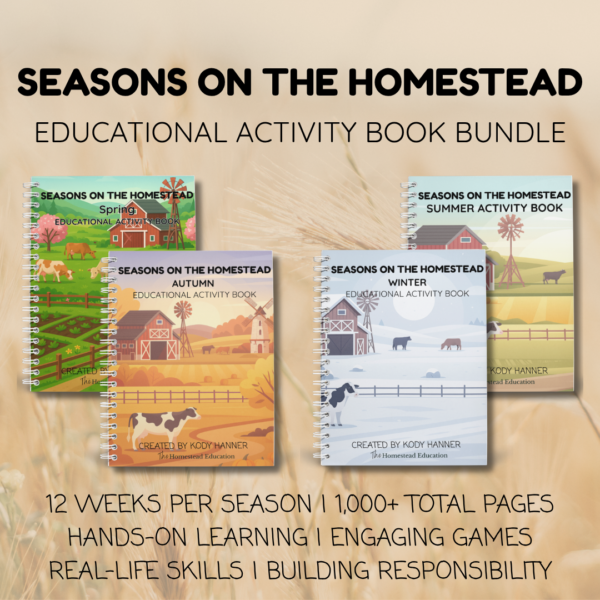
- Autumn of the Homestead Activity Book: https://www.thehomesteadeducation.com/product/seasons-on-the-homestead-autumn-educational-activity-book/
- Hanner Homestead: info@hannerhomestead.com
- 80/20 Rule Book: https://amzn.to/4AeMfTl
- The Gut Health Product That Changed My Life: https://shareplex.us/share/8qE7_VL
Kody's Links
- Homestead Education Curriculum – http://thehomesteadeducation.com/homesteadeducationcurriculum
- Homestead Family Reading List – https://www.thehomesteadeducation.com/homestead-summer-reading-list/
- ESA Funding: https://www.thehomesteadeducation.com/funding/
- Instagram – https://instagram.com/homestead_education
- Facebook – https://facebook.com/thehomesteadeducation
- Raising Self-Sufficient Kids Book – https://www.thehomesteadeducation.com/product/raising-self-sufficient-children/
Life Lately on the Homestead
We have had a lot going on around here lately.
I think I say that every episode.
And I probably also say every episode that I always say that.
At least I’m consistent.
One of the most exciting things happening lately is that we had two amazing litters of piglets born recently.
We’ve raised pigs for a long time, and I have been excited about plenty of litters, but these two have absolutely blown my mind. They look incredible.
They were actually born on the last night of the county fair.
ShowHide Full Transcript
We were heading to the fair to pick up the pigs we had purchased at the auction, and Ron and I were also planning something resembling a date night. We were going to have dinner there, listen to the band, and actually enjoy ourselves.
I wore a dress.
I even wore these beautiful handmade suede sandals that I had ordered from a tribe that had been making them for generations. They were a little treat to myself.
Naturally, we stopped at the barn first.
We needed the trailer, and while we were there we decided to check a couple of sows we had moved into the farrowing crates. We thought they still had a few days, but because we were going to be gone at the fair, we had moved them just to be safe.
We walked in and thought, Is she in labor?
And right about then, a piglet came out.
Yep.
That would be labor.
Both sows were farrowing.
So there I was, wearing a dress and my nice suede sandals, with my dress hiked up to my knees, squatting in a pig pen trying to help a sow.
Luckily, the shoes survived.
I cannot say the same for several other pairs of shoes that have unexpectedly ended up in the barn during farrowing.
Eventually, we made it to the fair, although much later than planned. Ron was loading the pigs into the trailer while I was practically sprinting toward the food court because the food vendors were shutting down before the band.
And I was ready for dinner.
I’ve talked before about our county fair, but ours isn’t really the stereotypical corn dogs and cotton candy experience.
A lot of the food vendors are local restaurants. Some don’t even operate food trucks. They literally bring their restaurant food to the fair and serve it under an awning.
The food is amazing.
A lot of it is made with really high-quality ingredients, and there’s even one local restaurant that closed its brick-and-mortar location but still brings out its food truck for fair.
So I was not missing dinner.
We eventually got our food, spent time with the kids, enjoyed the fair, and even managed to sell a couple of our butcher-ready hogs while we were there.
Some people had promised butcher hog donations to organizations like the Shriners but hadn’t been able to purchase what they needed at the auction. Someone gave them our information and told them that we frequently have pigs available.
I thought that was pretty cool.
After some issues we had with 4-H several years ago, we stepped back a little bit from trying to be heavily involved in that local circle. We’ve mostly just done our own thing.
If local people get on our waitlist, great.
We also sell a lot of pigs outside the area and ship pork.
So it was nice to realize that people locally still recognize how many pigs we raise and what we do.
By the time we got home, there were around nineteen piglets between the two sows.
We did lose one, which unfortunately happens sometimes, but we still ended up with eighteen piglets from those two litters—and we have two other litters right now too.
So we are a little pig poor at the moment.
A lot of people don’t like raising winter pigs, but we don’t mind it. We have enough cover for them that we don’t worry too much about the cold slowing their growth.
We’ll probably sell about half of these and feed out the other half.
I’m actually really excited about having this many piglets right now because normally we start running low on pigs around this time of year. Then the piglets born in January go straight to 4-H kids, which means I often don’t have my own butcher pigs again until summertime.
Then people contact us wanting pork and we have to tell them no, or our inventory gets low enough that I have to temporarily shut down pork sales on the website.
With this many pigs—and litters spaced out anywhere from a couple of weeks to a month apart—I think we’re going to have much more consistent pork availability next year.
That makes me really happy.
And these piglets genuinely look incredible.
One of the mothers has been here for several years. She has always produced good pigs, and they’re out of the same boar we’ve had for a couple of years.
But something about this litter is just exceptional.
The other mother is a new gilt out of one of our really good sows. She was sired by our previous boar, who was also excellent but getting older and no longer producing the way we needed him to.
These piglets are stocky, active, and beautiful.
I cannot wait to see how they feed out.
Adding Gloucestershire Old Spots
We’re also working on adding another breed into our rotation: Gloucestershire Old Spots.
They are considered a heritage breed.
When people hear “heritage pig,” they sometimes think of something like Kunekunes or Idaho Pasture Pigs—smaller, slower-growing pigs that tend to carry more fat and are often referred to as lard pigs.
We raise large-breed heritage pigs.
Our Herefords are technically considered a heritage breed, although they also function very much like commercial pigs.
Gloucestershire Old Spots are similar in the sense that they can still grow out like a commercial hog.
Honestly, I’ve seen many heritage pigs grow better and faster here than some of the show-bred pigs people bring into North Idaho from places like Nebraska.
They’re being raised in a completely different climate.
Our heritage pigs simply seem to handle the cold better.
Whether they do well in the show ring really depends on the judge.
Some judges will look at a heritage pig and basically say, “Nope.”
Other judges recognize that these are agricultural fairs and they’re judging a market class, not simply which pig best fits a particular show-pig look.
We bought two Gloucestershire Old Spot gilts and a barrow.
The plan is to eventually breed the gilts, while the barrow will be raised for our own freezer so we can compare the meat to our Herefords.
Our main herd boar is a Berkshire from older bloodlines. He hasn’t been bred as heavily toward the modern commercial look where you sometimes lose some of the fat and characteristics that make the meat so good.
A lot of our sows come from show or commercial lines, and breeding them to that older-line Berkshire has produced some really nice pigs.
So if you are not a pig person, congratulations—you just learned a lot about pigs.
And if you are a pig person, you are probably excited for me right now.
Chickens, Ducks, and the Chicken Coop Disaster
That’s the pig excitement.
The chicken situation is a little less glamorous.
We lost quite a few chickens this year.
Then a friend of ours, who is unfortunately going through a really difficult divorce, needed to get rid of all of her chickens.
So we brought them home.
Great.
Except she also had two ducks.
We are not duck people.
Our plan was to bring the ducks home temporarily, build them their own pen near the pond, and eventually let them live down there.
They’re both males, so we figured if they survive the winter, maybe we’ll get them some girlfriends and eventually have duck eggs.
For now, though, they had to stay with the chickens.
And male ducks can attempt to breed hens, which can seriously injure the chickens because of anatomical differences.
So I did not want them staying together long-term.
But my husband, my boys, and my older daughter have all been working on a wildfire this summer, and I simply did not have the time to run the farm and simultaneously build an entirely new duck setup.
We wanted to build another chicken tractor and temporarily use that for them.
It just didn’t happen.
As a result, my chicken coop turned into a slimy, disgusting mess.
I finally got the ducks moved into one of our meat-bird tractors.
Hopefully, within the next week or so, we’ll finish building our mobile laying-hen tractor. Then I can move the chickens out of the main coop, clean everything thoroughly, put down new bedding, and only move part of the flock back in.
The mobile tractor can keep moving around while the weather is decent and then eventually be parked under the barn awning for winter.
I’m excited to get that whole system working better.
The Chick Shipment From Hell
We also ordered meat birds.
Yes, it’s a little late in the season.
This year was just one of those years when we did not get ourselves together in the spring.
We realized we still had a small enough window to raise birds and have them butchered before the really cold weather arrives, so we ordered one hundred chicks.
They shipped in two days.
I went straight to the post office that morning and picked them up.
We loaded the box into the car, drove across town to run another errand, and while I was inside, Ron checked the chicks.
Out of one hundred birds, sixty-five were dead.
Sixty-five.
I have ordered chicks plenty of times.
Occasionally, you lose one or two in shipment. Especially with a large group, sometimes one gets trampled.
But sixty-five?
They were flattened all over the bottom of the box.
As we separated the living chicks from the dead ones, we found one that was literally black and stuck to the bottom of the box.
I have seen chicks dry onto the cardboard after being stepped on.
This was different.
I honestly wondered whether they had packed the box a week earlier and forgotten to ship it.
I contacted the hatchery and asked if they could simply reship the birds.
No.
They only issue refunds.
And the refund takes around ten days.
That’s fantastic when you have a very small seasonal window to raise meat birds.
It was a hatchery I had never used before, although it was a name I recognized.
They’re located in a northern state, and part of the reason I ordered from them was because I thought birds coming from a similar climate might be slightly better suited to our weather.
I don’t know what went wrong.
Maybe they got too cold.
Maybe there was a problem before shipment.
Maybe they were sick.
I have no idea.
At this point, I think I have about four of those original chicks still alive.
They continued dropping like flies after we got them home.
I ended up ordering another batch from a different hatchery, which cost me about another hundred dollars, and I still haven’t even received the refund from the first one.
Those chicks arrive Friday.
I don’t want to put them into the same brooder with the surviving birds, so now I’ll be taking the brooder apart, hosing it down, scrubbing it with a wire brush, and disinfecting everything within an inch of its life.
If disease had anything to do with the first group, I do not want it affecting the new chicks.
Mostly, I’m just frustrated.
Yes, these were meat birds.
But I still hate the fact that that many animals died.
It feels incredibly wasteful.
Why We’re Going Back to Cornish Crosses
I am excited to get chicken back in the freezer, though.
Last year we tried Freedom Rangers and were extremely disappointed.
I understand why people dislike the concept behind Cornish Cross chickens.
But I also know that if I’m raising them myself, they’re at least being fed quality feed and raised under conditions I control.
Our Freedom Rangers simply did not grow the way I expected.
We pushed feed on them.
The weather wasn’t even particularly cold.
They were around fifteen to twenty weeks old by butcher time, and some carcasses were barely two pounds.
For a family our size, that doesn’t work.
We couldn’t even use them as normal roast chickens.
If we wanted something like chicken soup or enchiladas, it took four birds just to have enough shredded chicken for one meal.
Two years ago, we butchered one hundred Cornish Cross birds.
They were beautiful.
They were the perfect size.
We broke down a bunch into packages of breasts and thighs, kept plenty whole for roasting, saved feet for broth, and packed the freezer.
Then we had a power outage.
We have seven freezers, so when the power goes out, we start the generator and rotate which freezers are plugged in.
We only had so many outlets.
Eventually, the power came back on.
A few days later, we left town for a conference.
When we came home, we went into the meat room to get ice and immediately smelled something.
It was September, so it was still warm.
Somehow, when we had rotated all the freezers during the outage, the chicken freezer never got plugged back into the house.
It was still plugged into the generator.
Which had been shut off.
By the time we discovered it, the meat wasn’t simply thawed.
It was warm.
There was no “maybe we can refreeze this” or “maybe we can feed it to the dogs.”
It was garbage.
One hundred chickens.
Gone.
So yes.
I would really like to put some decent chicken in the freezer again.
Getting Ready for Winter
Meanwhile, we’re starting the daily transition into winter.
We’re harvesting.
We’re putting away firewood.
We’re picking grapes, apples, pears, and berries.
The garden went in extremely late because we had to redo the beds, so I’m not going to get everything I hoped for.
I have zucchini coming on.
The carrots look great.
There are a few other things doing well.
But I don’t think I’m getting tomatoes.
That one hurts.
My tomato plants are gorgeous.
They are huge and healthy because we cleaned the garden up, rebuilt the beds, added fresh compost, and did everything right.
They just don’t have enough season left.
Which is especially tragic because I just got some really great crocks and wanted to experiment with fermenting tomatoes.
Apparently, not this year.
And all of that brings us to what I actually wanted to talk about today:
How do I get it all done?
The Question Everyone Asks Me
I recorded a similar episode a couple of years ago, but this is one of those subjects that changes constantly.
Your homestead grows.
Your business changes.
Your children get older.
You have another baby.
Your priorities shift.
Something is always evolving.
So this is probably a conversation I could have every year.
It is also one of the questions I get most often.
At events.
From people who message me.
From local friends.
“How do you get it all done?”
And I understand why people ask.
We homestead.
I run a business.
We sell meat.
We run our own print shop, and it isn’t only for our own books. I print for homeschool families, small authors, and even church Bible-study workbooks.
We homeschool.
We run a homeschool co-op.
My husband is the fire chief.
I travel for events.
There is always something.
But as I kept thinking about recording this episode, I ran into a problem.
Right now, I feel like I’m getting nothing done.
My wheels are turning and I’m not going anywhere.
I am working an obscene number of hours.
I’m directing the kids.
We were supposed to start school last week, and today I finally did the first math assessment with one of my children.
My to-do list is a mile long.
I needed to record this podcast, edit it, upload it, build the blog post, create the newsletter, and handle everything else that needs done.
I lost my full-time assistant of two years about four months ago.
I’m trying to get a new VA started for customer service, but all of my SOPs are outdated.
It has been two years since I created many of them.
Our technology stack has changed.
Our policies have changed.
Some of the programs aren’t even the same anymore.
So I can’t simply send the new person an old video and tell her to follow it.
I’m rewriting everything.
I’ve been trying to do that for four months.
A few weeks ago, someone reached out to me who needed some extra work. She’s an agriculture teacher and thought doing a few hours of customer service each week might be a great fit.
I thought, Oh my gosh. This is a blessing.
Three weeks later, I still haven’t properly started her because I haven’t had five uninterrupted minutes to write down the passwords and information she needs.
That is where my head was when I started planning an episode called How I Get It All Done.
And I told Ron:
“I feel like a fraud.”
How am I supposed to tell people how to organize themselves and get things done when I currently feel like I’m accomplishing nothing?
He reminded me of something I wasn’t seeing.
The projects on my plate right now are not small projects you sit down, finish, check off, and move past.
They are large projects that require pulling information from dozens of places and creating systems that will support the business for years.
Meanwhile, we have gotten the farm almost completely back into order in only a couple of weeks.
We’re processing grapes.
We’re canning.
We’ve had family meetings about expectations.
We are almost caught up on shipping—which is something we are basically never able to say this time of year.
He said, “If anybody can get things done, it’s you.”
I needed that reminder.
Then we started talking about school.
It’s the twins’ senior year, and I want it to count.
Savannah has dyslexia, so she needs extra work with grammar and phonics, but she also needs to complete science courses and other graduation requirements.
I was feeling like I wasn’t meeting everyone’s needs.
Savannah happened to be in the car while we were talking.
She said, “Mom, why don’t I do the courses I actually need this year, and then keep working through phonics afterward? I’m only planning to go to community college first anyway. If it takes me another year before I’m ready for a four-year school or vet school, I’d rather homeschool another year than let this hold me back from the career I want for the rest of my life.”
And I thought:
I’m so glad we had this conversation in front of her.
Sometimes the thing you think you are failing at is not even the thing your child is asking you for.
Also, I Was Exhausted
To be fair, I was also physically exhausted.
Earlier that day, we had spent hours helping the same friend who gave us the chickens clean out her property before listing it for sale.
She’s moving into a tiny home and had a three-bay garage, shop area, and studio apartment that needed cleaned out.
We brought the teenagers.
We hauled lumber, plywood, supplies, and all kinds of things that will be incredibly useful around our place.
It was a great trade-off.
She didn’t have to haul everything to the dump herself, and we received materials we’ll use.
But it was hours of lifting, bending, sweeping, carrying, and cleaning.
It was also cold in North Idaho.
I didn’t realize how cold I had gotten until I walked inside and started warming up.
Then all I wanted to do was sleep.
Instead, it was 7:30 at night and I was recording a podcast I probably should have recorded at 7:30 that morning.
So I was drinking an all-natural energy drink at 7:30 at night because I knew I would probably still be working at 1:00 in the morning.
And honestly?
That brings me to one of my tricks.
I Work When Everyone Else Stops Needing Me
Once everyone else settles down at night, I can accomplish more in three hours than I sometimes accomplish during the entire rest of the day.
There are nine people in my house.
I manage the home.
I manage the farm.
I delegate.
And at the same time, I’m trying to do deep creative work for the business.
That is very hard when someone needs you every few minutes.
Around eight or nine at night, the teenagers start heading downstairs to watch a movie or play on their phones.
The little boys usually get a little bit of tablet or movie time after dark.
Ron starts working on fire-department things.
Nobody needs me to delegate anymore.
That is when I can finally think.
Is staying up until one in the morning my recommendation for healthy time management?
Probably not.
But I’d be lying if I said it wasn’t sometimes how I make things work.
The Gloves and Grapes Story
Here’s another example of what my brain looks like.
I was picking grapes the other day.
There’s a nasty vine that grows through our grapes and raspberries with poisonous berries on it, and it can slice your hands badly, so I was wearing gloves.
Someone pulled into our driveway.
We live in the middle of nowhere, so I was thinking, Who are you?
Turns out the sign at the end of our driveway that says Hanner Homestead — Come On Down, We’re Home apparently works.
They had driven out from town because they had heard about us.
The wife had even bought my book, Raising Self-Sufficient Kids, from Amazon.
They wanted to buy pork.
So I went into the meat room, talked with them, sold them pork and beef, gave them our information, and eventually went back to my day.
The next day, some friends were visiting, and I was teaching them how we ship meat.
I looked on top of one of the freezers.
There were my gloves.
And an entire bundle of grapes.
I had apparently walked into the meat room carrying the grapes I was picking, set both the gloves and grapes on top of the freezer, helped customers, and completely forgot they existed.
For the rest of the afternoon, every time the wife looked at those grapes sitting on top of the freezer, she started laughing.
So here is the actual answer to the question:
How do I get it all done?
I don’t.
I Don’t Get It All Done
I don’t do everything myself.
I don’t always get everything done.
And there are definitely days when I work so many hours that I am beside myself with exhaustion.
But I’m running successful businesses.
My kids are doing well.
We are raising incredible food for ourselves and our community.
Sometimes I even sleep.
Really spoiling myself there.
And I’m building this life with the love of my life in one of the most beautiful places I could imagine living.
I am working for the life I wanted.
The life I dreamed about.
That life requires work.
And I’m okay with that.
We also have downtime.
So even though I currently feel like I’m not getting everything done, there are some very specific things we have implemented that make our life functional and successful.
1. I Do Not Do Everything Myself
I delegate to my family.
I delegate to employees when I have them.
I should not have to do every single thing.
There are nine people in my house right now.
Why would I personally run the entire farm, keep the house clean, cook every meal, wash every piece of laundry, and run the businesses that make this lifestyle possible for everyone else?
No.
We are not playing that game.
I am absolutely the first person to say, “Oh, we’re building a new chicken tractor? Great. I’m out there.”
I’ll build.
I’ll haul.
I’ll work.
But am I getting up every morning to feed all the animals when I have teenagers and adult kids in the house?
No.
The six-year-old gets a pass.
He’s six.
But the nine-year-old, the seventeen-year-olds, the twenty-year-olds, and the twenty-one-year-old?
You can feed animals.
At times, we raise as many as 350 hogs a year.
We have multiple breeding herds.
We have around fifteen cows.
We farrow year-round.
We have milk cows.
We have chickens.
This isn’t a hobby farm.
It is not gigantic commercial agriculture either, but it is a real working operation.
Morning feeding can take an hour or two.
There is no reason I need to personally spend those two hours doing chores someone else in the family is fully capable of doing.
That does not mean Ron and I never feed.
If the kids are away overnight, attending a football game, or have something else happening, we tell them to sleep in and we handle it.
They’re our animals too.
But we divide responsibilities based on who can do what best.
Most of the boys are not going to handle my customer service the way I do.
So why would I send myself to feed pigs while they sit in the house and I eventually have to come back and answer customer emails?
They can feed.
I can handle the customer service.
2. Delegation Only Works if You Build Systems
I do not just send the kids to the barn and hope they make good decisions.
I make sure feed is available.
I create charts showing which animals get which feed.
The amount is calculated based on the animal’s age, size, production stage, and number of animals in the pen.
For example, piglets start on a high-protein starter feed.
As they grow, they move to a grower ration.
Eventually they move onto a finishing feed with lower protein and more energy.
The amount changes too.
Instead of telling the kids, “That pen gets one bucket,” I build the system around something like:
Two scoops per pig.
That matters because sometimes there are two pigs in that pen.
Sometimes there are twenty-five.
I created laminated charts that essentially work like whiteboards.
They can write down how many pigs are currently in each pen.
If we send pigs to butcher or move animals between pens, the number gets erased and updated.
I spent an entire afternoon calculating rations, cleaning the barn office, making signs, laminating them, hanging them, and teaching everyone how to use them.
Was that a lot of time?
Yes.
But those four hours could easily save forty hours over the next six to twelve months.
They may also save thousands of dollars.
If pigs aren’t being fed enough, they don’t gain efficiently.
If they’re overfed or put onto the wrong ration, you may end up with excessively fat pigs and bring home a lot more fat and much less saleable meat.
So I invest time into creating systems for my family because doing that means I do not have to personally manage every decision every day.
The kids feed in the morning.
Then they report back to me.
Who needs more feed?
Which animals look ready to move?
Which sows need to go into farrowing areas?
Which piglets are ready to wean?
Which pigs are ready to sell?
Which are approaching butcher weight?
I receive the information.
Then I delegate the next actions.
If we suddenly have twelve piglets ready to sell, I note that in my spreadsheet.
Then Ron handles the back-and-forth with buyers.
Why?
Because he doesn’t have twenty thousand things happening simultaneously.
He can answer a few pig-sale messages during lunch without it disrupting everything else.
That removes the sales conversation from my plate.
3. Stop Answering the Same Question Over and Over
We do the same thing with whole-hog sales.
Customers always have the same questions.
How does this work?
How do I reserve a pig?
How do I know I’m going to receive my meat?
How much will the butcher cost?
What happens next?
Years ago, I created an informational sheet and contract answering all of those questions.
Now when someone wants a whole hog, Ron sends them the information.
He can still answer questions.
But he does not have to rewrite an explanation every single time someone contacts us.
I created that contract about six years ago.
I’ve updated it occasionally.
The heavy work happened once.
It has made our lives easier hundreds of times since then.
This applies to business and life.
If you do something repeatedly, take the time to create a system.
Even if the system is only for you.
I have a folder on my phone with quick links I use constantly for business and social media.
Instead of hunting through bookmarks or Google every time, I open one place.
Maybe that only saves seconds.
But if you do something several times a day, 365 days a year, those seconds turn into hours.
Big picture, our lives run pretty smoothly because of the time we have invested in systems.
Does that mean nobody forgets anything?
Absolutely not.
They’re teenagers.
My husband is on the fire department.
I swear that every time I hand out a chore list, Ron gets a fire call and a teenager forgets what they were doing.
That’s life.
Those moments make me feel like I’m spinning my wheels.
But usually they’re temporary seasons inside a much larger system that works.
4. The Mental Load Is Real
Another thing I’ve had to remind myself is that I am definitely not the only woman feeling overwhelmed.
I see the same conversation everywhere.
Especially among women trying to raise families, homeschool, homestead, stay home with their children, and still earn income.
People sometimes call part of this the “trad wife” movement.
I like being a stay-at-home mom.
I like being with my children.
I like being with my husband.
I like cooking dinner.
I also really enjoy teaching my daughter to cook dinner.
She’s seventeen now and does a huge portion of our cooking because she loves it and decided that was a responsibility she wanted to take on.
We still meal plan together.
While she’s cooking she’ll ask, “Mom, what should I do if I don’t have this?”
I’m still teaching her.
She is also an amazing cook.
But the reality is that while people may be trying to return to more traditional family structures, the economy is still demanding two-income households in many cases.
So women are staying home with their children while also working from home.
And that can be brutal.
A lot of us are also trying to rebuild some version of a multigenerational family.
People were not designed to function completely isolated from one another.
Historically, grandparents, aunts, older siblings, extended family, and neighbors worked together.
Now everyone lives separately.
Everyone has their own mortgage.
Everyone needs childcare.
Everyone has separate bills.
People are hemorrhaging money while simultaneously working themselves to death.
And women often carry an especially strange burden because whether they work inside or outside the home, they still feel responsible for the house, children, homeschooling, appointments, meals, schedules, and everything else.
Sometimes while also working as many or more paid hours than their husbands.
I work more hours than Ron.
That is not a complaint.
He’s retired from the military and is a disabled veteran.
He works on the farm.
He’s the fire chief.
He has his responsibilities.
But our relationship also has to reflect the reality that if I’m working those hours, he has to participate in maintaining our household too.
5. Executing a Task Is Not the Same as Owning a Task
This has caused some difficult conversations in our marriage.
And yes, sometimes they turn into arguments.
I have told Ron, “I’m exhausted. I cannot do everything.”
And sometimes his first response is defensive.
“What do you mean you do everything? Last week I did this. This morning I made coffee.”
He starts listing things because he hears:
You are a bad husband who does nothing.
That isn’t necessarily what I’m saying.
But I could probably list one hundred and fifty things I did that day to make our lives continue functioning.
When he responds by listing three things he did over the last two weeks, I sometimes have to laugh a little.
That doesn’t mean he actually only did three things.
The issue is the difference between doing a task and owning the responsibility for that task.
For example, he might say, “Let me pay the bills this month.”
Great.
But that often means I still manage the budget and tell him:
“Today, pay the power bill.”
Then:
“How much?”
“This amount.”
“Which card?”
“This one.”
“What’s the login?”
“This.”
He technically paid the power bill.
But did that responsibility leave my brain?
No.
It was still on my list.
I still had to remember it.
I still had to initiate the task.
I still had to give him the information.
I still had to make sure it was completed.
Sometimes it would literally take me less effort to open the app on my phone and pay it myself while I was doing something else.
So when he says, “Why are you upset? I paid the bill. I took that off your plate.”
I have to explain:
“No. You executed the task I assigned you. I still managed the entire thing.”
Those are not the same.
That distinction matters even more when you are managing eight other people all day long.
Everyone comes back asking what to do next.
Someone needs help rebuilding something outside.
Someone needs a decision.
Someone needs a password.
Someone needs an answer.
You leave your desk.
You solve their problem.
You return to work.
Then someone else comes in.
By the end of the day, yes, you feel like you did everything.
6. Sometimes People Need to See the Mental Load for Themselves
Recently, Ron and I left for five days for a conference.
I left two chore lists.
One was for inside responsibilities.
One was for outside responsibilities.
The inside list was primarily for Savannah, my twenty-year-old son’s girlfriend, and the little boys helping where appropriate.
The outside list was for my seventeen-year-old son, my twenty-year-old nephew, and my twenty-one-year-old son.
We got home.
The inside list was completely marked off.
There were a couple of items where Savannah said, “I wasn’t sure how you wanted this handled, so I set it aside for us to go through together.”
Perfect.
Then I started looking at the boys’ list.
“What did you guys actually do?”
They insisted they had finished it.
They had not.
Then they explained that they got tired of Savannah constantly telling them they needed to get up and do something.
She kept saying she was tired of doing everything.
They were irritated because, from their perspective, they had already gone out and fed the animals.
Then she expected them to do more.
And I said:
“Yeah.”
Because Savannah got up.
Got the little boys up.
Made sure everyone ate.
Woke the boys because I guarantee they slept in.
Handled customer service.
Bound books.
Packed shipping orders.
The boys would go into town for football practice, make themselves breakfast, leave a mess, and she would clean it up.
Then she would remind them there were chores.
They’d get mad because she wasn’t their mother.
Then they would work for an hour, decide it was hot, and call it a day.
Meanwhile, she continued working.
She did the everyday tasks and the larger projects I had left for her.
She washed laundry.
Cooked dinner.
Handled customer service.
Did shipping.
Managed inventory.
Shampooed the carpet.
Prepared the kitchen for harvest season.
Organized utensils.
Pulled out the canning supplies.
Sanitized jars.
Then she would ask one of the boys to please put dinner away because she wanted a break.
They would say, “We’ll do it later.”
Then they’d go to bed.
She would wake up the next morning and clean it up.
Eventually, she got angry and told them:
“You guys aren’t doing anything. I’m doing everything.”
From their perspective, that was unfair because they had done some things.
They had fed animals.
They had gotten someone to football practice.
They had handled a couple of responsibilities.
But then something interesting happened.
Ron saw the entire dynamic from the outside.
He looked at the house.
Clean.
Laundry done.
Customer service handled.
Shipping done.
Her projects completed.
Then he looked at the boys’ list.
Not done.
He told them:
“Yeah. She did everything.”
“And the things you did do? I guarantee she had to ride you to get them done. She woke you up. She reminded you. She managed it.”
They did not enjoy hearing that.
Later, Ron came to me.
“I see what you mean.”
That is what I deal with every day.
And seeing Savannah experience the same thing finally helped him understand the difference.
The older boys were taking Wyatt’s girlfriend back to college, and Wyatt had a football game.
Ron asked, “Do you mind if I take Savannah on a daddy-daughter date? I want to take her to her favorite restaurant and the demolition derby. I feel like she needs a night off.”
I said, “Do it.”
She absolutely earned it.
And when everyone left and it was only me and the little boys at home?
They are so calm when it’s just us.
We made dinner.
We cleaned up after ourselves.
We did some canning together.
Then they played on the floor while I did some computer work.
It was peaceful.
Those conversations are hard.
I do not enjoy telling my husband that I feel like I’m carrying everything.
I don’t want to hurt him.
I don’t want to turn it into an accusation.
But if you never say anything, nothing changes.
Sometimes you have to explain what is happening in a way the other person can finally see.
Otherwise, you continue feeling like your wheels are spinning.
7. I Stopped Trying to Make a Planner Work
Another major thing that helped me was giving up on traditional planners.
I felt like I was a slave to them.
I spent too much time trying to plug things into whatever system the planner creator thought I should follow.
My life does not work that way.
Sometimes you simply fit things wherever they fit.
Yes, a doctor’s appointment happens at a certain time.
But I cannot realistically write:
10:00 AM — Customer Service
Sometimes I’m rebuilding an entire webpage.
While the page loads, I switch over to email and answer a customer.
Then I jump back to the site.
Then someone walks in and asks me something.
That is how my brain works.
So I stopped trying to force myself into a planner and started using a notebook.
I use different colored pens because apparently that is essential to my existence.
On the right side of the page, I create a few running sections.
One section contains my current projects—the things I need to be aware of or continually make progress on.
Another section is supplies I need to order.
Another is recordings I need to make.
Then I have larger farm projects.
These aren’t daily chores like feeding animals.
They’re things like:
Repair all chicken tractors.
That project may take multiple days.
On a daily list, I might write:
Repair meat-bird tractor.
But in the project area, the broader project remains visible until the entire thing is done.
Each day gets its own color and checkboxes.
Depending on the week, I may put two or three days on a page or the entire week.
The opposite page stays available for notes.
If I’m on a phone call, doing calculations, or suddenly have an idea, I write it there.
Because I’m left-handed, that layout works especially well for me.
Instead of fitting myself into somebody else’s bubble, I built a system that fits me.
If I don’t finish something, I take a picture of the page, turn to a fresh page, and carry unfinished tasks forward.
The notebook also becomes a record of my ideas.
Sometimes I’ll use an entire page to sketch out a curriculum idea or podcast episode.
It might take me three weeks to act on it.
But the idea is still there.
I usually go through about one notebook per year.
Then they go on the bookshelf.
I have gone back to notebooks from two years earlier because I remembered making notes about a curriculum idea and wanted to find them.
I actually used a similar process years ago when I worked in food safety.
Everything from the day lived on one page.
I always knew where to go back and find it.
8. I Use Asana for the Things My Notebook Can’t Remember
Obviously, you cannot run an entire business from a handwritten notebook.
You will forget things.
So I also use Asana.
That is where I put repeating tasks, long-term reminders, procedures, and things involving multiple people.
For example, every week it reminds me to write a newsletter.
That task has subtasks for every piece of the newsletter.
When I have VAs working with me, one person may prepare the podcast blog and add the link and description into that task.
Then, when I go to write the newsletter, those pieces are waiting for me.
Sometimes I’m the person completing all of those subtasks.
But the system still keeps track of them.
I also use it for things that happen months away.
I might need a reminder that two weeks before winter I should change the website over to marketing Winter on the Homestead.
My notebook is not going to remind me about something three months from now.
Asana will.
Every Monday, I sit down and review my tasks.
Then I either move them into my handwritten weekly list, complete them, or reschedule them.
Asana is my long-term brain.
My notebook is my daily brain.
Digital planners alone do not work very well for me.
And attaching every business task to my calendar makes the calendar so cluttered that I want to throw the entire computer away.
So I use each system for what it does best.
9. Choose Your Battles
Another thing I do is choose priorities.
Our grass looks terrible right now.
The farm looks great.
That’s the priority.
As long as the yard is mowed enough for the little boys to play in, do I really care if the lawn is perfect?
I mean…
Yes.
It annoys me.
But it is not the end of the world.
When I’m deciding where my energy needs to go, I try to use the 80/20 Rule, also known as the Pareto Principle.
The basic idea is that a relatively small percentage of your actions produce the majority of your results.
In business, if I have one hundred products and one product earns ten dollars a year while another earns one hundred thousand dollars, which one deserves my attention?
The one making one hundred thousand dollars.
If some smaller products sell alongside it, wonderful.
But I should not be spending eighty percent of my energy perfecting something that contributes almost nothing to our income.
The same applies to the farm.
Does my lawn have any meaningful effect on how much money we earn from pork?
No.
The only connection is that customers occasionally visit the farm, and I want the place to look reasonably presentable.
But the height of my weeds has absolutely nothing to do with the quality of my pork.
When customers come down our driveway, they can see green grass.
They don’t need to know half of that green is weeds.
Next spring, when we are not in harvest season, maybe we’ll work on the lawn.
This year, Ron was gone on fires and we had well problems that prevented me from watering properly.
The lawn suffered.
It is what it is.
You cannot treat everything like the highest priority.
10. Hire for the Things That Are Keeping You From the Important Work
This is one I still struggle with.
I need to get better at hiring.
It isn’t even that I don’t want to spend the money.
I think part of it is the homesteader mentality.
You start believing there is nothing you cannot figure out how to do yourself.
I also don’t particularly enjoy delegating.
I like having help.
I do not love the interpersonal experience of telling another adult what to do.
But I’ve hired people in different ways over the years.
Right now, we have nobody working for us consistently, and it is exhausting.
My previous assistant was with me for two years.
She handled customer service, logistics, a lot of the social-media backend, newsletters, and many of the pieces that happened after I finished creating something.
I could record a podcast and barely touch it again.
Tonight, it’s pushing 8:30.
After I finish recording, I still have to edit this episode.
Upload it.
Put it on YouTube.
Create the blog.
Put it into the newsletter.
All of that used to happen without me.
Losing someone after two years also made me realize there were pieces of her job that I did not completely know anymore because she had simply handled them.
Processes changed over those two years.
She was part of changing them.
I never had to sit down and rewrite the SOP because she already knew the new process.
Now I do.
It has also made me rethink the structure.
Until the company grows enough that I can hire a true operations manager, it may make more sense to have multiple specialized part-time people.
Someone for customer service.
Someone for podcast production.
Someone for another area.
Then if one person leaves, one piece of the business comes back to me.
Not everything.
It is also difficult to find one highly skilled assistant who wants to create a yearly marketing strategy in the morning, punch and bind books in the afternoon, and chase pigs in between.
That might be how I operate.
Most high-level assistants do not.
Which probably means I need a farmhand too.
That is another thing that is hard for a farmer to admit.
You think:
This is my farm. I should take care of it.
But when I consider the number of pigs we raise, the products we sell, the store, the shipping, and everything else happening here, a farmhand would not simply be “someone who feeds my animals.”
They would handle all of the secondary things that stop the farm from constantly interrupting our daily lives.
I think about housekeeping the same way.
Sometimes in summer I hire a housekeeper because we are so busy.
And I tell the kids:
“The housekeeper is not here to clean up after you.”
They still have to pick up their messes.
The housekeeper is there to take the already-functioning house and get it polished enough that I can film in the kitchen or have people over on Friday night without squeezing another five hours of cleaning into my week.
A farmhand should work the same way.
They might feed occasionally if we’re out of town.
But their purpose would be to keep the larger operation maintained so our normal family life is not constantly derailed.
There are still parts of the homestead I would probably never delegate.
The garden is one.
That is mine.
I enjoy it.
We don’t rely heavily on produce sales for income.
Sometimes we have extra produce and put it in the farm-store refrigerator.
But the garden is largely for our family.
I do sell quite a few plant starts, so I might have someone help under the grow lights or with repotting.
But weeding and harvesting?
That is my time.
11. I Have to Take Care of My Health
This one matters too.
When I stay on top of vitamins, eat quality food, support my gut health, and get enough sleep, I can actually accomplish things.
There is one part of my routine I haven’t talked about very much publicly because there is such a stigma around products sold through certain types of companies.
But people ask me in person all the time how I keep going.
A lot of the time, I’m standing there drinking one of the health drinks I use and joking:
“Here’s the secret.”
So I finally decided to talk about it.
I have used Plexus products for almost ten years.
And in that entire time, I have never tried to aggressively sell them to anyone.
I’ve told friends what I use.
I’ve shared products.
I’ve said, “If you’re interested, here’s where I get it.”
But I never wanted to become the person sending the stereotypical “Hey girl!” MLM message.
That is not me.
I’m sharing it because these products became part of a much bigger gut-health journey for our family.
As a child, I had strep throat constantly.
I was on antibiotics over and over again for years.
By adulthood, my digestive system was a wreck.
My stomach was constantly upset.
I dealt with recurring issues that had me taking one medication after another.
That was around the time I began learning more about the gut microbiome and the effects years of antibiotics can have.
It was also around the time Ron was diagnosed with liver disease, so our family was already looking much more carefully at nutrition, gut health, food, and overall lifestyle.
That is when we found Plexus.
I am not claiming Plexus cures liver disease or any other medical condition.
What I can say is that supporting our gut health became an important part of the larger lifestyle changes we made, and Plexus became one of the tools we have continued using.
Their basic system includes products aimed at digestive health, probiotics, and microbiome support.
We have used those consistently for years.
We notice when we stop.
When I travel and do not pack them, my stomach tends to feel worse and I come home feeling much more run down.
Ron notices the same thing.
They also make an energy drink called Active that has become the energy drink I am comfortable having around my teenagers.
I like the ingredients much more than traditional energy drinks, and my ADHD teenagers especially like it.
They also have products containing things like creatine, colostrum, and other supplements we have added at different times.
There are a few products I personally do not tolerate as well, so I pick and choose what works for me.
And that is really my entire “sales pitch.”
Except it isn’t much of a sales pitch.
These were useful products during an important health journey for our family, so I decided I was finally willing to share the referral link.
If you want to look into them, I’ll leave the link in the show notes.
If you decide to purchase through my link, I may receive a commission.
If you have questions about what we personally use and how we fit the products into our routine, you can reach out to me.
I also want to make something clear:
No supplement replaces good food.
We still focus heavily on fermented foods, yogurt, kombucha, fermented vegetables, quality meat, and everything else we talk about regularly on this show.
This is one tool.
Not the whole toolbox.
So, How Do I Get It All Done?
I don’t.
I build systems.
I delegate.
I decide what actually matters.
I stop expecting myself to complete everything perfectly.
I use tools that fit the way my brain works instead of forcing myself into systems that don’t.
I hire when I can.
I have difficult conversations when the people around me don’t understand the mental load I’m carrying.
I take care of my health.
And sometimes I still stay up until one o’clock in the morning editing a podcast.
That part probably won’t make the productivity books.
But this life is not about perfectly checking every box.
It’s about making sure the important things continue moving forward.
The farm does not have to be perfect.
The business does not have to be perfect.
My house definitely does not have to be perfect.
My kids do not need me to perfectly orchestrate every minute of their education.
What matters is that the systems are working well enough that we are still building the life we want.
And most of the time, we are.
I realize I have talked for over an hour.
Apparently, I needed adult friends today, and you guys got to be them.
I would genuinely love to hear how you manage your own homestead, family, business, and time.
What systems make your life easier?
Where do you feel like your wheels are spinning?
And if you’re struggling to see the bigger picture and just need someone to help you think through it, feel free to send me a message.
I love those conversations.
I am also extremely busy, so it might be four to six business weeks before I answer.
But I’m here for you.
If you got something out of today’s episode, please leave a review.
Those reviews help other people discover the podcast, enjoy my wackiness, and hopefully learn something useful along the way.
Thank you all for being here.
Keep growing.
I’ll see you next week.