
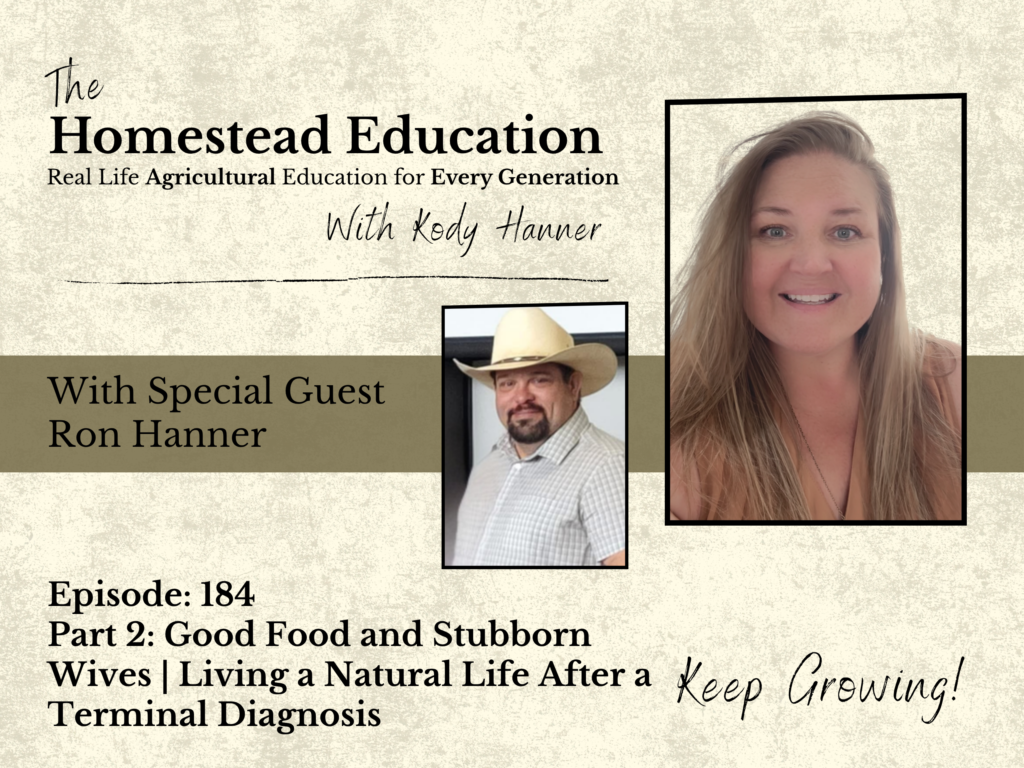
Episode: 184 Part 2: Good Food and Stubborn Wives | Living a Natural Life After a Terminal Diagnosis
- Kody Hanner
Episode Highlights
Kody Hanner and Ron Hanner share a raw, practical story about marriage, parenting, homesteading, and rebuilding health after Ron was told he had end-stage liver disease and might have only a year to live. What follows is a story of fear, grit, and gradual change that led their family to rethink food, home life, and what it means to fight for one another. This episode matters because it connects nutrition, mindset, family systems, and healing in a way that feels lived in rather than theoretical.
In this episode:
- Kody and Ron explain how they met, blended two families, and quickly built a new life together in Oregon
- Ron describes the shock of being told he was “a little cirrhotic” and later diagnosed with compensated end-stage liver disease at 35
- They talk through the emotional fallout, including fear, withdrawal, PTSD, and the strain the diagnosis put on the marriage
- Kody shares how the doctor’s vague advice to pursue a more natural lifestyle became the first thing she could grab onto
- They break down the drastic changes they made to food, including cooking from scratch, avoiding preservatives, and sourcing cleaner ingredients
- The move to homesteading in North Idaho becomes a major turning point as they begin producing more of their own food
- Ron explains how he managed chronic pain and disability through a spinal cord stimulator instead of narcotics
- They discuss homeschooling, family meetings, chore systems, and how they learned to make the whole household part of the process
- Kody and Ron share how they moved toward cleaner living with homemade cleaners, tallow and lard, fewer artificial scents, and more herbal remedies
- The episode closes on their broader message: be proactive, be intentional, and do not hide from the hard things
Podcast Links and Resources
- Hanner Homestead: www.hannerhomestead.com
- Hanner Homestead IG: www.instagram.com/thehannerhomestead
- Hanner Homestead FB: www.facebook.com/thehannerhomestead
Kody's Links
- Homestead Education Curriculum – http://thehomesteadeducation.com/homesteadeducationcurriculum
- Homestead Family Reading List – https://www.thehomesteadeducation.com/homestead-summer-reading-list/
- Instagram – https://instagram.com/homestead_education
- Facebook – https://facebook.com/thehomesteadeducation
- Raising Self-Sufficient Kids Book – https://www.thehomesteadeducation.com/product/raising-self-sufficient-children/
Kody Hanner (03:32)
Which pretty much put me out of commission between pregnancy, bed rest, and a really rough delivery and postpartum, put me out of commission for a year. So the couple of years that I had spent learning how to cook completely from scratch for Ron, he got to step in and be a full time farmer while I couldn’t even hardly get out of bed.
Ron Hanner (03:54)
Slash dad slash caretaker. It was definitely another test of our will and our strengths.
ShowHide Full Transcript
Kody Hanner (04:05)
And we definitely learned how to compromise in marriage through those few years. And still learning.
But then something happened. We were about four years into our farm here. At that point, we were growing or locally sourcing seventy-five to eighty percent of our food.
Ron Hanner (04:34)
Four years into our farm here and what was
Kody Hanner (04:37)
Year and a half, two years down in Oregon still.
Ron Hanner (04:40)
Yeah, six years after the initial diagnosis.
Kody Hanner (04:47)
So yeah, we were, you know, doing most of it ourselves. I’m definitely gonna tell you guys the brass tacks of what we did here in a little bit. But Ron had to have surgery, and because of his liver issues, they sent him down to Palo Alto, California, to have the surgery at a larger VA hospital there with a doctor from Stanford, right? Yeah.
Ron Hanner (05:11)
Actually, she’s from Stanford.
Kody Hanner (05:13)
University of California, maybe? I don’t know. Whatever big college is down there. And, she said that, you know, while she was doing the surgery, it was a scope surgery where they could get a really good look. She wanted to look at his liver and do some biopsies. Like, because at this point his labs and everything looked great, but to go from, like, short terminal to now this is six years later and really showing no signs of liver disease via labs and scans and stuff, she wanted a really good look not only at the outside of his liver on both sides, but also the inside via biopsy.
So he went into this surgery, and halfway through the surgery, she had to come talk to me because they had to change their plan on something else. And she goes, But I want to tell you, while I’m here, his liver looks amazing. And I was like, what, what do you mean, amazing? Like, she goes, There’s a little scarring. Like, yeah, he definitely had cirrhosis, but from a visual look and preliminary biopsy, he has a fully healed liver. She’s like, Good job. I wanna talk to you more and went back into his surgery.
And I mean, it was like, I wish we could have gotten that news together, but what a feeling. Usually in surgery you’re worried they’re gonna come out and say your spouse died. Instead, she came out and told me that he’s gonna live. Like really going to live.
Ron Hanner (07:03)
Yeah, unfortunately I don’t get to add to this one a whole lot because I was still in surgery under anesthesia. So I didn’t get to hear any of this.
Kody Hanner (07:12)
And I don’t think that he even fully comprehended it for probably a week after surgery, because he was pretty drugged up for a few days there. But
Ron Hanner (07:19)
Yeah, I still, you know, you tell me some of this, and I’m like, Why didn’t she tell me this? Why didn’t the doctor tell me? Why don’t I remember hearing any of this? Well, ’cause I was still in surgery. She came out and talked to Kody while I was still being worked on. So that’s why I don’t know any of this other than what Kody told me.
Kody Hanner (07:38)
Even the stuff that he was informed of, he doesn’t remember because they had him on a morphine drip with his own little clicker for it.
Ron Hanner (07:46)
Very little of that. They were even like, why aren’t you using this? Because I don’t need it.
Kody Hanner (07:54)
Yeah, kind of simply just the anesthesia. Like, there definitely was some memory loss for a couple of days there.
Ron Hanner (07:59)
No, there’s memory loss anyway.
Kody Hanner (08:03)
So yeah, six years into this story that we’re now on going on nine years of.
Ron no longer had liver disease. I mean
Ron Hanner (08:15)
Yeah, what in the world is that and how do you how do you go from you’re dying, you’re miserable, you’re just all kind of messed up to You’re good to go. Get out there and live. Huh? How do I do that now? Well Yeah, I’m
Kody Hanner (08:34)
We’ll let you know when he figures that out.
Ron Hanner (08:36)
Still working on that. I’m still working on that. But it just
How do you how do you do that? You go from everything in your life is as normal as it can be one day to all of a sudden get your affairs in order and prepare your family because you’re gonna die. Like probably very soon. Two six years later. What was it? Six years later. Yeah, about six years later. Hey, you’re you’re good. Live life, enjoy it. You’re you don’t have much to worry about with this liver stuff.
How how do you keep flip flopping with this stuff and try to keep things normal? It’s it’s been that’s been a a journey on its own.
Kody Hanner (09:28)
I’m he’s definitely learned a lot though. He’s learned how to be flexible to some new ideas. Yeah ish.
Ron Hanner (09:39)
Ish. I can only be so flexible through you know, they they tell you that military brainwashes you, and I’m always like, no, it no, it doesn’t. after my experiences, they can definitely take a grown man who was functioning as a man of the household and break you down to feeling like a child again and accepting yourself as a child to rebuilding you.
in a in the way that they want you to be, and that’s to be reactive to everything, not proactive to things. So that’s that’s my current downfall is I am I’ll sit back and wait for everything to happen and then I react to it rather than it it drives Kody crazy that I’m not proactive. But I can react to everything wonderfully.
Kody Hanner (10:30)
He also has a and I don’t know if this is military or the illness or what, because I’ll admit we only had a couple years to get to know each other before everything changed. So I mean we definitely have gone through lots of phases of re learning about each other, re-falling in love with each other, all of it. But his first reaction to everything is that’s not going to work.
Ron Hanner (10:56)
yeah, that’s my reactivity.
Kody Hanner (10:58)
It was
Ron Hanner (10:59)
Or pessimist.
Kody Hanner (10:59)
pe pessimism, you know, like, hey, if you eat healthy it’s it could save your life. Not gonna work. Hey,
Ron Hanner (11:06)
Not gonna work, not gonna happen.
Kody Hanner (11:07)
if we run the cows through this chute, we won’t have to like sort them.
Ron Hanner (11:14)
Yeah.
Kody Hanner (11:15)
Even yesterday I said I got some turkeys and I said I’m gonna take the kids’ old trampoline and I’m gonna get these one by four pieces and frame it out to put the chicken wire on so that we have a turkey tractor that’s taller, the size of a trampoline. And but I want it to look a little nicer with the wood framing and that’ll also help hold the chicken wire on because we’ve had issues of, you know, animals pulling up the chicken wire and stuff. So I wanted
A little bit more stable. His immediate reaction, like, I guess if you want to, but I think it’s gonna make it really heavy and we won’t be able to move it. And I was like, Well, I mean, we’ll just have to see. And mind you, we have another chicken tractor made out of the exact same material that’s smaller, but way more wood-heavy than this one’s gonna be. And we had his fire chief over for dinner last night, and he literally walked over to the chicken tractor and goes,
Is this real heavy to pick up for the kids to move? And he like put his hand on the corner and lifted it three off three feet off the ground, one handed. So I I keep telling Ron that eventually I’m gonna earn enough trust in him that he’s gonna trust believe me that things will actually work.
Ron Hanner (12:28)
I you’ve got the trust, I just don’t believe anything from anybody.
Kody Hanner (12:33)
Fair enough.
But I think one thing that you learned the most from all of this is it was actually from one of my favorite homestead educators husbands was what?
Ron Hanner (12:53)
Well he
He has a podcast and his his own gig that he he does now and throughout his podcast that I I don’t see I don’t listen to a lot of his podcasts currently ’cause we’re just so crazy busy, but I still see his his reels and all pop up on Instagram and as soon as I do I immediately zone in and listen because this man has touched me in a way that
Not a whole lot of people can grab hold of me and get my attention. anyway, his name is Christian Winger, an amazing man, amazing husband, an amazing father, somebody that you can definitely look up to and try and model yourself more after and know that you’ve got a good a good influence there. his big one is is don’t hide.
When you start listening to his stuff, go follow him right now. take a just pause this for a second. Go jump on and follow him. Jill and Christian both are amazing people. Definitely something to look up to, somebody to look up to. We’re fortunate enough to be able to be in the same realm as them and and be able to form a bit of a friendship with them that.
makes you be able to understand them even a little bit better than the general public seeing on the social media side. But his his big one is don’t hide.
I I tend to hide from the problems quite often. It’s just like, they’re all my side and if they don’t come back then I don’t have to worry about But that’s not a way to live.
Meet your meet your issues head on. Jump out there and let’s tackle them. Let’s fix them. Let’s let’s make them go away permanently. Otherwise, if you hide, they’re just gonna keep coming back and haunting you in one way or another. so I wanna give Christian a big shout out there. He’s he’s been a big part of my kind of awakening with this whole thing. Get out here and and be proactive.
Fix the things that you can fix. Don’t don’t wait until they’re here to haunt you to fix them. another one that just hit me recently that came from Christian as well. And I I grabbed onto this one and I’m working it every day. Is be intentional. If you are intentional and you get out there and
Do your day intentionally. You you make you ha handle your chores. You do the things in a day that you need you’ve set out to do. You feel great about yourself. If you just be lazy and you don’t do anything intentional for that day, and it’s that day wasn’t already planned, that lazy day wasn’t planned, that that take a break day wasn’t planned.
And all of a sudden you’ve got three, four, five days that you’ve sat around and done absolutely nothing, it feels pretty bad. so do everything intentionally. Get out here and farm intentionally, get out here and grow your food intentionally, make sure your animals are being raised properly, make sure that the things that are are needing to be done around the farm are being done.
Make sure you’re intentionally taking time to spend with your family, with your kids, with your wife, which I am an idiot for pushing my wife aside too much and and not giving back what I should. Because God knows this woman has put her her everything as to the side and focused on getting me to the next step in life and
health and just everything. So two things there that came directly from Christian Winger. Don’t hide and live intentionally. If you don’t hear anything else here, listen to those two things and and do it. I promise your life’s going to be so much better with it.
Kody Hanner (17:28)
Yeah, it the changes I’ve seen in Ron over the last couple of years, emotionally and mentally has has been amazing. And I know that guys like Christian have been a huge change on that. And what it has brought us to though, and it’s even things like putting himself out there and not hiding, has made it where we’re at a place where we’re at today where we have
the opportunity to share this story with you and hopefully help someone else. And whether that is through your health journeys or your mental health journeys, this has been a huge part of it. So let let’s let’s talk about what we did, like so that they can they can make these changes themselves. And you know, when we talk nutrition, nutrition isn’t just about your weight. It isn’t just about your physical health, but it’s about your mental health and your mental well being and
everything else that goes along with it. Like you cannot be a functioning person without proper nutrition. And I think that’s gonna be a huge piece of this. So first off, get out of the grocery store.
Ron Hanner (18:43)
Most definitely 100% get out of the grocery store. The grocery store is a building that has been created to poison people. regardless what you want to think, I want you to look into. You might have just heard that statement and been like, whoa, this guy’s a freaking nut job. You know, sometimes I might be a little bit, and that’s that’s okay. But I want you to step back and look at what’s in that grocery store.
You’ve probably heard the term shop the outside edges. Okay. That’s that’s definitely gonna be better than what you’re gonna get on the inside of the grocery store, on the the in the center of that grocery store. But look at what is actually happening to the foods on the outside, even your organic foods. They the organic’s a sales gimmick.
Kody Hanner (19:33)
It it’s literally listed as a USDA marketing label.
Ron Hanner (19:37)
Yes. I hate to say it and a lot of folks might not even they a lot of folks can’t do what we’ve had to do and what we’ve done for ourselves. But I need you guys to get out of the grocery store. If you’re you’re looking for some major health changes, literally get out of the grocery store. Start finding your local farmers. Go to your farmers markets.
I can promise you the foods that you’re gonna get from your local farmers and your farmers’ markets per se, because everybody can find a farmer’s market. It that food is gonna be so much more clean for you. It’s not gonna have all these big chemicals. You know, I just I was talking to my fire chief last night, and we’ve got facility down here in the valley in our fire district that our county
hazmat guy is deemed the most dangerous part of our the most dangerous thing in our county is this one facility. And this one facility holds and just distributes the chemicals to the commercial farmers. and the the chemicals that they’re putting out, it’s they’re so so dangerous that yeah, this facility that has to to distribute is the most dangerous spot in our our county because
Of what the chemicals are. I can’t even think right off the top of my head what they are, but they’re terrible.
Kody Hanner (21:12)
So when we first started on this journey, the first six months to two years before we got that first like what you’re doing is working, we were like 100% strict adherence to this lifestyle.
Ron Hanner (21:30)
Had to be.
Kody Hanner (21:31)
We yeah, yeah, we absolutely had to be. there is some rules with transplant or not so
There are rules for people who have liver disease on what they can eat, what they can can consume, what medications they can use, protocols they could use. Because if you ever get to the point that you need a liver transplant, you have to show that you’ve been like a hundred percent compliant with your doctors. So we had a lot of you know, we we followed that very, very closely until we moved. And part of that was we finally got the
you know, he’s doing better. But we also were able to find doctors that saw things in a more holistic way. Yeah. So, you know, like for example, one of them is raw milk. We got a cow because we wanted to be producing all of our own food.
Ron Hanner (22:27)
That was stupid.
Kody Hanner (22:29)
Yeah, Ron wanted a dairy cow. I did not want a dairy cow. Now Ron realized why I didn’t want a dairy cow.
Ron Hanner (22:36)
I
fought for this dairy cow.
Kody Hanner (22:38)
Now he realizes why I never wanted to do dairy and now we run a small micro raw dairy so where we sell milk off of our property.
Ron Hanner (22:48)
And you know, thank God for why Wyatt loves the the raw milk, the dairy he works his butt off with it and that’s wonderful because if it wasn’t for him, I’d sell the dairy cows and I’d go down and buy from one of our other neighbors that that does raw dairy so I didn’t have to deal with the milk cows. Yeah.
Kody Hanner (23:06)
So I but you know it has been it’s nice having beef every year too. So
Ron Hanner (23:11)
It’s I I love it. I love that Wyatt does take it on. In fact, he’s about to start getting paid really well for for running the dairy farm portion of it. And I love having our own milk right here. we know what’s going into it, we know what’s coming out of it, we know the changes in the the cream and fat levels throughout the year and why it’s happening and all of that stuff. And we can explain to our customers, hey, this is right now you’re not gonna have as much fat because the time of year. It’s just the way Mother Nature works.
Kody Hanner (23:41)
And that’s what we need too. Like we need the more hydrating milk this time of year and stuff. So with that, raw milk is not generally on an approved liver diet list. And so we actually low temp pasteurized all of our milk. Of course, I was pregnant at the time and we had a two year old or one and a half year old, two year old, something like that. So, you know, we were comfortable with that low temp pasteurization at the time. So we couldn’t, not only were we not gonna be compliant if we drank the raw milk.
Ron was more susceptible to various pathogens, more so than other people would be because his immune system was potentially down, he was, you know, potentially compromised. And also a should he get a pathogen infection, that could be much more detrimental to somebody with liver disease than the average healthy person. Now, when working with a holistic doctor, and I’m the they’re
We don’t even go to like a weird doctor. We just go to a family practitioner in a more holistic minded community. And they have walked us through where we can make the changes that we know are actually right for us. And so I am huge on, you know, maybe even before you start any of this, find a doctor that you align with. Cause I hear so many people talk about, I mean, we could go down all sorts of rabbit trails with
you know, vaccines and holistic health and functional medicine and all those things. I don’t need to go into that right now. Find a doctor who believes in what you believe in or what you’re trying to learn more about and they are gonna help you down a path much better, especially if you’re dealing with any type of d diseases that you need help with. If you d if it’s just that you want, you know, somebody who in that you’re trying to pursue a healthier lifestyle, there’s books, there’s
you know, nutritional holistic nutritionalists and things like that you can go to. But I definitely suggest a doctor or someone in your corner who follows the rules that you want to be following. So we now that we don’t have to have strict adherence, we’re a little bit more lax, but we’re still producing 60, 70% of our own food. what we do buy is we buy a lot of our flour from local mills that, you know, have the
mills right here. You can have those things shipped in. There’s companies like Azure Standard that you can order really great things and they might have a drop in your area. You go pick up your bulk foods that were grown naturally and it’s amazing.
So there’s a lot of different ways that you can do that. one thing that we really had to change, one of them, we had we had to grow ourselves. I mean, there we had to change our mindset completely. And it wasn’t just learning about the natural foods and things like that. We had to learn a new way of eating. We had to we did a lot of mindset work through podcasts and books and
Just anything that we could do to better what who we were and what we were doing. but one thing in changing the way we eat is we had to look at the American diet in a completely different way. And that was really hard at first.
Because it did feel like
we weren’t getting enough to eat or that we were having to eat some strange things and stuff. And pretty much what it comes down to is one, we really focused on gut health. Of we’ve used different supplements, we’ve used, you know, food as medicine, all those types of things. But gut health, and there’s a lot of different ways you can pursue that, a lot of practices. You do what works best for you, but find a way to
Balance your gut bacteria to not be adding more inflammation and hardening to your digestive system because that is a comp let there is a direct line that has been established now with like Alzheimer’s patients and things like that in published studies on the connection between your gut and your brain and your hormones and everything that you need for your body to run properly.
The next one is portion size. And the main reason I’m bringing this one up is because it comes down to cost. A lot of people, and the, you know, just really what you need to. You know, a lot of people say, I don’t want to buy from a farmer because it costs so much more for the food. But that food honestly goes so much further because it’s nutrient dense. It actually meets the needs of your body. So your body isn’t craving more.
Like we can eat a fraction of what we used to eat and
Ron Hanner (28:45)
Yeah.
Kody Hanner (28:46)
still get the same amount of nutrients and fuel, and our brains feel better and our bodies feel better. because if you think about it, a lot of the foods at the store, you know, even just something as simple as a potato versus a potato chip, you could eat a pound of potato chips and you’re still not gonna feel full because they just
dissolve and break down to nothing in your stomach and move through your system quickly. They have seed oils that are, you know, hardening for our intestines. They’re full of you know, salt and sodium and all those things where you could cook something with your pound of regular potato, even salt it and butter it, and your body is going to be much more nourished from that same thing.
What it really comes down to bottom line is it’s more work.
Ron Hanner (29:41)
Yeah, most definitely it’s a lot more work.
Kody Hanner (29:43)
And that’s where I mean, and even on the lowest level, how mu it’s so much easier to walk over and grab a bag of potato chips out of the pantry than it is to even like you can bake a potato in the microwave if you really wanted to. but you know, throwing a potato in the toaster oven or the oven and waiting the 45 minutes for it to cook, you have to be, what did Ron say? More intentional about what you’re doing. So you have to plan and say, I’m going to be hungry at noon. And if I wait till noon, I’m gonna be more.
apt to grab the quick food than I am to say, I know it’s better for me to have the long food and so I’m gonna have to go put a potato in the oven an hour before if I want to bake potato for lunch.
Ron Hanner (30:27)
Yeah, don’t don’t put it in the then in the microwave. The microwave’s gonna destroy every bit of nutrients that’s in that food.
Kody Hanner (30:33)
It really is. I was just more making the point that I mean, it technically doesn’t have to be outrageously hard. Like, you we’re saying we grow all of our own food. Sometimes that’s an eighteen hour a day job. Sometimes we’re farrowing piglets at one in the morning and everything else. We’re not saying you have to do that. We’re saying go buy a half a hog from the person who’s willing to be up at one in the morning with the piglets.
Ron Hanner (30:53)
We’re out there doing it. You know what? I can promise you that the pork that we’re gonna sell you, unless you’ve requested for it to have the vaccines that commercials, commercial piggeries do, or whatever they’re called. It works for me. I can guarantee you that your your pork that’s coming from us is not gonna have that unless you’ve requested it.
Kody Hanner (31:15)
Yeah, absolutely. You’re getting a completely different product.
Ron Hanner (31:18)
And I’m gonna be out there at three o’clock in the morning, one o’clock in the morning. In January at times, I’ll tell you what, it gets cold. But we do it for ourselves, we do it for our four H kids, and we’ll do it for you as well.
Kody Hanner (31:32)
Yeah, we do it for our customers. I mean, because we want to see this healthy food getting to people. And there’s thousands of other farmers like that, like us across the United States right now. so I mean, you just really have like I said, you have to look at how the American diet is and just do it different, make food stretch farther. I mean, one chicken can be two to three meals for our family depending on how we process it. so I mean, we’ve talked about food a lot.
another thing that we did is we completely like almost eliminated our toxin load. so Ron talked a little bit about doing the spinal stimulator over medications. We took that one step further. he uses essential oils, natural remedies, heat, shower, and stuff like that for his back before he’ll say, Okay, like there’s a difference between I worked too hard today and I just need like
To take a hot shower and put some essential oils on my back versus I lifted a hay bale weird and actually pulled something and now I need a muscle relaxer. Where before it was kind of like I worked really hard today, I’m gonna take a muscle relaxer. So we’ve made a lot of those changes where we step outside of Western medicine first, but then still acknowledge that there’s a place for Western medicine.
Ron Hanner (32:50)
Yeah, most definitely.
Kody Hanner (32:52)
I mentioned the essential oils. we use multiple different things. We use herbal medicine. We’ve learned a lot about that as well. to fill especially the things that are like chronic things. Like if you can drink molen tea every day for your asthma rather than taking steroids, like that’s that long term onslaught of like your liver.
Ron Hanner (33:17)
Speaking of mulling, I wanna Mom drinking some.
Kody Hanner (33:19)
Yeah, and we should definitely get some for her. His mom’s struggling with a C O P D. And so we’re hoping that’ll really help open up her airways.
And we have so much mullen growing on our property that it gets annoying and we’re actually cutting it down with weed eaters and just leaving it to lie. So
Ron Hanner (33:35)
another huge part with this that we didn’t even we didn’t even realize we were getting with this house that we bought was the amount of medicinal herbs and plants that grow right here on our 40 acres naturally we just when we bought the property we weren’t aware of it and we’ve been taught so much about it we’ve got elderberries and we’ve got the molin and we’ve got just
Kody Hanner (34:01)
So I mean it’s been a it’s been a huge blessing. one thing I say is if you’re interested in that, you know, find good books on identifying plants. we also have an app that we use. It doesn’t always work when we’re out of service, but we will compare the app to the book to make sure we’re using the right herbs because some of them can be really bad for you. And in the South, you can all often find like a granny minter is what they call them.
And they will actually go with you out and teach you how to use your herbs and stuff. So that’s a lot of really great options there. even like our we still love hiking, but we don’t always have time for it because luckily we do enjoy farming. So we were able to say farming is our hobby, but it also is healing us. But we still wanna be in the woods. And so we take the opportunity,
when we want to go hiking or be out in the woods in general, that’s when we’re foraging for berries, that’s when we’re hunting. It’s something else to feed us, but we still get that time and the fresh air and we call it wilderness therapy. Yeah.
Ron Hanner (35:09)
it’s once again it’s it it’s intentional. We are intentionally going in the woods for a very specific purpose other than just to hike. We’re going in to pick our huck.
Kody Hanner (35:19)
For psyching is a great exercise.
Ron Hanner (35:21)
it
is and we look at the miles that we wind up covering doing this. I mean we get we get lots of lots of actual hiking time in and some of the places that we’re finding for our our foraging and soon to be we’re gonna add to our foraging mushrooms because we’ve had some pretty big fires in our area in the last few years and I just know the morales are just exploding in those areas.
Kody Hanner (35:43)
yeah. Well,
and honestly, sometimes like when we go out for a hike, we’ll go say go to, you know, just a quick two mile hike while the kids are at a meeting or something. And I feel like I am dying at the end of that hike where we can go out Huckleberry picking and because we’re intentional and we’re seeking something and we’re having fun, we’ll get back and look at our mileage and we’re at like five or six miles. Yeah. So we actually get it’s maybe not as intense, but we’re getting almost more exercise.
size and doing something we love and coming home with a food that we eat year round. Yeah. So another one is we made started making all of our own cleaners. And at first we were a little concerned, you know, I come out of, you know, food safety in food plants and things like that.
Ron Hanner (36:30)
Hold on, let me back up on this. When this with this diagnosis, the greatest part of it was you can’t you’ve got to be staying away from like all the the cleaners, the chemicals. You that is just gonna absorb through your skin, get into your liver, it’s gonna make things worse. Yes, I don’t have to scrub toilets no more. I don’t have to do floor cleaning anymore. I’m getting out of so much of this stuff that I hate. Well, guess what?
Kody Hanner (36:54)
I discovered making your own cleaners out of natural products that are actually good for
Ron Hanner (36:58)
And now I’m cleaning floors and scrubbing toilets and Yeah.
Kody Hanner (37:01)
By the way, our toilet’s dirty.
Ron Hanner (37:03)
I know.
Kody Hanner (37:07)
so your skin and your lungs absorb way more toxins and have more of a absorbency than like any other organ, like even your digestive tract. So, I mean, that was a huge one is we make all our own cleaners primarily out of essential oils. There are some we buy that we feel safe with. do your research on those because it’s constantly changing. a lot our lotions are all
you know, tallow or lard based. We also cook with tallow and lard. That’s our primary we don’t and we render all of it ourselves so we know how clean it is. but even just taking that next step. Don’t buy lard at the store though. Buy buy fat from the butcher or something and render your own. Mm-hmm. that’s been a
Ron Hanner (37:56)
Super simple.
Kody Hanner (37:57)
Yeah.
Ron Hanner (37:57)
Just low temperature, extended amount of time, let it let it cook itself off of the impurity let the impurities cook out. Strain it. Do it one more time. Take it a let it be a couple day process. Just super low heat. You’re gonna come up with a product that’s gonna be pretty amazing.
Kody Hanner (38:18)
And the other one that we really pulled out was any artificial scents because besides the toxic load, they’ve also found that they’re hormone disruptors. And we don’t want that for our children. And so no more candles, no more air fresheners. We will use diffusers. when I say no candles, we will use I make lard candles with some essential oils. There’s some options there where you can still kind of have that ambiance. if you use
real beeswax for your candles, the real pure stuff, but just don’t be adding those scents in because that that’s a huge one. And you’ll actually find that you don’t like them after a certain amount of time. So I mean even we make all of our own laundry detergent. Our clothes last longer. We don’t smell and we’re pig farmers. So I think that that is enough to say right there. so that that’s one that I would take out as well.
What has really ended up being, I mean, you can make all the changes you want or try to implement all the changes you want. What needs to change though the most is taking this on as a family. You need everybody on board. You need your spouse on board, you need the kids on board, because this this is a lot of work and it’s a lot of changes. And if not everybody is in on it, that’s just gonna be a whole nother level of stress, regardless of
How deep into this you do or don’t want to go. right off the bat, you know, we mentioned that we’re a blended family, and the concept of chores was a little challenging for like the older boys. you know, between losing their mom and Ron had been in Iraq for a long time, there wasn’t a lot of structure in that sense.
so what we did right off the bat in making that change, and I I counsel a lot of families to do this that are making those big changes, because that’s huge changes for kids. And rather just, okay, suddenly you have all these chores.
Ron Hanner (40:28)
Sorry about that. Wrong button.
Kody Hanner (40:31)
After you do all your chores, or sorry, and instead of just making everything a chore, it’s an everyone helps role. you know, I say a lot to people: chores are an obligation where responsibilities are a privilege. And we’re privileged to be able to run our farm, have this beautiful stuff, have everything we have, keep our health great, but it does take everybody, and it’s an everybody helps.
Ron Hanner (40:57)
Yes, most definitely.
Kody Hanner (41:00)
We also sit down and have family meetings, usually about quarterly, where we set the goals of the family, the kids education, our farm, both as what we want to grow for ourselves and how we wanna expand our farm business.
Ron Hanner (41:17)
just us setting those goals. That’s that’s us and the kids. Yeah. They’re they’re inputting it is just as important, if not more important, than ours. Because so much so many of the chores are their responsibilities as well. So we need to understand what what they’re wanting out of it as well.
Kody Hanner (41:35)
So yeah, we’re constantly setting what those goals are as a family, as a couple. And we we write them down and we hang them up. And you know, sometimes it’s you know, the the big goal, we want to take a vacation this summer, and so everybody’s working towards that. But then when we do these quarterly goals, we write down everything that needs to happen on the property over a course of a quarter. And that way, you know, like when the teens
Get done with their school for the day and they want something to do, they can pick something off that list to go start working on. And even the little ones are a part of that one. And what that ends up doing is it allows all of us to meet the needs and expectations of each other. And it allows us to take ownership in those things that need to happen rather than that ownership being forced on each person.
Ron Hanner (42:29)
It helps us stay very intentional of what we’re doing.
Kody Hanner (42:32)
It does, absolutely. you know, we also when we have a list of things that need to be done or if there’s something in the house that’s not working, we don’t just say like, hey, the kitchen is always trashed. You guys need to clean up after yourselves. You need to do something about it. I say, Hey, we’re obviously not having a good routine on getting the k keeping the kitchen clean. What can we do? And that’s when we start in, you know, Larson will be like, Well, when I get done.
Doing all the milk in the morning, I can make sure I’m sweeping the floor because I’m coming in with my muddy boots. And my daughter goes, Well, you know, when I’m done cooking, I can make sure if I’m making something that isn’t for the whole family or if I’m just going in to like bake for fun, that I’m cleaning up completely after myself. And, you know, then I jump in and say, Okay, then every morning after I make my coffee, I’m gonna get all the milking equipment ready to go. And it just it makes it where instead of assigning chores, people are s
Each of the children are seeing where there’s an issue and taking ownership of it. And I use the kitchen as an example because, you know, everybody has a kitchen,
Ron Hanner (43:38)
And everybody uses it.
Kody Hanner (43:40)
but we do this across everything. And the kids have they found their niches. You know, we have issues at the barn. And, you know, my son’s like, okay, well, I can, you know, make myself, you know, make a change at the barn to make this happen. And my daughter goes, Well, and I can make sure that I’m handling the medications and
writing it in the record book or whatever is needing to happen for the family that isn’t just it’s not chores, it’s their it’s their jobs, you know, and they they have so much ownership in it. one of those is we really, really, really work on this one is being proactive. And you know, we kinda joked about that a little bit at the beginning that Ron’s reactive and not proactive.
But what we really find is that being proactive in what we’re doing keeps the issues from ever coming up. So instead of, you know, well, I’ll do something with the fence when the if the fence breaks, well, what ends up happening is not only is the fence now broken and we have to get it fixed, we have animals roaming loose, we have issues with neighbors, like on down the line, where if we say, We’re gonna build a really good fence before we ever put that animal in that pin.
We aren’t having to pay twice for the fence because it’s not damaged. We aren’t having to deal with issues with neighbors, you know. And that just kind of goes from there. But we do that with kind of we work on doing that with everything that we’re doing. it ends up saving us a lot of money, a lot of time, a lot of stress.
but what Ron and I have touched a lot on throughout this is what all of this has done to our relationship and what we are on a daily basis trying to do. And, you know, when we stand up here to talking to you about our marriage, we don’t feel like we are here telling you how to have a good marriage because we have a perfect one. We’re up here being able to give you information.
on having a healthy marriage because we don’t have a perfect one and because we’re constantly seeking out what we were never modeled as children.
Ron Hanner (45:58)
It’s we’re far from from perfect. We’ve just had some pretty incredible, unfortunate experiences in life that we have taken and turned from worst case scenario to actually in some cases being able to prove the medical fields wrong. And we want to take that and and put it out for people to understand that.
what we’ve been led to believe is not necessarily the correct way. if we just take our experiences and keep them to ourselves, there’s so many people out there that we can talk to and and give advice to and very possibly save a life here and there. And some folks that know me know that I I thrive on that now in life is is saving lives and helping people as much as I can where I can. To the point I’ve gotten
comfortable with talking to people in public and doing onstage different on stage shows and get out there and just communicate with folks. It’s it’s important that we share our experiences and get it out there. Let let people hear it.
Kody Hanner (47:12)
It’s definitely, you know, Ron is also on our local fire department. He just got certified as EMR, which is similar to an EMT. because yeah, saving lives is his calling, whether that’s literally stopping someone from bleeding out or that’s where he gets his reactive time in. And then we get to come here and share this information with you as our proactive part of saving lives.
Ron Hanner (47:41)
I gotta say, if if it wasn’t for this stubborn wife of mine, I I sure as he couldn’t be here to talk with folks and to wait for that pager to go off to go help somebody, whoever it may be, and whatever their their crisis is. If it wasn’t for my wife, Kody, being there for me and my my crisis, I couldn’t be there for anybody else in theirs.
Kody Hanner (48:08)
So I mean we’re lucky that he’s
Ron Hanner (48:12)
She came along a little too late because I I’ve had some major crises that I sure sure as heck needed her with me on.
Kody Hanner (48:20)
You know what though? It’s we have a lot of pain in life. And I mean, it’s just it’s one of those things that comes with it. And I think if everything was perfect, had we ran into some of these issues that we have, we wouldn’t have had the grit to get through them. Yeah, most definitely. And that hasn’t made us stronger and made us appreciate each other more. You know, it’s kind of Ron tells me this all the time, but it’s, you know, no one’s
No one’s here on earth is coming to save you. Yeah. But your spouse is probably about your closest. Mm-hmm. You know, I kind of always joke it’s a it’s like a face only a mother could love, but instead, it’s only a mountain your spouse will climb.
so you don’t have to do these things alone. Be there to cheer your spouse on, help them and reach out a hand when it gets too hard and just make sure you don’t underestimate the power of good food.
Ron Hanner (49:26)
Stubborn wives.