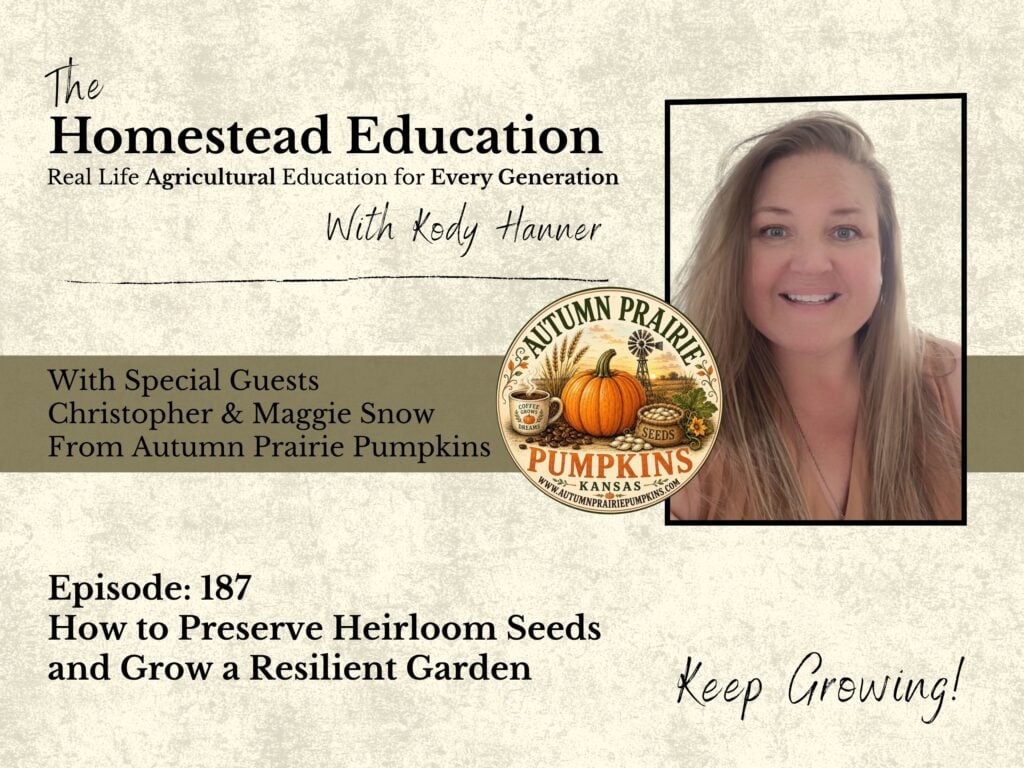
Episode 187: How to Preserve Heirloom Seeds and Grow a Resilient Garden
- Kody Hanner
Episode Highlights
Seed saving is about far more than collecting a few seeds at the end of the gardening season. It is a practical way to preserve heirloom varieties, strengthen your garden, and keep more control over your family’s food supply.
In this episode, I’m joined by Christopher and Maggie Snow of Autumn Prairie Pumpkins to discuss seed saving, heirloom pumpkins, hand pollination, pest-resistant squash varieties, and the small suburban garden that grew into a micro farm and seed business.
Christopher and Maggie explain the difference between heirloom and F1 hybrid seeds—and why seeds collected from a hybrid plant may not produce the same variety the following year. We also walk through their seed-saving process, including covering unopened blossoms, hand-pollinating flowers, preventing unwanted cross-pollination, and labeling the seeds they intend to preserve.
We also talk about:
Why heirloom seeds matter for food security and resilience
How to begin seed saving in your own garden
The difference between heirloom and F1 hybrid varieties
How squash and pumpkins cross-pollinate
Using blossom bags and hand pollination to keep seeds true
Choosing squash varieties adapted to local pests and conditions
Squash vine borers, cucumber beetles, and natural pest-management methods
Growing vertically in a small suburban backyard
Preserving unusual culinary pumpkins and their agricultural history
Turning a passion for gardening into a small farm business
You do not need acres of land, generations of gardening knowledge, or a naturally green thumb to begin growing food and saving seeds. Sometimes it starts with one stubborn pumpkin plant—and a willingness to learn why it survived when the others did not.
Learn more about Christopher and Maggie, shop their heirloom seeds, and find their pumpkin cookbook at AutumnPrairiePumpkins.com.
Use code HOMESTEAD10 for 10% off your order.

Podcast Links and Resources
- The Pumpkin Bakery Book: autumnprairiepumpkins.com/products/the-pumpkin-bakery-cookbook-signed-paperback
- Ten Tomatoes that Changed the World: https://link.amazon/B0cuEn6db
- Guns, Germs, & Steel: https://link.amazon/B02DY7mdr
Kody's Links
- Homestead Education Curriculum – http://thehomesteadeducation.com/homesteadeducationcurriculum
- Homestead Family Reading List – https://www.thehomesteadeducation.com/homestead-summer-reading-list/
- ESA Funding: https://www.thehomesteadeducation.com/funding/
- Instagram – https://instagram.com/homestead_education
- Facebook – https://facebook.com/thehomesteadeducation
- Raising Self-Sufficient Kids Book – https://www.thehomesteadeducation.com/product/raising-self-sufficient-children/
Hi everyone, and welcome back to The Homestead Education podcast!
Today I have a really unique couple on because what they’re doing is something that we just don’t hear about every single day. So I have Christopher and Maggie Snow from Autumn Prairie Pumpkins. I knew I was gonna get it wrong. So you know, too many like peas in a row or something. But so I’m really excited to have you guys on today, and I’d love for you to introduce yourselves.
ShowHide Full Transcript
Meet Christopher and Maggie Snow
Kody Hanner: Hi everyone and welcome back to the Homestead Education Podcast. Today I have a really unique couple on because what they’re doing is something that we just don’t hear about every single day. I have Christopher and Maggie Snow from Autumn Prairie Pumpkins. I knew I was going to get it wrong. too many like peas in a row or something. But so I’m really excited to have you guys on today and I’d love for you to introduce yourselves.
Chris Snow: Okay. my name is Christopher Snow and I work in cybersecurity and I also like to grow pumpkins and save heirloom seeds and grow sunflowers and tomatoes and things like that. My wife Maggie got us into gardening a few years back and I’d never thought about gardening before really. I did try it once and it just didn’t work out because of all the like bugs, the squash vine bores and stuff, and then I just kind of was like, I tried it. But when Maggie wanted to try it again and that’s how it got started basically.
Kody Hanner: I feel you there. My husband says I can’t have a garden unless I have an automatic waterer because.
Maggie Snow: That’s true. And I’m Maggie. we live in central Kansas and kind of like Christopher said, we both started this. last year I always used to joke that I had a black thumb when it came to gardening. I remember getting a cactus one time as a Christmas gift and somehow managing to kill it. I didn’t I didn’t think that I was any good at gardening either. But we got into it, started with some easier stuff and kind of said, okay, we can do this and turned it into a little micro farm here in our suburban backyard. And that’s how it started. Well.
From a Childhood Pumpkin Memory to a Suburban Micro Farm
Kody Hanner: That’s awesome. I totally get the black thumBthing too. My mother-in-law used to say, if you want to kill a houseplant, give it to Kody. Now I grow almost enough food to feed our family, like on gardens. it’s I think the houseplant thing and the garden thing is different. In fact, she was super proud of me one time because I kept like this flower on a cactus alive for a really long time. And we were getting ready to move and realized that it was a fake flower hooked to the cactus. I was like Well, that’s how I keep it alive. how did you get kind of more into the pumpkins versus just some other crop or just a full garden?
Chris Snow: I tried the Cucurbita pepo varieties, such as sugar pie pumpkins and stuff, and they were just getting wiped out by the squash vine borers. And my.
Maggie Snow: You should start back at the beginning though, with your.
Maggie Snow: Where the pumpkin started. The pumpkin obsession started.
Chris Snow: Yeah. I guess from when I was a kid, my I remember my mom taking me to a pumpkin patch and my father was in the air force and I just fell in love with the I was like four or five and I just fell in love with the pumpkin patch. It was it was so great and it probably just left a lasting impression on me. The pumpkins did and then the scenery and then all of the crisp air and stuff and it was it was just something that I always wanted.
Kody Hanner: A core memory.
Chris Snow: I always wanted my own pumpkin patch since that point in time and.
Maggie Snow: Yeah. then when we started with the gardening, we and we started with like potatoes and kind of easier, easier type stuff. but that core memory for him kind of came back up and he wanted to grow pumpkins and we had we had a bunch of pumpkins, but of course I tried the zucchini and the summer squash and we just noticed that it they were just getting decimated. I remember I was I was trying to grow a zucchini plant vertically and it had two or three zucchini on it. I was so proud of myself and I literally walked like I watered it that morning and then at lunch I went outside to check on things and all of a sudden the plant had just fallen over and I was like, What in the world?
Growing Pumpkins Around Squash Vine Borers
Kody Hanner: Be sad. I think the only thing we’re getting out of our garden this year is zucchini, but that’s my fault.
Maggie Snow: That’s when we learned about the squash vine borer.
Kody Hanner: Explain that one. I.
Kody Hanner: Have a lot of people ask me about it, but I live in North Idaho and we have flies and mosquitoes and that’s about it, so.
Maggie Snow: Consider yourselves lucky. He we will let him talk about the squash a little bit more.
Chris Snow: I had grown the sugar pies and they got all destroyed But the butternuts and the seminoles were fine and so were the Long Island cheeses. I just, me being kind of an engineer, I just I had to figure out why and I fig I found that, these are moschata variety and they’re they kind of evolved to handle the squash vine borer and pests and disease better.
Maggie Snow: The bugs themselves are the larva, right? They’re the larva of a moth. And they’re really they’re actually the moths are kind of pretty. They’re they’re white moths that fly around, but they lay they lay their eggs and their larva right usually like near plants and they love they love like squash and zucchini and that kind of thing. And the larva will actually burrow into the stem of the plant, and then they will grow and they will eat the stem of the plant from the inside out. And that’s why you can have, like with the zucchini that we had, you don’t really see it because the larva burrows in, but then it eats the stem from the inside out and the whole plant falls over. And that’s usually when you can diagnose that it’s a squash vine borer because you can see this white caterpillar basically. living inside the stem of your plant and there’s no there’s no coming back from that. The only way when we were looking into it that year trying to see if we could save anything, the only thing short of going pretty strong with like a lot of chemical pesticides and stuff like that would be insect netting, kind of like what you have to do with brassicas and just cover the entire thing. with insect netting and some of these pumpkins that he was trying to grow, we kind of looked at each other and went, these pumpkin vines can get like ten, fifteen feet long. We can’t.
Kody Hanner: That’s a lot.
Maggie Snow: That is unmanageable to just put insect netting over the whole thing.
Chris Snow: One though, one real quick question. the squash vine boar moth is actually red and black. is okay. I think you were thinking of the cabbage.
Maggie Snow: I probably was thinking of the cabbage moth, yeah.
Chris Snow: And then like I we don’t have like a whole lot of space. what we ended up doing was I built cattle panel tunnels that you can just walk through. And we have quite a few of them and they go anywhere between fifty feet to twelve to sixteen feet. And you get the surfa you get more, you get basically twice as much space because you can use utilize the upper space and the lower space for things that can handle more shade.
Maggie Snow: Yeah. But he last year when we had all this happen with the with the moths, kind of like he’s he was saying, he noticed that the butternuts that he had planted, they were doing fine. And we know we had a whole bunch of squash vine borers come through, but they were doing all right. And we were like, Well, okay, why are those ones okay? And all the rest of them are not. And that kind of put him down the rabbit hole of learning about the moschata varieties of.
Kody Hanner: Mm-hmm.
Maggie Snow: Squash, which are resistant to the vine borer, and we have them so bad here in Kansas that we thought, okay, well let’s let’s work with nature instead of trying to work against it and just plant the stuff that the vine borers seem to have a harder time with. And so far it’s been working really well.
Kody Hanner: That’s good to hear. so this was like last year this happened, so this season have you had had any issues or not as much or.
Chris Snow: We did have a few issues with the butternuts, or not the butternuts, but the Honeynuts. And then I looked up why because they’re a hybrid of the moschata and or the yeah, the moschata and the Cucurbita maxima from the there’s a squash in the Cucurbita maxima family called the buttercup. And back in the eighties, and then into the nineties, they actually crossbred them to get the honey nut. And it was actually a it was It was done that way and a chef was actually involved in the in the in the experiment too because they wanted the right taste and a little more sweetness.
Kody Hanner: Right, yeah.
Maggie Snow: But we had the vine borers for sure, because we sell at the local farmers market and there’s a couple of other there’s a couple of other people around us that grow the pumpkins too and they have all commented about they were bad again this year, but we didn’t other than the Honeynuts, we really didn’t have too many problems with them because everything we grew was moschata and so the stems are the stems are thicker and woodier, so the larva can’t They can’t burrow into them.
Managing Cucumber Beetles and Squash Bugs
Kody Hanner: That makes sense.
Chris Snow: Biggest I think we had more issues with the cucumber beetles than we did.
Maggie Snow: Here that was the big problem.
Chris Snow: Yeah. Pretty much with we did have squash bugs, but those were not that bad. I think the biggest one was the cucumber beetles. They were they were bad this year in Kansas anyway.
Kody Hanner: Hmm. And so the only way really to deal with these is normally pesticides, right?
Chris Snow: But we don’t really like to use pesticides. we like to try to first, treat it naturally like you would normal, like pretty much anything else, you don’t want to go nuclear on a cut. You’d want to, start with something more natural and then kind of go I don’t know.
Kody Hanner: Right. my husband has liver disease and that’s what started our journey. And so we try not to use any pesticides on our property and we do occasionally deal with like at the end of harvest we’ll have I don’t remember what they’re called at the moment, but it’s like a little like gnat and it will come up and just turn my greens into lace like overnight. Like they eat everything in between. I go out there and it looks like Ghost greens.
Maggie Snow: That sound that sounds like the cabbage moths. Huh.
Kody Hanner: Like a little they’re a little black buttons.
Chris Snow: Making little like do the leaves look like they have like netting now on them because they’re.
Maggie Snow: We get those we get those too.
Kody Hanner: And so I’ll go out if I catch like that they’re starting to show up, I’ll I have a like an essential oil spray that I use and put on there. But I have to put it on every day because it washes off when I water and stuff. But it holds them out a little bit longer and.
Maggie Snow: We’ve done that we’ve done like neem oil, a little bit of soap and neem oil and water and that works okay. The only problem is, anytime it rains or you water, of course, it kind of washes off. And this year we were so hot for so long that the we found that the neem oil was actually it was actually focusing like sun rays and was burning. It was burning some of the leaves. So.
Kody Hanner: These bugs like so if they’re in your area, they’re just in your area. There’s like nothing you can do to like, some big preventative measure or something.
Chris Snow: I think I’ve and I’ve tried all these. Some people will put tinfoil on the roots, some people will put they’ll they’ll put little like barriers around the stems. But honestly, in my experience that never worked because they always got around them, in them and you take off the tinfoil and that was like the only thing holding the plant up. And it.
Kody Hanner: Like what about like Diatomaceous Earth or something?
Chris Snow: Tried that also and that did that didn’t work. you can.
Maggie Snow: Get like if you have an infestation and you want to try to save the plant, you can get like Bt and take a like a syringe and inject it into the into the actual stem of the plant, but.
Maggie Snow: That doesn’t really work either.
Chris Snow: You can try to cut the borer out, the larva, and then just kind of like patch it. That can work, but it really slows down the R in my case, maybe some other people don’t have this problem, but it was just a lot simpler to just grow the ones that were resistant and.
Maggie Snow: Freeze. That’ll do it.
Kody Hanner: That’ll do a lot of other things too.
Maggie Snow: Ha.
Chris Snow: It’s kind of like security in depth, you want to be able to build the environment around it in layers. the first thing that I started with was, back when I was first starting was, all these all this stuff that didn’t work, but then, like in cybersecurity, we just built, the system that worked and that was more immune to the attacks. that’s what.
Kody Hanner: That makes sense. with finding that the moschata variety had adapted more, you guys, going into your heritage seed stuff, is there an option for a hardier variety of pumpkins from like an heirloom bank that might have a stronger resistance to it?
Chris Snow: Are you asking like are there.
Kody Hanner: Like say for the pumpkins. Is there maybe like a heirloom variety that might have a more resistance to it than.
Chris Snow: Seminole pumpkin is an heirloom. it came from the in the Everglades in Florida and the Seminole Indians used to grow.
Kody Hanner: Should be able to live through anything.
Chris Snow: Yeah. And they are I’m not going to say they’re bulletproof because nothing’s really bulletproof, but they’re very highly resistant. and I they live on they thrive on neglect. You can literally plant it and come back and as long as it gets some water, it seems to be fine. It outgrows a lot of the damage that squash bugs and cucumber beetles do. But yeah, they’re they’re pretty much immune well, they’re very resistant to the borer and a lot of other pests too.
Kody Hanner: Okay. the like the cucumber beetles and squash bugs, what are the options for those?
Chris Snow: You can use neem oil if you if you get it in time, you can use like, natural sprays. you can and I’ve done this is you can you can plant like marigolds and stuff like that it’s kind of like a more of a trap crop and a deterrent. but.
Maggie Snow: Kaolin clay can work. Do.
Maggie Snow: Like kaolin clay spray on the leaves and things, that can work, but then you run into the same kind of issue as soon as you as soon as it rains, you’re having out to spray it again.
Chris Snow: We’ve done stuff like that. you yeah, so and then other than that’s what we’ve done. we have well we have used like we have used like eight a few times. I don’t like using it, but we have used it a few times around the around the plants to to get rid of the beetles.
Kody Hanner: Okay. That’s like it’s like a I’ve seen it before but I.
Chris Snow: Yeah. It’s more it’s supposed to be s well, depending on who you ask, it’s supposed to be safer than a lot of the.
Kody Hanner: People go, well, why don’t you just go all organic? And I’m like, well, because organic sprays a lot of times are chemicals too. They’re just accepted under the organic label. I’d rather just go all natural where I can. But we always do risk over benefit with my husband’s liver and stuff, or like for myself, I am like highly allergic to yellow jackets, like anaphlaxes and everything. it’s makes more sense for my husband to like go out in the evenings with a pair of gloves on and spray all the nest with the poison. than it does for me to accidentally get stung. But, like he really shouldn’t be messing with the poisons, but it’s better than in this case, like the immediate of me getting stung where he can have like precautionaries,.
Kody Hanner: Or when we first moved here, this farm hadn’t been farmed in, I don’t know, five years or something. it was super overgrown with like thistle and stuff. we said, okay, where do we want our gardens? And we did some spray on some of the other areas. To just get it under control, but then now it’s been seven years and we’ve never put another thing on it. So.
Maggie Snow: Yeah. We were using the eight. I think it was at the peak of when we had the squash bugs and the cucumber beetles. It was like the peak of their kind of season. We did like I think it was like two weeks maybe or two or three weeks of treatments just during that time. And then we and then we stopped because usually you can you can kind of get it under control.
Chris Snow: And you spray you do one week, as little as you can and then you kind of just, wait and see and then if it’s if it continues to be really bad, you try a little bit more and then it’s always, you do as, the least amount to get the best results to and s with stuff like that. and it’s a combination of other stuff too. Like the clay, the clay works really well, especially in the heat, because it’s almost like putting sunscreen on a plant.
Chris Snow: And it helps with the squash bugs too, because they don’t like to sit on I guess it’s it doesn’t I don’t know how squash bugs feel, but it’s not that comfortable, I guess, for them. But And it doesn’t suffocate the plant or anything. it’s really neat. Okay.
Maggie Snow: Yeah. Going out there with the little mini shop vac. I used to I used to kind of giggle because he would go out there in the morning with the little and you’d just hear him in the backyard with the shop vac just sucking all the sucking all the bugs off the leaves,.
Kody Hanner: Giving up bugs.
Maggie Snow: Which it worked, but I was like.
Chris Snow: Walk under the tunnel and you can get the little eggs.
Kody Hanner: And they use like a little vac like a mini vacuum for like catching bees and s like queen bees and stuff. that’s yeah, that makes sense.
Maggie Snow: Yeah. I’m sure our neighbors thought we were insane, but.
Chris Snow: But it’s the s.
Kody Hanner: But you don’t vacuum your lawn? come on.
Chris Snow: We’re not bothering anyone.
Kody Hanner: The noise complaint. is your neighbor mowing this morning? No, he’s vacuuming.
Maggie Snow: His vacuuming his pumpkin plants.
Kody Hanner: Hey, if it works, it works. I am all about that. we were looking at a really hard freeze at the end of August a few years ago. huh. And I remembered that I had seen all the white tablecloths from our wedding. The bag had got ripped open and they were all browned on the side. And I was like, Well, it’s been eight years and we haven’t used them yet. And so we went and grabbed all those tablecloths and ripped holes in them and put over the T post so we could tent all of our.
Kody Hanner: Yep. garden boxes and we made it through that freeze and then we were still harvesting tomatoes in October. Yeah. That was.
Kody Hanner: Worth it to me. I’m not using those tablecloths, but I will use those tomatoes.
Chris Snow: And we’re not due for a frost for a while, I hope. that’s what the weather’s that’s what all the weather’s crossed. Yeah.
Kody Hanner: We actually still aren’t either up here. We had one teeny frost and so some of my squash have like the brown on the edge of their leaves, but they tend to shelter the rest of the plant. So.
Chris Snow: Mm-hmm. And yeah, it’s so hopefully the only thing really is the sun. you have you’re not getting as much sun as the as the as the days get shorter. it may decrease the size of your plants, but I’m just trying to finish up.
Kody Hanner: Here we’ll hear in a couple more weeks. It’ll be dark at four o’clock here, so.
Chris Snow: Mm. I’m just trying to finish up the ones that are on there that I that are almost there and it’s just like.
Maggie Snow: We kind of had a there was a hot spell this summer, like July and kind of July and August where.
Kody Hanner: I know. I went to the Ozarks in the first week of September and I thought I was going to die.
Maggie Snow: It was hot, it was humid, and everything kind of everything kind of stopped. Like the pumpkin plants survived and like my peppers and stuff survived, but they all kind of stopped producing, because it was too hot. And then now like now it has finally started to cool off today, being the exception because it’s ninety today. but.
Kody Hanner: I’m like here in my sweater, like.
Maggie Snow: We kind of we kind of had this resurgence and so we have what? yeah. Almost another almost another thirty pumpkins out there that we keep looking at the frost forecast, like, okay, we’ve we’ve got like thirty more days. Can they make it thirty more days?
Chris Snow: If anything we’ll get summer squash out of it,. They just won’t be as the skins won’t be as.
Maggie Snow: We’ll be out there with towels and bed shots too, just wrapping up the place.
Chris Snow: Had to do that with our tulips because our tulips came up in April, they was it they came they were coming up actually in March and because it was warming up and then we had that cold spell in April and it like it basically liquefied the petals. We were out there though trying to cover up and they a lot of froze. So.
Kody Hanner: I had that with some of my like berries and apples and stuff this year because we got that late freeze and so it froze a lot of my all of our blossoms. But we still had a decent harvest and then we harvested it all and it’s wildfire season and my family all took off because they’re firefighters and everything rotted in the buckets because I just couldn’t keep up. My.
Why Seed Saving Matters
Kody Hanner: Pigs had a lot of funky apples. okay, I want to hear a little bit more about how you got into the heirloom seeds. I know you were talking about you found the varieties, but you’re doing a little bit more with that now, right?
Chris Snow: So I’m trying to so I’m encouraging I’m saving them. I also want to I’m trying to encourage people to grow more of the heirlooms rather than a lot of the F1 hybrids because I s I do sell F1 hybrids on my site, but you can only grow once, really. because if you try to grow if you try to grow more than once, you don’t know where to go.
Kody Hanner: You don’t get the same, yeah. Of.
Chris Snow: Yeah. Yeah. So.
Kody Hanner: Course, I now have spoon tomatoes that literally grow like weeds. Like I went out to one bed that we didn’t do anything with this year. We were kind of using it as our tool bed while we rebuilt our boxes. And it is like waist deep of weeds. And I got to looking at it and almost all of them are spoon tomatoes growing straight up with the weeds with little tomatoes all on.
Maggie Snow: Hey, yeah. we were still kind of discovering, I think earlier this year, when we were we were getting into this, we were discovering a lot of these moschata varieties. And, the seminal, that’s his favorite. We do have the Musquée de Provence, the or the fairy tale that we that we have as a French heirloom.
Maggie Snow: Bella. but we were kind of discovering a lot of those. Oops, sorry. Bella. but we were discovering a lot of those, a lot of those heirloom varieties. And, we thought they were so cool and especially, kind of learning how to save the seeds and how to how to put the bags on the flowers before they open up to make sure that we’re keeping the seed, true to form. Mm-hmm. But one of the things we started noticing from some of the seed catalogs and things like that we were looking at was there’s been a definite shift towards the F1 hybrids. And that’s it makes sense from like a big business perspective. If you’re wanting people to have to come back every year and buy the seeds, yeah, it makes total sense. But.
Kody Hanner: Not for our over.
Maggie Snow: Not for our overall goals, exactly. We are very much more.
Kody Hanner: We had this talk about like seedless grapes and stuff the other day.
Maggie Snow: Exactly. Like we are very much more into the, increasing resilience and making sure that you’re growing, you’re growing things and being, being able to save the seeds and.
Kody Hanner: Just give somebody else too much control over your food.
Maggie Snow: Exactly. Exactly.
Chris Snow: It just makes there’s only like four companies in the and I think in the country that or in the world it’s like bear and then there’s a couple of other ones that o own majority of the seeds, and or the distributors and I just don’t I and I also think I think that it will it has future impacts on the environment because what happens when those companies are gone. Or what happens if something, happens in the environment and then we’re we’ve already destroyed the ability to grow our own food. it’s like, Great, now what? Is this yeah.
Kody Hanner: You’re preaching you’re preaching to the choir on that one.
Maggie Snow: It’s about resiliency. that’s kind of why we got into why we decided to try the gardening thing again in the first place. Was it was a lot of just kind of seeing everything that was going on and going, We may want to see if we can start supplementing our food a little bit,? And we’ve that has just become something that we’re we’re still very into. And so we’ve we do have some F1 hybrids and we do sell them. But yeah, we very much are more into the heirloom varieties and that’s what we’re wanting to preserve more of and sell more of because it’s about resiliency and securing your own food supply and being able to be out of the perpetual cycle of having to get seeds all the time every year and.
Kody Hanner: Although that is my favorite time of the year. I always take Christmas to New Year’s off and I’m.
Chris Snow: It’s Christmas in.
Kody Hanner: Just I fill out my new planner, I order my seeds for the year,.
Maggie Snow: It was insane. Like that was the first time since he because we started Autumn Prairie Pumpkins, or he really started it. And then in January, all of a sudden, like we were going out to the mailbox, and it’s just like I think every day we got two or three seed catalogs that showed up in our mailbox. And it’s like my gosh.
Chris Snow: And then well we do sell our business is basically selling seeds and heirloom seeds and then some F1 hybrids and yes we do love our customers, but we also want people to be resilient and.
Maggie Snow: The air the heirlooms are the favorite.
Kody Hanner: And I get that because like, I sell homeschool curriculum. That is literally a the business that supports my family. But at the same time, I created this business because I wanted children to start learning this resilience and self sufficiency before they had to learn it. Yeah. it’s a passion project that now also supports my family.. And I you kind of mean I was going to actually bring that up when you mentioned pumpkins as a child. And then, in your adult life you do cybersecurity. But which has helped you in your pumpkin business now. But how many people our age are switching careers to more who did anyone ever tell you if you love pumpkins, you could literally be a pumpkin farmer? And you kind of you laugh about it, but it’s like, why not? there’s plenty of people in the world that they’re job is being a pumpkin farmer,? And I think that there’s just kind of that stigma that goes along with I it’s I think it’s part of that same control conversation of, don’t be a farmer. Those are that’s poor, dirty, hard work and you don’t have to, you aren’t, going to you’re not intelligent. You’re not educated. And I’m like, the most of the farmers I know are the most educated people I know. So.
Chris Snow: They’re very resilient. and I think also us not being so dependent on, like need it now, just in time, have to have things. I know that gardening has taught me patience because in, it world, it has to be done now. everything has to be done now.
Maggie Snow: Yeah. That’s tomatoes. That’s why I have to do multiple rounds of cherry tomato plants because yeah, they disappear. We’re out there working on them. But it’s yeah, it’s a it’s about getting outside and being able to do things too, because when you sit, we both have work from home kind of computer jobs and it’s like when you’re sitting in front of a computer for eight hours a day. That.
Kody Hanner: You need that excuse to go outside.
Maggie Snow: Needs yeah, you need something that’s going to get you outside and get touching grass as they say,.
Kody Hanner: I love that, like God designed the agrarian calendar, not me. I can be like, sorry, can’t work today. God says I have to put in my garden.
Maggie Snow: Exactly. Like, I need to take off today because we’re s I still have tomatoes on the vine and it’s starting to.
Kody Hanner: Starting. it kind of started like my kids and husband were kind of always like, why do we have to do everything on your schedule? And I was like, it’s a farm schedule. It’s agrarian calendar. I didn’t make it.
Maggie Snow: Ha.
Kody Hanner: I’m just the only one capable of following it.
Chris Snow: Yeah. it’s plus it’s just I think it also gives you more exercise too. And I think a lot of I think a lot of people need more exercise like I did I do and it really helped me.
Kody Hanner: I’m I said I’m an author, I sit at a computer all the time. yeah, sometimes I need that, like the bending over and pulling weeds and all the everything that goes along with it. And then I still go, I did that for two months straight, didn’t lose any weight. That was dumb.
Chris Snow: But also it’s like curiosity too. It’s like I’ve learned so much just watching bees, on how they on how they work and how it’s very they’re almost like they’re almost programmed to know and how to work together and in a in a to bring the pollen and to go to the other, it’s just it’s.
Kody Hanner: They’re impressive. Like and they run like that programming is all the pheromones that like the Queen’s putting out and stuff. Like it is maybe that’s what I need to get like my crew to do stuff. I need to like figure out the right pheromone combination. Just make them like trigger their brain to like go outside and do chores.
Maggie Snow: There you go.
Chris Snow: It’s amazing. I really like watching how nature works and it’s it’s really for everything that you ask, they s it seems to have an answer for it’s pr it’s pretty cool.
Heirloom Seeds and F1 Hybrids
Kody Hanner: It absolutely does. I had a question a little bit earlier and we kind of skipped over it. which like I know what heirloom seeds are, but let’s back it up a little bit because we kind of jumped into a lot of terms that like people that are listening maybe like, that sounds really interesting, but I don’t know what they’re talking about. what are heirloom seeds?
Chris Snow: There usually a variety that’s been around for at least seventy-five years, like the like the Waltham butternut. that is considered an heirloom now. but it was about I think back about over seventy-five years ago that it that it first came out. but they’re basically older sea older varieties of plants and then you have the newer stuff like the crop The F1 hybrids are the are the hybrids like the.
Kody Hanner: That’s one of like the first generation of a hybrid, right? Yeah.
Chris Snow: And the what’s nice about the heirlooms is that you can save the seeds.
Maggie Snow: There’s they’re more stable, so you’re you’re going to get, if you get heirloom seeds like a like an heirloom Waltham butternut and you save the seeds out of the fruit that you get, you can plant that seed the next year and you will you will get a Waltham butternut. That’s the.
Chris Snow: As long as it didn’t cross with another one.
Chris Snow: Because.
Maggie Snow: The F1 hybrids, that’s where you kind of get into a little bit of guessing game because they’re so new that you.
Chris Snow: It’s.
Maggie Snow: Could save the seeds and you might not get what you think you’re getting.
Kody Hanner: Like sometimes with my carrots, I always I plant like a few different varieties. Like I like the taste of the Tendersweet better, but my kids love the rainbow ones, but I think they kind of taste like dirt. So.
Kody Hanner: I do a variety of those. But and I’ll seed save out of And I’ll plant those the next year and we get some really cool fun things. But then I won’t seed save seed save that year, I’ll seed save the next year. Like so I rotate it. And I always like label my seeds so I know.
How Controlled Pollination Protects Seed Varieties
Maggie Snow: Yep. We label the heirlooms that we do too. And we have the we put the blossom bags over top of them when when the flowers are going to open. we go out and Chris especially Christopher goes out and puts the bag over the flowers when they’re going to open that morning. We you can tell the night before, so we put the bag on it. And then that morning we go out and we hand pollinate that one with a mail from the same And from the same s.
Kody Hanner: And how do you hand pollinate?
Chris Snow: From the same species. and you want to tr just.
Maggie Snow: Like yeah.
Chris Snow: I’m sorry. we just take the male and then you peel off the petals and then the female you just ruBthe little thing in there. And.
Kody Hanner: I’m just curious, I’ve seen people do it almost with like makeup brushes, like.
Chris Snow: I actually know I don’t do that just because I don’t usually have a paintbrush or a makeup brush with me, but I just.
Maggie Snow: Gotta get enough in there too, I know.
Kody Hanner: I the makeup brush that has like the finer things.
Kody Hanner: Than like a paintbrush, but.
Maggie Snow: Yeah. because we’ve had a couple instances where if you don’t get if you don’t fully get the female, all the I forget the name, but the tendrils on the inside, if you don’t fully get them all pollinated, you can get like half a fruit kind of out of it.
Kody Hanner: Okay. You get kind of a little bit.
Maggie Snow: Route because it didn’t it didn’t fully take, so.
Chris Snow: When you do pollinate, you do want to try to mix up the like if you have two of the same plant or two plants of the same species, you do want to try to get some diversity in there by taking it from the even though it’s the same species, you want to try to get like a male from there and then pollinate it onto the other.
Kody Hanner: Not cross pollinating on the same plant. Self.
Kody Hanner: Pollinating from the same plant.
Maggie Snow: Yeah. Yeah.
Chris Snow: Just to get some diversity in there. I think it’s called I can’t remember what that’s called, where you where that where you just use one plant to self pollinate. you’ll get seed from it, but hopefully the next the next line you do plant, you do cross pollinate it with another variety of the same species.
Kody Hanner: The only C I ever got in college was in genetics, so.
Maggie Snow: Yeah. we’re cyber security and then historian by training. yeah, we don’t know, we’re learning more as we go. But.
Kody Hanner: Since college I’ve mainly focused on animal breeding. it’s kind of you d you can’t self breed with animals, but we do line breed. Like I will breed like, daughters back to their sires and stuff as long as I know those calves are going to be terminal or whatever. Because we like or our pigs, we raise a lot of piglets. And so I know that ninety nine percent of my piglets are going to be terminal, meaning they’re going to market. I’ll be butchered, and if they are going to be bred, they’re getting bred by like I sell a piglet and they keep it and breed it rather than it still staying in my same genetics.
Preserving Flavor History and Genetic Diversity
Maggie Snow: Yeah. Yeah. But the heirloom seeds, we kind of like those too for the historical purposes, just saving stuff that’s, 75 years or older because some of these, a lot of these squash and pumpkins, the these are not things you can go to the store and just buy. these are like the fairy tale, that’s one of our favorites. And, prior to that. it’s a French heirloom. We had never seen we had never seen it before, but it looks exactly like what you would expect out of like a Cinder Cinderella fairy tale story. And, when you when you taste them, because we all our pumpkins are all culinary, they’re all for growing and eating. And just the taste and the flavor profiles that I feel like we’re all kind of missing out on by having that lack of variety available, readily for purchase.
Chris Snow: A lot of the stuff too is like we like the tromboncinos as well and because of the way they grow, it’s not a standardized way to ship things too, so it would cost more. that’s.
Maggie Snow: They don’t want to ship yeah, they don’t want to ship a three foot long squash.
Maggie Snow: To your grocery store. But they’re they’re amazing. The flavor profile’s amazing, and that’s kind of been one of the side treats of this.
Kody Hanner: What you’re talking about with them not being in stores, I just started reading the book Ten Tomatoes That Changed the World. And I haven’t got into it too much, but what I’m understanding about it is that basically like we were so narrowed down to just a few varieties that are actually being regularly sold that we’re losing varieties of everything else. And that’s not just tomatoes.
Chris Snow: And you gotta think like, what is that doing to our environment? What is that doing to yeah, so.
Kody Hanner: And that’s I was reading something the other day where they’re talking about how like, we see a piece of land and we clear it and put lawn down. Like we’re literally like destroying the environment through monoculture, even if we’re not farmers.
Chris Snow: Yeah. We plant clover.
Maggie Snow: Yep.
Gardening as Work Curiosity and Family Life
Chris Snow: Better for the soil and.
Maggie Snow: Mm-hmm.
Chris Snow: Yeah, so I’m sorry.
Kody Hanner: That time of year.
Maggie Snow: Thanks. Yeah.
Chris Snow: A garden that my wife got into gardening and it just made me like really fascinated with how seeds grow and then of course I like pumpkins so I started growing pumpkins and I sell seeds on a website for moschata varieties and then also sunflowers seeds. it’s really fun. I like to hear from peop people that come to the website, people that purchase, people that I just I also sell coffee and soaps too, but it’s just it’s something different along with what I what I do in my normal job. And that’s really nice because just sitting behind a computer for your whole life, like kind of a lot of things pass you by.
Maggie Snow: Yeah. Varieties alive. That’s, it started out, with hey, let’s kind of try to secure some of our own food and now it’s become, it’s.
Chris Snow: Side business.
Maggie Snow: A little side business, but where a lot of it too is just like, that’s a cool variety, that’s the let’s try to keep it going. Let’s.
Kody Hanner: And then you’re saying you’re like kind of turned yourself into a historian. There’s so much fun history with food. There.
Maggie Snow: There is.
Kody Hanner: Is like you would love my bookshelves.
Maggie Snow: I know. I know. When I was in when I was in college and I was studying history, I loved it. And now like on YouTube I see a lot of these channels that are like just YouTube channels dedicated to like historical recipes and making historical recipes and it I part of me is like, Why didn’t I ever think of that when I was in college?
Kody Hanner: When I was in school, I actually like really hated history. I thought it was terrible. Like why do I have to sit through this class and just listen to them like memorizing battle dates and stuff? Yeah.
Maggie Snow: The way it’s taught,.
Kody Hanner: There was other stuff we learned, obviously, but I felt like that there was such a high focus on that it took away from feeling connected to history. And then, the parting line is always if you don’t learn it, you’re going to repeat it. And it’s like, but I all I did was memorize a bunch of dates. I didn’t actually learn why people did things.
Kody Hanner: And that’s when I got a little older. just in general, like I think getting older, we’re like, I’m more interested now. But I read the book Guns, Germs, and Steel. And it.
Kody Hanner: Was a requirement for like it was a like upper division agricultural humanities course that was required or something. And I read that and I was just like There were so many whys answered in it that it just opened up my eyes to like everything else I wanted to learn. And that’s a huge part of what I’m doing in my world now is, really trying to get kids to want to learn history through why we do everyday things. And that’s.
Kody Hanner: Not big difference.
Maggie Snow: Yeah. And how they, how they adapted to, to what they needed. that’s the fun thing about the heirloom varieties too, is, it’s not necessarily about, changing to, adding more fertilizer, more chemicals, this, just trying to get trying to get what you want out of it. it’s more of a, well, how did they adapt? like the Seminole pumpkin itself, it’s this how did it adapt? And we kind of started growing it here. We weren’t even sure if it would take in Kansas, but nope. It’s it doesn’t.
Kody Hanner: Yeah. One of them for me is I read the backstory on mortgage lifter tomatoes. Mm-hmm.
Maggie Snow: Yes.
Kody Hanner: And I was just like, the they used to call pigs mortgage lifters and we’re pig farmers. when I read about a tomato called a mortgage lifter, and I would probably live off garden tomatoes all summer long if that was allowed or whatever. I guess it’s allowed, but here in North Idaho, sometimes I have really great tomato harvests and sometimes I don’t. Sometimes I don’t I haven’t I don’t have any green tomatoes yet. Or I have I have like green small green ones, nothing’s even starting to turn yet. And I’m like, well, guess I’m not getting tomatoes this year. That was fun,. It was a nice hobby. and I did get my garden in late this year because we realized we had to rebuild our beds like last minute. it went in almost a month late, but I had all my starts like ready to go, but they just were stunted. But like I said, I’m getting my zucchinis. I threw the seeds in and after I got the garden in and I’ve been harvesting zucchinis for three weeks. whatever.
Maggie Snow: You don’t get the bor you don’t get the borers, so good on ya.
Kody Hanner: Although this time of year I have to avoid the garden once it gets to evening time because we have black flies and they bite me and I’m really like allergic and not like the bees, but like I’ll look down and have like holes in my arm with like blood just pouring out of and I’m like And then my whole arm will swell up and so then I’m like I end up working like on my computer for too long, then I’m like, I needed to get out to the garden and then I get out and get all bit up and my husband’s like, Why don’t you do that in the morning?
Kody Hanner: Better.
Chris Snow: Mosquitoes here. Yeah. Mosquitoes are horrible here.
Maggie Snow: We had to develop a we had to develop a calendar, especially in the summer when it got super hot. Like we would go out, it’s like okay, we gotta get everything done before about nine o’clock in the morning. And then after that, we are not going outside again until at least nine o’clock at night because.
Kody Hanner: Right. here in June it’s light at four in the morning.
Chris Snow: I love that because I love that because you can go out and you can get so much done right at daylight and then you can and then it’s like you can go do your normal job and then when you come back there’s light and you can do more things and it just but when it gets at like three o’clock in the afternoon, you’re like,.
Kody Hanner: One year we had a really bad heat wave and all the tomatoes were ripe like right then, but it was like a hundred and ten every day. And so we ended up harvesting the garden by like spotlight and like the headlights of our trucks all parked down there. We’re like with the kids are with flashlights like digging through plants, like trying to harvest.
Maggie Snow: We may or may not have done that a couple of times. just out there with like flashlights or like the floodlights, the motion detectors. we’re out there trying to harvest something and the light turns off and so you’re standing up going trying to make the light turn back on.
Kody Hanner: I love it. and that’s one of the beautiful parts of life. we were t we talk about having these things that like bring us joy and stuff, but like my nephew just moved up here and the other day we were sitting and talking and he goes, He’s 20. And he goes, I love that your guys’ family time is going to work in the garden in the evenings. Like everybody’s in a hurry to get dinner done to get out there together. And then you guys talk about like things other than the farm. You talk about hopes and dreams and the way someone’s feeling or we all listen to music and sing and he’s like I’m used to trying to just have a conversation with my little brother and he turns the T V up. And he’s like, What a different life,?
Chris Snow: People are always on their phones and never can talk to against.
Kody Hanner: Right. they’re they’re a great tool and they sometimes have tools for entertainment, but like you don’t need to live on Yeah. like I love that I can be out in the garden and still be working, like returning emails or, just turn on some music and I don’t have to like find the stereo in an extension cord and because I remember those days too. yeah. Do I have batteries in my stereo?
Maggie Snow: Yeah. Cancel.
Chris Snow: This takes dis I take I take discipline on that. just yeah, like with anything that’s really cool, you don’t want to have too much of it. So.
Using the Harvest and Building a Pumpkin Business
Kody Hanner: Mm. Mm-hmm. and humans aren’t wired for moderation, so.
Maggie Snow: No.
Kody Hanner: Do you guys want to tell everybody a little bit we’ve talked about your business and I see you guys have a cookbook. I’d love to just hear a little bit more about that.
Chris Snow: Yes. we kind of we’ve cooked thing Maggie and I like to bake. We always have. and she.
Maggie Snow: Worked at a bakery in college.
Chris Snow: Actually cooks better, way better than I do. But I’ve always liked to bake and we’ve we’ve just gathered recipes over the years and we’ve tweaked them and then we’ve, s and thrown some out and then saved a lot and then we were Just kind of like let’s let’s put this in a book and yeah, and since we.
Maggie Snow: Pile it and put it in a book. And this year we got active in the farmers market and we had a we had a couple of our pumpkin snickerdoodles and our pumpkin blueberry muffins were really popular. And so, we started having people ask, hey, can we have the recipe or what do what do put in these? And so it was actually my husband’s idea to make a cookbook. So.
Kody Hanner: It’s actually a great marketing tool. Like with our whole hogs, people don’t always want to buy a whole hog because they don’t know what to do with all the different cuts. my daughter and I wrote the Heritage Pork cookbook. And so, like they get a printed copy free if they buy more than a quarter hog. So.
Maggie Snow: That’s an awesome idea. We may have to look at it.
Chris Snow: And all the all the stuff that we bake, like the pumpkins, like it’s the pumpkin bakery and so it’s basically focused towards pumpkins, but we’ll probably do something different also with other.
Kody Hanner: I think a lot of people don’t grow a lot of varieties of squashes and stuff because they don’t know what to do with them.
Chris Snow: Yeah. A lot I like to it’s so funny because like a lot of these, like the like the Seminoles, they’re very sweet. even more so than like the ones that like the pumpkin pie pumpkins, they and.
Kody Hanner: That’s good to know.
Chris Snow: You don’t have to put as much sugar in things and because it’s and it’s lots of there’s there’s fiber in them and I actually just At lunchtime I’ll just cut open a small squash, nuke it, and then that’ll be my lunch until dinner and it fills you up. But anyway. Yeah.
Kody Hanner: We do that. We have zucchini fries. Because we always have so many zucchinis that the kids at the end of season take all the big ones. and some of them get shredded like bread and stuff, but they’ll take the big ones and put them through our French fry maker where they come out like the perfect. And then they like flash freeze them and put them in little bags. And then all year long, when they just want a snack or, like something to go with their lunch, they just put some zucchini fries in the air fryer or the toaster oven or the deep fryer if we have it out. And They put whatever they’ll put ranch seasoning on it or Cajun seasoning and it’s like these great little snacks all the time.
Maggie Snow: That you wouldn’t have thought of. the fur the most common question we get, with people at the farmer’s market, is like, can I make a pie out of this? Like, yeah, you can you can do that, but you can also.
Chris Snow: Here’s our book.
Maggie Snow: Like that’s kind of where, yeah, that’s some of where the cookbook started. And I think we’re I’d like to do one that’s a little bit more not baked goods focused, but because you can just do you can do so much with them just, sauteing them with a little bit of chili seasoning or, the soups or stuffed pumpkins is one something that we do a lot with like wild rice and sausage and.
Kody Hanner: I think a lot of people like, the potatoes like the go-to. But there’s so many things that like certain squashes could be cooked exactly the same way a potato is and it’s not as starchy.
Maggie Snow: Exactly. Yeah. And that’s like the cool thing about like the tromboncinos that we mentioned earlier, though they’re kind of cool because you can harvest them early when they’re still green and they basically are a zucchini or you can let them go all the way to maturity and then they develop that hard skin on the outside and they really are more like a sweet potato.
Where to Find Autumn Prairie Pumpkins
Chris Snow: And you can and you can harvest a lot of the squashes when they’re early. It’s just going to be like a summer squash. They just taste sweeter as they get older. and the skin’s hardened up. Plus they last a lot longer when they’re fully mature.
Kody Hanner: Yeah. That makes sense. All right. do you want to tell everyone like the name of your guys’ website and where if they can find you on social media or.
Chris Snow: We have website, autumnprairiepumpkins dot com. and you can go there and get the get the seeds that we grow. You can get the cookbook, the soaps, the coffee. and then of course and we do have an app now. it’s basically it’s it’s only on Apple for right now. We’re still developing the Android. that should probably be out in dis in December.
Kody Hanner: Nice.
Maggie Snow: Instagram and.
Chris Snow: We have Instagram and Facebook. Yeah. We’re not on X or anything like that. We’re just on.
Kody Hanner: I’m not an accident.
Chris Snow: We just, we got the two and then the app and a website.
Kody Hanner: All right. I’ll make sure I link all of this and I see that you offered everyone a ten percent off coupon. We did. and it’s homestead ten, but I will make sure everything is in the show notes. I hope you guys enjoyed the conversation today. I hope my listeners did because I know I did and I just want to thank you guys for coming on.
Chris Snow: Thank you.
Maggie Snow: Thank you for having us.
Kody Hanner: Have a good one. Me too.